
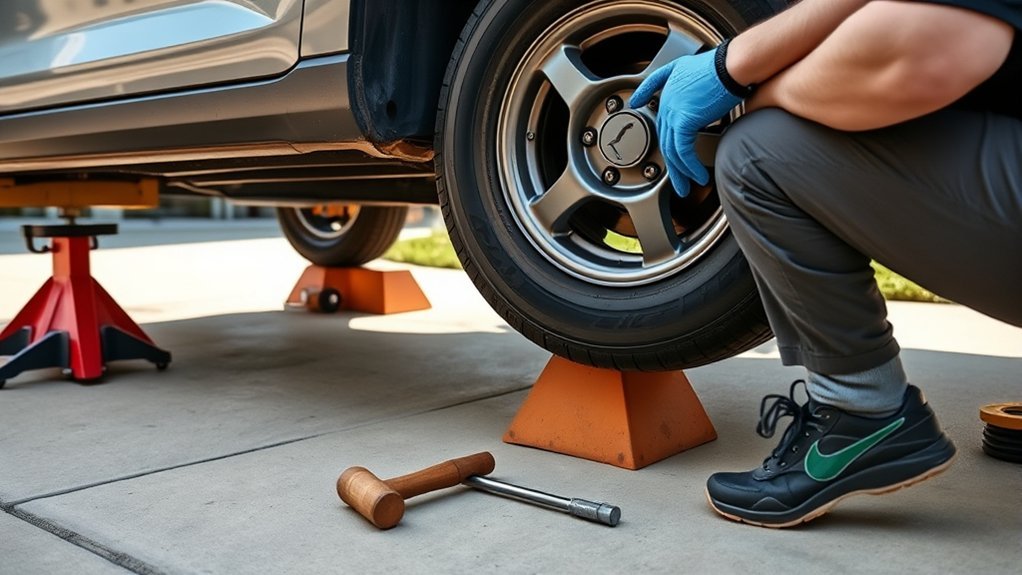
A tire that “won’t come off” is usually a wheel stuck to the hub, not the rubber tire itself. Rust, road salt, dirt, and corrosion around the center bore can bond the wheel to the brake rotor or drum even after the lug nuts are loose. Work slowly, support the vehicle correctly, and use the least aggressive method that frees the wheel.
Quick Answer
To remove a stuck tire, park on flat ground, set the parking brake, chock the wheels, loosen the lug nuts slightly, lift at the correct jack point, and support the vehicle on jack stands. Spray rust penetrant around the hub, leave one lug nut loosely installed, then kick the tire sidewall or tap it with a rubber mallet until the wheel breaks free.
Key Takeaways
- Never work on a vehicle supported only by a jack; use properly rated jack stands on solid, level ground.
- Keep one lug nut or wheel bolt threaded on a few turns so the wheel cannot fall when it suddenly breaks loose.
- Spray penetrant at the hub seam and lug holes, but avoid soaking brake pads, rotors, drums, or calipers.
- Use controlled force: kick the tire sidewall, tap with a rubber mallet, or use protected leverage instead of swinging a steel hammer at the wheel.
- After removal, clean the hub and wheel mating surfaces, keep lug threads dry, and torque the wheel in a crisscross pattern to the vehicle manufacturer’s spec.
At a Glance
| Time Required | 20–45 minutes for a lightly stuck wheel; longer if corrosion is heavy |
| Difficulty | Moderate DIY, but stop if the vehicle is unstable or the wheel will not move safely |
| Tools Needed | Lug wrench or breaker bar, correct socket, jack, jack stands, wheel chocks, rust penetrant, rubber mallet, wire brush, gloves, eye protection, torque wrench |
| Cost | Usually $0–$20 if you already have lifting tools; more if you need a torque wrench, jack stands, or roadside help |
Warning: Do not crawl under the vehicle or put any body part under the wheel area while the vehicle is supported only by a jack. If you are on a shoulder, soft ground, a slope, or near traffic, call roadside assistance instead of forcing the repair.
Why a Wheel Gets Stuck on the Hub
A stuck wheel is usually caused by corrosion between the wheel’s center bore and the hub lip. This is common in wet climates, snowy areas that use road salt, and vehicles that go a long time between tire rotations. Dirt, brake dust, and light galvanic corrosion between dissimilar metals can also make the wheel grip the hub tightly.
Overtightened, damaged, or dirty lug hardware can make removal harder too, but that is a separate problem from a wheel that is already loose on the studs yet still stuck to the hub. If the lug nuts themselves will not turn, treat that as a stuck-lug-nut problem before trying to remove the wheel.
Jack Up Safely and Loosen Lug Nuts
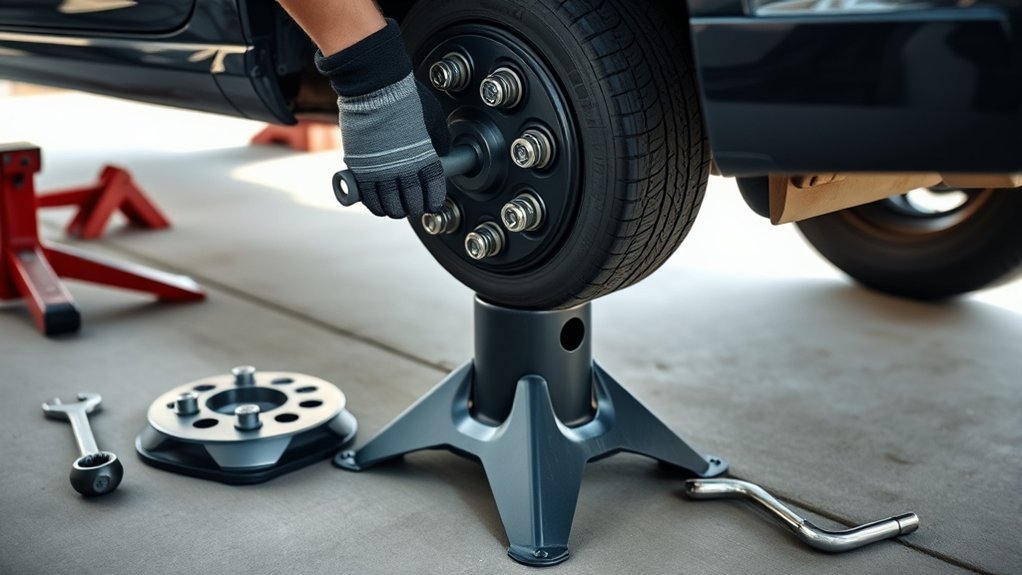
Start by parking on solid, level ground. Turn on the hazard lights if you are near a road, set the parking brake, and place wheel chocks on the wheels that will stay on the ground. Check your owner’s manual for the correct jack points before lifting.
Before the wheel leaves the ground, loosen each lug nut about a quarter to half turn with the correct socket or lug wrench. Do not remove the lug nuts yet. Loosening them while the tire is still on the ground helps keep the wheel from spinning and reduces the chance of shifting the vehicle on the jack.
Lift the vehicle only high enough for the tire to clear the ground, then place properly rated jack stands under the manufacturer-approved support points. Lower the vehicle gently onto the stands and give the vehicle a light stability check before continuing.
Note: A spare-tire scissor jack is meant for emergency tire changes, not heavy prying or hammering. If the wheel is badly seized, use proper stands on a flat surface or get professional help.
Spray Rust Penetrant on the Hub
With the vehicle supported on jack stands, remove the lug nuts except for one. Thread that last lug nut back on a few turns so the wheel stays captured if it suddenly pops loose.
Spray an automotive rust penetrant around the center hub opening, the lug holes, and the seam where the wheel meets the rotor or drum. Products such as WD-40 Specialist Penetrant are designed to loosen rusted-bonded parts, but they still need time to wick into the corrosion. Wait at least 10–15 minutes before applying force.
| Step | Action |
|---|---|
| 1 | Spray the hub seam, center bore, and lug holes lightly |
| 2 | Avoid brake pads, rotor friction surfaces, drums, and calipers |
| 3 | Wait 10–15 minutes so the penetrant can work |
| 4 | Reapply once if the wheel is still rust-bonded |
| 5 | Move to controlled impact or protected leverage |
Warning: Do not soak brake friction surfaces with oil or penetrant. If overspray reaches the rotor or drum surface, clean it properly before driving.
[Products Worth Considering]

The Trivd Frol 1/2" air impact wrench delivers high performance torque up to 1500 ft-lbs with a twin hammer impact mechanism for strong, balanced blows. It features an ergonomic grip, compact lightweight design, and quick-stop control with 3 forward speeds up to 8000 RPM plus a reverse speed. Built for demanding automotive repair and tire shop work, the rear exhaust helps keep debris away from the surface.

This 1/2-inch drive breaker bar delivers powerful leverage for loosening and tightening stubborn lug nuts and automotive fasteners. The 180-degree flex head helps you reach tight spaces at the angle you need, making tire and brake jobs easier. A spring-loaded ball detent design holds 1/2-inch sockets securely while the chrome-moly head provides durable strength for everyday use.

The SEESII cordless impact wrench delivers high tightening and loosening power for fast wheel bolt and industrial bolt work. Its brushless motor and variable-speed 3 forward/2 reverse modes help you control precision installs and stubborn nut removal. A dual-battery system with rapid charging and an included storage case make it ready for home, car, and jobsite use.
Kick or Tap the Wheel Free
Keep one lug nut loosely installed, then kick the tire’s outer sidewall with firm, controlled pressure. Aim at the rubber sidewall, not the rim, valve stem, rotor, caliper, or wheel weights. Rotate your position and repeat from different angles so the shock loads break the corrosion evenly.
- Aim at the outer sidewall near the edge of the tire.
- Use steady, controlled kicks instead of wild swings.
- Work around the tire so the wheel does not bind at one point.
- Stop and recheck the jack stands if the vehicle shifts at all.
If kicking does not work, use a rubber mallet or dead-blow hammer on the tire sidewall. A block of wood can help spread the force. Avoid hitting alloy rims directly with a metal hammer because it can crack, bend, or scar the wheel.
Pro Tip: Alternating between penetrant, waiting, and controlled tapping is safer than using one huge hit. Rust bonds often break after several smaller shock loads.
Pry the Wheel Loose With a Protected Lever
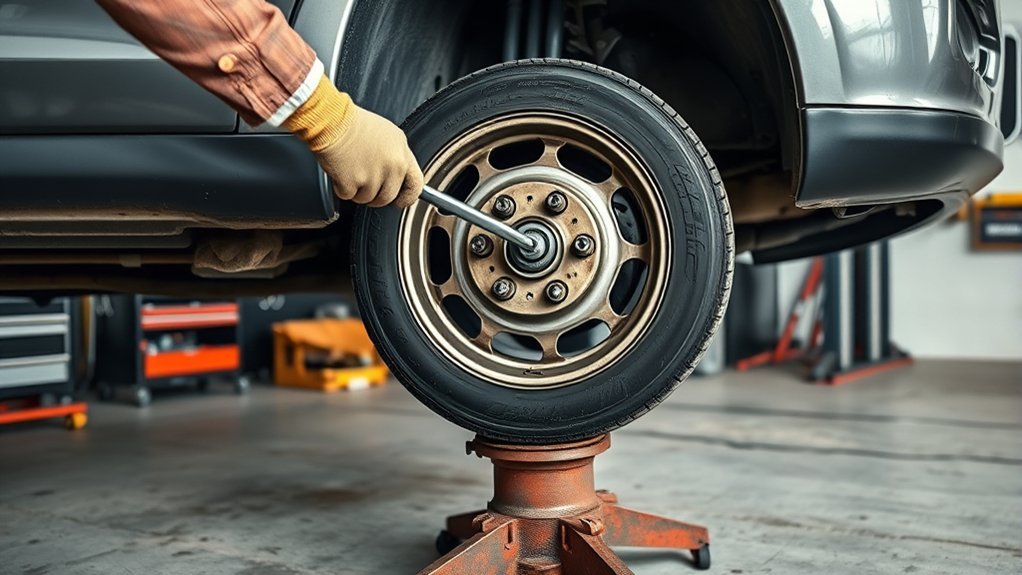
If the wheel still will not move, use protected leverage carefully. Place a wood block between the pry bar and the wheel so the tool does not gouge the rim. Apply pressure slowly and move around the wheel in small steps instead of forcing one spot.
Only pry against sturdy metal areas that can safely handle load. Do not pry against brake lines, ABS sensor wires, dust shields, calipers, thin sheet metal, or suspension parts you cannot identify. If you are unsure where to place the tool, stop and call a mechanic.
These crowbar techniques work best when you alternate pressure at several points around the wheel. The goal is to crack the corrosion bond at the hub, not to bend the rim or damage nearby brake parts.
[Products Worth Considering]

This VEVOR tire bead breaker uses a slide-hammer impact and wedge tip to separate tire beads from rims quickly and efficiently without damaging hub surfaces. The long handle and sturdy steel construction help reduce user strain while providing reliable, portable tire changing for cars, trucks, and more. Ideal for home mechanics and repair shops handling multiple vehicle tire sizes.

Upgrade your wheels with MIKKUPPA M12x1.5 mag seat lug nuts built for secure, corrosion-resistant performance. These closed-end chrome lug nuts are a direct replacement for select Toyota models, including Camry, Corolla, RAV4, Sienna, Avalon, Highlander, Matrix, Venza, and Prius. Triple-chromium plating and cold-forged, heat-treated steel help deliver strength for daily driving and replacement needs.

The 22800 wheel stud installer makes replacing wheel studs quick and secure, saving time and effort during tire service. It uses a ratchet or impact wrench to pull new studs firmly into place, helping when existing studs are too long. Compatible with most automotive wheels and light-duty truck wheel studs, it’s designed for easy, tool-assisted installation.
If the Wheel Still Will Not Come Off
If penetrant, sidewall kicks, mallet taps, and careful protected leverage do not work, do not keep escalating blindly. Avoid heating the wheel or hub with a torch, striking brake components, or driving the vehicle with loose lug nuts to “break it free.” Those shortcuts can damage the wheel, studs, bearings, brakes, or bodywork.
At that point, reinstall the lug nuts by hand, snug them in a crisscross pattern, lower the vehicle safely, and contact a mobile mechanic, tire shop, or roadside service. A shop can use a lift, better support points, and controlled tools without putting you under an unstable vehicle.
[Products Worth Considering]

These M14x1.5 closed-end chrome lug nuts are a one-piece replacement designed for secure fitment on compatible GM, Ford, and select Chrysler/Dodge models. Featuring a 60-degree conical seat and anti-rust chrome plating, they help resist corrosion and maintain a bright look for everyday driving. Built for long-term durability, they include OEM-style part references and are backed by 12 months of support.

This ecocstm ratchet wrench is designed to make emergency and routine tire changes faster with a 360° rotating head and quick forward/reverse switching. The extended handle provides extra leverage to reduce effort and hand fatigue, while the adapter helps fit many scissor jacks on cars, SUVs, trucks, and vans. Built for reliable performance with durable construction, it’s a practical travel essential for on-the-road preparedness.

This car D-wheel lock nut key provides an anti-theft solution for D-shaped wheel lock bolts, helping keep your wheels secure. It features a flower-shaped internal pattern that resists micro-adjustment theft while allowing removal and mounting of compatible locking nuts. Made for reliable performance under high torque, it’s easy to use with standard socket wrench turning for quick tire maintenance and emergency repairs.
Clean the Hub to Prevent Sticking Again
Once the wheel is off, clean the hub face, hub lip, and the matching wheel center bore with a wire brush. Remove loose rust, dirt, and corrosion until the mating surfaces are smooth enough for the wheel to sit flat.
- Inspect the hub face, studs, lug nuts, and wheel bore for corrosion or damage.
- Brush the hub face and wheel mating surface until loose rust is removed.
- Wipe away debris with a clean rag, keeping residue off brake friction surfaces.
- Apply only a very thin film of anti-seize to the hub face or center pilot if appropriate.
- Keep lug studs, lug-nut seats, wheel-bolt seats, and brake surfaces clean and dry unless your vehicle manufacturer gives different instructions.
Anti-seize compounds can help reduce seizing and corrosion when used sparingly, but wheel hardware torque is normally based on clean, dry threads. Tire Rack’s wheel torque guidance warns that lubricating hardware threads or seats can change torque readings and lead to incorrect clamping force.
When reinstalling the wheel, thread each lug nut by hand first to avoid cross-threading. Snug the nuts in a star or crisscross pattern, lower the vehicle until the tire just touches the ground, then use a torque wrench set to the vehicle manufacturer’s specification. Finish by lowering the vehicle completely and checking that all lug nuts are evenly torqued.
Frequently Asked Questions
Will WD-40 remove a stuck wheel?
WD-40 Specialist Penetrant or another automotive rust penetrant can help if corrosion is bonding the wheel to the hub. Spray it around the hub seam and lug holes, wait 10–15 minutes, then use controlled sidewall kicks or a rubber mallet. Standard water-displacing sprays may help lightly stuck parts, but a dedicated penetrant is usually better for rust.
How do you unstick a seized tire from the hub?
Support the vehicle on jack stands, keep one lug nut loosely installed, spray rust penetrant at the hub, wait, then kick the tire sidewall or tap it with a rubber mallet. If that fails, use protected leverage with a wood block. Stop if the vehicle shifts, the wheel will not move, or you cannot pry without risking brake or suspension damage.
Why will my tire not come off after I remove the bolts?
The wheel is probably rusted or corroded to the hub. This can happen even when all lug nuts or wheel bolts are removed. Road salt, moisture, dirt, and corrosion around the center bore can bond the wheel to the rotor or drum. Keep one fastener loosely installed while you break the wheel free so it cannot fall suddenly.
How do you break a stubborn tire bead?
Breaking a tire bead is different from removing a wheel stuck to the vehicle. The bead is where the rubber tire seals against the rim. To break a bead, the tire must be fully deflated and pressed off the rim with a bead breaker or tire machine. If your wheel is stuck on the hub, do not try bead-breaking methods; free the wheel from the vehicle first.
Is it safe to drive with loose lug nuts to free a stuck wheel?
No. Driving with loose lug nuts can damage studs, wheels, brakes, and hubs, and it can let the wheel separate from the vehicle. Use penetrant, controlled sidewall impacts, and protected leverage while the vehicle is safely supported. If the wheel still will not come off, reinstall and torque the hardware, then get professional help.
How can I stop a wheel from sticking again?
Clean the hub face and wheel center bore whenever the wheel is removed. Use a light anti-seize film only on the hub face or center pilot if suitable, keep lug threads and seats dry, and torque the wheel to the manufacturer’s specification in a crisscross pattern. Regular tire rotations also give you a chance to clean corrosion before it becomes severe.
Conclusion
A stuck tire can be frustrating, but the safe method is simple: stabilize the vehicle, use penetrant, keep one lug nut loosely installed, and free the wheel with controlled force instead of risky shortcuts. After the wheel comes off, clean the hub and wheel bore so the problem is less likely to happen again. Reinstall the wheel by hand-threading the hardware, tightening in a star pattern, and torquing to the specification in your owner’s manual.
Sources
- AAA Club Alliance — How to Change a Tire — supports safe parking, parking brake, jack points, and loosening lug nuts before lifting.
- Tire Rack — Proper Wheel Lug Nut or Bolt Torque — supports dry-thread torque, crisscross tightening, and torque-wrench guidance.
- WD-40 Specialist Penetrant — supports the use of penetrant on rusted-bonded parts.
- Permatex Lubricants and Anti-Seize — supports anti-seize use for corrosion and seizing prevention when used properly and sparingly.
- Bridgestone Tire Maintenance and Safety Manual — supports regular tire and wheel inspection and professional service when damage or unusual wear is found.
