
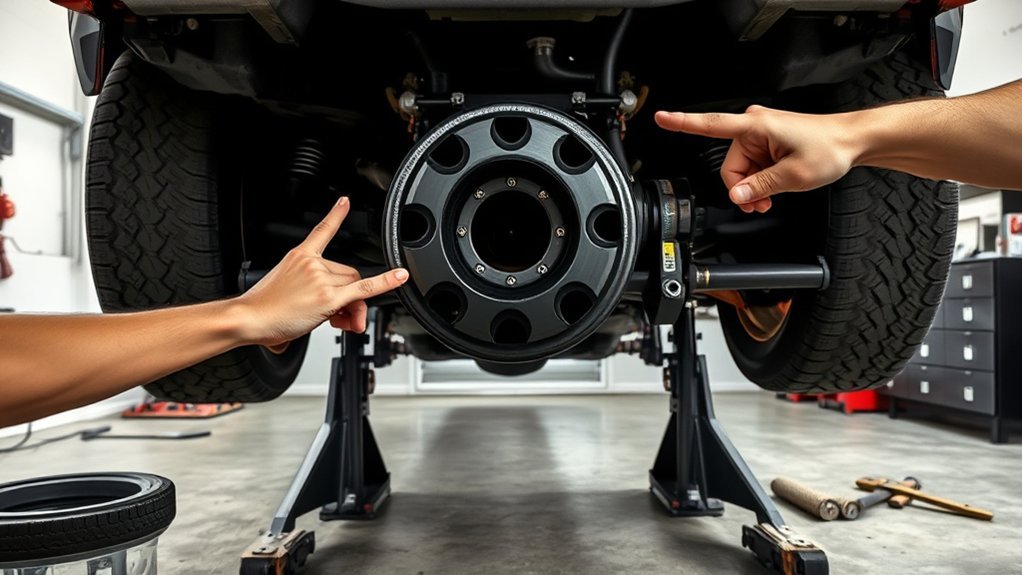
You can estimate your axle gear ratio at home by marking a tire and the driveshaft, then comparing wheel turns to driveshaft turns. The important part is choosing the right method for your differential type. An open differential uses different math than a limited-slip, locker, or spool, so identify how the wheels move before you count.
Quick Answer
To check gear ratio by spinning a tire, mark the tire and driveshaft, safely support the vehicle, then count driveshaft turns. If both wheels turn together, one tire turn equals the ratio. If one tire turns while the other stays still, turn the tire twice; the driveshaft turns will approximate the axle ratio.
Key Takeaways
- Always support the vehicle on jack stands and chock the wheels before turning a tire by hand.
- For a limited-slip, locker, or spool where both wheels rotate together, gear ratio equals driveshaft turns divided by tire turns.
- For an open differential with one wheel staying still, gear ratio equals 2 × driveshaft turns divided by tire turns.
- The easiest open-differential shortcut is to rotate one tire exactly two full turns and count the driveshaft turns.
- Confirm your estimate with the axle tag, build code, service information, or ring-and-pinion tooth count whenever accuracy matters.
At a Glance
| Time Required | 15–30 minutes for the spin test; longer if you remove the differential cover |
| Difficulty | Beginner for the spin test; intermediate for ring-gear inspection |
| Tools Needed | Wheel chocks, floor jack, jack stands, chalk or tape, gloves, flashlight, notebook, and a helper if available |
| Cost | Usually free if you already have safe lifting equipment |
How to Check Gear Ratio by Spinning the Tire
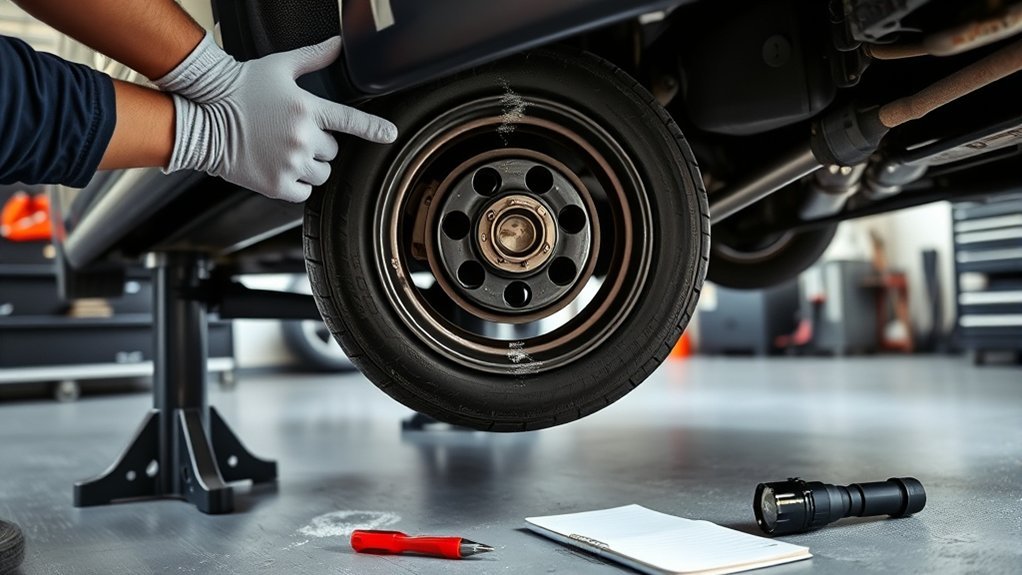
Use this method only when the vehicle is safely supported and the driven wheels can rotate freely by hand. The goal is simple: count how many times the driveshaft turns for a known number of tire turns, then apply the correct formula for your differential.
Warning: Never rely on a jack alone. Use a jack rated for the vehicle, lift only at approved lift points, set the vehicle securely on jack stands, and chock the wheels that stay on the ground. Do not crawl under the vehicle for this test.
Basic Spin-Test Steps
- Park on level, firm ground.
- Chock the wheels that will stay on the ground.
- Put the transmission in neutral so the driveshaft can turn.
- Lift the driven axle only as needed and support it on jack stands.
- Mark one tire with chalk or tape.
- Mark the driveshaft where you can see it clearly.
- Turn the tire by hand and count full and partial driveshaft rotations.
- Compare your count to common ratios such as 3.08, 3.55, 3.73, 4.10, or 4.56.
If the vehicle has all-wheel drive, four-wheel drive, a transaxle, an electronic parking brake, or a traction-control system that resists wheel movement, check the service manual before using the spin test. Some drivetrains need a different procedure or should be verified by the axle tag or build information instead.
Identify Your Differential Type First
Before you calculate anything, watch what the opposite tire does when you rotate one tire by hand.
| What You See | Likely Differential Type | Use This Method |
| Opposite tire turns the same direction | Limited-slip, locker, or spool | Rotate both tires together one full turn and count driveshaft turns |
| Opposite tire turns the opposite direction or stays still | Open differential | Hold one tire still and rotate the other tire exactly two full turns |
| Tires are hard to turn, bind, or move unpredictably | Limited-slip preload, parking brake drag, drivetrain binding, or wrong setup | Stop and verify with tag, build code, or a professional inspection |
What Tools You Need
For a basic tire-spin gear-ratio check, you do not need differential setup tools. You need safe lifting equipment and a clear way to mark rotations.
[Products Worth Considering]

This manual duck head tire changer kit makes tire installation and removal simpler by letting you embed the duck head into the tire with applied pressure. The integrated design and durable steel construction help reduce friction and improve efficiency and safety during use. Suitable for 16–21 inch wheels, it’s convenient for cars, trucks, SUVs, and ATV tires, with 24-hour after-sales support.

ROBLOCK rubber wheel chocks help prevent vehicle rolling with a non-slip grip for trucks, trailers, RVs, and small aircraft. The chocks include three yellow reflective strips to improve visibility in low-light parking and outdoor use. Lightweight and portable design makes them easy to place in front of or behind a tire during camping, loading, or maintenance.
Lock the Maxchock X-style wheel stabilizers between tandem tires to reduce sway and keep your RV travel trailer secure while camping. The adjustable design fits a wide range of wheel gaps, and included hardware lets you install quickly with a power drill. Built from heavy-gauge steel with zinc plating, the chocks include locks and an organizer case for safer, more convenient use.
Required Basic Tools
- Floor jack rated for the vehicle
- Jack stands rated for the vehicle
- Wheel chocks
- Chalk, paint marker, or tape
- Flashlight or work light
- Gloves and eye protection
- Notebook or phone to record the count
Helpful Setup Gear
A helper makes the test easier because one person can turn the tire while the other watches the driveshaft mark. A phone video can also help you replay the driveshaft movement if you lose count. If you plan to remove the differential cover, you may also need a drain pan, gasket or RTV specified for the axle, gear oil, torque wrench, brake cleaner, and the service manual torque specs.
Pro Tip: Put a long strip of bright tape around the driveshaft so each full revolution is easy to see. Count partial turns as fractions, such as one-quarter, one-half, or three-quarter turn.
How to Safely Lift the Vehicle
Start by parking the vehicle on a level, firm surface. Chock the wheels that will remain on the ground, then lift only at manufacturer-approved lift points. Lower the vehicle onto jack stands before you begin the test.
| Step | Action |
|---|---|
| 1 | Confirm level, firm ground |
| 2 | Chock the wheels that stay on the ground |
| 3 | Lift with a properly rated floor jack |
| 4 | Set jack stands securely under approved support points |
| 5 | Shake-test stability before turning the tire |
OSHA’s jack safety rules require a jack to be rated for the load and state that a raised load must be cribbed, blocked, or otherwise secured at once. Use that same mindset here: the jack lifts; the stands support.
[Products Worth Considering]

MaxxHaul solid rubber wheel chocks provide dependable vehicle stabilization for cars, trucks, trailers, and RVs across driveways, slopes, garages, and campsites. The molded non-slip traction surface helps prevent tire movement on pavement, gravel, and smooth floors, while the solid rubber resists cracking, crushing, deformation, and weather wear. A built-in handle enables quick, tool-free placement and removal for convenient use in all seasons.

Keep your RV, travel trailer, or fifth wheel securely in place with these heavy-duty X-shaped wheel chock stabilizers. Designed to clamp between tires, they reduce side-to-side movement for a steadier, level camping setup. The package includes a ratchet wrench, socket adapter, gloves, and a storage bag for easy installation and transport.

This 3-ton scissor car jack tire changing kit helps you lift cars and SUVs with a wide range to reach low sedans or higher vehicles. The set includes a ratchet wrench, multi-size lug wrench, gloves, a tire pressure gauge, and a storage bag for quick emergency repairs. Built for stable, secure lifting and universal compatibility, it’s ready for flat tires and roadside wheel changes.
How to Count Driveshaft Rotations
Mark one clear reference point on the tire and one on the driveshaft. Turn the tire slowly and smoothly. Every time the driveshaft mark returns to its starting position, count one full turn.
The ratio you want is the closest common axle ratio to your measured driveshaft count, not an exact laboratory number.
Formula for Limited-Slip, Locker, or Spool
If both rear tires rotate together at the same speed, use this formula:
Gear ratio = driveshaft rotations ÷ tire rotations
Example: If both tires make one full turn and the driveshaft turns about 3.75 times, the axle is probably a 3.73:1 ratio.
Formula for an Open Differential
If one tire turns while the other tire stays still, use this formula:
Gear ratio = 2 × driveshaft rotations ÷ tire rotations
The simple shortcut is to rotate the free tire exactly two full turns while the other tire stays still. Then the driveshaft count is approximately the axle ratio.
Example: If one tire turns two full revolutions and the driveshaft turns about 3.5 to 3.6 times, the axle is probably a 3.55:1 ratio.
How Open Differentials Affect the Test
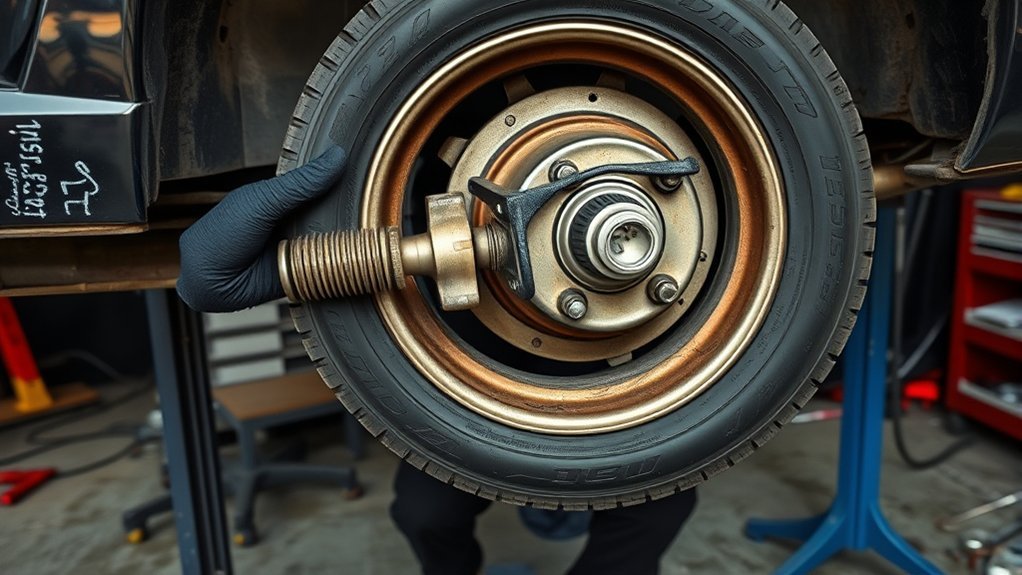
An open differential lets the two axle shafts rotate at different speeds. That is why the one-wheel spin test needs a correction factor. When one tire turns and the other tire is held still, the differential carrier effectively sees half of that wheel speed, so the driveshaft count is about half the actual axle ratio.
Note: If the opposite tire turns backward while you spin one tire, you may not get a useful driveshaft count. Hold the opposite tire still, or leave it on the ground if the vehicle setup allows the test safely.
How to Calculate Gear Ratio From Wheel Turns
After you count the rotations, match your result to the nearest common axle ratio. Small counting errors are normal because it is hard to judge partial driveshaft turns perfectly.
| Measured Driveshaft Turns | Likely Axle Ratio | What It Usually Means |
| About 3.0 turns | 3.08:1 | Common highway-friendly ratio |
| About 3.5 turns | 3.55:1 | Balanced street and light towing ratio |
| About 3.75 turns | 3.73:1 | Common truck, towing, and performance ratio |
| About 4.1 turns | 4.10:1 or 4.11:1 | More torque multiplication and higher cruising rpm |
| About 4.5 to 4.6 turns | 4.56:1 | Common for larger tires, off-road use, and stronger launch feel |
Use the table only after choosing the correct test method. For an open differential, the table applies when you rotated one tire two full turns with the other tire still. For a limited-slip or locker, the table applies when both tires rotated together one full turn.
How to Check the Axle Ratio Tag
The axle tag is often the fastest way to confirm your spin-test estimate. Look for a metal tag on the differential cover bolts, a sticker on the axle tube, a door-jamb axle code, a glove-box build-code label, or factory build information from the manufacturer.
Locate Axle Ratio Tag
Start at the differential cover. Many rear axles use a small metal tag held by one of the cover bolts. If the tag is missing, inspect the axle tube for a sticker or stamped code. Then check the door jamb, glove box, trunk label, owner’s manual, or service documentation for axle-code information.
Read Tag Numbers
The tag may show the ratio directly, such as 3.55, 3.73, or 4.10. Some tags or labels use axle codes instead of plain ratios, so you may need to decode the number using manufacturer service information. A limited-slip axle may also have a tag or code identifying the carrier type.
Verify Ratio Against Specs
Compare the tag, build code, or axle code with factory documentation. This matters because the gears may have been changed after the vehicle was built. If the tag says 3.73 but your spin test reads closer to 4.10, repeat the test and verify the ring-and-pinion tooth count before ordering parts.
How to Read the Ring Gear Stamp
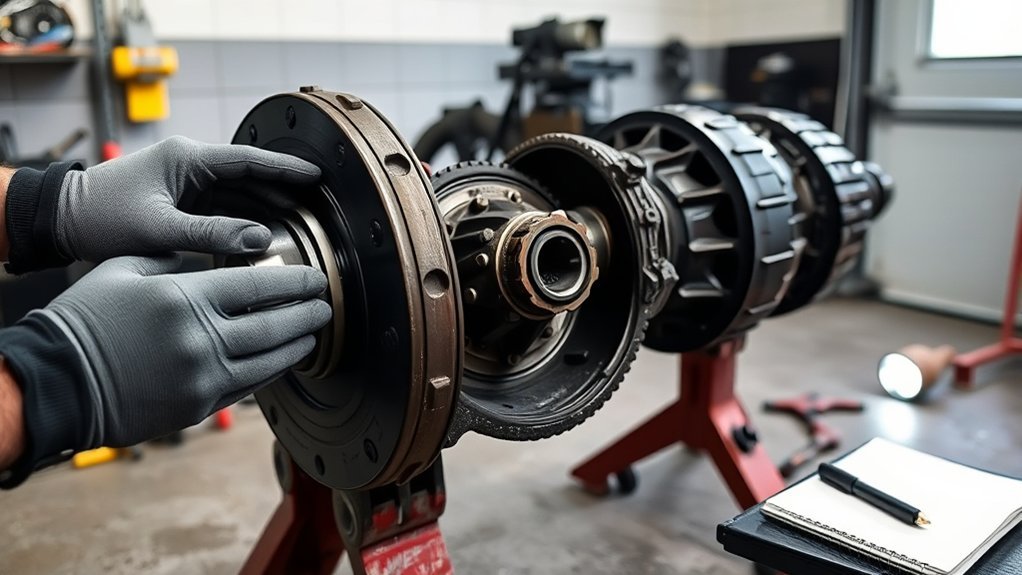
Removing the differential cover gives the most direct confirmation, but it is messier and requires proper reassembly. After draining the gear oil and removing the cover, rotate the carrier until you can read the ring gear markings. Many ring gears are stamped with the ratio, tooth count, part number, or manufacturing information.
If the ratio is not stamped clearly, count the teeth on the ring gear and pinion gear:
Gear ratio = ring gear teeth ÷ pinion gear teeth
Examples:
- 41 ring gear teeth ÷ 10 pinion teeth = 4.10:1
- 41 ring gear teeth ÷ 11 pinion teeth = 3.73:1
- 39 ring gear teeth ÷ 11 pinion teeth = 3.55:1
- 37 ring gear teeth ÷ 12 pinion teeth = 3.08:1
Before reinstalling the cover, clean the sealing surfaces, use the gasket or sealant specified for the axle, refill with the correct gear oil, and check for leaks. If the axle has a clutch-type limited-slip, it may require the correct limited-slip additive or fluid specification.
What Common Gear Ratios Look Like
Most spin-test results will not land perfectly on a ratio because you are counting by eye. Match your result to the nearest known ratio.
- 3.08:1: roughly 3 driveshaft turns.
- 3.55:1: roughly 3 and a half driveshaft turns.
- 3.73:1: slightly under 3 and 3/4 driveshaft turns.
- 4.10:1: just over 4 driveshaft turns.
- 4.56:1: about 4 and a half driveshaft turns.
- 5.13:1: a little over 5 driveshaft turns.
A higher numerical ratio, such as 4.56:1, multiplies torque more than a lower numerical ratio, such as 3.08:1. That can improve launch feel, towing response, or large-tire drivability, but it can also raise engine rpm at cruising speed depending on transmission gearing and tire diameter.
Does Tire Size Change Gear Ratio?
Tire size does not change the physical axle ratio inside the differential. A 3.73 ring-and-pinion set remains 3.73 no matter what tires are installed. However, tire diameter changes the effective gearing at the road. Taller tires travel farther per revolution, which can make the vehicle feel like it has a lower numerical axle ratio. Shorter tires do the opposite.
For safety and calibration, use tire sizes recommended by the vehicle manufacturer. NHTSA advises checking the owner’s manual or Tire and Loading Information Label for the correct tire size, and tire-size changes can also affect speedometer, odometer, ABS, and stability-control behavior.
Troubleshooting Bad or Confusing Readings
If your count does not make sense, do not assume the axle is unusual. Most bad readings come from setup or counting errors.
| Problem | Likely Cause | Fix |
| Driveshaft barely moves | Transmission not in neutral, parking brake drag, or opposite wheel spinning backward | Recheck setup and hold the opposite wheel still for an open-diff test |
| Count lands between two ratios | Partial-turn counting error | Repeat the test and record a video of the driveshaft mark |
| Tire is hard to turn | Limited-slip preload, brake drag, transfer case load, or unsafe setup | Stop and verify using axle tag or service information |
| Spin test disagrees with axle tag | Gears may have been changed, tag may be from another axle, or test math is wrong | Verify by ring-and-pinion tooth count |
[Products Worth Considering]

CircleRoad RV wheel chocks are designed to be installed between two tires to prevent wheel movement and improve parking stability. Built with a rust-proof finish for weather resistance, they help keep your tire position secure during travel trailer and motorhome stops. The package includes a multi-functional ratchet wrench and hex socket for fast installation.

Camco’s RV wheel chocks with an attached rope help keep your travel trailer securely in place for safer unhitching or parking. This 2-pack is compatible with wheels up to 26-inch diameter and features durable UV-resistant construction for reliable outdoor performance. The rope enables quick, safe removal so you can prepare for your next trip with less hassle.

The Big Rig Defense Tire Thumper is a truck tire pressure checker that lets you quickly check multiple tires by giving them a firm whack. Listen for a reassuring thump and feel the stick bounce when a tire is fully inflated, helping you get back on the road safely. It features a comfortable, glove-friendly handle and a secure wrist strap for confident use on busy routes.
When to Recheck the Ratio or Get Help
Recheck the ratio if the driveshaft count changes between attempts, if the opposite tire moves differently each time, or if the result does not match the axle tag or factory specs. You should also verify the ratio before ordering ring-and-pinion parts, correcting a speedometer, changing tire size, or diagnosing towing and acceleration issues.
Signs of Uncertainty
- The tire spins but the driveshaft barely moves.
- The count falls halfway between two common ratios after repeated attempts.
- You hear grinding, clunking, or binding while rotating the tire by hand.
- The axle tag, build sheet, and spin test all disagree.
- The vehicle has AWD, a transaxle, electronic parking brake, or unusual drivetrain controls.
Seek Professional Help
Ask a driveline specialist or qualified technician to verify the ratio if the axle has been modified, the differential type is unclear, or the vehicle behaves unusually on the road. Professional help is also smart if you need the differential cover removed, backlash checked, pinion preload inspected, or ring-and-pinion wear evaluated.
Frequently Asked Questions
How do you check gear ratio by spinning the tire?
Mark the tire and driveshaft, safely support the vehicle, put the transmission in neutral, and rotate the tire by hand. If both tires rotate together, count driveshaft turns for one tire turn. If one tire stays still on an open differential, rotate the free tire two full turns and count driveshaft turns.
What is the formula for gear ratio with tires?
For both wheels rotating together, use gear ratio = driveshaft rotations ÷ tire rotations. For an open differential with one tire turning and the other tire still, use gear ratio = 2 × driveshaft rotations ÷ tire rotations.
How do you figure out gear ratio without pulling the cover?
Use the tire-spin method, axle tag, door-jamb axle code, glove-box build code, VIN-based build information, or manufacturer service documentation. The spin test gives a good estimate, but factory codes or ring-and-pinion tooth count are better for parts ordering.
Why do you spin an open differential tire twice?
When one wheel turns and the other stays still, an open differential makes the carrier move at about half the speed of the turning wheel. Spinning the free tire twice cancels that half-speed effect, so the driveshaft count is close to the axle ratio.
Does tire size affect the axle gear ratio?
No. Tire size does not change the physical ring-and-pinion ratio inside the axle. It does change effective gearing at the road because taller tires travel farther per revolution and shorter tires travel less distance per revolution.
How do you tell gear ratio by spinning the pinion?
If the axle is out of the vehicle or the driveshaft is disconnected, rotate the pinion and count wheel rotation, but the same differential-type rules still matter. The most precise direct method is to count ring gear teeth and pinion teeth, then divide ring gear teeth by pinion teeth.
Conclusion
Spinning a tire can quickly estimate axle gear ratio, but the math depends on the differential. If both wheels rotate together, one tire turn and the driveshaft count will usually reveal the ratio. If the axle has an open differential and one wheel stays still, rotate the free tire two full turns and use the driveshaft count. For final confirmation, check the axle tag, factory build code, or ring-and-pinion tooth count.
Sources
- eCFR — 29 CFR 1910.244, Other portable tools and equipment — supports jack rating and securing a raised load.
- Carnegie Mellon University — Introduction to Mechanisms, Chapter 7: Gears — supports gear velocity ratio and tooth-count principles.
- NHTSA TireWise — supports tire-size label guidance and tire safety notes.
- Schema.org HowTo — supports the HowTo structured data format used below.
