
How to Change a Lawn Mower Tire: Step-by-Step Simple Guide
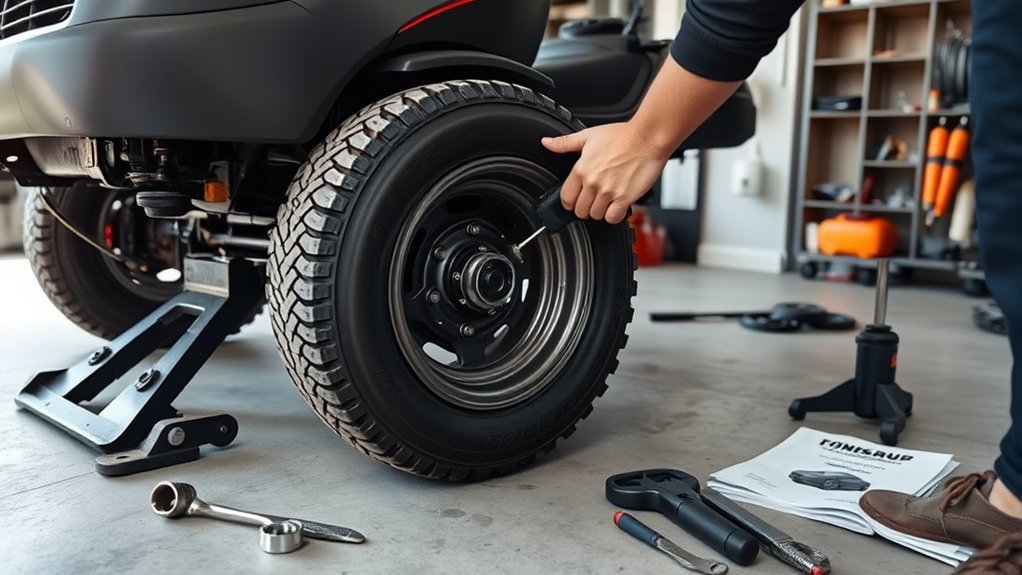
Changing a lawn mower tire is a manageable DIY job if you work slowly, support the mower correctly, and match the replacement tire to the size and load rating already on the machine. The safest process is simple: shut the mower down, secure it on level ground, remove the wheel, replace or reseat the tire, inflate it to the correct PSI, and check for leaks or wobble before mowing.
Quick Answer
To change a lawn mower tire, park on level ground, set the brake, remove the key, disconnect the spark plug wire, and support the mower with jack stands or solid blocking. Remove the wheel hardware, replace or reseat the tire, reinstall the wheel, inflate to the listed PSI, and check for leaks, drag, and wobble.
Key Takeaways
- Always shut off the mower, remove the key, wait for moving parts to stop, and disconnect the spark plug wire before working near the wheels.
- Support the mower with jack stands or solid blocking; never rely on a jack alone while your hands are near the axle or wheel.
- Match the tire size, rim diameter, hub fit, ply/load rating, and PSI shown on the old tire or in the operator manual.
- Use soapy water or approved tire lubricant on the bead, but stop if the tire will not seat before reaching the tire manufacturer’s maximum pressure.
- After installation, spin the wheel, check for leaks with soapy water, confirm the hardware is secure, and test the mower slowly before normal use.
At a Glance
| Time Required | 30 to 60 minutes for most mower tires; longer if the bead is stuck, the rim is rusty, or the tire needs a tube or valve stem. |
| Difficulty | Easy to moderate. Removing the wheel is usually easy; breaking and reseating a tubeless bead can be the hardest part. |
| Tools Needed | Gloves, eye protection, wheel chocks, jack, jack stands or solid blocking, socket set, pliers, valve core tool, tire levers, soapy water, pressure gauge, and air compressor or hand pump. |
| Cost | Usually the price of the tire, tube, valve stem, or pre-mounted wheel assembly. A tire-only replacement is cheaper, while a full wheel-and-tire assembly is faster. |
Warning: Never work on a mower that can roll, start, or fall. Park on level ground, set the parking brake, remove the key, disconnect the spark plug wire, chock the wheels, and support the mower with jack stands or solid blocking before removing a wheel.
Tools You Need Before Starting
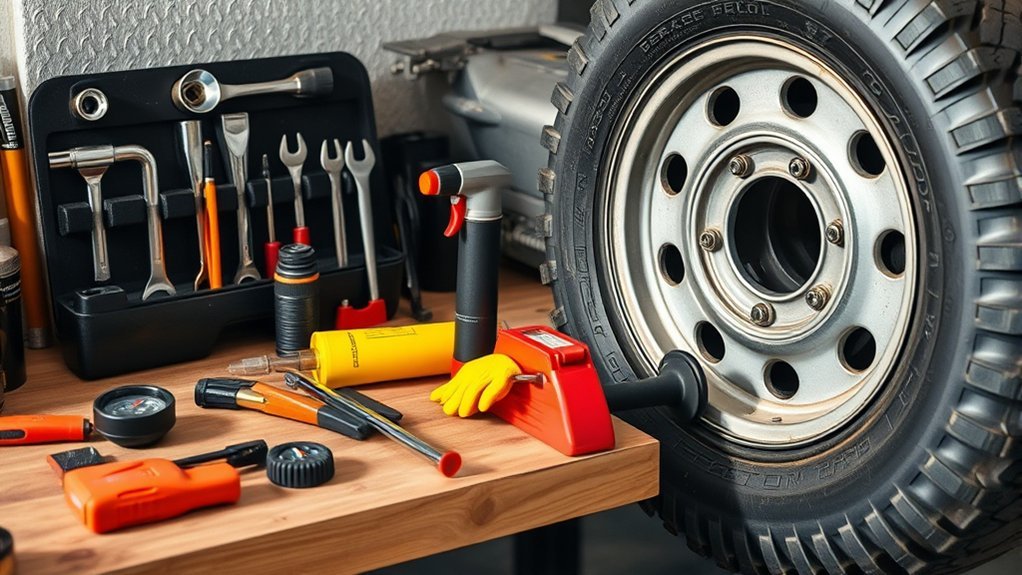
Before you start changing a lawn mower tire, gather everything you need so the mower is not left half-supported while you search for a tool. At minimum, use gloves, eye protection, wheel chocks, a jack, jack stands or solid wood blocking, a socket wrench, pliers, a valve core tool, tire levers, soapy water, a pressure gauge, and an air compressor or hand pump.
Check the mower’s operator manual before lifting the machine. The manual is the best place to confirm jacking points, wheel hardware, recommended tire pressure, and any torque specifications for your model. For general mower maintenance safety, the Toro operator manual advises removing the key, disconnecting the spark plug wire, and using jack stands or equivalent support when raising the machine.
If the tire is badly cracked, the rim is bent, or the valve stem leaks, you may also need a new valve stem, inner tube, or complete tire-and-wheel assembly. A pre-mounted wheel assembly is often the easiest option for homeowners because it avoids bead breaking and tire mounting.
[Products Worth Considering]

This multi-function tire valve stem removal tool set makes it fast to remove, install, bleed, and clean valve cores for easier tire maintenance. It includes valve core removers, a 4-way spool tool, replacement valve caps, and spare cores to handle replacements and repairs with confidence. Universal compatibility suits cars, trucks, motorcycles, bicycles, and more for roadside convenience.
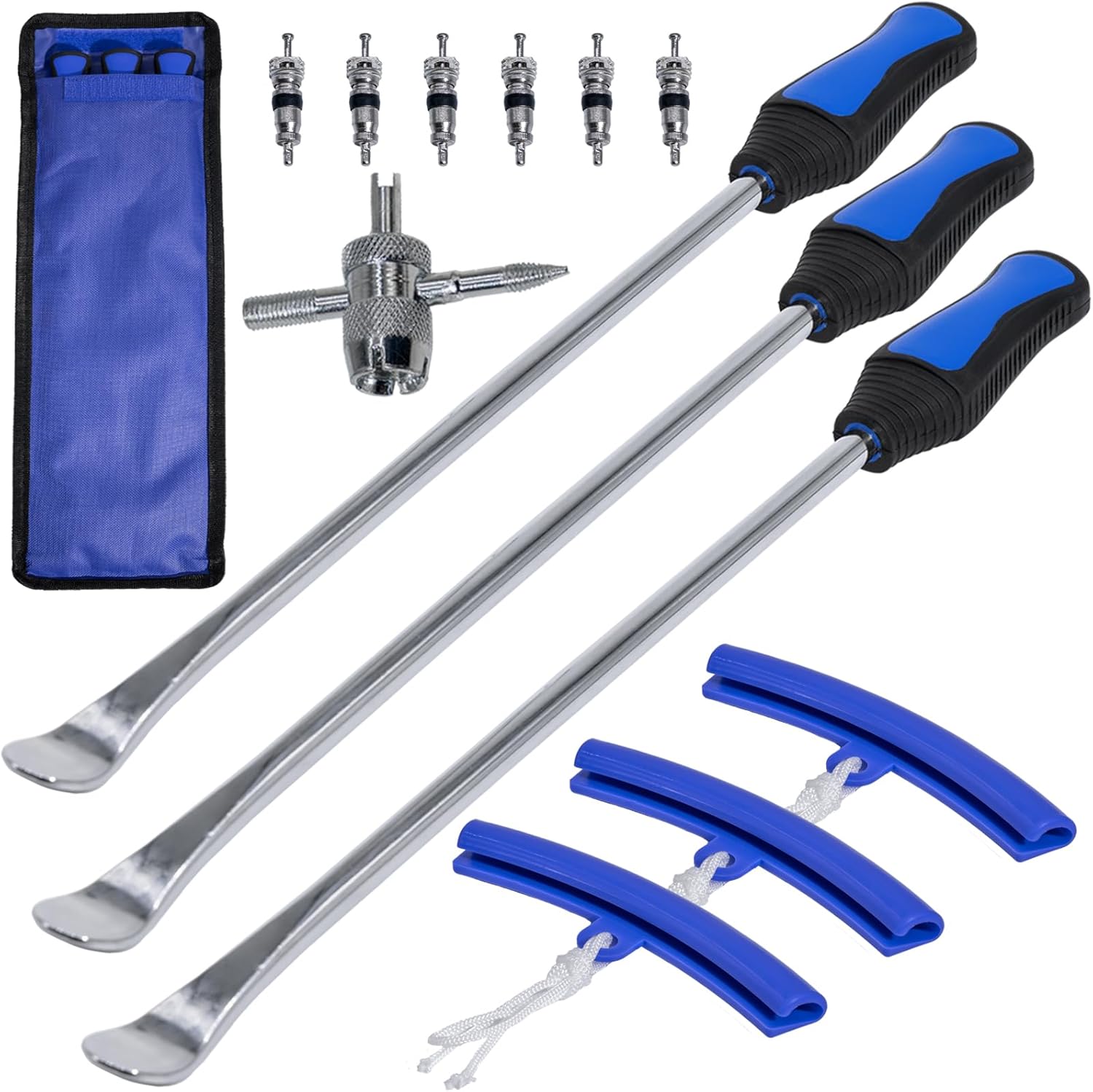
This tire spoon set helps you remove and install motorcycle, dirt bike, lawn tractor, and bicycle tires with extra leverage from a 14.5-inch spoon length. The kit includes tire removal tools, rim protectors, and a valve tool to simplify repairs and help protect rims during changing. Designed for quick, on-the-go service, it’s convenient for garage work, trails, and track-side fixes.

This VEVOR tire bead breaker uses a slide-hammer impact and wedge tip to separate tire beads from rims quickly and efficiently without damaging hub surfaces. The long handle and sturdy steel construction help reduce user strain while providing reliable, portable tire changing for cars, trucks, and more. Ideal for home mechanics and repair shops handling multiple vehicle tire sizes.
How to Secure the Mower Safely
Set the mower on a flat, firm, dry surface. Shut the engine off, remove the ignition key, wait for all moving parts to stop, and disconnect the spark plug wire so the engine cannot accidentally start. The U.S. Consumer Product Safety Commission also recommends disconnecting the spark plug before mower maintenance or repairs.
Park On Level Ground
Choose concrete, compacted gravel, or another firm surface. Avoid slopes, soft soil, wet grass, or uneven areas because the mower can shift when lifted. Engage the parking brake on a riding mower, place the transmission in park or neutral as directed by the manual, and remove any attachments that could make the mower unstable.
- Confirm the surface is flat, firm, and dry.
- Shut off the engine and remove the key.
- Wait for blades, belts, and pulleys to stop moving.
- Disconnect the spark plug wire and move it away from the plug.
Block Wheels Securely
Place heavy-duty wheel chocks or solid blocks snugly against the wheels that will stay on the ground. If you are working on a front tire, block the rear tires. If you are working on a rear tire, block the front tires. Push the mower lightly before lifting it; if it moves, reset the chocks.
| Checkpoint | Action |
| Surface | Park on level, firm ground. |
| Brake | Engage the parking brake if equipped. |
| Spark plug | Disconnect the spark plug wire before repair work. |
| Blocks | Chock the wheels that remain on the ground. |
| Support | Use jack stands or solid blocking after lifting. |
Lift and Support the Mower
Place the jack only under a sturdy frame point recommended by the operator manual. Raise the mower just high enough for the tire to clear the ground, then set jack stands or solid blocking under the frame. Lower the mower slightly onto the supports before you remove the wheel.
Note: A jack is for lifting, not long-term support. If the mower shifts or the support point looks weak, lower it and reset before continuing.
How to Remove the Old Lawn Mower Tire
Begin with the mower secured, supported, and disabled. Deflate the tire by removing the valve cap and pressing the valve core pin. If you are removing the tire from the rim, take the valve core out with a valve core tool so the tire fully releases pressure.
- Remove the hubcap or dust cap if your mower has one.
- Use pliers to remove the retaining clip, cotter pin, C-clip, or E-clip, if equipped.
- Remove washers in order and lay them down in the same sequence for reassembly.
- Slide the wheel off the axle. If it sticks, tap the wheel gently with a rubber mallet while pulling evenly.
- Inspect the axle for rust, bends, wear, or old grease before installing the replacement.
If the tire is stuck to the rim, press the sidewall down near the bead to break the seal. Work around the rim instead of forcing one spot. Use tire levers carefully so you do not gouge the rim or tear a reusable tube.
How to Choose the Right Replacement Tire
A correct replacement starts with the numbers and markings on the old tire. Lawn and garden tires commonly use a size such as 15×6.00-6, which means approximate overall tire diameter, tire width, and rim diameter in inches. Tire manufacturer tables, such as Kenda’s turf tire specifications, also list ply rating, rim width, maximum load, and PSI for each size.
Check Tire Size
Read the sidewall code on the current tire and match it exactly unless the mower manufacturer approves another size. A tire that is too tall, too wide, or made for the wrong rim diameter may rub the deck, sit poorly on the rim, or change the mower’s cutting height.
- Match the full size code, such as 15×6.00-6.
- Confirm the rim diameter matches the wheel.
- Check whether the tire is tubeless, tube-type, pneumatic, or flat-free.
- Use the operator manual if the sidewall is damaged or unreadable.
Match Tire Type
Choose the tire style based on how and where you mow. Turf tires are best for finished lawns because they provide traction without tearing grass. Lug tires grip better on soft soil, slopes, and utility work but can mark turf. Flat-free tires reduce puncture downtime but may ride firmer than pneumatic tires.
If your old tire used an inner tube, check whether the tire casing is still usable. A small tread puncture may only need a tube or patch, but sidewall cracks, dry rot, bead damage, or a bent rim usually call for replacement.
Verify Load Capacity
Do not choose a tire by size alone. Match or exceed the original tire’s ply rating and load capacity. A tire with the same size but a lower load rating may squat, leak, wear quickly, or fail under a heavy mower, bagger, or attachment.
- Match the original tire’s ply rating or load rating when possible.
- Use the mower manual for manufacturer-approved specifications.
- Account for attachments, baggers, hills, and rough ground.
- Do not assume every mower needs a 4-ply tire; the correct rating depends on the machine.
Match the Tire Size and Hub Fit
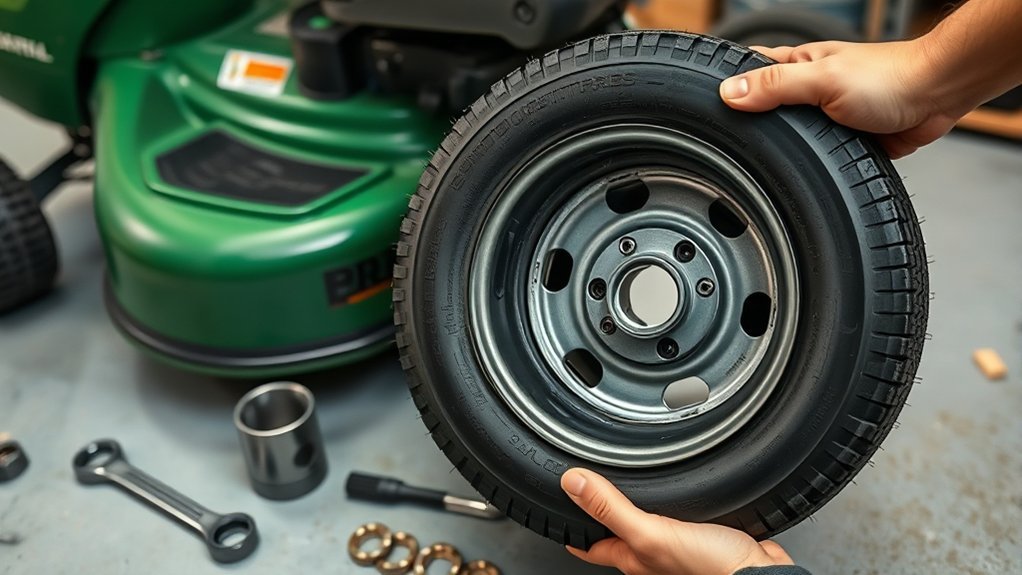
When replacing the complete wheel-and-tire assembly, tire size is only part of the fit. You also need the correct hub length, bore size, axle diameter, bushing style, and offset. Measure the bore through the center of the wheel and compare it with the replacement assembly.
If the replacement hub is too narrow, the wheel may slide or wobble. If the bore is too large, the wheel will not stay centered on the axle. If the offset is wrong, the tire may rub the deck, frame, or steering parts. When in doubt, use the mower’s model number to look up the correct part instead of guessing from tire size alone.
Pro Tip: Take a photo of the tire sidewall, axle hardware, and wheel hub before shopping. Those photos make it easier to match size, hub style, washer order, and clip placement.
How to Install the New Lawn Mower Tire
Clean the rim before installing the new tire. Dirt, rust, dried sealant, and bent rim edges can stop the bead from sealing. Wipe the bead seat clean and inspect the valve stem. If the stem is cracked, stiff, or leaking, replace it before mounting the tire.
- Lubricate both tire beads with soapy water or approved tire mounting lubricant.
- Set the tire squarely on the rim with the tread facing the same direction as the old tire.
- Work the first bead over the rim by hand or with tire levers.
- Push the bead into the rim’s drop center to create slack.
- Work the second bead over the rim without pinching the tube, if a tube is used.
- Install the valve core after the beads are in place, unless you need high airflow to start seating a tubeless tire.
Inflate slowly and watch the bead on both sides. The bead should rise evenly and seat all the way around the rim. If one section hangs up, stop, deflate, add more lubricant, and reposition the tire.
Warning: Do not use fire, starting fluid, or uncontrolled air pressure to seat a tire bead. Never exceed the tire manufacturer’s maximum bead-seating or inflation pressure. If the bead will not seat, deflate the tire and get help from a tire shop or equipment dealer.
Reinstall the Wheel and Tighten the Hardware
Slide the wheel back onto the axle and keep the hub square. Reinstall washers, spacers, clips, retaining rings, bolts, and dust caps in the same order they came off. If your mower uses one axle bolt, tighten that bolt to the manual’s specification. If it uses multiple wheel bolts or lug nuts, tighten them evenly in a crisscross pattern.
Align Wheel Properly
Push the wheel fully onto the axle so it seats flat and does not bind. The wheel should sit straight, with the hub centered and the tire clear of the mower deck, frame, and steering parts. Spin the wheel by hand before lowering the mower.
- The wheel should rotate freely.
- The rim should not wobble side to side.
- The tire should not rub the deck or frame.
- The axle clip or retaining hardware should sit fully in its groove.
Reattach Washers And Clips
Reinstall washers and retaining clips exactly as removed. Many mower wheels use washers to control spacing, so missing or reversed washers can create wobble, drag, or uneven tire wear. If a clip is bent, loose, or rusty, replace it instead of forcing it back into service.
Tighten Axle Hardware
Tighten the axle bolt, lug nuts, or retaining hardware firmly, following the operator manual when a torque value is listed. Do not overtighten a wheel that uses bushings because the wheel may bind. After tightening, spin the wheel again and check for scrape, drag, wobble, or side play.
How to Inflate the Tire Correctly
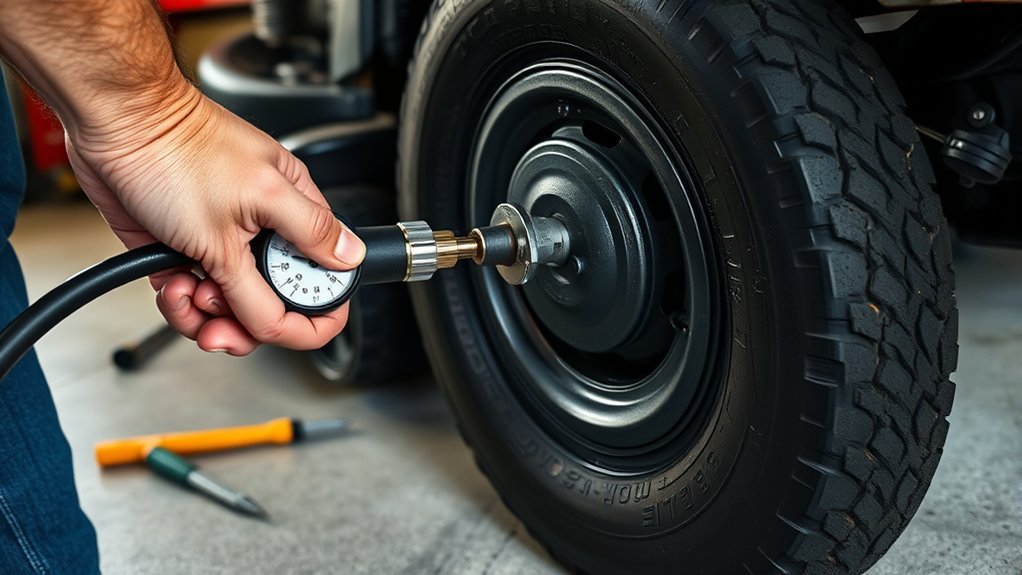
Check tire pressure when the tire is cold. Use the PSI listed on the tire sidewall or in the operator manual, and measure pressure at the valve stem with a tire pressure gauge. Toro’s maintenance guidance notes that uneven tire pressure can cause an uneven cut, so pressure matters for both safety and mowing quality.
- Attach the air chuck firmly to the valve stem.
- Add air in short bursts.
- Remove the chuck and check pressure with a gauge.
- Release air if you overshoot the target PSI.
- Reinstall the valve cap after the pressure is correct.
After inflating, spray soapy water around the bead and valve stem. Bubbles mean air is leaking. If the bead leaks, deflate and reseat the tire. If the valve stem leaks, replace the stem or tube.
[Products Worth Considering]

This 4-in-1 tire valve core removal tool helps you deflate, unblock, and remove or install valve cores quickly for easier tire repair. The multifunction design also supports re-taping damaged threads and reaming inside the valve stem for smoother service. Included as a 2-pack, it’s compact for convenient carry and works for cars, bicycles, and motorcycles.

This dual head and ball air chuck set provides closed-flow tire inflation that routes air only through the chuck engaged with the valve. It includes both dual-head and ball-head chucks plus quick plug fittings for easy, fast connections to air lines and compressors. Built for reliable, leak-resistant operation, it’s ideal for filling Schrader valves on bikes, motorcycles, cars, trucks, and more.
Do Lawn Mower Tires Need Balancing?
Most lawn mower tires do not need balancing after replacement because mowers operate at low speeds compared with road vehicles. What matters more is correct seating, proper inflation, straight wheel alignment, and secure hardware.
Check for problems by spinning the wheel by hand after installation. If the wheel wobbles, drags, or hops, look for a bent rim, wrong hub fit, uneven bead seating, missing washer, loose clip, or damaged tire. If vibration remains while mowing, stop and inspect the wheel assembly before continuing.
Troubleshoot Common Tire Replacement Problems
If the new tire does not fit, do not force it. Most problems come from wrong size, dirty rim edges, dry beads, poor hub fit, or a tire that is not fully seated.
| Problem | Likely Cause | Fix |
| Tire will not go on rim | Wrong rim size or dry bead | Confirm size and use soapy water or tire lubricant. |
| Bead will not seat | Poor bead contact, dirty rim, low air volume | Deflate, clean, relubricate, and retry safely. Stop if it will not seat within pressure limits. |
| Slow leak | Valve stem, bead leak, puncture, or cracked sidewall | Use soapy water to locate bubbles; replace valve stem, tube, or tire as needed. |
| Wheel wobbles | Wrong hub bore, missing washer, bent rim, loose clip | Recheck hub fit, washer order, retaining clip, and rim condition. |
| Uneven cut after repair | Unequal tire pressure or wrong tire size | Set all tires to spec and confirm the replacement matches the original size. |
When to Repair Instead of Replace the Tire
A tire does not always need full replacement. A small tread puncture in an otherwise healthy pneumatic tire may be repairable with a plug, patch, or inner tube. A leaking valve stem can often be replaced. A tire that slips off the bead because it was stored flat may only need reseating.
Replace the tire instead of repairing it if you see sidewall cracks, dry rot, exposed cords, a torn bead, a badly worn tread, or repeated leaks. Replace the wheel or complete assembly if the rim is bent, rusted through, cracked, or the hub no longer fits tightly on the axle.
Final Safety Check Before Mowing
Before you reconnect the spark plug wire and mow, inspect the repair one more time. A few minutes here can prevent a loose wheel, flat tire, uneven cut, or unsafe test drive.
- Confirm the valve cap is installed.
- Check tire pressure with a gauge.
- Spray soapy water around the bead and valve stem to check for leaks.
- Spin the wheel by hand and listen for rubbing.
- Confirm retaining clips, washers, bolts, and dust caps are secure.
- Lower the mower carefully and remove jack stands, blocks, and chocks.
- Reconnect the spark plug wire only after all tools are clear.
- Drive slowly in an open area and check for wobble before normal mowing.
Frequently Asked Questions
Can you change lawn mower tires at home?
Yes. Most homeowners can change a lawn mower tire at home with basic tools, a safe lifting setup, and the correct replacement tire. The key is to disable the mower, support it with jack stands or solid blocking, and match the tire size, hub fit, and PSI correctly.
How do I read a lawn mower tire size?
A size such as 15×6.00-6 usually means the tire is about 15 inches tall, 6 inches wide, and fits a 6-inch rim. Always match the full size code and confirm the ply rating, load capacity, and tubeless or tube-type marking.
Do I have to remove the wheel to change a lawn mower tire?
Usually, yes. Removing the wheel gives you better control, makes bead work easier, and lets you inspect the axle, washers, clips, and rim. Some quick inflation or bead reseating jobs can be done on the mower, but full tire replacement is easier and safer with the wheel removed.
What direction do you turn the bolt to loosen a lawn mower blade?
For many mowers with standard right-hand threads, the blade bolt loosens counterclockwise. However, some mower blade assemblies use left-hand threads that loosen clockwise. Check your operator manual before forcing the bolt, especially on multi-blade decks or model-specific blade assemblies.
How do you lift tires on a lawn mower safely?
Park on level ground, shut off the engine, remove the key, disconnect the spark plug wire, chock the opposite wheels, and lift from a sturdy frame point listed in the manual. After lifting, support the mower with jack stands or solid blocking before removing the wheel.
How much air should I put in a lawn mower tire?
Use the PSI listed on the tire sidewall or in the mower operator manual. Do not guess. Check pressure when the tire is cold, add air in short bursts, and use a tire pressure gauge to avoid underinflation or overinflation.
Do lawn mower tires need balancing?
Most lawn mower tires do not need balancing because mowers operate at low speeds. If you feel vibration or see wobble after replacement, check bead seating, rim condition, hub fit, washer order, tire pressure, and wheel hardware.
Conclusion
Changing a lawn mower tire is easier when you treat it as a safety-first repair instead of a quick swap. Secure the mower, disconnect the spark plug wire, support the frame properly, match the replacement tire carefully, and inflate it to the correct PSI. Before mowing, check for leaks, wobble, rubbing, and loose hardware. Once everything spins smoothly and holds pressure, your mower is ready to return to work.
Sources
- Toro Interactive Operator Manual — supports maintenance safety, jack stand use, spark plug disconnection, and tire pressure checks.
- U.S. Consumer Product Safety Commission: Rotary Power Mower Safety Tips — supports spark plug disconnection, eye protection, and mower repair safety.
- Ohio State University Extension: Power Lawn Mowers — supports mower maintenance safety, PPE, and disconnecting spark or electric power before repair.
- Kenda K358 Turf Rider Technical Specifications — supports tire size, ply rating, maximum load, and PSI examples for lawn and garden tires.
- WELD Racing Bead/Rim Seating Warning — supports bead seating pressure safety and damaged wheel/tire warnings.

Related Articles

Does the Sun Damage Car Paint? Prevention Tips
Keep your car’s shine intact before the sun wins—learn the hidden paint damage signs and prevention tips that matter most.
Read More
Which Part of a Tire Can Be Patched Safely?
When can a tire be safely patched, and why do some punctures spell trouble?
Read More
What Are Tire Valve Stems and How Do They Work?
Mysterious tire valve stems quietly seal air in and dirt out, but what happens when they fail might surprise you.
Read More