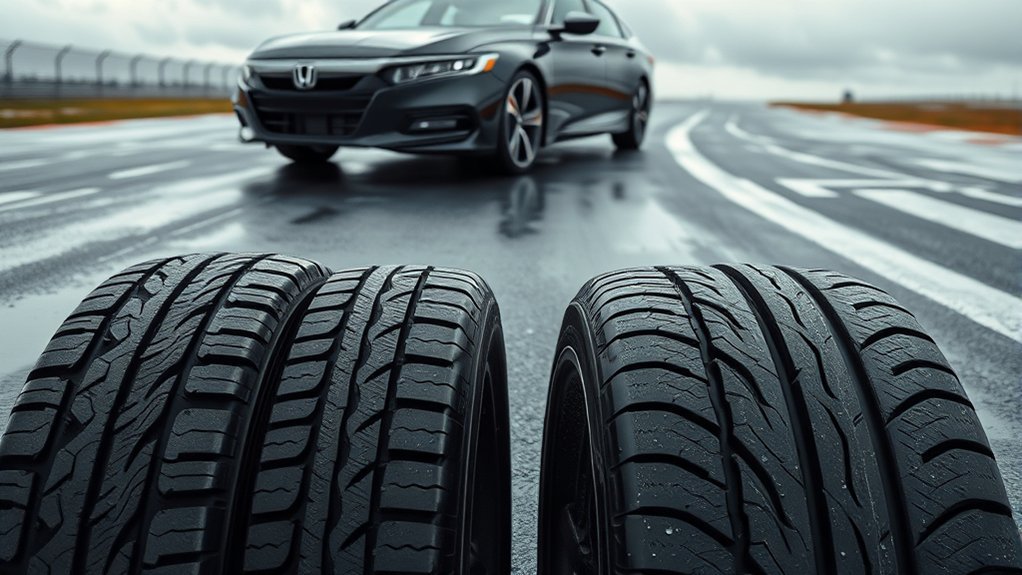
The tires on your Honda Accord do more than carry the car; they decide how much of your braking power actually reaches the road. The right tire type, enough tread depth, correct cold tire pressure, and a compound suited to your weather can shorten stopping distances and improve control. The wrong tire, a worn tire, or an underinflated tire can make even a healthy braking system feel weak when you need it most.
Quick Answer
Yes—tires can change how quickly your Honda Accord stops. The biggest factors are tread depth, rubber compound, tire type, temperature, road water, and correct cold tire pressure. A quality tire that matches your climate and Honda’s size/load specs gives the brakes more usable grip before ABS intervenes.
Key Takeaways
- Tread depth matters most in rain: worn tires need more distance to stop and are more likely to hydroplane.
- Use the tire size, load rating, speed rating, and cold PSI listed in your Honda Accord owner’s manual or driver-door tire label.
- Performance tires can improve warm-weather grip, but winter or 3PMSF-rated all-weather tires are safer choices for snow, ice, and sustained cold.
- Check pressure and tread monthly; TPMS is not a substitute for regular tire inspection.
At a Glance
| Time Required | 10–15 minutes to check tire size, pressure, tread depth, and tire category before shopping |
| Difficulty | Easy |
| Tools Needed | Owner’s manual or driver-door tire label, tire pressure gauge, tread-depth gauge or U.S. quarter, flashlight |
| Cost | $0–$15 for basic gauges; replacement tire cost varies by size, brand, and tire category |
How Tires Improve Honda Accord Braking Distance

Your Accord’s brakes create stopping force, but the tires decide how much of that force becomes traction. If the tire cannot grip the pavement, the anti-lock braking system may cycle sooner, the car may take longer to stop, and steering control can drop during emergency braking.
NHTSA explains that tire design, materials, construction, and tread design influence traction, handling, ride comfort, durability, and rolling resistance. For braking distance, the most important tire factors are tread depth, tread pattern, rubber compound, temperature range, tire pressure, and the tire’s ability to move water away from the contact patch.
Warning: Better tires do not cancel out unsafe speed, tailgating, standing water, ice, worn brakes, or low tire pressure. Always increase following distance in rain, snow, and cold weather.
Performance vs. All-Season vs. Winter Tires: Key Differences
No single tire is best for every Honda Accord driver. The safest choice depends on your climate, driving style, road conditions, and how much comfort, tread life, fuel economy, and braking grip you want to balance.
| Tire Type | Best For | Braking Trade-Off |
|---|---|---|
| Touring all-season | Daily commuting, comfort, long tread life, mild weather | Balanced, but not the shortest stops in extreme heat, heavy rain, ice, or aggressive driving |
| Ultra-high-performance all-season | Drivers who want sharper steering and stronger wet/dry grip without using a summer tire | Can improve warm-weather braking but may ride firmer and wear faster than touring tires |
| Summer/performance | Warm climates, dry roads, wet roads above about 45°F, sportier driving | Strong warm-weather grip, but unsafe for snow/ice and poor for sustained cold |
| Winter | Snow, ice, slush, freezing rain, and regular temperatures below about 45°F | Shorter cold-weather stops, but faster wear and less precise feel in warm conditions |
| All-weather / 3PMSF-rated | Drivers who want one tire set with certified severe-snow traction | A useful middle ground, though still not equal to dedicated winter tires on ice |
In warm dry or wet conditions, performance-focused tires can stop shorter than comfort-focused touring all-seasons because their compounds, tread designs, and casing construction are tuned for grip. In one Tire Rack category test, max-performance summer tires stopped 13 feet shorter than the closest category and 20–40 feet shorter than most others in 60–0 mph braking comparisons. That does not mean every performance tire will beat every all-season tire on every Accord, but it shows why tire category matters.
For cold weather, the choice changes. Michelin notes that winter tires stay flexible below 45°F and that summer tires harden in cold temperatures. If your Accord sees regular snow, ice, or freezing rain, a winter tire or a 3PMSF-rated all-weather tire is usually safer than a basic all-season tire.
[Products Worth Considering]

The SAFELIFE dial tire tread depth gauge measures tread depth in 1/32 inch increments with clear, easy-to-read 2-inch dial face. Color zones using a traffic light system help you quickly judge whether tread is low, marginal, or ample for safer driving. Built with a durable zinc cast body and a metal detect probe for precise, comfortable use across cars, motorcycles, trucks, and buses.

Monitor tire tread wear with a smart, color-coded depth gauge that shows clear condition ranges at a glance. The bar is range marked for fast, easy readings, helping you maintain safer traction and performance. Each gauge is portable with a pocket clip, and the set includes 20 units for daily use and sharing.

Keep your tires properly inflated with this analog VONDIOR tire pressure gauge, designed for fast, easy readings without batteries. The swiveling, two-axis hose and large glow dial help you measure at any tire angle with instant visibility. Built with a protective rubber shield, it supports durable, low-maintenance use for cars and trucks.
Tire Tread Depth and Its Impact on Stopping Power
Tread depth is one of the easiest tire-safety checks you can do at home. Deep enough grooves help the tire move water away from the road contact patch. As tread wears down, the tire loses wet traction and becomes more likely to hydroplane.
In Tire Rack’s wet 70–0 mph test, a BMW sedan stopped in 195.2 feet on new 10/32-inch tires, 290.0 feet on 4/32-inch tires, and 378.8 feet on 2/32-inch tires.
Those numbers come from a controlled Tire Rack test and are not a guaranteed Honda Accord stopping distance. Still, they show the pattern clearly: worn tread can dramatically increase wet stopping distance even when the brakes and ABS are working properly.
Use these tread-depth checkpoints:
- 6/32 inch or more: Generally strong tread depth for normal wet-road use, assuming the tire is not aged, damaged, or unevenly worn.
- 5/32 inch: Start planning replacement if you drive in snow, slush, or mountain conditions.
- 4/32 inch: Start shopping for replacement tires if rain and highway driving are common. AAA recommends that consumers begin shopping when tread reaches 4/32 inch.
- 2/32 inch: Replace immediately. NHTSA says tires are not safe and should be replaced when tread is worn to 2/32 inch.
Pro Tip: Check tread in at least three places across each tire—inside edge, center, and outside edge. Uneven wear can point to underinflation, overinflation, alignment problems, or worn suspension parts.
How Weather and Road Conditions Impact Tire Performance
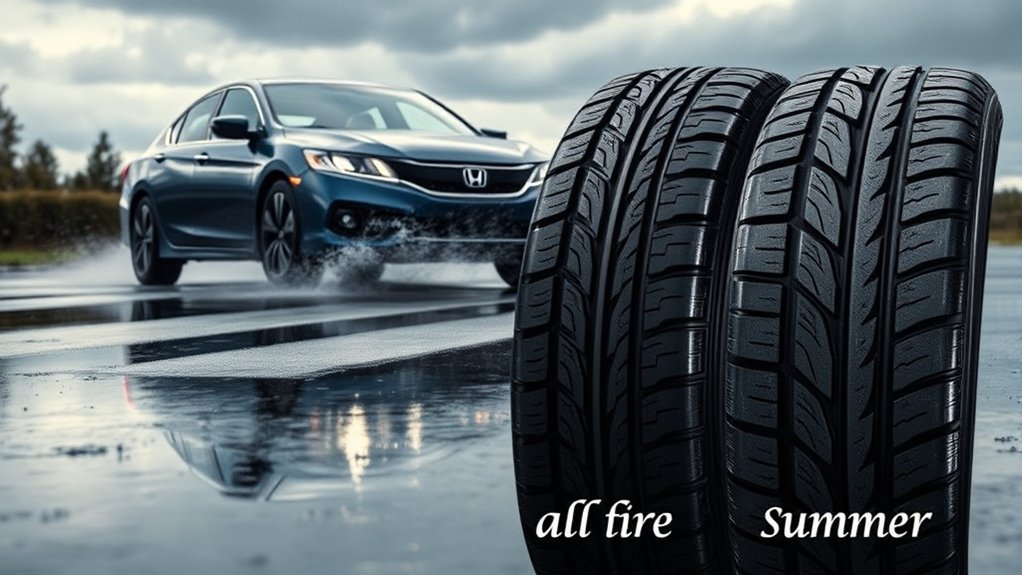
Weather can change braking distance more than many drivers expect. Rain creates a water layer between the tire and the pavement. Snow and slush demand a tread pattern that can bite and evacuate packed material. Ice reduces available friction so much that even excellent tires need far more stopping room.
Road surface also matters. Smooth, oily pavement after the first rain, gravel, leaves, potholes, and standing water all reduce grip. Wider or performance-oriented tires may feel excellent on dry roads but can still hydroplane if tread depth is low or water is deep enough.
Temperature is just as important. Summer and performance tires are built for warm conditions. In sustained cold, their rubber can become less flexible, reducing grip even on dry pavement. Winter tires and many 3PMSF-rated all-weather tires are designed to stay more pliable in cold weather, helping braking and steering control.
How to Choose the Right Tires for Your Honda Accord
Choosing the right tires for your Honda Accord starts with Honda’s specifications, not with brand names alone. Honda says the tire and loading information label on the driver’s doorjamb lists the original tire sizes and proper cold tire pressures. Use that label and your owner’s manual as the baseline before comparing models.
[Products Worth Considering]

Measure tire tread depth quickly and accurately with this LUMITECO dial gauge that reads in 1/32" increments up to 14/32". The color-coded green/yellow/red zones make it easy to judge tire wear and know when replacement is needed. A rugged, compact design with a protective pouch helps keep the gauge ready for use on cars, trucks, motorcycles, and more.

Accurately measure tire tread depth with a calibrated gauge marked from 0 to 1 inch in 1/32 inch increments. The color-coded bar helps you quickly identify tread condition ranges, supporting safe driving for trucks, motorcycles, automobiles, and passenger vehicles.

This tire inflator with pressure gauge delivers long-lasting performance with a durable rubber-protected gauge and sturdy build. The longer hose and 360 swivel air chuck help you seal the valve securely and keep your hands free while measuring, inflating, or deflating. It’s battery-free for reliable use and provides ±2 PSI accuracy in the mid-range for most typical tires, with universal compatibility for 1/4 NPT compressor outputs.
Step 1: Confirm the correct size, load rating, and speed rating
Match the tire size listed on your Accord’s driver-door placard or owner’s manual. Also choose a tire with a load index and speed rating that meets or exceeds Honda’s requirement. Do not choose a tire only because it fits the wheel diameter; the wrong load rating can affect safety, ride, handling, and braking.
Step 2: Match the tire category to your climate
- Mild climate and daily commuting: A quality touring all-season tire is often the best balance.
- Warm climate and sportier driving: A performance all-season or summer tire may improve steering feel and wet/dry braking.
- Snow, ice, and regular freezing temperatures: Choose dedicated winter tires or a 3PMSF-rated all-weather tire.
- Heavy rain: Prioritize wet-braking test results, hydroplaning resistance, and tread depth.
Step 3: Compare real braking and wet-traction data
Do not rely on price alone. AAA’s all-season tire testing found that new high-priced tires did not automatically perform significantly better than new low-priced tires in wet stopping distance, lateral acceleration, and noise-vibration-harshness. Look for independent test results for the exact tire model and size whenever possible.
Step 4: Use the correct cold tire pressure
NHTSA says the correct tire pressure is the vehicle manufacturer’s recommended cold PSI, not the maximum pressure printed on the tire sidewall. Check pressure when the car has been parked for at least three hours or driven less than one mile. Underinflation increases heat, wear, and rolling resistance, while overinflation can reduce the size and shape of the tire’s contact patch.
Note: TPMS warns you only when pressure is significantly low. It does not replace a monthly pressure check with a gauge, and it does not measure tread depth, tire age, cuts, bulges, or uneven wear.
Maintenance Habits That Keep Braking Consistent
Even the best tire can lose braking performance if it is neglected. Use this quick maintenance routine to keep your Honda Accord’s tires working as intended:
- Check pressure monthly: Use the cold PSI on the door-jamb label or owner’s manual.
- Measure tread monthly: Use a tread-depth gauge or coin test, and check across the full tire width.
- Rotate on schedule: Follow the owner’s manual or tire installer’s guidance to reduce irregular wear.
- Inspect for damage: Replace tires with sidewall bulges, exposed cords, deep cuts, cracking, or repeated air loss.
- Fix alignment issues: Pulling, vibration, feathered tread, or one-sided wear can reduce contact with the road.
- Avoid mixing tire types: Mixing summer, all-season, winter, or different performance levels can make braking and cornering unpredictable.
[Products Worth Considering]

Measure tyre tread depth precisely with a digital gauge that reads in both MM and inches, helping you monitor safe driving conditions. The large LCD screen is easy to operate, and the compact tool fits for cars, trucks, and motorcycles. It provides high accuracy with a 0-25.4mm range and includes a 1-year warranty for added peace of mind.

The TYAMATE TM8 solar-powered wireless TPMS delivers real-time tire pressure and temperature monitoring with six alarm modes for safer driving. A vibrant color LCD display shows readings clearly while windshield mounting keeps it hands-free and easy to read. With a wide 0–87 PSI range, strong 433.92 MHz signal transmission, and quick sensor pairing, it’s ideal for RV, sedan, SUV, MPV, and truck use.

Milton S-921 pencil tire pressure gauge helps you maintain optimal tire pressure for passenger cars with accurate readings in PSI and kPa. It features a built-in deflator valve for convenient pressure adjustments, plus a single chuck head and nylon indicator bar for easy use on the go. Built from durable plated brass and designed for reliable performance, it’s a practical road trip and cold-weather maintenance tool.
Frequently Asked Questions
How do tires affect braking distance?
Tires affect braking distance by controlling how much grip the car has during a stop. Tread depth, rubber compound, tire pressure, temperature, road surface, and water evacuation all influence whether the tire can hold the road or slide, hydroplane, or trigger ABS sooner.
Are performance tires always better for Honda Accord braking?
No. Performance tires can improve warm-weather dry and wet braking, but they may ride firmer, wear faster, cost more, and perform poorly in snow or sustained cold. For many Accord drivers, a high-quality touring all-season or 3PMSF-rated all-weather tire is the safer year-round choice.
Is 4/32 inch tread depth safe?
A tire at 4/32 inch may still be legal, but wet traction is already reduced compared with a newer tire. If you drive in frequent rain or at highway speeds, 4/32 inch is a smart point to begin shopping for replacement tires. At 2/32 inch, replace the tire immediately.
What tire pressure should I use on a Honda Accord?
Use the cold tire pressure listed on your Accord’s driver-door tire and loading label or in the owner’s manual. Do not inflate to the maximum PSI printed on the tire sidewall unless that number matches Honda’s specified cold pressure, which it usually does not.
Do winter tires shorten braking distance?
In snow, ice, slush, and sustained cold, winter tires usually provide better braking and steering control than summer or basic all-season tires because their compounds stay flexible and their tread patterns are designed for cold-weather traction. In warm weather, winter tires are not the best choice.
Can I mix tire types on my Honda Accord?
Avoid mixing tire types, such as summer tires on one axle and all-season tires on the other. Different grip levels can make braking, cornering, and emergency maneuvers unpredictable. For the most stable braking performance, use four matching tires with similar tread depth and condition.
Conclusion
The right tires can make your Honda Accord stop more confidently, especially in rain, cold, and emergency situations. Choose tires that match Honda’s size and pressure specifications, your local climate, and your driving style. Then protect that braking performance with monthly pressure checks, regular tread inspections, rotation, and timely replacement. A tire with the right compound, enough tread, and correct pressure gives your brakes the grip they need to do their job.
Sources
- NHTSA TireWise — tire tread, tire pressure, TPMS, tire maintenance, and tire safety guidance
- Honda Accord Tire and Loading Information Label — where to find original tire sizes and proper cold tire pressures
- Tire Rack: What Honest Abe Doesn’t Tell You About Minimum Tread Depths — wet braking test data at 10/32, 4/32, and 2/32 inch tread depths
- AAA All-Season Tire Testing — wet stopping-distance and handling changes for tires worn to 4/32 inch
- Michelin: Summer vs. Winter vs. All-Season Tires — tire category differences, cold-weather guidance, and 3PMSF information