
Common Toyota Tacoma Tire Modifications Explained
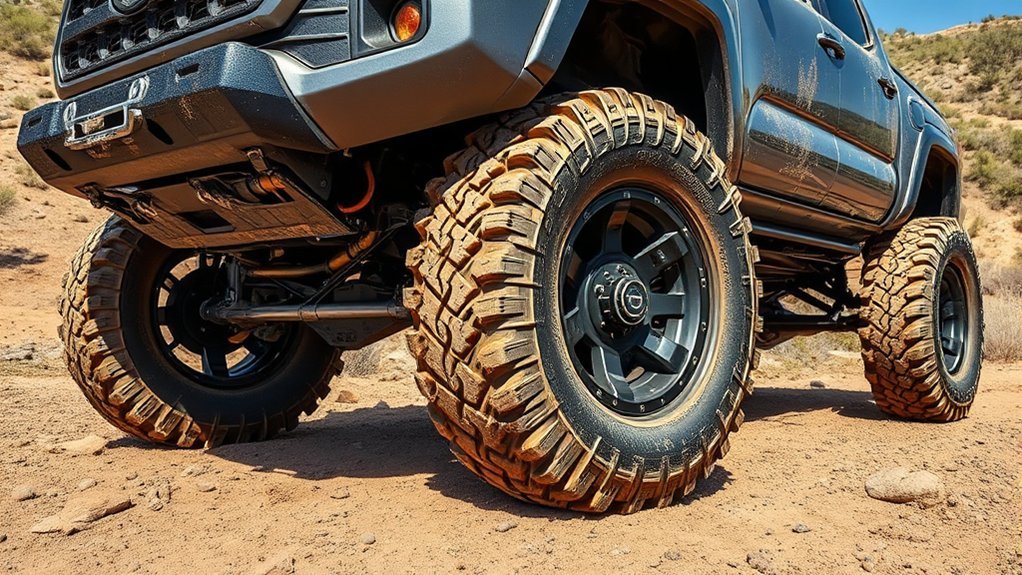
Modifying the tires and wheels on your Toyota Tacoma can improve ground clearance, trail traction, and appearance, but fitment is never determined by tire size alone. Your model year, trim, suspension, wheel width, offset, alignment, brake package, and the tire’s actual measured dimensions all affect whether a setup clears safely.
Quick Answer
Start with the tire size and pressure listed on your Tacoma’s door-jamb label. Mild upsizing may work without suspension changes, but 32- to 33-inch setups often need careful wheel-offset, alignment, and clearance checks. Never assume a leveling kit prevents rubbing, and keep replacement tires properly load-rated.
Key Takeaways
- Confirm your exact model year, trim, factory tire size, wheel size, and load requirement before shopping.
- Common sizes such as 265/75R16, 265/70R17, 275/70R17, and 285/70R17 are examples, not universal Tacoma fitments.
- Wheel offset can solve one clearance problem while creating another at the fender liner, body mount, or suspension.
- Larger, heavier, or more aggressive tires can affect acceleration, braking feel, fuel use, steering, speedometer accuracy, and ride comfort.
- Use the door placard for cold pressure, verify TPMS operation, and inspect full-lock and suspension-compression clearance after installation.
Warning: A tire that mounts on the wheel is not automatically safe for the truck. The tire and wheel must meet the Tacoma’s load requirements, clear the brakes and body through the full steering and suspension range, and use the correct lug-seat hardware and torque specification.
Understanding Common Tire Modifications for Your Tacoma
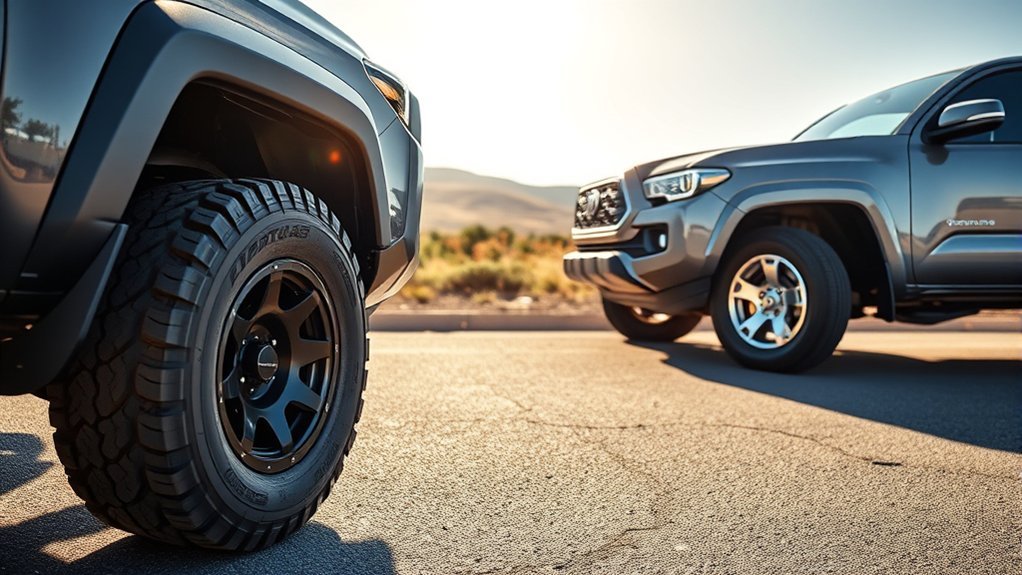
Most Tacoma tire modifications fall into four groups: a larger overall diameter, a wider tread, a more aggressive tread design, or a different wheel size and offset. Each change affects the truck differently.
- Larger diameter: Raises the axle and differential slightly farther from the ground. The added ground clearance equals about half of the increase in tire diameter.
- Wider tire: Changes the contact patch and may improve flotation on some loose surfaces, but it can also increase rubbing and steering effort.
- All-terrain or mud-terrain tread: Changes traction, road noise, wet-road behavior, weight, and rolling resistance more than size alone.
- Different wheel offset: Moves the tire inward or outward, changing clearance at the upper control arm, fender liner, body mount, and outer fender.
Toyota Tacoma factory sizes vary by generation and trim. For example, Toyota lists 245/70R17, 265/70R17, and 265/65R18 configurations for the 2024 Tacoma, while selected 2026 TRD Pro, Trailhunter, and i-FORCE MAX TRD Off-Road models use 33-inch tires from the factory. That variation is why a size that fits one Tacoma may rub on another.
Note: The size molded on a tire is nominal. Two tires labeled 285/70R17 can have different measured diameters, section widths, tread widths, and shoulder shapes. Check the tire manufacturer’s specification sheet before treating two products as identical.
Monitor tread depth, condition, pressure, and wear after any modification. The National Highway Traffic Safety Administration recommends using the owner’s manual or the driver-side Tire and Loading Information Label to identify the correct tire size and cold inflation pressure.
[Products Worth Considering]

Universal magnetic jack pad with aluminum grooved design to protect vehicle pinch welds during lifting. Durable nylon pad inserts are upgraded and secured with screws to resist damage and keep in place. Designed to fit most single vehicle pinpoint welds for safer, stable jacking when changing tires, repairs, or performing oil changes.

EVOULTES heavy duty tire inflator with an integrated gauge delivers accurate pressure readings from 10–120 PSI, helping you inflate, deflate, and check tires in one tool. The 16.5-inch extended dual-head air chuck with swivel base reaches hard-to-access dual wheel valves on trucks and RVs. A brass trigger core and side-mounted air release valve make operation smooth, with standard 1/4" NPT threading and quick-connect compatibility for easy setup.

The Fanttik X10 Pro is a cordless portable tire inflator that reaches up to 150 PSI and can inflate an R15 tire in about 35 seconds for quick roadside or home top-ups. With AccuInFlate auto-stop and smart start/stop controls, it helps maintain accurate pressure and frees your hands once the target is reached. A high-visibility digital display and preset modes make it easy to set and monitor inflation for cars, motorcycles, bikes, and balls.
What Problems Do Larger Tires Solve for Tacoma Owners?
Larger tires can help a Tacoma clear trail obstacles, improve approach to ruts, and increase the footprint available for off-road traction. A larger overall diameter raises the axle centerline, while a suitable all-terrain, hybrid-terrain, or mud-terrain tread can improve grip on dirt, gravel, rocks, sand, or mud.
However, tire size alone does not guarantee better traction or stability. Tread compound, tread pattern, tire pressure, load, terrain, suspension setup, and driver technique all matter. A wider stance may feel more planted in some situations, but excessive offset can worsen steering behavior, increase leverage on wheel bearings, and cause contact at the outer fender.
The best Tacoma tire modification is the smallest change that delivers the clearance and traction you need without creating new braking, steering, rubbing, or load-capacity problems.
Potential benefits include:
- More differential and underbody clearance from a taller tire.
- Improved traction when the tread and compound match the terrain.
- Stronger sidewall construction when you select an appropriate light-truck tire.
- A more aggressive stance and additional wheel protection on rough trails.
Common tradeoffs include:
- Slower acceleration and more frequent transmission shifting.
- Longer or less predictable braking feel, especially with heavier tire-and-wheel assemblies.
- Reduced fuel economy from added mass, rolling resistance, and aerodynamic drag.
- More road noise and a firmer ride with aggressive or high-load-range tires.
- Possible speedometer, odometer, TPMS, and driver-assistance calibration differences.
Best Tire Sizes for Your Toyota Tacoma Setup
The safest starting point is the factory size on the driver-side door placard. Toyota and NHTSA recommend using the original size or another size approved for the vehicle. The sizes below are common Tacoma discussion points, but they are not guaranteed fits across every year, trim, drivetrain, wheel, or suspension package.
| Tire Size | Approx. Nominal Diameter | Fitment Guidance |
|---|---|---|
| 265/75R16 | 31.6 inches | A common earlier-generation Tacoma size. Verify wheel width, brake clearance, load rating, and generation-specific body clearance. |
| 265/70R17 | 31.6 inches | A factory size on some fourth-generation configurations. It is not the factory size for every Tacoma. |
| 275/70R17 | 32.2 inches | A moderate upsize on some builds. Check full-lock clearance, caster, wheel offset, liner clearance, and actual tire dimensions. |
| 285/70R17 | 32.7 inches | Often needs careful wheel selection, alignment, liner work, or suspension changes. A leveling kit alone does not guarantee clearance. |
| 285/75R16 | 32.8 inches | A wide and tall setup that may contact the liner, mud flap, body mount, or suspension depending on generation and wheel specifications. |
| 33×12.50R17 | Varies by manufacturer | A broad aftermarket category, not a guaranteed 33-inch measured tire. Expect a detailed clearance review and possible trimming on many setups. |
A fixed “stay under 33 inches” rule is inaccurate because some 2026 Tacomas leave the factory with 33-inch tires, while other trims use smaller tires and different suspension or wheel packages. Use your original configuration as the baseline rather than applying one limit to every Tacoma.
Pro Tip: Compare the manufacturer’s measured diameter and section width for your exact tire, then test one mounted front wheel through full steering lock before buying or mounting the complete set.
How Lift Kits Influence Tire Size and Handling
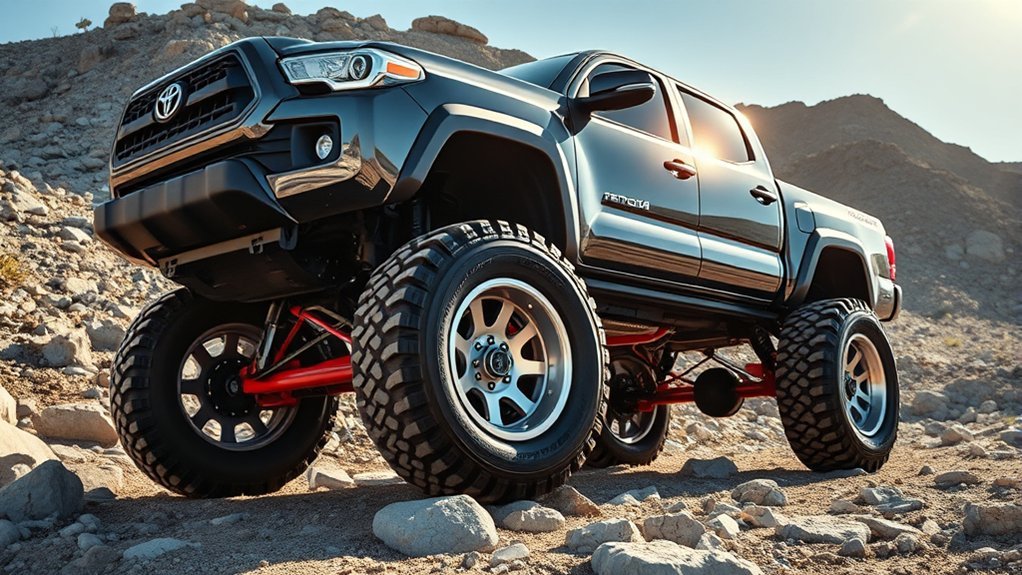
A leveling or lift kit can create more vertical space above the tire, but it does not automatically move the body mount, firewall, pinch weld, fender liner, bumper edge, or suspension components. Those areas often determine whether a wider tire rubs while turning or when the suspension compresses.
A lift can also change alignment angles, steering feel, CV-joint angles on 4WD models, droop travel, shock position, and suspension geometry. Correct components and a professional alignment are essential after installation. Regearing may improve drivability with a large diameter increase, heavy tires, towing, or frequent mountain driving, but it is not automatically required for every tire upgrade.
| Suspension Change | What It May Help | What Still Needs Verification |
|---|---|---|
| Stock suspension | Factory handling and geometry; some mild upsizes may fit | Model year, trim, wheel width, offset, caster, liner, mud flap, body mount, and full-compression clearance |
| About 2-inch leveling kit | Additional vertical clearance and a more level stance | Turning clearance for sizes such as 275/70R17 or 285/70R17, alignment range, shock travel, and upper-control-arm clearance |
| About 3-inch lift | More space for off-road articulation and larger-tire builds | Whether 33-inch tires require trimming, aftermarket control arms, corrected bump stops, or driveline-angle changes |
| About 4-inch lift or larger | Build-specific room for very large tires | Whether 35-inch tires require major trimming, body-mount work, gearing, brake changes, steering corrections, and local legal compliance |
Treat every lift-height and tire-size pairing as a planning example, not a fitment guarantee. Tire shoulder shape, wheel backspacing, alignment, and how the truck is loaded can change the result.
Choosing the Right Wheel Offset for Your Tacoma
Wheel offset is the distance between the wheel’s mounting surface and its centerline. Positive offset moves the wheel inward, zero offset places the mounting surface near the centerline, and negative offset moves the wheel outward.
- Positive offset: Often keeps the tire closer to the factory position. Too much inward placement can reduce clearance at the upper control arm or suspension.
- Zero offset: Moves many aftermarket wheels farther outward than stock, depending on wheel width. It is not automatically the correct choice for a stock-height Tacoma.
- Negative offset: Can improve inner clearance but may increase contact at the fender liner, bumper edge, mud flap, or body mount. It also changes scrub radius and increases leverage on steering and hub components.
Ranges such as -10 to -38 mm are common in aggressive aftermarket builds, but they should not be treated as universal recommendations. A -25 mm wheel may clear the upper control arm while rubbing the outer liner sooner. A +30 mm wheel may keep the tire tucked in but reduce inner clearance. Wheel width matters too, so offset should always be evaluated with width or backspacing.
Note: Two wheels with the same offset can place their inner and outer lips differently if their widths are different. Compare wheel width, offset, backspacing, tire section width, and brake clearance as one package.
How to Prevent Tire Rubbing Issues
Preventing rubbing requires more than choosing a smaller nominal diameter. Check the complete tire-and-wheel package through steering, suspension movement, and real vehicle load.
- Confirm the baseline: Record the factory tire size, wheel size, door-placard pressure, and current ride height.
- Check actual tire dimensions: Use the manufacturer’s measured diameter, section width, and approved rim-width range.
- Measure inner and outer clearance: Inspect the upper control arm, sway bar, shock, liner, mud flap, bumper edge, pinch weld, and body mount.
- Test full steering lock: Turn both directions while moving slowly forward and backward. A tire may clear in one direction and rub in the other.
- Check suspension compression: A setup that clears on level pavement may rub during braking, cornering, articulation, or when carrying cargo.
- Align the truck: Caster and toe can change where the tire sits in the wheel opening. Use specifications suitable for the suspension system and tire package.
- Modify carefully: Liner reshaping or mud-flap removal may help minor contact. Structural cutting, body-mount modification, or brake-line relocation should be handled by a qualified professional.
Do not reduce street tire pressure simply to stop rubbing. Use the correct cold pressure for the vehicle, load, and tire construction. NHTSA states that the recommended pressure comes from the vehicle placard or owner’s manual, not the maximum pressure molded on the tire sidewall.
After changing tires or wheels, confirm that the tire pressure warning valves are installed and registered. Toyota lists TPMS initialization as necessary when tire size or inflation settings change on the 2024 Tacoma.
Warning: Never trim brake hoses, wiring, structural mounts, or suspension parts for tire clearance. If a tire contacts a structural or safety-critical component, revise the wheel, tire, alignment, or suspension setup.
How Aftermarket Wheels Enhance Tacoma Tire Performance
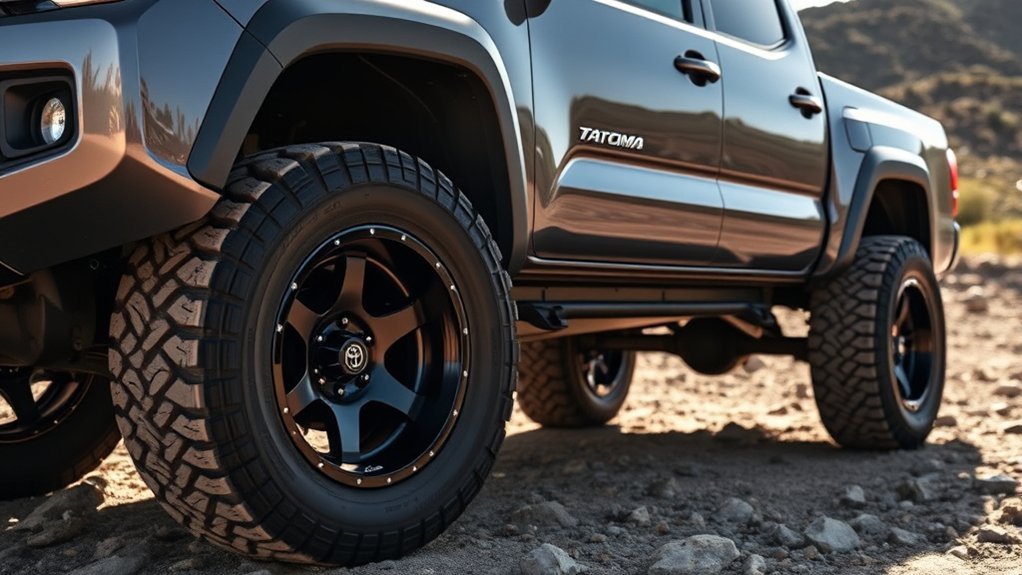
Aftermarket wheels can improve fitment flexibility by giving you more choices in diameter, width, offset, backspacing, and construction. They can also provide a design suited to trail use or make it easier to mount a tire with the rim-width range you need.
Do not assume aftermarket wheels are lighter or stronger than the original wheels. Some are lighter, while others are much heavier. Compare the actual wheel weight, load rating, manufacturing method, and intended use.
Before buying, verify:
- Wheel load rating: It must support the truck’s axle and payload requirements.
- Brake clearance: Diameter alone does not guarantee clearance around the caliper.
- Center bore and hub fit: Use the correct hub-centric arrangement when required.
- Lug-seat type and hardware: Factory and aftermarket wheels may use different seat profiles or shank requirements.
- TPMS compatibility: Sensors, valve stems, registration, and initialization must work with the truck.
- Wheel width: The tire must be approved for the selected rim width.
- Offset and backspacing: These control inner and outer placement and affect rubbing risk.
A wheel between 7 and 9 inches wide can support many popular Tacoma tire sizes, but the correct width depends on the exact tire specification. Use the tire manufacturer’s approved rim-width range rather than a broad rule.
Popular Wheel and Tire Combinations for Improved Performance
Common Tacoma combinations can help you compare options, but they do not replace a model-specific fitment check. The same tire and wheel can behave differently on a second-generation, third-generation, and fourth-generation Tacoma.
[Products Worth Considering]

This portable cordless tire inflator delivers up to 160 PSI with fast 17 L/min airflow to help you quickly top up tires and get back on the road. It features dual power mode, running on a 21V rechargeable battery or a 12V DC adapter for convenient roadside use. An automatic shut-off with digital pressure gauge helps prevent overinflation, and a built-in LED light improves visibility in low-light conditions.
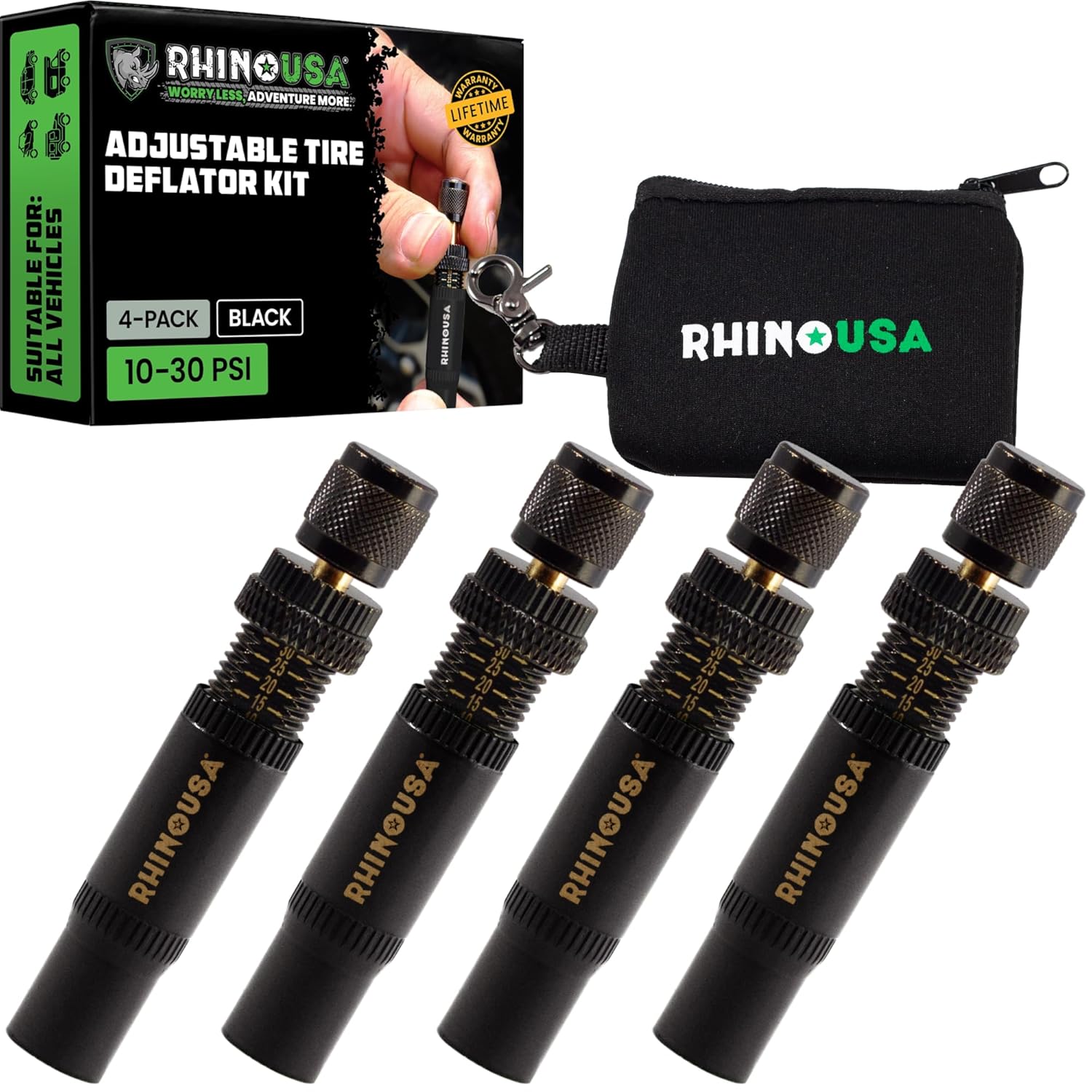
Use the Rhino USA adjustable tire deflators to air down all four tires at once by screwing one deflator onto each valve stem, letting you step away while the tires reach your preset pressure. Each deflator independently adjusts across a 10–30 PSI range with laser-etched indicators for quick setup and verification, making it ideal for beach, sand, and rocky off-road trails.
Tire Size Upgrades
- 265/75R16: About 31.6 inches in nominal diameter. This is a common earlier-generation Tacoma setup, but you still need the correct wheel, brake clearance, load rating, and offset.
- 265/70R17: Also about 31.6 inches. Toyota uses this as a factory size on some 2024 Tacoma configurations, making it a useful reference point for selected fourth-generation trims.
- 275/70R17: About 32.2 inches. This moderate increase may improve clearance, but full-lock rubbing can depend on wheel placement and alignment.
- 285/70R17: About 32.7 inches. Many builds use it with 17×8.5 or 17×9 wheels, but aggressive negative offsets can increase outer-fender and body-mount contact.
- 285/75R16: About 32.8 inches. The extra width and sidewall can require more clearance work than the diameter alone suggests.
Wheel Offset Adjustments
The combinations below are examples seen in aftermarket Tacoma builds. They are not guaranteed fits.
| Wheel Size | Example Offset | Example Tire | Main Checks |
|---|---|---|---|
| 17×9 | -12 to -19 mm | 285/70R17 | Outer liner, body mount, mud flap, caster, wheel-bearing leverage, and tire coverage |
| 16×8 | 0 mm | 265/75R16 | Generation, brake clearance, inner suspension clearance, fender position, and hub fit |
| 17×8.5 | -10 mm | 33×12.50R17 | Measured tire size, suspension travel, trimming, body mount, alignment, and load rating |
All-Terrain vs. Mud-Terrain
Choose the tread category based on where you actually drive.
- All-terrain: Best for mixed pavement, gravel, dirt, and moderate trail use. These tires usually balance road comfort, noise, wet performance, and off-road traction better than mud-terrain designs.
- Hybrid or rugged terrain: Sits between all-terrain and mud-terrain. For example, Nitto classifies the Ridge Grappler as a hybrid-terrain tire, not a pure mud-terrain tire.
- Mud-terrain: Uses larger voids and more aggressive lugs for mud, rocks, and severe trails. A tire such as the BFGoodrich Mud-Terrain T/A KM3 prioritizes extreme off-road traction and toughness, with more noise and on-road compromise than a typical all-terrain.
For a daily-driven Tacoma, an all-terrain tire is usually the most balanced choice. Choose mud-terrain only when your terrain and use justify the added noise, mass, and road-performance tradeoffs.
How Tire Modifications Affect Speedometer, Gearing, Brakes, and Fuel Use
A taller tire travels farther with each revolution. If the vehicle is not recalibrated, the speedometer may read lower than the truck’s actual speed. You can estimate the difference with this formula:
Actual speed = indicated speed × new tire diameter ÷ original tire diameter.
For example, moving from a 31.6-inch tire to a 32.7-inch tire increases nominal diameter by about 3.5%. At an indicated 60 mph, the mathematical estimate is about 62.1 mph. Actual results depend on the tires’ measured loaded radius and the vehicle’s calibration.
Larger tires also create taller effective gearing. That can reduce engine speed at a given road speed, but the added leverage, mass, and rolling resistance may make acceleration slower and increase transmission shifting. Regearing can restore performance on heavily modified trucks, but the decision should consider engine, transmission, axle ratio, tire weight, towing, terrain, and daily driving.
Braking performance can also change because the brake system must control a heavier rotating assembly with more leverage. Drive cautiously after an upgrade and confirm the truck stops straight without vibration, pulling, contact, or warning lights.
Load Rating, Rim Width, and Tire Pressure
Every replacement tire must have enough load capacity for the truck and its intended payload. Do not choose a tire only because the diameter fits. Check the Tire and Loading Information Label, Gross Axle Weight Ratings, tire load index, wheel load rating, and the tire manufacturer’s load-and-inflation information.
Passenger-metric and light-truck tires can feel different even when their dimensions are similar. An LT tire may offer stronger construction for towing or trails, but it can be heavier and ride more firmly. A higher load range does not mean you should inflate the tire to the maximum sidewall pressure.
Use the vehicle placard as the starting cold pressure. If you switch construction, load range, or size, have a qualified tire professional determine whether a different cold pressure is needed to carry the same load safely. Never use pressure changes as a substitute for proper clearance.
NHTSA recommends checking all tires, including the spare, at least monthly when cold. It also notes that TPMS warns only after a tire becomes significantly underinflated, so the system does not replace manual pressure checks.
Spare Tire and 4WD Compatibility
The original claim that you can never use the stock spare with larger tires is too broad. Some Tacomas leave the factory with a spare that differs from the road tires. For example, Toyota’s 2024 specifications list certain 265/70R17 configurations with a 245/75R17 spare. Use a factory-provided spare only as directed in the owner’s manual and treat any temporary-use limitation seriously.
After a substantial tire-size change, compare the spare’s rolling diameter, load capacity, wheel clearance, and intended use with the new setup. A large mismatch can affect handling and may stress a four-wheel-drive system, especially if driven far or at high speed.
For remote travel, towing, or serious off-road use, a matching full-size spare is the most practical setup. Keep all four service tires closely matched in size, construction, tread pattern, and tread depth, and rotate them according to the manual.
Installation and Post-Upgrade Checklist
- Confirm tire size, load index, speed rating, construction, and approved rim-width range.
- Confirm wheel diameter, width, offset, backspacing, center bore, load rating, lug seat, and brake clearance.
- Install compatible TPMS sensors and complete registration or initialization.
- Balance every new tire-and-wheel assembly.
- Torque the wheel nuts to the specification for your exact model and wheel type.
- Perform a professional alignment after suspension or wheel-position changes.
- Check clearance at full lock in both directions, while moving forward and backward.
- Check clearance with cargo, passengers, braking dive, and suspension articulation.
- Verify there are no warning lights, vibrations, pulling, unusual noise, or contact marks.
- Recheck pressure, wheel-nut torque, and visible rubbing after the initial drive and according to the wheel or installer instructions.
NHTSA recommends balancing new tires and using proper alignment to support safe operation and even wear.
Frequently Asked Questions
How do tire modifications affect fuel efficiency in my Tacoma?
Larger, heavier, wider, or more aggressive tires often increase rolling resistance and rotational mass, which can reduce fuel economy. The result varies with tire construction, pressure, wheel weight, gearing, speed, terrain, and driving style.
Are specific tire brands recommended for off-roading?
Choose by terrain, size availability, measured dimensions, load rating, construction, wet-road behavior, noise, and warranty rather than brand alone. All-terrain tires suit mixed use, hybrid-terrain tires add aggression, and mud-terrain tires suit severe off-road conditions.
What is the lifespan of modified tires on a Tacoma?
No reliable universal mileage applies. Tire life depends on compound, tread category, alignment, pressure, rotation, load, heat, road surface, off-road use, and driving habits. Inspect tread depth and condition regularly and follow the tire manufacturer’s service guidance.
Can I use the stock spare tire with larger tires?
Possibly for temporary use if Toyota supplied it for your configuration and the owner’s manual allows it. After a major upsize, compare rolling diameter and load capacity. A matching full-size spare is better for long-distance, towing, or remote off-road travel.
How do tire modifications affect my Tacoma’s warranty?
Aftermarket parts do not automatically cancel the entire warranty. The FTC states that coverage can be denied for damage caused by a defective or incorrectly installed aftermarket part, and the manufacturer or dealer must connect the part to the damage. Keep receipts, specifications, alignment reports, and maintenance records.
Do I need to regear after installing larger tires?
Not always. Regearing becomes more useful when the diameter and weight increase is large, acceleration suffers, the transmission hunts between gears, or you tow and drive steep terrain. Evaluate the complete drivetrain and use before changing axle ratios.
Will a leveling kit stop 285/70R17 tires from rubbing?
Not necessarily. A leveling kit adds vertical clearance, but rubbing can still occur at the liner, mud flap, body mount, bumper edge, upper control arm, or during suspension compression. Wheel width, offset, caster, and the tire’s actual dimensions remain critical.
Conclusion
The right Toyota Tacoma tire modification matches your model year, trim, load, wheel, suspension, and real driving needs. Start with the factory placard, use measured tire specifications, and treat common sizes such as 275/70R17 or 285/70R17 as examples rather than promises. Careful offset selection, alignment, TPMS setup, and full-range clearance testing will give you a safer and more capable result.
Sources
- Toyota 2024 Tacoma Owner’s Manual: Maintenance Data — factory tire sizes, wheel sizes, pressures, spare configurations, and wheel-nut specifications.
- Toyota USA Newsroom: 2026 Tacoma — current factory 32- and 33-inch tire configurations on selected trims.
- Toyota 2024 Tacoma Owner’s Manual: Items to Initialize — TPMS initialization after tire-size or inflation changes.
- NHTSA TireWise — tire-size selection, cold pressure, tread, balancing, alignment, rotation, and TPMS guidance.
- Federal Trade Commission: Auto Warranties — aftermarket parts and warranty-coverage guidance.
- Nitto Ridge Grappler Product Page — official hybrid-terrain classification.

Related Articles
Best Toyota Tacoma Tire Set Deals
You rely on your Tacoma for daily driving, work runs, and weekend adventures, so picking the right tire set matters more than you might…
Read More
Best Winter Tire Deals for Toyota Tacoma
Choosing the right winter tires for your Toyota Tacoma matters because it directly affects your safety, traction, and confidence when roads turn icy or…
Read More
Best Highway Tire Deals for Toyota Tacoma
You rely on your Tacoma for long drives, towing, and everyday hauling, so picking the right highway tire matters more than you might think.…
Read More