
Quick Answer
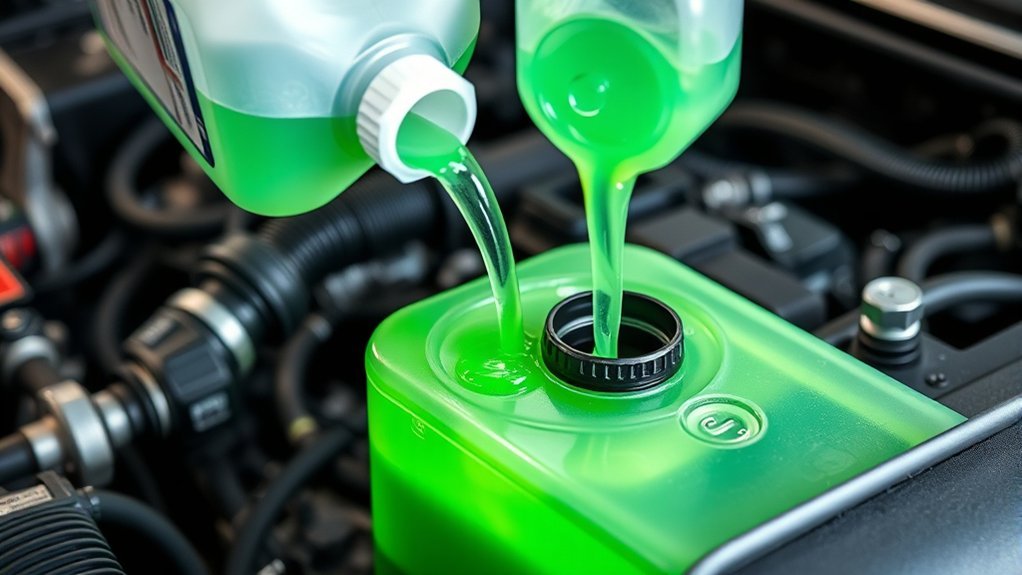
A 50/50 antifreeze mix is premixed coolant that can usually be poured in as supplied. A typical ethylene-glycol 50/50 coolant protects to about -34°F (-37°C), while system pressure can raise its boiling protection substantially. Use only a formula that meets your vehicle maker’s coolant specification.
Key Takeaways
- Premixed 50/50 coolant already contains the water it needs, so you normally do not add more water before use.
- Freeze and boil protection vary by formulation and cooling-system pressure, so bottle and OEM specifications matter.
- Coolant color is not a universal compatibility standard; match the required chemistry or approval instead.
- Low coolant or overheating can indicate a leak or cooling-system fault, not simply “old coolant.”
- Coolant life depends on the vehicle and formulation, so follow the manufacturer’s service schedule rather than a universal year rule.
What Is Antifreeze 50/50 Mix?
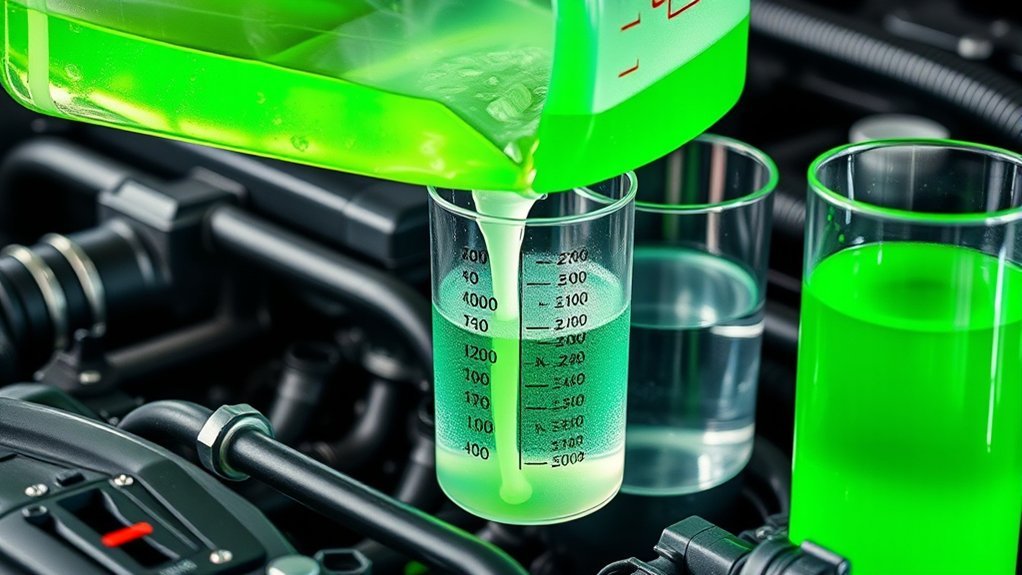
Antifreeze 50/50 mix is pre-diluted engine coolant: the manufacturer has already blended coolant concentrate with water at about a 1:1 ratio. Ready-mix products from manufacturers such as GLYSANTIN are specifically sold for direct use without further dilution, while concentrates must be mixed before they go into the cooling system.
The concentrate portion commonly uses ethylene glycol or propylene glycol plus corrosion inhibitors and other additives. The water portion is usually deionized or otherwise purified. GLYSANTIN’s usage guidance recommends a 50:50 dilution for its concentrate products and states that its ready-mix products are already diluted for immediate use.
Do not identify coolant by color alone. Green, orange, yellow, blue, pink, and red dyes can appear in different formulations. What matters is the exact coolant requirement in your owner’s manual or service information, including any OEM approval or chemistry requirement.
[Products Worth Considering]

Upgrade your Toyota tire setup with these corrosion-resistant, leak-proof valve stem caps designed to help protect the valve core from water, snow, and road grime. The caps feature a snug rubber seal and durable copper alloy construction to resist rust and oxidation while maintaining stable tire pressure. Ideal for replacing worn original caps and keeping your wheels looking clean and stylish.

Upgrade your vehicle’s tire protection with these stylish, corrosion-resistant valve stem caps designed for Mercedes Benz AMG applications. The durable one-time die-cast construction and electroplated finish help resist oxidation and wear. A simple screw-in installation keeps moisture and debris out to maintain valve integrity.

Fran Wilson Nourish My Eyes eye pads are a convenient at-home spa treatment designed to soothe tired eyes, reduce puffiness, and help diminish the look of dark circles. Infused with a cucumber, green tea, and mulberry extract blend, they provide targeted hydration and a cooling, refreshing under-eye experience. Simply apply for 5–15 minutes to help restore a more bright, refreshed appearance.
Why a 50/50 Mix Protects Your Engine
A 50/50 mix works because water and glycol contribute different strengths. Water transfers engine heat efficiently, while glycol lowers the freezing point, raises the boiling point, and carries the additive package that protects cooling-system metals and seals.
The result is a practical compromise for everyday driving. It is not automatically the correct ratio for every vehicle or every climate, but it is widely used because it balances temperature protection and cooling performance.
Freeze and Boil Protection
A typical ethylene-glycol 50/50 coolant begins freezing around -34°F to -35°F (-37°C). Its boiling point is around the mid-220s °F at standard atmospheric pressure, and a pressurized cooling system can raise the effective boil-over protection further.
| Example | Freeze Protection | Boiling Protection |
|---|---|---|
| Mobil Delvac 50/50 prediluted coolant | -34°F (-37°C) | 226°F at standard pressure; 265°F with a 15 psi pressure cap |
| Chevron’s general 50/50 water-glycol example | About -35°F (-37°C) | About 223°F before accounting for cooling-system pressure |
Those figures are examples, not a promise for every coolant. ExxonMobil’s 50/50 technical data lists -34°F freeze protection, a 226°F ASTM boiling point, and 265°F boil protection with a 15 psi cap. Chevron’s coolant guidance also explains that radiator-cap pressure changes the boiling point.
Optimal Heat Transfer
More antifreeze is not always better. Water is an effective heat-transfer fluid, so raising the glycol percentage too far can reduce the mixture’s ability to carry heat away from the engine.
That is why a balanced mixture matters. Too much water weakens freeze protection and dilutes corrosion inhibitors; too much concentrate can reduce heat-transfer performance and may not improve freeze protection beyond the formulation’s useful range. Follow the ratio approved for your vehicle rather than assuming the strongest concentration gives the best protection.
When to Use 50/50 Antifreeze
Use 50/50 antifreeze when your vehicle calls for a compatible premixed coolant and you want a ready-to-pour product. It is especially convenient for topping off a cooling system that already contains the same approved formulation or for refilling a system when the manufacturer specifies that concentration.
A 50/50 premix is a good choice when:
- You have confirmed that the product meets the required OEM coolant specification.
- The existing coolant is known and compatible with the product you are adding.
- You want to avoid measuring concentrate and water yourself.
- The vehicle’s specified concentration is close to the premix supplied in the bottle.
Do not assume every vehicle uses exactly 50/50. For example, Toyota’s 2025 Camry manual specifies a 50% coolant/50% deionized-water mixture for the U.S. but a 55% coolant/45% water mixture for Canada. That is a useful reminder that the vehicle maker’s specification overrides a generic rule.
Warning: Never remove a radiator or pressurized coolant cap while the engine or cooling system is hot. Hot coolant can spray out under pressure and cause serious burns. Also clean spills promptly and keep antifreeze away from children and pets.
Many automotive antifreezes contain ethylene glycol. The CDC/NIOSH ethylene glycol guidance notes that ingestion can cause serious systemic toxicity. Store coolant in its original container and dispose of used fluid according to local rules.
How to Check Your Vehicle’s Coolant Specs
Start with the owner’s manual or official service information. You are looking for the required coolant product, specification, chemistry, concentration, and replacement schedule, not just a color name.
- Find the coolant requirement. Look in the maintenance or engine-compartment section for the exact coolant specification or approved product.
- Check the bottle label. Confirm that the premix meets the same OEM requirement or approval.
- Confirm the concentration. Verify whether the vehicle calls for 50/50 premix, a different premix, or concentrate mixed to a particular ratio.
- Match what is already in the system. If you do not know what coolant is in the vehicle, avoid choosing a replacement based only on color.
Terms such as IAT, OAT, and HOAT describe families of corrosion-inhibitor technology, but the broad family name alone may not prove compatibility. The safest check is the vehicle manufacturer’s required specification plus the product label’s stated approvals or applications.
Signs Your Coolant Needs to Be Replaced
Coolant should be replaced according to the vehicle maker’s maintenance schedule, and sooner when inspection or testing shows contamination or degraded protection. There is no single “2–5 year” rule that applies to every 50/50 coolant because service life depends on both the vehicle and the coolant formulation.
| What You Notice | What It Can Mean | Best Next Step |
|---|---|---|
| Rust, sludge, debris, or obvious contamination | Corrosion, mixed fluids, or degraded coolant | Inspect the system and service the coolant as required |
| Coolant level keeps dropping | Possible external or internal leak | Find the leak instead of repeatedly topping off |
| Engine temperature rises abnormally | Low coolant, airflow, thermostat, pump, fan, blockage, or another cooling fault | Diagnose the cooling system; do not assume a coolant change alone will fix it |
| Service interval is due | Additives may no longer provide intended protection | Replace with the specified coolant at the required interval |
A change in color by itself is not enough to diagnose coolant failure because coolant dyes vary by brand and formula. If the fluid looks oily, milky, unusually thick, or contaminated, investigate the cause before simply draining and refilling it.
You can also test glycol concentration with a suitable hydrometer or refractometer. This can tell you whether freeze protection is in the expected range, but concentration testing does not by itself prove that the corrosion inhibitors are still healthy.
[Products Worth Considering]

This tire valve adapter kit lets you connect a 3/4-inch garden hose to tire valves to fill tires with air or liquid. It includes two adapters for standard bore and large bore valves plus a convenient bleeder valve to release trapped air. Designed for tractor tire tubes and compatible air/water valves and extensions, it’s a practical repair tool for getting back on the road or field quickly.

Mighty Patch for Tired Eyes helps visibly awaken and de-puff under eyes with soothing hydrogel comfort. Infused with niacinamide, tri-hyaluronic acid, panthenol, and allantoin, the patches cool the eye area and refresh the look of tired eyes. Contoured to fit and designed not to slip, they’re worn for 30+ minutes or until clear for a quick morning pick-me-up.
Tymate TM7 is a wireless tire pressure monitoring system that delivers real-time pressure and temperature readings for safer driving. It includes four external sensors, a bright color LCD display with adjustable backlight, and six alarm modes for high/low pressure, fast leakage, high temperature, and sensor signal or battery issues. The system covers a wide 0–144 PSI range and plugs into your vehicle’s cigarette lighter socket for quick DIY setup.
50/50 Mix vs. Concentrated Antifreeze
The main difference is convenience versus control. A 50/50 mix is already diluted and ready to use, while concentrated antifreeze lets you choose the final water-to-coolant ratio when the vehicle or climate requires something different.
| Factor | 50/50 Premix | Concentrate |
|---|---|---|
| Preparation | Ready to pour | Must be diluted to the specified ratio |
| Best for | Simple top-offs and routine fills when 50/50 is specified | Custom ratios, bulk service, or situations where residual water must be accounted for |
| Mixing error risk | Lower | Higher if ratio or water quality is wrong |
| Flexibility | Fixed concentration | Ratio can be adjusted within manufacturer limits |
One important exception is a cooling system that has just been flushed with water. Some water can remain trapped in the engine or heater circuit. In that situation, pouring in only 50/50 premix can leave the final concentration weaker than intended. A proper refill procedure must account for the water already in the system.
Frequently Asked Questions
Can I mix different antifreeze colors safely?
Do not use color alone to decide whether two coolants can be mixed. Different formulas can share the same color, and compatible products can use different dyes. Match the coolant specification, chemistry, and approved application instead. If the existing coolant is unknown, identify it before adding a different product.
How long does 50/50 antifreeze usually last?
There is no universal lifespan for all 50/50 antifreeze. The service interval depends on the coolant technology, the vehicle manufacturer, and operating conditions. Follow the maintenance schedule for your exact vehicle and coolant rather than replacing it solely because a generic number of years has passed.
Is 50/50 mix safe for all engine types?
No. A 50/50 concentration can be common, but the coolant formula still has to meet the engine and vehicle manufacturer’s requirements. Different systems may require specific inhibitor chemistry, approvals, or concentrations. Always verify the coolant specification before topping off, flushing, or changing brands.
Can I add water to a 50/50 mix?
You normally should not add water to premixed 50/50 coolant because it is already diluted for use. Extra water lowers the glycol and inhibitor concentration. If you must correct a mixture or deal with an emergency, use the vehicle maker’s procedure and restore the proper concentration afterward.
What happens if I use too much antifreeze?
Too much concentrate can reduce heat-transfer performance and may give worse freeze protection once you move beyond the useful range for that coolant. It can also leave the corrosion-inhibitor package at an unintended concentration. Use the ratio specified by the vehicle and coolant manufacturers instead of assuming more antifreeze is safer.
Conclusion
An antifreeze 50/50 mix is the simplest choice when your vehicle requires a compatible premixed coolant at that concentration. It gives balanced temperature and corrosion protection without home mixing, but it is not universal. Match the OEM specification, keep the concentration correct, and treat repeated coolant loss or overheating as a problem to diagnose rather than something to solve with repeated top-offs.
Sources
- GLYSANTIN Usage & Maintenance: 50:50 concentrate dilution and ready-mix guidance.
- ExxonMobil Mobil Delvac 50/50 Technical Data: freeze point and boiling-point values at standard and pressurized conditions.
- Chevron Coolant System Maintenance: 50/50 temperature protection, pressure effects, and concentration testing.
- Toyota 2025 Camry Owner’s Manual: coolant chemistry and U.S./Canada mixture examples.
- CDC/NIOSH Ethylene Glycol Guidance: ingestion hazards and toxicity.
”’
import re, json, html as htmlmod
img_count=html.count(“
[Products Worth Considering]

A concentrated tire and tube mounting compound designed to help simplify mounting rubber tires and tubes on passenger, semi truck, construction, and OTR applications. Its ultra-thick formula packs beads effectively and includes rust inhibitors to help protect against corrosion during use.

This inline air pressure regulator helps you precisely control air flow from your compressor with an integrated 0-150 PSI gauge. It improves finish quality by reducing overspray and material waste for automotive spray painting and other pneumatic tools. The universal 1/4 NPT threads make it easy to connect to air hoses, compressors, and spray guns for quick, on-the-fly adjustments.

Steelman white tire marking crayons provide high-contrast, semi-permanent marks for repairing and inspecting tires and equipment. They write on wet or dry, smooth or coarse surfaces including rubber, metal, glass, and wood, making them ideal for puncture location and damage outlining. The lead- and zinc-free crayons resist weather and fading yet wipe away when you no longer need the marks.
