
Why Tire Sidewall Strength Matters on a 4Runner
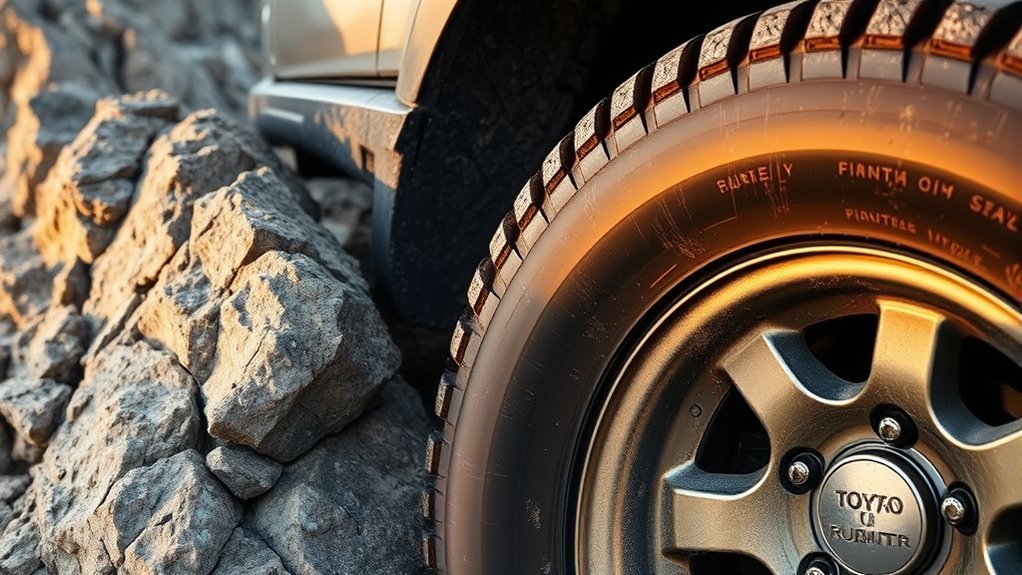
Your 4Runner’s sidewall strength determines whether you’ll crawl home on a flat or finish the trail. LT-rated tires with 3-ply construction handle over 3,000 lbs—nearly 1,000 lbs more than P-rated alternatives—while resisting punctures at sub-15 PSI pressures that destroy weaker sidewalls. Three-ply architecture distributes load and puncture forces across multiple layers, preventing the pinch cuts and deformations that strand vehicles on technical terrain. The specific construction choices behind your rubber matter more than you’d expect.
Protect Your 4Runner: How Sidewall Strength Works Off-Road
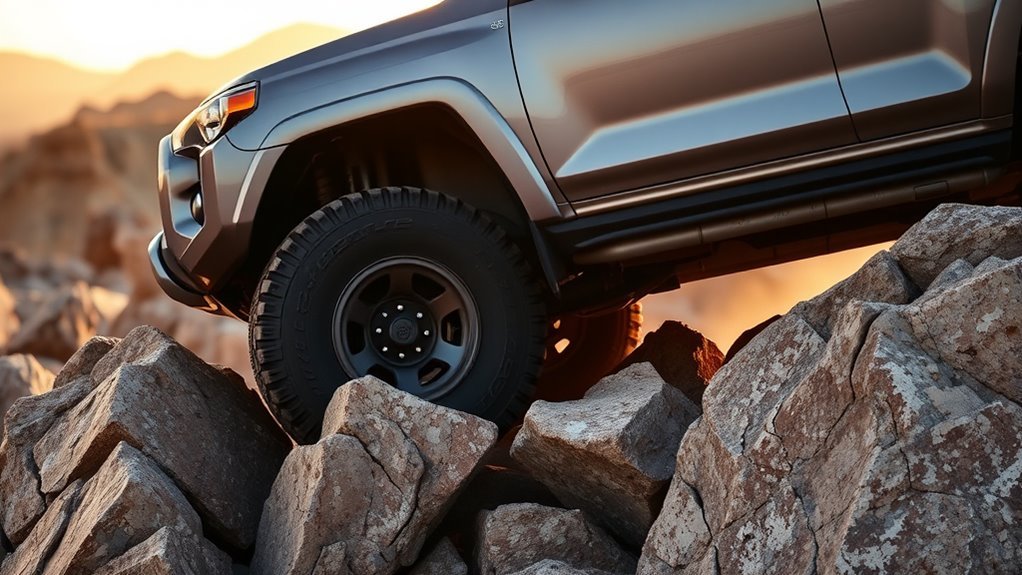
Navigate technical trails with confidence by understanding how sidewall construction directly impacts your 4Runner’s vulnerability to terrain-induced failures. LT-rated tires deliver superior off-road performance through multi-ply designs that dramatically outperform P-rated alternatives in demanding environments. You’ll gain measurable tire durability when selecting reinforced options like the BFG All-Terrain KO, whose cut-resistant layers absorb impacts from jagged rocks and sharp debris.
Strategic sidewall stiffness enables precise load management across uneven surfaces, reducing tire roll during aggressive terrain navigation. This structural integrity allows you to run lower pressures for traction enhancement—expanding your contact patch without sacrificing puncture resistance. You’re fundamentally trading rigid highway efficiency for adaptive grip that conforms to irregular topography.
The payoff manifests as unwavering driving confidence. Stiffer sidewalls maintain predictable handling through ruts and ledges, transforming uncertain passages into calculated maneuvers. Your 4Runner becomes an extension of deliberate intent rather than a liability on the trail.
Decode the Build: How 2-Ply and 3-Ply Sidewalls Differ
Note brand variability in ply ratings; verify actual carcass construction rather than relying on nominal classifications. Your liberation depends on equipment that won’t strand you.
Pick Your Rating: P-Rated or LT-Rated for Stronger Sidewalls?
You need to weigh load rating differences when selecting between P-rated and LT-rated tires for your 4Runner. P-rated tires typically support 1,874 lbs at 35 PSI, while equivalent LT-rated tires handle 2,469 lbs at 50 PSI due to reinforced construction. These construction material variations—particularly the additional nylon or steel plies in LT sidewalls—directly translate to 32% greater load capacity and measurably enhanced puncture resistance on rough terrain.
Load Rating Differences
While P-rated tires deliver adequate performance for standard passenger duty, you’re sacrificing sidewall integrity if you regularly subject your 4Runner to loaded expeditions or technical terrain. Load capacity ratings reveal the critical divergence: P-rated tires typically max out at 2,205 lbs per tire, whereas LT-rated variants exceed 3,000 lbs. This 36% capacity advantage directly impacts tire performance when you’re hauling gear across unforgiving topography.
Sidewall flexibility becomes your enemy in demanding driving conditions. P-rated construction prioritizes comfort through pliant sidewalls that deform under stress, compromising stability. LT-rated tires employ higher ply ratings—often 3-ply sidewalls—transforming flexibility into controlled rigidity. You’re gaining puncture resistance and predictable handling when fully loaded. For liberation seekers pushing beyond pavement, LT ratings aren’t optional; they’re engineering necessity.
Construction Material Variations
Load capacity ratings only tell part of the story; the materials comprising your tire’s sidewall determine how that strength manifests under duress.
LT-rated tires utilize advanced construction materials—typically 3-ply or 4-ply polyester/steel hybrid layers—that dramatically outperform P-rated alternatives. These manufacturing processes integrate thicker gauge rubber compounds and reinforced bead bundles, creating sidewall durability that resists deformation under extreme articulation. You’ll witness superior material performance when crawling over sharp granite; the multi-ply architecture distributes puncture forces across redundant load paths rather than concentrating stress on single-ply weak points. P-rated tires rely on lighter 2-ply construction with less robust rubber formulations—acceptable for pavement, insufficient for liberation. Your 4Runner demands sidewalls engineered through precise manufacturing processes that prioritize cut resistance over ride compliance. Choose accordingly.
Air Down With Confidence: Why Sidewall Strength Matters at Low PSI
When you air down to 15 psi for technical terrain, your sidewalls absorb the full load that internal pressure no longer supports. A 3-ply construction prevents excessive flexing, maintaining tire shape and protecting against punctures from sharp rocks. LT-rated tires with stiffer sidewalls enable you to run lower pressures confidently without risking roll-off or loss of vehicle control on uneven surfaces.
Preventing Sidewall Damage
Because you’re airing down to roughly 15 psi for technical terrain, your sidewalls become the primary load-bearing structure, and LT-rated construction with 3-ply reinforcement—like BFG’s AT KO series—delivers the flexural rigidity needed to prevent pinching or rupture against sharp obstacles. This puncture resistance transforms your 4Runner’s capability, letting you traverse jagged rock gardens without catastrophic sidewall failure.
Your expanded contact patch demands off road durability that standard P-metric tires simply cannot provide. When you drop pressure, weaker sidewalls fold, creating pinch points where cuts propagate rapidly. Reinforced 3-ply designs distribute stress across multiple cord layers, maintaining structural integrity through extreme articulation cycles.
Investing in robust sidewall construction liberates you from terrain anxiety. You’ll confidently attack technical lines, knowing your tires won’t betray you when flexed to their operational limits.
Maintaining Tire Shape
Drop your 4Runner’s tire pressure to 15 psi, and you’ll immediately feel the expanded contact patch clawing for grip—but without sufficient sidewall rigidity, that same flexibility becomes your liability. Tire flexibility enables terrain adaptability, letting sidewalls deform around rocks and roots instead of cutting. Yet uncontrolled deformation risks bead unseating or catastrophic failure.
LT-rated 3-ply construction—exemplified by BFG AT KO architecture—delivers calibrated stiffness: enough compliance for traction, enough strength to maintain structural geometry. At 15 psi, reinforced sidewalls resist excessive bulging, preserving lateral stability through off-camber sections and preventing tire roll-off during dynamic cornering loads.
You command your 4Runner’s footprint. Proper sidewall engineering transforms low-pressure vulnerability into controlled capability—maximizing flotation without sacrificing predictable handling when terrain demands precision.
Enabling Lower Pressures
Although terrain demands often push you below 20 psi, sidewall integrity—not pressure alone—determines whether you gain traction or gain a trail-side failure.
Stronger sidewalls let you air down confidently. LT-rated construction with 3-ply reinforcement, like BFG’s KO series, maintains structural integrity at 15 PSI where standard tires collapse. This transforms tire performance:
- Expanded contact patches multiply off road traction through distributed ground pressure
- Robust carcass plies resist pinch flats between rim and sharp rock edges
- Reinforced shoulders absorb impact loads without catastrophic rupture
- Flexible conformability reduces point loading on irregular surfaces
You control the terrain instead of surviving it. Reinforced sidewalls aren’t optional equipment—they’re your license to explore beyond maintained routes.
Balance the Trade-Offs: Sidewall Strength vs. Daily Ride Comfort
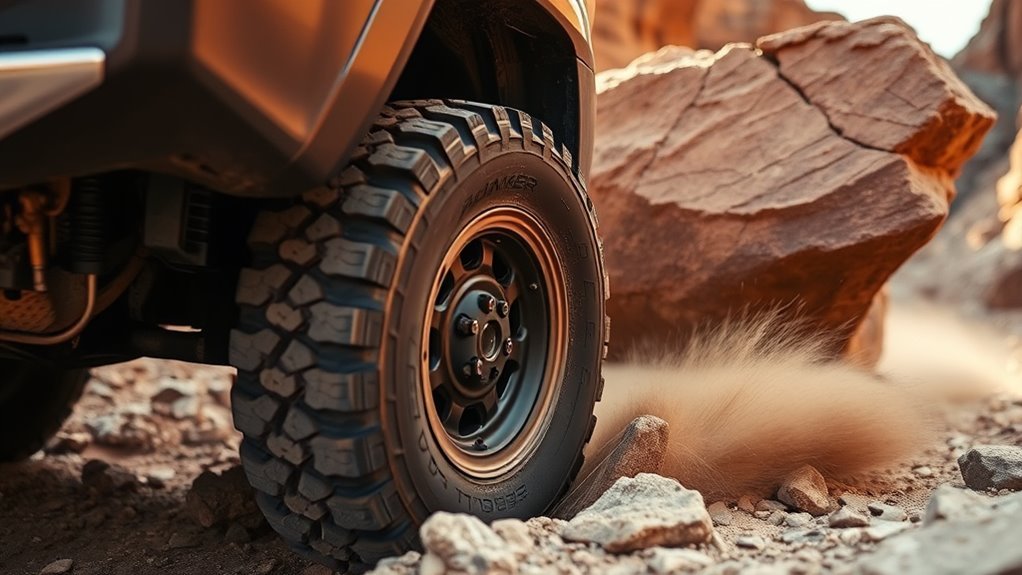
When you’re selecting tires for your 4Runner, you’ll immediately encounter a fundamental engineering compromise: increasing sidewall plies for off-road durability inherently raises the tire’s spring rate, which directly translates to reduced compliance on paved surfaces. Your tire selection dictates this baseline behavior—LT-rated options with 3-ply sidewalls deliver superior puncture resistance and load distribution, yet transmit more road imperfections to the chassis.
You can mitigate this through pressure management: reducing highway pressures within manufacturer limits partially restores ride quality without sacrificing terrain considerations. Comfort adjustments extend to driving techniques—avoiding expansion joints and adjusting your line selection minimizes harsh impacts. Load distribution matters; properly balanced cargo reduces dynamic stress on stiff sidewalls.
The liberation you seek demands accepting calculated trade-offs. Prioritize off road performance for your primary use case, then deploy these compensatory strategies. Your 4Runner becomes a precision instrument: capable, controlled, and appropriately compliant when you master these variables.
Inspect Before You Roll: Spot Sidewall Damage Early
Three minutes of systematic inspection before every departure separates catastrophic failure from preventable maintenance—your 4Runner’s sidewalls conceal damage that manifests at highway speeds or under load stress.
Sidewall inspection demands disciplined attention. Run your palm across each tire’s flank, feeling for:
- Cuts deeper than 2mm that penetrate the outer rubber layer
- Bulges indicating internal ply separation or belt failure
- Puncture wounds from trail debris that compromise structural integrity
- Abrasion patterns from rock contact during off-roading
Damage detection requires contextual awareness. Uneven wear patterns signal alignment drift or pressure anomalies—both accelerate sidewall degradation. Under-inflation increases flex cycles by 40%, generating heat that degrades polyester and steel reinforcement. Post-trail inspections prove non-negotiable; terrain that your tread survives often lacerates sidewalls. Document findings photographically. Your liberation depends on mechanical reliability—neglect transforms minor abrasion into blowout scenarios at 70 mph. Inspect systematically. Depart confidently.
Frequently Asked Questions
What’s the Best Sidewall Material for Extreme Rock Crawling?
You want a 3-ply sidewall construction with high polyester content for extreme rock crawling. This maximizes tire flexibility while resisting punctures, letting you conquer terrain that would shred lesser rubber and liberate your 4Runner’s true capability.
Can I Repair a Torn Sidewall or Must I Replace?
You must replace a torn sidewall—no tire maintenance tips or sidewall repair techniques can safely restore structural integrity. Sidewall flex cycles exceed 300,000 per 1,000 miles; any compromise risks catastrophic failure under load.
Does Sidewall Strength Affect Fuel Economy Significantly?
Sidewall strength acts like a ship’s hull—rigid designs increase rolling resistance by 3–5%, but your tire pressure and driving habits dominate fuel economy; aggressive acceleration dwarfs sidewall effects, liberating you to prioritize durability without guilt.
How Does Temperature Change Impact Sidewall Durability?
Temperature extremes degrade your sidewall flexibility through accelerated polymer chain scission and oxidation; you’ll lose 15-25% elasticity per 20°F deviation from ideal, compromising load-bearing capacity and increasing blowout risk during thermal cycling.
Are Stronger Sidewalls Worth the Extra Weight Penalty?
Yes, they’re worth it. You’ll overcome the “heavy tires kill MPG” myth when you realize sidewall design optimizes weight distribution, reducing unsprung mass effects. Your 4Runner gains traction, durability, and freedom to explore terrain without compromise.
Conclusion
You’ve now mastered sidewall ply counts, load ratings, and PSI calculations—congratulations, you’re basically a tire engineer. Go forth and air down with mathematical precision, inspecting every millimeter of rubber like it owes you money. Just remember: your LT-rated, 3-ply fortress of a sidewall won’t save you from that curb you’ll inevitably kiss at the grocery store. Data-driven off-roading ends where parking lots begin.

Related Articles

When to Switch to Winter Tires on Your 4Runner
The best time to switch to winter tires on your 4Runner is crucial for safety; discover essential tips for choosing the right tires!
Read More
How a Lift Kit Affects Tire Wear on a Toyota 4Runner
Getting a lift kit on your Toyota 4Runner secretly destroys your tires—but the fix is simpler than you think.
Read More
Do All-Terrain Tires Work in Snow on a 4Runner
Beneath the surface of all-terrain tires lies a crucial question: can they truly handle snow on your 4Runner, or is there a better option?
Read More