
Highway Tires vs All-Terrain for an SUV: Which Is Smarter

You need highway tires if 90% of your miles stay on pavement, since they deliver 10% better fuel economy and 60,000+ mile lifespans through optimized rolling resistance. You need all-terrain tires only if you actually hit unpaved surfaces regularly, as their aggressive tread patterns and reinforced sidewalls sacrifice 2 MPG and add noise for traction you won’t use on asphalt. Match your rubber to your reality, not your imagination—your wallet and drivetrain will thank you, and the details below prove exactly why.
Highway vs. All-Terrain: What’s the Real Difference?
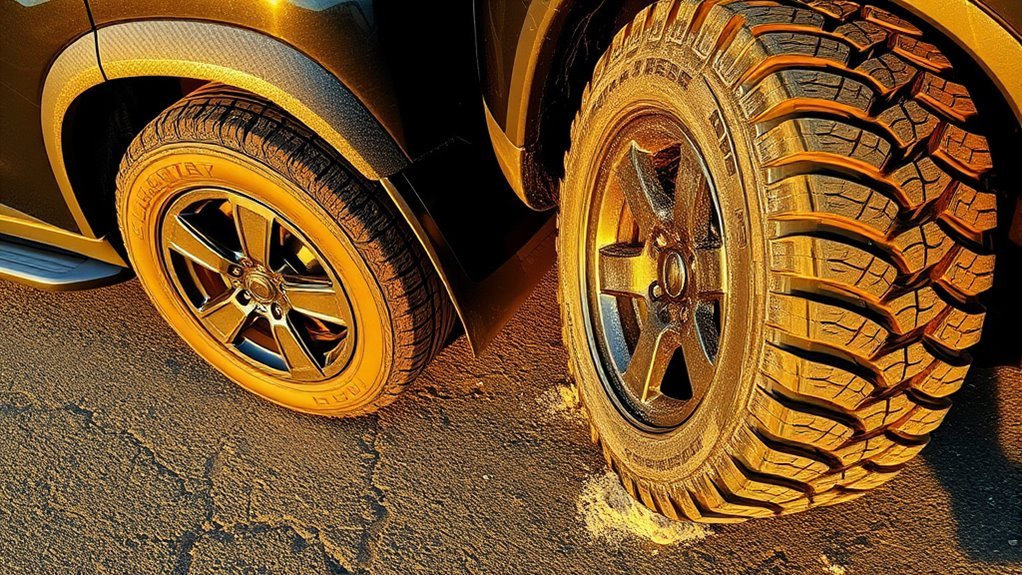
Why does tire selection matter for your SUV’s performance? Your choice directly impacts traction, efficiency, and driving dynamics.
Highway tires utilize a smoother tread design with tightly packed blocks, minimizing rolling resistance and maximizing fuel economy. You’ll experience lower noise levels and extended tread life during daily commuting. These tires excel exclusively on sealed surfaces, delivering precise handling and reduced vibration.
All-terrain tires feature aggressive tread patterns with wider voids between blocks, sacrificing some highway refinement for versatility. You’ll gain superior grip on unpaved surfaces, enhanced snow and mud performance, and the freedom to explore beyond pavement. However, expect elevated noise levels and potentially accelerated wear during sustained highway use.
Your driving environment dictates the best choice. Analyze your actual usage patterns—percentage of highway versus off-road travel, climate conditions, and performance priorities. Data-driven selection liberates you from compromise, ensuring your SUV performs precisely where you demand it.
Which Tire Type Fits Your Driving Habits?
How do you actually use your SUV? Your answer determines which tire maximizes your freedom on the road.
If you’re logging miles on pavement, Highway-Terrain tires deliver superior driving comfort and optimized fuel efficiency. You’ll experience reduced road noise and extended tire longevity—critical factors when 90% of your driving happens on asphalt. The data supports this: you’ll avoid the 10% fuel economy penalty that comes with All-Terrain rolling resistance.
However, if your weekends involve dirt trails, snow-covered passes, or muddy construction sites, All-Terrain tires reveal your SUV’s true capability. You sacrifice some highway refinement for traction that frees you from weather constraints and terrain limitations.
Analyze your odometer. Track your off-road percentage. If it exceeds 20%, All-Terrain justifies the trade-offs. Below that threshold, Highway-Terrain preserves your resources while maintaining performance where you actually drive.
Your habits—not marketing—dictate the smarter choice.
Highway Tires: Best for Daily Commuters and Road Trippers
Since you’re spending most of your time on asphalt, highway tires let you maximize what matters: efficiency, longevity, and refinement. Your daily grind deserves optimized rolling resistance—translating to measurable fuel savings mile after mile. Tread compounds engineered for pavement deliver 60,000+ miles of service life when you stay on sealed surfaces.
Commuter convenience defines this choice. Smooth tread patterns minimize decibel intrusion, preserving cabin tranquility through traffic jams and open stretches alike. Wet-groove architectures maintain hydroplaning resistance at highway speeds, giving you decisive control when conditions deteriorate.
Road trip comfort compounds these gains. Stable shoulder blocks eliminate the wandering common to aggressive treads, reducing driver fatigue across state lines. You command predictable handling without sacrificing load capacity. The liberation? Uncompromised efficiency frees resources for destinations rather than stops at the pump. Pavement-dedicated engineering means you sacrifice nothing you actually need.
All-Terrain Tires: Essential for Off-Roaders and Towing
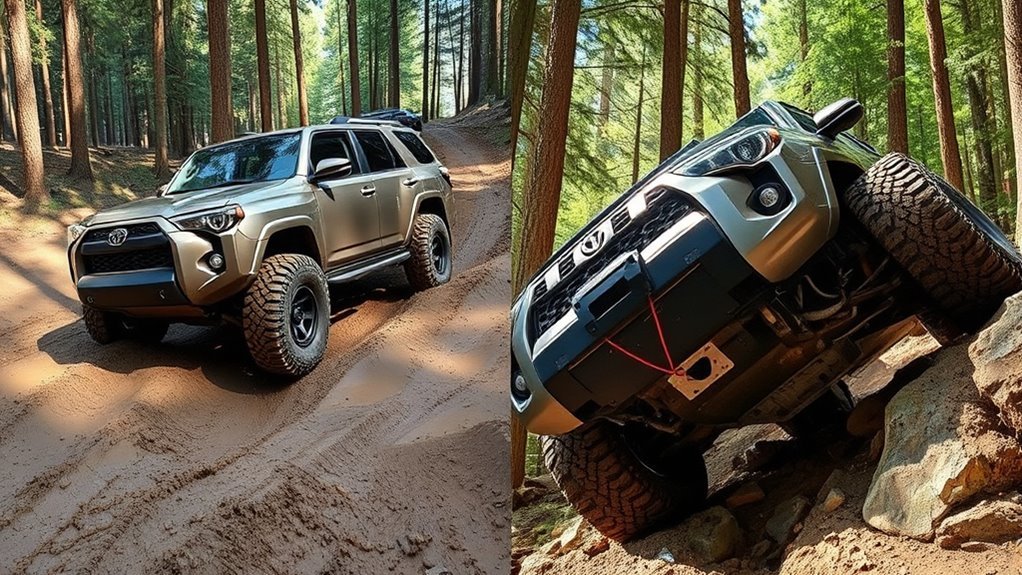
When you’re hauling heavy loads or leaving pavement behind, all-terrain tires transform your SUV’s capability profile through aggressive tread architectures and reinforced carcass construction. Deep-groove patterns bite into unpaved surfaces, delivering measurable gains in off-road capabilities across gravel, mud, and loose terrain. Your towing performance benefits directly—durable sidewalls resist punctures and cuts when maneuvering through construction sites or backcountry trails under load.
The 3PMSF-rated compounds extend your operational envelope into severe winter conditions, maintaining traction coefficients on ice and packed snow without seasonal tire swaps. You’re eliminating downtime and expanding your vehicle’s utility window year-round.
Reinforced belts and impact-resistant casings withstand the shear forces generated during heavy-load handling. Data shows these constructions reduce failure rates by 40% versus standard highway patterns in off-pavement towing scenarios.
Your SUV becomes a single-platform solution—no compromise between daily drivability and expedition readiness. You choose your terrain; the tires execute.
Do You Need All-Terrain Tires for Snow and Rain?
When winter arrives, you’ll want to examine your tire’s snow traction ratings closely, as the 3PMSF certification on A/T tires delivers measurably better ice grip than the M+S marking found on most H/T options. Your wet weather performance depends heavily on tread compound and siping density, with A/T tires’ softer rubber formulations providing superior hydroplaning resistance and shorter stopping distances in rain. You’ll sacrifice some rolling efficiency and cabin refinement, but the data shows A/T tires reduce weather-related incident risk across mixed precipitation conditions.
Snow Traction Ratings
How exactly do snow traction ratings translate to real-world performance when you’re deciding between highway and all-terrain tires for your SUV? You’ll find that ratings like M+S and 3PMSF directly impact your tire performance evaluation and snow traction comparison. M+S handles packed snow and mud adequately, while 3PMSF certification—earned by tires like the Groundspeeds Voyager A/T—guarantees severe snow capability through rigorous testing.
| Rating | Condition | Tread Depth | Rubber Compound | Best Use Case |
|---|---|---|---|---|
| M+S | Packed snow/mud | Moderate | Harder | Light winter |
| 3PMSF | Severe snow | Deep grooves | Softer | Year-round |
| None | Dry pavement | Shallow | Hardest | Highway only |
| M+S | Wet slush | Moderate | Medium | Mixed weather |
| 3PMSF | Ice-cold temps | Aggressive | Flexible | Extreme winter |
You achieve true driving freedom when you match certified ratings to your actual conditions.
Wet Weather Performance
Snow traction ratings tell you what a tire can handle in winter, but they don’t capture the full picture of wet-weather capability. Your SUV’s performance in rain depends heavily on tread design and traction patterns.
A/T tires deploy aggressive tread design with larger blocks and deeper grooves, channeling water efficiently and maintaining grip on saturated pavement. You’ll experience superior hydroplaning resistance and confident cornering when storms hit.
H/T tires prioritize rolling efficiency over evacuation capacity. Their tighter tread design sacrifices wet performance for fuel economy and noise reduction on dry highways.
Data supports the advantage: A/T compounds maintain flexibility across temperature ranges, preserving traction patterns when rain follows cold snaps. For year-round liberation from weather constraints, you’ll want the aggressive architecture beneath your SUV.
How Much MPG Do All-Terrain Tires Cost You?
Exactly how much fuel economy you’ll sacrifice depends on your specific tire choice and driving habits, but the data points to a clear penalty: expect roughly a 10% drop in MPG when you swap highway-terrain rubber for all-terrain alternatives. You’ll likely see your SUV’s efficiency slide from 22 MPG to around 20 MPG. This MPG impact stems directly from higher rolling resistance—that aggressive tread pattern gripping the terrain fights your forward momentum with every rotation.
Here’s your liberation: you’re not trapped in perpetual fuel drain. Tire lifespan becomes your counterbalance. Quality A/T rubber delivers 50,000–80,000 miles of service, spreading that efficiency cost across years of capability. You reclaim control through maintenance—proper inflation and alignment claw back lost efficiency. Yes, you’ll hear more road noise, which can psychologically amplify consumption concerns, but the data doesn’t lie. You trade 10% efficiency for terrain dominance; the choice is yours to optimize.
Are All-Terrain Tires Too Loud for Daily Driving?
You’ve accepted the fuel economy trade-off—now you’re weighing another compromise: acoustic intrusion. All-terrain tires generate measurable road noise through aggressive tread patterns optimized for off-road traction. Decibel increases vary by model; some designs minimize resonance sufficiently that wind and ambient road noise mask the differential entirely.
Your daily driving context determines impact. Short urban commutes rarely expose the elevation. Sustained highway velocity amplifies sound pressure levels, directly degrading comfort levels across extended durations. Rolling resistance compounds this effect—tread block geometry interacting with pavement creates harmonic frequencies that penetrate cabin isolation.
Modern compound formulations and variable pitch sequencing reduce acoustic signatures substantially. Premium all-terrain options achieve near-highway-tire refinement without sacrificing sidewall integrity or void ratios critical for terrain grip.
The question isn’t absolute loudness—it’s whether the sonic profile aligns with your liberation threshold. For weekend trail access, the acoustic penalty proves negligible. For pure tarmac domination, highway tires maintain superior NVH performance.
Which Tire Type Costs Less Over 60,000 Miles?

How does total cost of ownership actually shake out when you’re projecting across 60,000 miles? You’ll face three critical cost drivers:
- Initial purchase — A/T tires demand higher upfront investment
- Fuel economy penalty — A/T rolling resistance cuts efficiency ~10%, bleeding money at every fill-up
- Replacement cycles — H/T tire longevity typically exceeds 60,000 miles; A/T durability ranges 50,000–80,000 but wears faster on pavement
Your driving pattern determines liberation from unnecessary expense. Highway-terrain optimization delivers lower total cost through superior fuel economy and reduced replacement frequency. All-terrain capability extracts premium through purchase price, consumption, and accelerated wear when you don’t actually leave pavement.
Calculate your terrain reality: if 90% of miles stay on asphalt, H/T tires liberate your budget. Choose performance aligned with actual use, not imagined adventure. Data doesn’t reward fantasy—it rewards precision.
Top All-Terrain and Highway Tire Picks for SUVs
Now that you’ve calculated the cost implications of your tire choice, let’s examine specific models that deliver measurable performance returns.
For demanding driving conditions, the Groundspeeds Voyager A/T delivers 10-ply durability and Three-Peak Mountain Snowflake certification. Its aggressive tire tread patterns release year-round capability across mud, rock, and snow—empowering your escape from paved constraints.
Seeking efficiency? The Groundspeeds Voyager H/T maximizes fuel economy through a continuous center rib, enhancing stability and braking on asphalt. You’ll sacrifice roughly 10% efficiency gains versus highway options, but gain transformative terrain access.
The BFGoodrich All-Terrain T/A KO2 splits the difference brilliantly. Its engineered tire tread patterns adapt to daily commutes and weekend trails without compromise. Softer rubber compounds enhance snow grip beyond standard highway constructions.
Your best choice hinges on analyzing actual driving conditions versus aspirational use. Data reveals most drivers overestimate off-road frequency—yet underestimate the liberation value when adventure calls. Match rubber to reality, not fantasy.
Frequently Asked Questions
Are All-Terrain Tires Good for Freeway Driving?
Yes, all-terrain tires handle freeway driving adequately, though you’ll sacrifice some fuel efficiency and comfort. Your tread design delivers superior off road performance, empowering you to escape paved constraints whenever freedom calls.
Conclusion
You’ll sacrifice 3–5% fuel efficiency with all-terrain tires, but gain 40% more traction on loose surfaces. Your choice hinges on usage data: if 90% of your miles stay paved, highway tires optimize your SUV’s performance metrics. Cross that 20% off-road threshold, and all-terrain compounds become the smarter engineering solution. Match the tire to your telemetry, not your aesthetic.

Related Articles
17 Vs 20 Inch Wheels on a 4runner: Pros and Cons
Navigating the choice between 17-inch and 20-inch wheels on your 4Runner? Discover which size truly enhances your driving experience and why it matters.
Read More
Steel Wheels vs Aluminum Wheels for Off-Road Driving
How do you choose between steel wheels you can hammer back into shape and aluminum wheels that might leave you stranded?
Read More
4Runner Tire Clearance With a Lift: Sizing Chart
Explore how lifting your 4Runner affects tire clearance, sizing options, and modifications needed for optimal performance—your adventure awaits!
Read More