
19-Inch vs. 18-Inch Tires on Toyota Camry: Pros, Cons and What to Expect
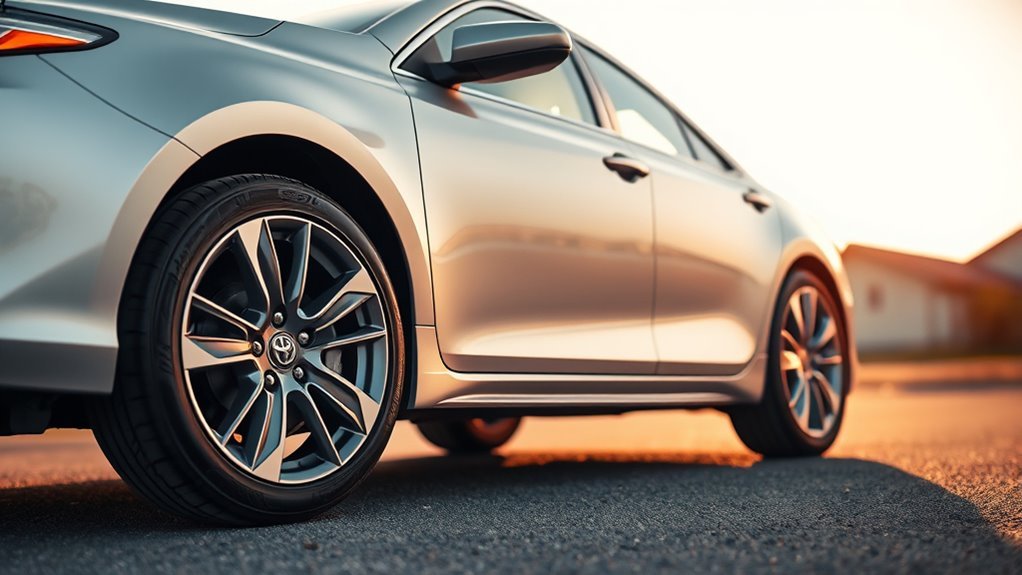
On a Toyota Camry, 18-inch tires usually give you a smoother, quieter ride, better pothole compliance, and lower tire costs. They also tend to improve initial acceleration because they’re lighter and have less rotational mass. Nineteen-inch tires sharpen steering response, cornering grip, and the sporty feel, but they can ride firmer, cost more, and slightly reduce MPG. If you want the best fit for your priorities, the details below help narrow it down.
18-Inch vs 19-Inch Wheels for a Camry
When you compare 18-inch and 19-inch wheels on a Toyota Camry, the main tradeoffs are comfort, cost, and performance. You’ll usually find 18-inch wheels give you a more balanced package: they cost less to buy and replace, and tire choices are broader. That freedom matters when you want practical control over long-term ownership. By contrast, 19-inch wheels can boost aesthetic appeal and sharpen the Camry’s stance, but they often carry higher tire prices and fewer options. They’re also typically heavier, which can hurt MPG. In handling terms, 19-inch setups may reduce sidewall flex and feel more precise, yet the performance trade offs are modest in everyday driving. If you want style without sacrificing too much practicality, 18-inch wheels often make the stronger case for you.
How 18S and 19S Change Ride Comfort
When you move from 18-inch to 19-inch tires on your Camry, you’ll usually feel a firmer ride because the shorter sidewall absorbs less of each bump. The 18-inch setup typically offers more cushion and better compliance over rough pavement, while the 19-inch setup can feel more direct but also harsher. This sidewall difference is the main factor behind the tradeoff in ride comfort between the two sizes.
Ride Comfort Differences
With 19-inch tires, you’ll usually feel a firmer ride because the shorter sidewalls flex less and pass more road texture into the cabin. You may notice sharper response and steadier cornering, but your ride quality drops on patched pavement, expansion joints, and rough streets. By contrast, 18-inch tires give you a more forgiving setup, since the taller sidewalls absorb bumps and soften impacts more effectively. That makes daily commuting and long drives feel easier, with fewer comfort trade offs. If you value a calmer cabin and less fatigue, 18s usually fit better. If you want a sportier feel and don’t mind extra harshness, 19s deliver that character. The difference is real, and you’ll feel it most when the road isn’t smooth.
Sidewall Impact on Ride
The difference in ride comfort between 18-inch and 19-inch tires comes down largely to sidewall height. You get more sidewall flexibility with 18-inch tires, so they absorb bumps, potholes, and pavement seams better. That extra cushioning improves ride quality and usually reduces road noise, giving you a calmer cabin on rough streets. By contrast, 19-inch tires use shorter sidewalls, so they transmit more impact energy and can feel firmer over uneven surfaces. You may notice sharper steering response with 19-inch setups, but in everyday driving the handling gain is often modest. If you want a more liberated, less constrained drive over imperfect roads, 18-inch tires give you a more forgiving, technically balanced compromise than 19-inch options.
What 19-Inch Wheels Add to Handling
19-inch wheels sharpen the Camry’s handling by pairing firmer steering feedback with reduced sidewall flex, so you’ll notice a more direct response during cornering and quick lane changes. That extra rigidity improves steering precision, letting you place the car with less delay and more confidence. Compared with 18-inch setups, the larger tire footprint can boost dry-road grip, which supports stronger cornering performance when you’re pushing harder. You’ll also feel quicker turn-in because the shorter sidewalls deform less under load, so the chassis reacts more immediately to steering inputs. For drivers who want a more connected, liberated feel, this setup makes the Camry seem less isolated from the road. The tradeoff is that wider tires can increase torque steer during hard acceleration in front-wheel-drive use, so you may notice the wheel tugging slightly when power comes on abruptly.
Do 19-Inch Wheels Hurt MPG?
Yes, 19-inch wheels can hurt MPG because you’re increasing rotating mass, which takes more energy to accelerate and keep moving. On the highway, you may see fuel economy drop from about 30–32 MPG with 18-inch wheels to roughly 28–30 MPG with 19-inch wheels, depending on tire design and driving conditions. Wider tires can also raise rolling resistance, so the efficiency loss isn’t just from weight alone.
Rotating Mass Impact
Because 19-inch wheels usually weigh more than 18-inch wheels, they add rotating mass that can slightly hurt MPG by requiring more energy to spin up during acceleration. You’ll feel that difference most when you launch, merge, or stop-and-go drive, because your Camry must work harder to move extra weight at the rim. In comparative terms, 18-inch setups often support better fuel efficiency, while 19-inch rims can trim miles per gallon a bit, depending on tire design and compound. The effect isn’t huge, but it’s real and measurable. Tire pressure, load, and alignment also matter, so you shouldn’t blame wheel size alone. Over time, extra mass can raise tire wear and stress braking hardware, nudging maintenance costs higher too.
Highway MPG Difference
On the highway, 19-inch wheels can still hurt MPG, though the gap is usually smaller than in stop-and-go driving. You can expect fuel efficiency to slip from roughly 33-36 MPG with 16- or 17-inch setups to about 28-30 MPG when you move to 19-inch wheels at similar speeds. The added 4-5 pounds per rim increases rotating load and rolling resistance, so your engine must work a bit harder to maintain highway performance. You may also notice firmer ride quality and more vibration, which can make the car feel less smooth even when cruising steadily. Because 18- and 19-inch diameters can alter speedometer accuracy, your fuel-use readings may look slightly off. If you want the most efficient daily driving, 17-inch wheels usually win.
Tire Width And Resistance
Beyond wheel weight alone, tire width plays a big role in whether 19-inch Camry wheels hurt MPG. When you move to wider 19-inch tires, you usually increase the contact patch, so you get more grip and sharper tire performance. But that same larger footprint raises rolling resistance, and that extra drag can lower fuel economy. In practical terms, you may see highway MPG fall from about 30-32 with 18-inch tires to roughly 28-30 with 19-inch setups. The wider, heavier tires also add about 4-5 lb per corner, which makes acceleration less efficient. You’ll notice traction differences, but they don’t come free. If you value efficiency, the 18-inch package keeps resistance lower; if you value handling, 19s trade some MPG for control and presence.
Camry Tire Costs and Availability
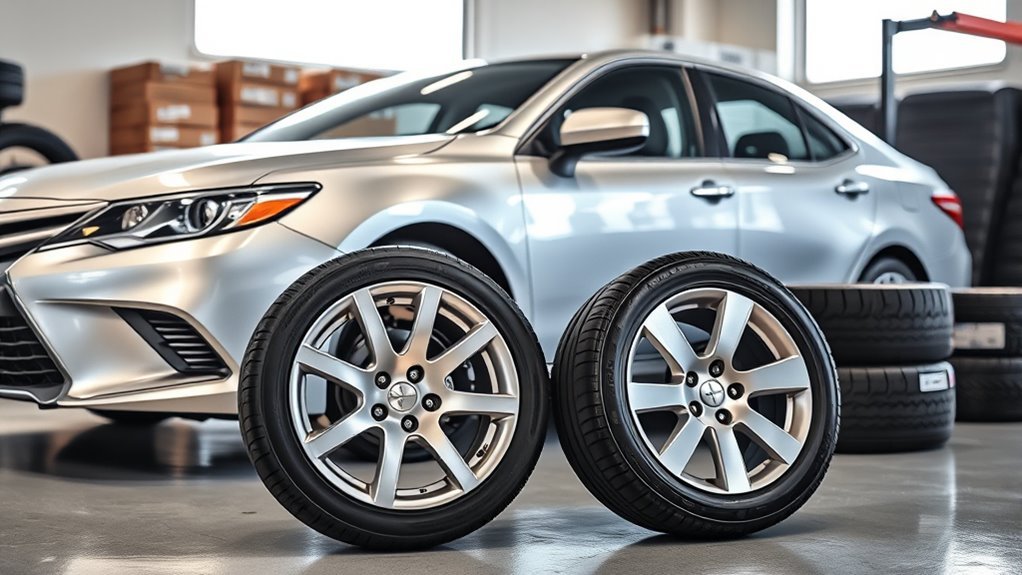
When you compare Camry tire costs, 18-inch tires are usually the more economical choice, with prices around $300 each versus more than $350 for many 19-inch tires. That gap widens when you buy a full set: you’re often near $1,200 for 18-inch rubber and above $1,400 for 19-inch fitments. You also get more freedom with 18-inch options, because manufacturers stock them in more all-season and winter designs. That broader market can improve seasonal suitability and give you better control over tire longevity through choices matched to your driving conditions.
How Wheel Weight Affects Acceleration
Wheel weight also plays a major role in how a Camry feels off the line. When you choose 19-inch wheels, you usually add rotational mass, so the engine has to work harder to overcome wheel inertia. That extra effort can blunt initial acceleration, especially in stop-and-go driving where every launch demands more energy. With 18-inch wheels, you typically reduce mass by about 4 to 5 pounds per corner, and that difference can add up across all four wheels. You may not notice a huge change in steady cruising, but you can feel a clearer performance impact when merging, passing, or pulling away from a light. Lighter wheels also let the brakes slow the car more easily, since there’s less rotating weight to control. If you want a Camry that responds with less resistance, the 18-inch setup generally delivers a sharper, more efficient launch and a freer-feeling drive.
Which Size Handles Potholes Better?
On rough roads, 17-inch wheels usually handle potholes better than 18-inch wheels because the taller sidewall gives you more cushion between the rim and the pavement. You get better shock absorption, so impacts don’t reach the cabin as sharply, and ride stability stays more predictable. In practical pothole performance, that extra sidewall works like a buffer, reducing the chance that a deep hit will bend a rim or pinch a tire. By contrast, 18-inch wheels use shorter sidewalls, so they transmit more road force and can feel harsher over broken pavement. You may notice sharper impacts, less compliance, and a greater risk of wheel damage if you drive through damaged streets often. 18-inch setups can improve handling on smooth roads, but potholes expose their tradeoff. If you want the more forgiving daily-driving choice, 17-inch wheels usually serve you better.
Best Tire Options for 18S and 19S
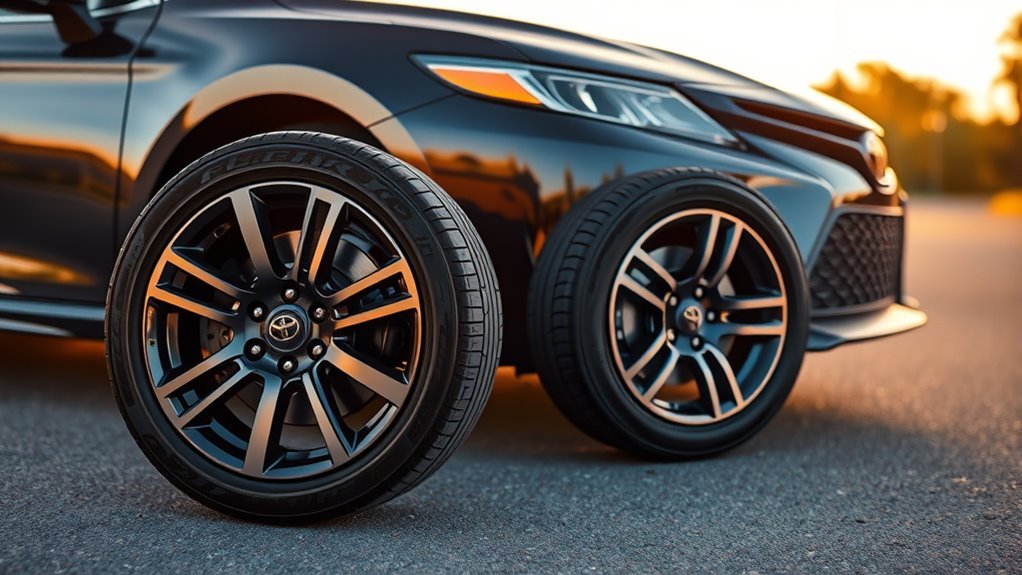
If you’re deciding between 18-inch and 19-inch tire setups for a Toyota Camry, the tire choices themselves matter as much as the wheel size. For 18s, you get broader availability, stronger value, and more winter tire options. Michelin Defender suits all-season use, while Michelin Ice xi3 gives you dependable cold-weather traction. For 19s, low-profile choices like Continental ExtremeContact can sharpen grip and steering response, but stiffer sidewalls reduce compliance.
| 18S | 19S |
|---|---|
| Michelin Defender | Continental ExtremeContact |
| Michelin Ice xi3 | Limited winter tire options |
| $200–$300+ | Often $300+ |
| Wider selection | Narrower selection |
| Comfort-balanced | Sport-focused |
These tire performance comparisons show the tradeoff clearly: 18-inch setups support freer, more flexible ownership, while 19-inch tires prioritize sharper dynamics and appearance. If you want lower cost and easier replacement, 18s usually win. If you value grip and accept firmer ride quality, 19s fit that goal better.
Which Wheel Size Fits Your Driving Style?
Your driving style usually points you toward one size or the other: 18-inch wheels favor comfort, value, and everyday usability, while 19-inch wheels lean toward sharper response and a more aggressive look. If you prioritize driving preferences that reward a relaxed commute, the 18-inch setup gives you better ride quality, stronger pothole tolerance, and lower maintenance considerations. Its taller sidewalls absorb impacts more effectively, so you keep control without sacrificing comfort.
Choose 19-inch wheels if you want a firmer performance balance, quicker steering feel, and stronger visual appeal. They can sharpen handling characteristics, but the gain may feel modest unless you drive aggressively. You should also weigh cost efficiency and fuel impact: 19-inch tires usually cost more and can trim MPG, while 18-inch options stay cheaper and more efficient. For most Camry drivers, 18-inch wheels deliver the best all-around freedom, while 19-inch wheels suit you when style and response matter more.
Frequently Asked Questions
Are 18 Inch Wheels Worth It?
You’ll likely find 18-inch wheels worth it only if you want sharper tire performance and styling. The cost comparison shows higher tire prices, firmer ride, and slightly worse mpg, so practicality usually favors 17-inch wheels.
What Are the Best Tires to Buy for a Toyota Camry?
You’ll do best with Michelin Defender or Bridgestone Turanza among tire brands; choose 17-inch all-season tires for balance, or Michelin Ice xi3 for winter. Compare performance ratings, tread life, and price before buying.
What Size Wheels Give the Smoothest Ride?
17-inch wheels usually give you the smoothest ride; their taller sidewalls absorb bumps better. You’ll get more tire comfort and less road noise, plus solid wheel durability, compared with 18-inch or 19-inch setups.
Conclusion
So, if you choose 18-inch wheels, you get a softer, more forgiving ride, like a well-cushioned chair on rough streets. Go with 19-inch wheels, and your Camry feels sharper and more planted, like a knife slicing cleanly through corners. You’ll usually trade a little comfort, mpg, and pothole protection for better response and a sportier stance. In the end, the best size isn’t the flashiest one—it’s the one that matches how you actually drive.

Related Articles
FWD vs. RWD Tire Wear on Toyota Camry: Why the Pattern Differs
Higher front-tire wear on a Camry or shifted rear stress in RWD can surprise you—discover why the pattern changes.
Read More
Toyota Camry 18-Inch Tire Size: Factory Specs and Compatible Options
Buckle up to discover the ideal tire size for your Toyota Camry's 18-inch wheels and uncover compatible options that enhance performance.
Read More
OE Tires vs. Replacement Tires for Toyota Camry: Do You Have to Match OEM?
Owning a Toyota Camry means weighing OE tires against replacements, but do you really need to match OEM exactly?
Read More