
Why Your Toyota Tacoma Needs Alignment After Bigger Tires
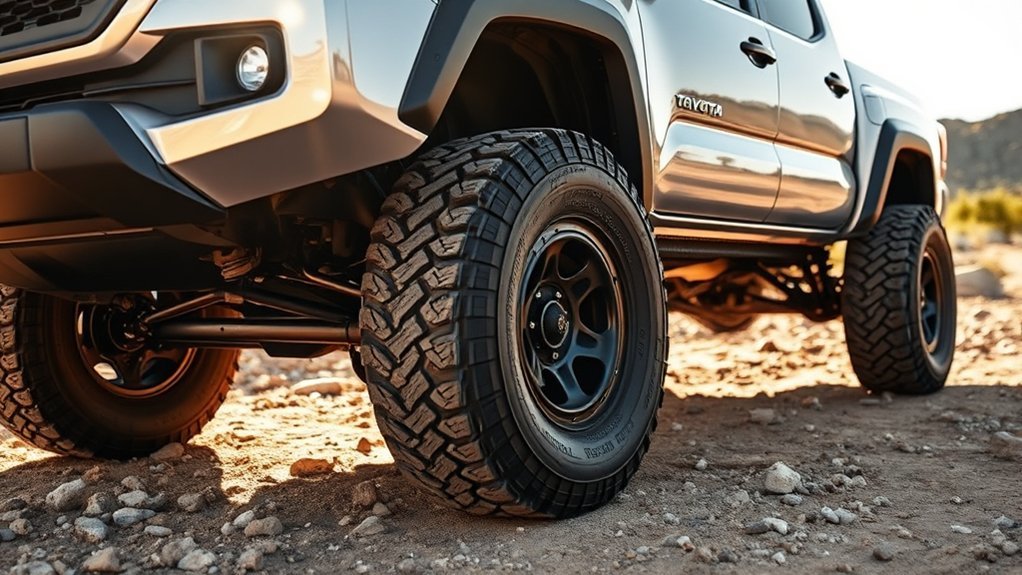
Bigger tires can change how your Toyota Tacoma steers, accelerates, brakes, and tracks on the road. However, tire diameter alone does not automatically knock the alignment out of specification. Problems are more likely when upsizing also involves a lift, leveling kit, different wheel offset, poor clearance, worn suspension parts, or an incorrect tire-and-wheel combination.
Quick Answer
Bigger tires do not automatically knock a Toyota Tacoma out of alignment, but the complete setup can. A lift, leveling kit, different wheel offset, worn suspension parts, or poor fitment may affect steering geometry and tire wear. Check alignment after modifications and whenever the truck pulls, the steering wheel sits off-center, or tread wears unevenly.
Key Takeaways
- Tire diameter alone may not change camber, caster, or toe, but a lift, leveling kit, wheel-offset change, or worn component can.
- Book an alignment after geometry-changing suspension work, a hard pothole or curb impact, or when you notice pulling, uneven wear, or an off-center steering wheel.
- A speed-related vibration usually requires a wheel-balance, runout, or tire-damage check before an alignment adjustment.
- Verify tire size, load capacity, wheel width, offset, inflation requirements, clearance, and electronic-system compatibility before upsizing.
- There is no universal 6,000-mile or 15,000-mile alignment schedule for every Tacoma.
Last updated: July 17, 2026. Fitment and maintenance recommendations vary by Tacoma year, trim, drivetrain, suspension, and wheel package.
How Larger Tires Affect Suspension Geometry
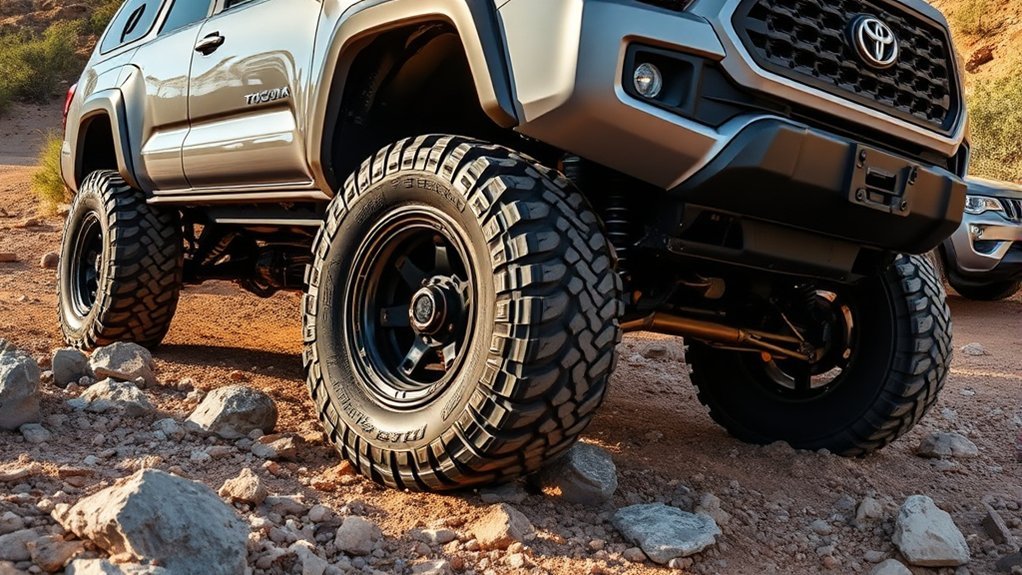
Wheel alignment describes the position of the wheels relative to the truck and the road. The three main measurements are camber, caster, and toe. Camber describes inward or outward wheel tilt, caster affects steering stability and return-to-center behavior, and toe describes whether the tires point slightly inward or outward.
Installing a taller tire without changing the suspension does not always move those measurements outside Toyota’s specifications. The tire does, however, change the rolling radius, contact patch, rotating mass, and available clearance. A taller tire also raises the truck by approximately half of the increase in overall tire diameter, which can slightly raise the center of gravity.
The alignment risk increases when bigger tires require a lift or leveling kit. Raising or lowering a vehicle changes suspension-arm positions and can alter camber, caster, and toe. Continental identifies lifting and lowering as vehicle modifications that change suspension geometry and require professional realignment.
Wheel choice matters as well. A wider wheel or different offset can move the tire inward or outward. That may affect steering effort, scrub radius, fender clearance, suspension clearance, and wheel-bearing load even when the alignment machine still shows acceptable camber, caster, and toe.
Note: Tire pressure can also change steering feel and wear patterns. Use the pressure specified for your configuration by the vehicle or tire professional, and check it cold. Seasonal temperature changes can lower pressure, as explained in this guide to cold-weather tire-pressure loss.
[Products Worth Considering]

This VEVOR tire bead breaker uses a slide-hammer impact and wedge tip to separate tire beads from rims quickly and efficiently without damaging hub surfaces. The long handle and sturdy steel construction help reduce user strain while providing reliable, portable tire changing for cars, trucks, and more. Ideal for home mechanics and repair shops handling multiple vehicle tire sizes.

Universal magnetic jack pad with aluminum grooved design to protect vehicle pinch welds during lifting. Durable nylon pad inserts are upgraded and secured with screws to resist damage and keep in place. Designed to fit most single vehicle pinpoint welds for safer, stable jacking when changing tires, repairs, or performing oil changes.

Camco Trailer Aid Plus tandem tire ramp lifts your trailer for quick, safe tire changes with ample clearance from its 5 1/2-inch lift. It helps you change a flat tire without unloading cargo, making roadside and routine maintenance more efficient. The heavy-duty, waterproof and rustproof polymer design supports up to 15,000 lb and is built for easy portability and storage.
What to Check Before Installing Bigger Tires
Do not choose a tire from diameter alone. Confirm the complete tire-and-wheel package before installation. The National Highway Traffic Safety Administration recommends using the original tire size or another size recommended by the vehicle manufacturer.
- Year and trim: Tacoma factory tire sizes and suspension setups vary across generations and trims.
- Door-jamb placard and owner’s manual: Confirm the original size, load information, and recommended cold pressure. Toyota provides year-specific information through its Tacoma manuals and warranty portal.
- Load capacity: The replacement tire must support the truck’s axle loads, occupants, cargo, and towing use. Never install a tire with inadequate load capacity.
- Wheel width and diameter: The wheel must be approved for the selected tire size.
- Offset and backspacing: These dimensions determine how close the tire sits to the suspension, frame, fender, and body mount.
- Full-lock clearance: Check both steering directions while the suspension is loaded, not only while the truck is parked on level ground.
- Compression clearance: The tire must not contact the body, liner, wiring, brake hose, or suspension during bumps and articulation.
- Speedometer and gearing: A meaningful diameter increase can change indicated speed, effective gearing, acceleration, and transmission behavior.
- Electronic systems: Large circumference changes may affect ABS, stability control, traction control, driver-assistance functions, and wheel-speed calculations.
- Spare tire: Confirm that the spare is suitable for the drivetrain and intended emergency use.
- TPMS: Confirm sensor compatibility and complete any required relearn procedure.
Michelin recommends staying with the vehicle manufacturer’s specified size or an approved alternative. Its tire-size guidance also warns against selecting a smaller tire or one with less load-carrying capacity than the original equipment tire.
Warning: Do not drive with a tire that rubs the brake hose, suspension, body, frame, or wiring. Rubbing that appears only during full steering lock, braking, off-road articulation, or heavy compression can still damage the tire or vehicle and create a loss-of-control risk.
Signs Your Tacoma Needs Alignment After Tire Changes
After installing new tires or wheels, inspect how your Tacoma tracks and how the tread begins to wear. Pulling, an off-center steering wheel, and abnormal edge wear justify an alignment measurement. However, pressure differences, wheel imbalance, tire construction, road crown, brake drag, and worn steering parts can create similar symptoms.
Uneven Tire Wear Patterns
Wear concentrated on one inner or outer edge can indicate incorrect camber or toe. Feathered tread blocks may also point to toe trouble. Compare all four tires and inspect several points around each tread rather than judging one small area.
Not every wear pattern comes from alignment. Wear in the center can indicate excess inflation, while wear on both shoulders can indicate inadequate inflation or overloading. Cupping or scalloping may involve wheel imbalance, worn shocks, damaged tires, loose components, or alignment. This guide to inside-edge tire wear explains additional patterns to inspect.
Vehicle Pulling to One Side
A Tacoma that consistently drifts or pulls on a flat, level road may have an alignment, tire, brake, or suspension problem. First confirm equal cold pressure from side to side. Then note whether the truck pulls continuously, only during braking, or only on certain roads.
| Symptom | Possible Causes | Recommended Check |
|---|---|---|
| Pulls while cruising | Alignment, unequal pressure, tire conicity, road crown, or worn steering parts | Check pressure, inspect tires, and measure alignment on level equipment |
| Pulls while braking | Brake drag, caliper trouble, tire traction difference, or suspension movement | Inspect the braking and suspension systems before adjusting alignment |
| Uneven edge wear | Camber, toe, pressure, overloading, or worn components | Inspect tread, steering parts, suspension joints, and alignment measurements |
| Vibration at a certain speed | Wheel imbalance, tire runout, bent wheel, trapped debris, or tire damage | Balance and inspect the wheel-and-tire assembly first |
Vibration: Alignment or Wheel Balance?
A vibration that becomes stronger at a certain road speed usually points toward imbalance, tire runout, a bent wheel, improper mounting, or tire damage. Alignment problems can contribute to abnormal wear, and that wear may eventually create vibration, but alignment is not normally the first adjustment for a freshly installed wheel-and-tire vibration.
New tires should be balanced when installed. If vibration remains, ask for the wheel mounting, balance, radial runout, lateral runout, and tire condition to be checked before replacing suspension parts or changing alignment settings.
Off-Center Steering Wheel
If the steering wheel is not centered while the Tacoma travels straight on a level road, the toe relationship or steering-wheel centering may be incorrect. This can happen after suspension work, tie-rod adjustment, a hard impact, or an incomplete alignment procedure.
Do not accept a result based only on the truck appearing to drive straight. Ask the technician to center and lock the steering wheel correctly, measure all available angles, and provide the final alignment report.
Ensure Proper Alignment After Installing Bigger Tires
An alignment measurement after upsizing is especially valuable when the installation includes a lift, leveling kit, control arms, tie rods, steering work, or wheels with a different offset. It provides a baseline and confirms whether the truck remains within the correct specification for its configuration.
Importance of Alignment Check
A professional alignment check should include more than a quick toe adjustment. The technician should inspect the tires, steering linkage, ball joints, control-arm bushings, wheel bearings, ride height, and other relevant components before adjusting the truck.
- Measure first: Record the initial camber, caster, toe, steering-wheel position, and thrust direction.
- Inspect for looseness or damage: An alignment cannot remain accurate when a joint, bushing, bearing, tie rod, or mounting point is worn or loose.
- Use the correct specification: The shop should select the correct Tacoma year, trim, drivetrain, and suspension configuration.
- Adjust what is actually adjustable: Some angles may require approved hardware or correction parts after a lift.
- Road-test the result: Confirm straight tracking, steering-wheel centering, return-to-center behavior, and the absence of rubbing.
Signs of Misalignment
Recheck the Tacoma if it pulls on a level road, the steering wheel remains crooked, the tread begins feathering, or one shoulder wears faster than the other. Also return to the shop if the truck behaves differently after suspension settling or after a hard curb, pothole, or off-road impact.
If the measurements are within specification but the truck still pulls, the technician should investigate tire conicity, mismatched pressures, brake drag, frame or suspension damage, and road-crown sensitivity rather than repeatedly changing alignment angles.
Benefits of Proper Alignment
Correct alignment supports even tread wear, predictable steering, straight-line stability, and consistent handling. It may also reduce unnecessary tire scrub. However, alignment cannot correct an unsuitable tire size, poor wheel offset, inadequate load capacity, rubbing, or an out-of-balance wheel.
Consistent tire size and tread condition also matter, particularly on four-wheel-drive models. Review this explanation of why matching tire size and tread depth can support stable operation.
Alignment After a Lift, Leveling Kit, or Offset Change
A lift or leveling kit changes ride height and suspension position, making an alignment necessary after installation. Depending on lift height and component design, the technician may need to correct caster, camber, toe, or steering-wheel position. Some setups require control arms, correction hardware, or other parts to reach an acceptable range.
Changes to ride height can also affect camera or radar positioning on trucks equipped with driver-assistance systems. Toyota’s own Tacoma TRD lift-kit information emphasizes that the kit was specifically engineered and validated for compatibility with Toyota Safety Sense on eligible models. That does not mean every aftermarket lift has received the same validation.
Different wheel offset does not necessarily change the alignment readings, but it can change steering feel, scrub radius, leverage on steering and bearing components, and tire clearance. Tell the alignment technician the new wheel width and offset rather than reporting only the tire diameter.
The Benefits of Regular Alignment Checks for Your Tacoma
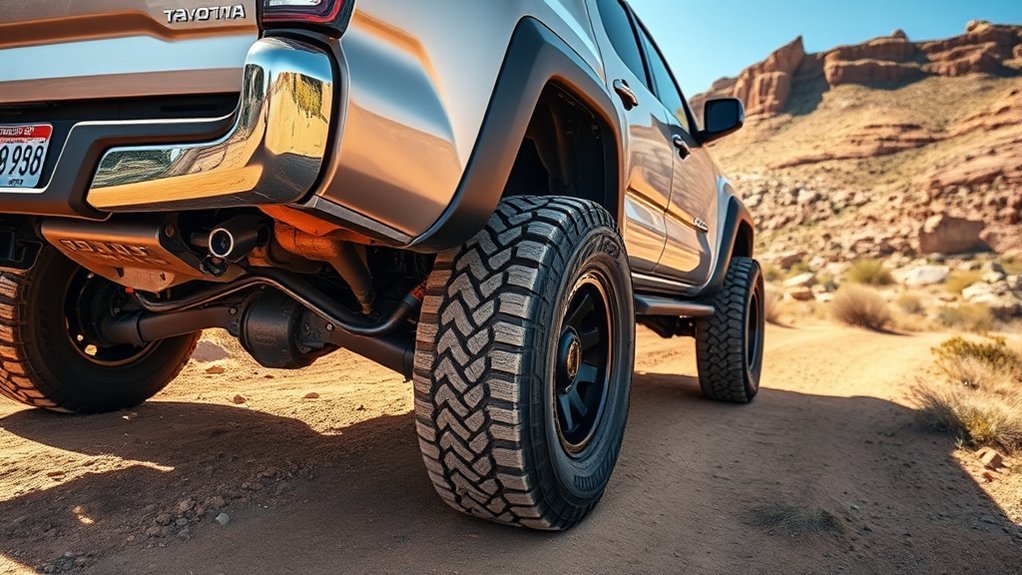
Your Tacoma does not need an alignment adjustment simply because a fixed mileage number has arrived. A more useful approach is to inspect alignment after suspension or steering work, after a lift or leveling installation, after a significant impact, when fitting a substantially different wheel-and-tire package, or when symptoms appear.
Tire rotations and routine inspections create useful opportunities to compare tread wear and catch a developing problem. Follow the schedule in the owner’s manual for your exact truck and tire configuration. This guide to tire-rotation frequency explains why rotation and alignment are related maintenance tasks but not the same service.
Regular pressure checks are equally important. A Tacoma with correct alignment can still wear tires poorly when pressure is wrong, the truck is overloaded, or the tires do not match the intended load and use. Alignment, inflation, rotation, and balancing work together to support longer tire life.
Pro Tip: Ask for a printed or digital before-and-after alignment report. Keep it with the tire, wheel, suspension, and installation records. The report provides a baseline if the truck later develops pulling, uneven wear, or a warranty dispute.
[Products Worth Considering]

Make hard-to-reach areas easier to access with the MAXXHAUL truck tire service step featuring an adjustable width and height. The foldable design stores compactly, while the serrated non-slip platform provides secure footing for tire-related maintenance. It fits most stock tire sizes up to 31-inch diameter with a 300-lb capacity.

EVOULTES heavy duty tire inflator with an integrated gauge delivers accurate pressure readings from 10–120 PSI, helping you inflate, deflate, and check tires in one tool. The 16.5-inch extended dual-head air chuck with swivel base reaches hard-to-access dual wheel valves on trucks and RVs. A brass trigger core and side-mounted air release valve make operation smooth, with standard 1/4" NPT threading and quick-connect compatibility for easy setup.
Tire Size Change Warranty Implications
Installing aftermarket tires or wheels does not automatically cancel the entire vehicle warranty in the United States. According to the Federal Trade Commission, a manufacturer or dealer may deny coverage for damage caused by a defective aftermarket part or incorrect installation, but unrelated warranty coverage remains in effect.
- Read the written warranty: Coverage, exclusions, and claim procedures can vary by model year and component.
- Use suitable parts: Select tires and wheels with appropriate size, load capacity, fitment, and clearance.
- Document the work: Keep invoices, tire specifications, wheel specifications, alignment reports, and installation records.
- Record existing conditions: Photographs and before-installation alignment measurements can help show whether a problem existed earlier.
- Ask for a written explanation: If coverage is denied, request the specific reason and the connection between the modification and the failed component.
Seasonal tires require the same fitment care. A dedicated winter setup should use an approved wheel-and-tire combination with suitable load capacity and consistent circumference. See this comparison of all-season and winter tires for more background.
How to Talk to Alignment Technicians
Give the technician complete information about the modification instead of saying only that the truck has bigger tires. Bring the tire size, wheel width, wheel offset, lift or leveling-kit details, and any recent steering or suspension work.
Describe the symptom precisely:
- Does the Tacoma pull while cruising, braking, or accelerating?
- Is the steering wheel off-center on a flat road?
- At what speed does a vibration begin?
- Which tire shows abnormal wear, and on which edge?
- Did the issue begin immediately after installation or later?
- Does rubbing occur at full lock, over bumps, while reversing, or with cargo?
Ask the shop to complete the following:
- Confirm cold tire pressures and tire condition.
- Inspect steering and suspension components for looseness or damage.
- Verify wheel-and-tire balance if vibration is present.
- Measure alignment using the correct Tacoma specification.
- Explain any measurement that cannot be adjusted into range.
- Check clearance at full steering lock and through available suspension movement.
- Center the steering wheel and road-test the truck.
- Provide the before-and-after measurement report.
Frequently Asked Questions
How Often Should a Tacoma Get an Alignment?
There is no universal alignment interval for every Tacoma. Check it after suspension or steering work, a lift or leveling installation, a significant pothole or curb impact, or when you notice pulling, uneven tread wear, or an off-center steering wheel. Follow any inspection guidance in the owner’s manual for your exact model.
What Will Happen if I Put Bigger Tires on My Truck?
Bigger tires may increase ground clearance, but they can also change acceleration, effective gearing, braking feel, fuel use, steering effort, speedometer accuracy, and clearance. Significant size changes may affect ABS, stability control, and driver-assistance systems. The result depends on tire weight, diameter, width, wheel offset, pressure, and the truck’s suspension.
How Big of a Tire Can You Put on a Toyota Tacoma?
No single maximum size applies to every Tacoma. Safe fitment depends on generation, year, trim, drivetrain, factory wheel package, wheel width, offset, suspension height, alignment range, body clearance, and intended use. Check the door placard and Toyota manual first, then have a qualified tire professional verify the complete setup.
Do Bigger Tires Always Require an Alignment?
Not always. An approved tire change on the same wheels and unchanged suspension may leave the alignment measurements within specification. An alignment check is still sensible after a major change. An adjustment is especially important when the installation includes a lift, leveling kit, steering work, suspension parts, or symptoms of misalignment.
Can Bad Alignment Cause Steering-Wheel Vibration?
Alignment-related wear can eventually contribute to vibration, but a vibration that appears at a particular speed more often points to wheel imbalance, tire runout, a bent wheel, improper mounting, or tire damage. Have the wheel-and-tire assembly inspected and balanced before assuming alignment is the only cause.
Will Bigger Tires Void a Tacoma Warranty?
Aftermarket tires do not automatically void the entire warranty in the United States. However, coverage may be denied for damage caused by an unsuitable tire, wheel, modification, or incorrect installation. Keep fitment specifications, receipts, installation records, and alignment reports.
Conclusion
Bigger tires do not automatically ruin a Tacoma’s alignment, but the surrounding changes can. A lift, leveling kit, different wheel offset, incorrect fitment, worn components, or inadequate clearance may affect steering, tire wear, and safety.
Confirm the complete tire-and-wheel package before installation. Afterward, check pressure, clearance, balance, steering-wheel position, and tread wear. Book a professional alignment measurement when the suspension geometry changes or when the truck pulls, tracks poorly, or develops uneven wear.
Sources
- National Highway Traffic Safety Administration: Tire Safety — replacement tire sizing, alignment, inflation, rotation, and tire-safety guidance.
- Toyota Tacoma Manuals and Warranties — year-specific tire, wheel, pressure, maintenance, and warranty information.
- Michelin: Changing Tire Size or Specifications — manufacturer-recommended sizing and load-capacity guidance.
- Continental: Wheel Alignment — alignment symptoms and the effects of lifting or lowering a vehicle.
- Federal Trade Commission: Auto Warranties — aftermarket parts, maintenance records, and warranty-coverage principles.
- Toyota: Tacoma TRD Lift Kit — suspension-lift and Toyota Safety Sense compatibility considerations.

Related Articles
How Tire Weight Affects Toyota Tacoma Performance
How does tire weight influence your Toyota Tacoma's performance and efficiency? Discover the surprising effects that could change your driving experience.
Read More
Tire Noise Levels by Tire Type on a Toyota Tacoma
A comprehensive look at how tire types affect noise levels in your Toyota Tacoma reveals surprising insights that could enhance your driving experience.
Read More
How To Choose Tires for a Dual Use Toyota Tacoma
Unlock the secrets to selecting the perfect tires for your dual-use Toyota Tacoma, ensuring optimal performance and comfort on every adventure. Discover more inside!
Read More