
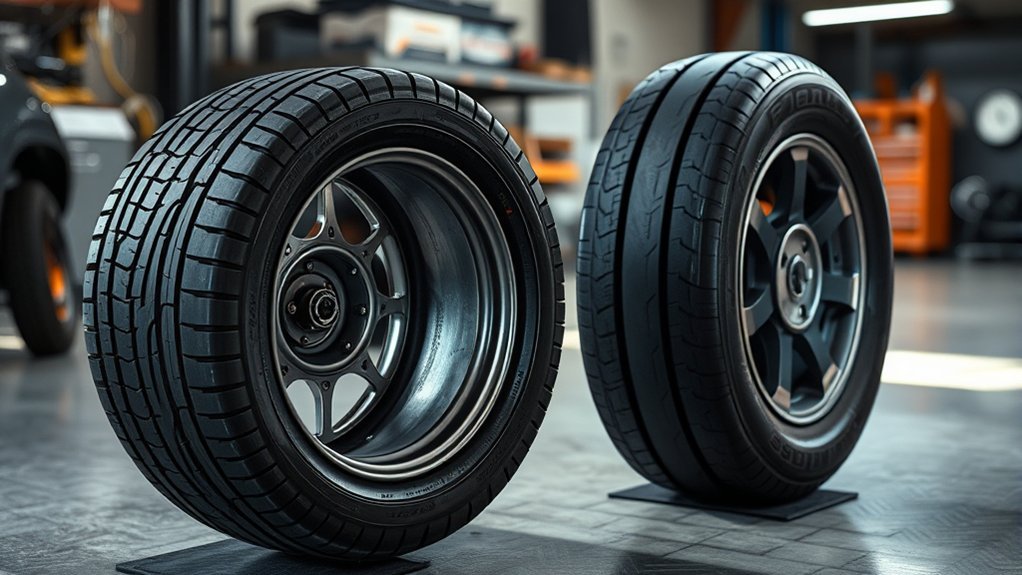
Car tires aren’t solid rubber because passenger vehicles need more than puncture resistance. A modern pneumatic tire has to carry the vehicle, absorb road impacts, maintain predictable contact with the pavement, manage heat, and work efficiently at sustained road speeds. Pressurized air and a flexible reinforced casing let engineers balance those demands without turning each wheel into a heavy, harsh block of rubber.
Quick Answer
Passenger cars use air-filled tires because pressurized construction carries load while allowing controlled flex. That flex cushions impacts, helps the tread follow uneven pavement, limits tire mass, and supports efficient highway operation. Solid tires resist punctures, but conventional solid rubber produces a harsher ride, more heat, and stricter speed and duty-cycle limits.
Key Takeaways
- Pneumatic tires combine pressurized air with a reinforced flexible casing, giving passenger cars load support and useful compliance without the mass of a conventional solid-rubber tire.
- Tire compliance helps absorb bumps and maintain more consistent contact with irregular pavement, improving ride quality and predictable handling.
- Conventional solid tires resist punctures but can generate substantial heat under continuous operation, which is why they are commonly used on slower industrial equipment.
- Rolling resistance depends on the complete tire design, not simply whether a tire contains air. Correct inflation is especially important for pneumatic passenger tires.
- Modern airless tires are not simply solid blocks of rubber; they use engineered flexible structures to reproduce some of the compliance normally supplied by a pneumatic tire.
Why Passenger Car Tires Stay Air-Filled
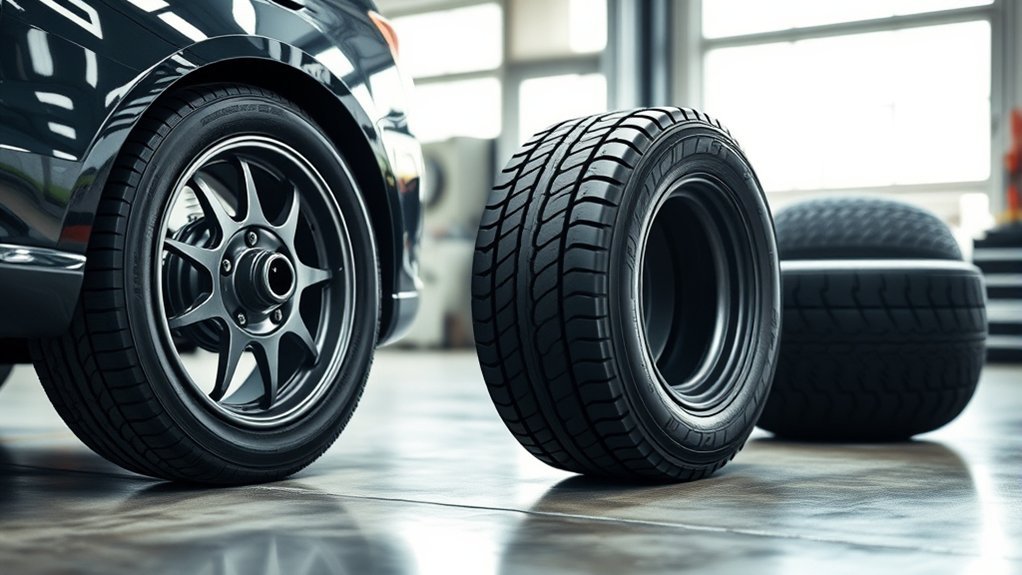
Passenger-car tires stay air-filled because a pneumatic structure can carry substantial load while remaining relatively light and flexible. The pressurized air, inner liner, sidewalls, belts, beads, and carcass work together as a system. As the tire contacts the road, its lower section deflects and forms a contact patch while the reinforced structure keeps the tire controlled.
That arrangement gives engineers something a conventional solid block of rubber struggles to provide at the same time: load capacity, useful deflection, relatively low mass, acceptable heat generation, ride comfort, and sustained road-speed capability.
A solid tire can certainly carry heavy loads. In fact, solid tires are widely used on industrial equipment. The problem is that obtaining the required load capacity, durability, and cushioning from rubber alone usually means using a substantial amount of elastomer or a specialized layered construction. That can increase mass and heat generation while reducing compliance.
For a passenger vehicle, the advantage is not simply that air “holds the car up.” The entire pneumatic structure creates a lightweight, tunable load-support system that can flex repeatedly at road speed.
Pneumatic tires do require maintenance because pressure can change with temperature or slowly decrease over time. The National Highway Traffic Safety Administration recommends checking tire pressure at least once a month when the tires are cold and using the pressure specified by the vehicle manufacturer.
Note: Use the cold inflation pressure on the driver-door Tire and Loading Information label or in the owner’s manual. The pressure molded on a tire sidewall is not the vehicle’s normal recommended inflation target.
How Air-Filled Tires Absorb Impacts
When a pneumatic tire rolls over a bump, the tread, sidewall, carcass, and pressurized cavity allow controlled deformation before the full disturbance reaches the wheel and suspension. In simple terms, the tire acts as the first compliant element between the road and the vehicle.
This matters because a sharp road input can be spread over more time and movement rather than being transferred almost instantly through a rigid wheel. The suspension still does most of the large-scale work of controlling vehicle motion, but the tire filters many smaller, faster road disturbances before they reach the suspension.
Inflation pressure is part of that tuning. Too little pressure causes excessive deflection, heat, imprecise handling, and increased risk of tire damage. Excessive pressure can make the tire harsher and alter the intended contact-patch and wear behavior. Correct pressure gives the tire the response the vehicle manufacturer designed around.
This combination helps a car deal with pavement seams, coarse surfaces, potholes, and other irregularities without requiring the suspension to absorb every small disturbance by itself.
How Solid Tires Affect Ride Comfort
A conventional solid tire has no pressurized cavity providing the same degree of tunable compliance. The rubber itself and any internal cushioning layers have to deform to absorb road inputs.
That can work well on forklifts, airport equipment, platform trucks, and other machines that value puncture resistance and predictable uptime. On a passenger car traveling much faster and farther, however, a less-compliant tire would transfer more high-frequency road disturbance into the wheel, suspension, steering system, and body.
With less tire compliance, more of each sharp road input has to be managed by the suspension, wheel, and vehicle structure.
The result can be a harsher ride and more vibration over broken pavement. A heavier conventional solid tire could also increase unsprung mass—the mass that moves with the wheel rather than being supported by the suspension. Higher unsprung mass can make it harder for the suspension to keep the wheel following rapid changes in the road surface.
Solid tires therefore trade some comfort and high-speed flexibility for excellent resistance to punctures, cuts, and impact damage. That trade makes sense in many industrial environments but is much less attractive for everyday passenger-car use.
[Products Worth Considering]

Measure tire tread depth quickly and accurately with this LUMITECO dial gauge that reads in 1/32" increments up to 14/32". The color-coded green/yellow/red zones make it easy to judge tire wear and know when replacement is needed. A rugged, compact design with a protective pouch helps keep the gauge ready for use on cars, trucks, motorcycles, and more.

Upgrade your garden cart, wagon, trolley, or hand truck with solid puncture-guarded tires that help prevent flats for worry-free pushing. Textured tread improves stability, grip, and shock absorption for smoother, safer travel over outdoor surfaces. Built with strong polyurethane and durable bearing components for long-lasting performance and confident handling.
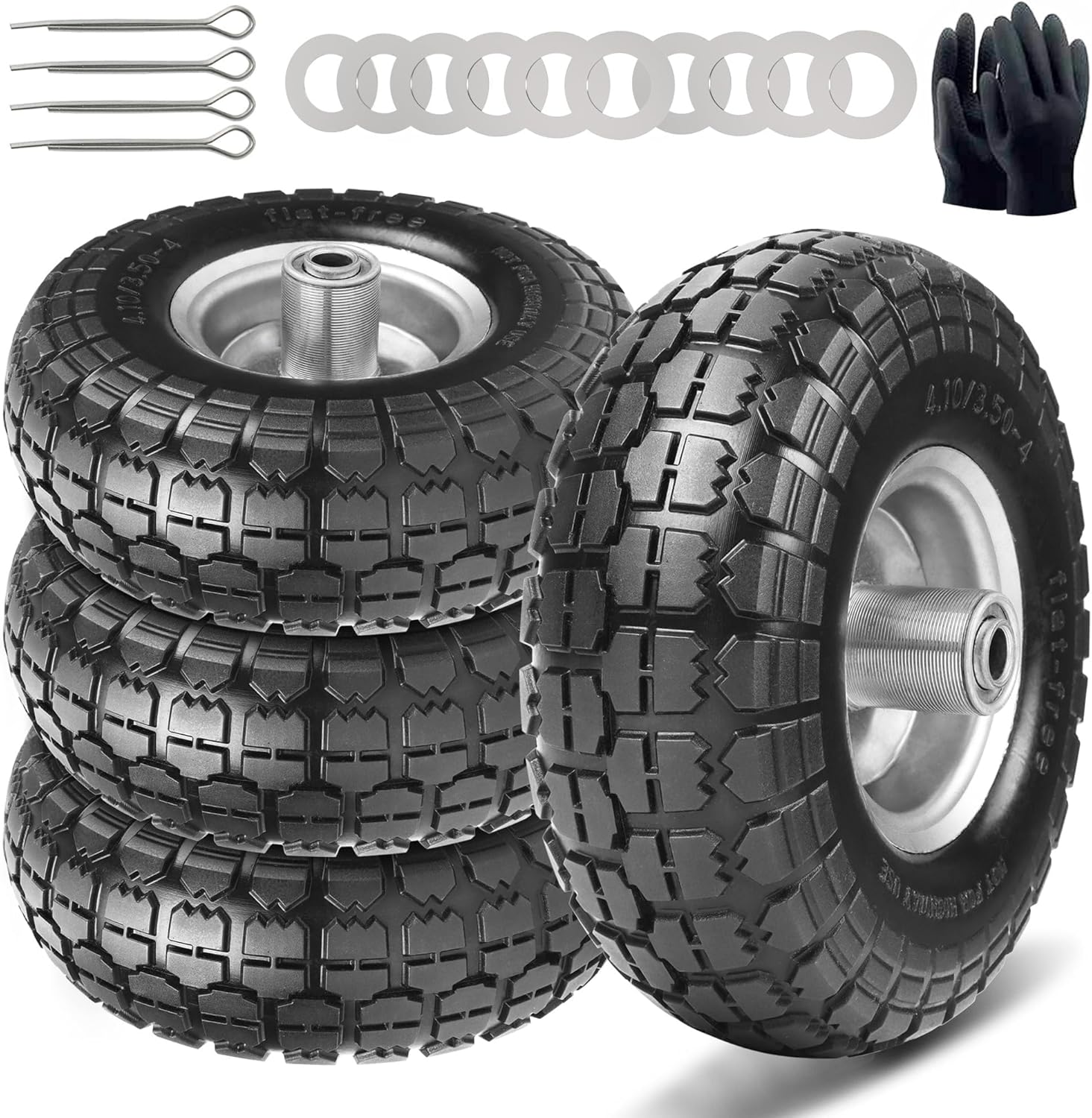
Upgrade your hand truck, garden cart, or yard wagon with flat-free solid rubber tires that eliminate blowouts and maintenance. The serrated tread delivers excellent traction and stable rolling, while double sealed bearings help keep movement smooth on many terrains. Heavy-duty steel rims and 200kg max load support durable performance for demanding outdoor use.
Why Solid Rubber Tires Run Too Hot
Heat is one of the most important limitations of conventional solid tires at sustained speed. Rubber is viscoelastic: when it is repeatedly compressed and flexed, not all of the mechanical energy is returned. Some is converted to heat through hysteresis.
A thick solid structure contains a large volume of material undergoing repeated deformation. Heat generated inside that material must then travel outward before it can dissipate. Under heavy loads, long travel distances, or excessive speed, the internal temperature can become high enough to accelerate wear or damage the tire.
This is why the explanation is more complicated than saying a pneumatic tire is cooler because air “moves around” inside it. Passenger tires are sealed. Their thermal behavior comes from the complete construction, including the amount and type of rubber being deformed, reinforcement materials, tire geometry, inflation, load, speed, and heat transfer through the tire and wheel.
Continental’s solid-tire operating guidance specifically warns that excessive travel distance and average speed can create enough heat to cause thermal damage in industrial solid tires.
A 2025 review of non-pneumatic tire technology likewise identifies heat buildup from material hysteresis as a central engineering challenge for solid designs. Modern non-pneumatic tires therefore use specialized materials, cavities, spokes, or other structures rather than simply replacing the air chamber with one thick block of rubber.
How Air-Filled Tires Improve Grip
Pneumatic construction gives engineers control over how a tire deflects as the vehicle accelerates, brakes, and corners. That controlled flexibility helps the tread remain in useful contact with an imperfect road surface.
Air pressure alone does not create grip. Tire compound, tread design, temperature, road surface, load, alignment, construction, and inflation all influence traction. The advantage of the pneumatic design is that the casing can be engineered to deform predictably while still carrying the vehicle’s load.
Contact Patch Flexibility
The contact patch changes shape as a pneumatic tire rolls and as vehicle forces change. Proper inflation allows the casing and tread to deform within their intended range, helping distribute load across the footprint.
This does not mean that a larger contact patch automatically creates proportionally more friction. Real tire grip is much more complex. What matters is that the tire maintains a stable, predictable interaction with the road while its tread compound and pattern generate the required longitudinal and lateral forces.
Incorrect inflation changes that behavior. Michelin notes that an underinflated tire can develop a softer, less precise contact patch, while excessive pressure can make the contact patch smaller and harder and can transmit more road irregularities into the vehicle.
Surface Conformity
Real pavement contains small peaks, grooves, joints, and irregularities. A compliant tire can deform around those features instead of behaving like a rigid wheel rolling across their tops.
The tread compound and individual tread blocks provide much of the small-scale conformity, while the casing and sidewall control larger deflections. Tread grooves and sipes also help manage water, although wet traction depends on the complete tire design rather than air pressure alone.
A conventional solid tire can still deform and generate strong traction in the environment for which it was designed. However, achieving passenger-car levels of compliance, handling, heat control, durability, and speed capability simultaneously is much more difficult with a thick solid-rubber structure.
How Air-Filled Tires Improve Fuel Efficiency
It is more accurate to say that modern pneumatic passenger tires can be engineered for low rolling resistance than to claim that every air-filled tire automatically rolls more efficiently than every solid tire.
Rolling resistance comes largely from energy lost as the tire repeatedly deforms. Compound chemistry, tread depth, construction, temperature, load, speed, and inflation pressure all affect that loss. Solid industrial tires can also be designed for reduced rolling resistance, so the presence or absence of air is not the only factor.
Inflation pressure is especially important on a pneumatic passenger tire. Underinflation increases deflection and energy loss. According to the U.S. Department of Energy, keeping tires properly inflated can improve gasoline-vehicle fuel economy by about 0.6% on average and by as much as 3% in some cases.
DOE guidance estimates that a 1-psi drop in average tire pressure can reduce gas mileage by about 0.2%, while proper inflation can improve mileage by up to about 3% in some cases.
The goal is not to inflate beyond the vehicle specification in pursuit of lower rolling resistance. Correct pressure gives the intended balance of efficiency, braking, handling, ride quality, tire wear, and impact resistance.
Pro Tip: Check pressure before driving or after the vehicle has been parked for at least about three hours. A warm tire normally shows a higher pressure, so adjusting a hot tire to the cold specification can leave it underinflated later.
Where Solid Tires Work Best
Solid tires are valuable where punctures, cuts, debris, heavy loads, and equipment downtime matter more than highway-speed ride quality. Continental lists applications including forklifts, airport vehicles, heavy-duty transport vehicles, platform trucks, logistics facilities, and other industrial equipment.
| Environment | Main Benefit | Typical Tradeoff |
|---|---|---|
| Warehouses | No pressure-related flats | Less ride compliance |
| Scrap yards | High cut and puncture resistance | Heat must be managed |
| Airports | Stable, durable industrial service | Duty-cycle limits may apply |
| Construction sites | Resistance to sharp debris | More vibration than pneumatic alternatives |
| Recycling plants | Low flat-related downtime | Continuous high-speed operation is unsuitable for many designs |
Solid tires make sense when damage resistance and uptime dominate the decision. Passenger cars face a different operating profile: sustained road speeds, long distances, changing pavement, braking and cornering demands, noise expectations, and ride-comfort requirements. That combination strongly favors pneumatic construction.
[Products Worth Considering]

Monitor tire tread wear with a smart, color-coded depth gauge that shows clear condition ranges at a glance. The bar is range marked for fast, easy readings, helping you maintain safer traction and performance. Each gauge is portable with a pocket clip, and the set includes 20 units for daily use and sharing.

MaxxHaul solid rubber wheel chocks provide dependable vehicle stabilization for cars, trucks, trailers, and RVs across driveways, slopes, garages, and campsites. The molded non-slip traction surface helps prevent tire movement on pavement, gravel, and smooth floors, while the solid rubber resists cracking, crushing, deformation, and weather wear. A built-in handle enables quick, tool-free placement and removal for convenient use in all seasons.

Steelman white tire marking crayons provide high-contrast, semi-permanent marks for repairing and inspecting tires and equipment. They write on wet or dry, smooth or coarse surfaces including rubber, metal, glass, and wood, making them ideal for puncture location and damage outlining. The lead- and zinc-free crayons resist weather and fading yet wipe away when you no longer need the marks.
How Airless Tires Differ From Solid Rubber
“Airless” does not necessarily mean “solid rubber.” Modern non-pneumatic tires try to eliminate inflation pressure while retaining the controlled deflection that makes pneumatic tires effective.
Instead of a solid block, an airless design may use flexible spokes, composite structures, cavities, or multiple materials that bend under load and spring back as the wheel rotates. These structures are engineered to manage stiffness, heat, fatigue, ride quality, and contact with the road.
Michelin’s Tweel airless products are already used in selected off-road and commercial applications. Michelin also describes UPTIS as an airless wheel-and-tire prototype intended for passenger cars and light trucks.
That distinction matters. The future alternative to a pneumatic passenger tire may eventually be a sophisticated non-pneumatic structure, but that is very different from putting a thick ring of ordinary solid rubber on a highway car.
[Products Worth Considering]

Vigorder rubber cement glue delivers superior adhesion and cures quickly within about 30 seconds for seamless rubber bonding. Once cured, it helps provide a strong, durable, waterproof seal that holds up to vehicle weight, pressure, and heat. Suitable for cars, motorcycles, trucks, bicycles, and off-road tires, it’s designed for emergency patch and maintenance repairs.

Orange Seal regular formula tubeless sealant quickly seals punctures and forms a durable bond inside your tire to help reduce flats. Made with natural latex, it adheres effectively to rubber and seals from the inside out, including the critical bead-to-rim interface for a reliable ride. It seals punctures up to 1/4 inch, slices up to 3/4 inch, and performs in temperatures as low as 11°F across MTB, road, cyclocross, gravel, and e-bike applications.

This portable cordless air pump inflates car, motorcycle, bike, and ball tires with up to 150 PSI and real-time LCD pressure monitoring. It features a built-in rechargeable battery, four unit modes (PSI/KPA/BAR/KG/CM²), and an auto shut-off to prevent over-inflation. An LED light and USB-C/USB-A ports make it useful for nighttime emergencies and charging devices.
Frequently Asked Questions
How Often Should Car Tire Air Pressure Be Checked?
Check tire pressure at least once a month and before long trips. NHTSA recommends measuring pressure when the tires are cold and using the vehicle manufacturer’s specification on the driver-door label or in the owner’s manual. Also inspect the tread and sidewalls while checking pressure.
Can Air-Filled Tires Be Repaired After a Puncture?
Some can. The U.S. Tire Manufacturers Association recommends considering repair only when the injury is confined to the tread area and is no larger than 1/4 inch (6 mm). The tire should be removed from the wheel for inspection, and a proper repair must both fill the injury and seal the inner liner. Shoulder and sidewall injuries are not repaired under this procedure.
Do Tire Size and Width Affect Handling?
Yes, but wider or larger tires do not automatically provide better handling. Tire compound, construction, sidewall height, wheel width, pressure, load rating, alignment, suspension geometry, and road conditions all matter. Use the original tire size or another size specifically approved for the vehicle rather than choosing a wider tire solely for presumed extra grip.
What Causes Tire Sidewall Damage?
Common causes include curb strikes, potholes, road debris, driving while significantly underinflated, overloading, aging, and abrasion. Inspect tires for cuts, cracks, scrapes, bulges, exposed cords, or other visible damage. A bulge or structural sidewall damage should be evaluated promptly by a tire professional rather than patched like a normal tread puncture.
How Long Do Regular Car Tires Usually Last?
There is no single mileage or age that applies to every tire. Replacement depends on tread depth, damage, irregular wear, inflation history, climate, storage, driving conditions, and manufacturer guidance. NHTSA notes that some vehicle and tire manufacturers recommend replacing tires that are six to ten years old regardless of remaining tread, so check the recommendations for your specific vehicle and tires.
Are Airless Tires the Same as Solid Rubber Tires?
No. A conventional solid tire relies mainly on solid elastomer layers to carry the load. Modern airless or non-pneumatic tires can use flexible spokes, composite materials, cavities, and engineered structures to provide controlled deflection without compressed air. Their goal is to combine puncture resistance with more pneumatic-like ride and handling behavior.
Can You Put Solid Tires on a Normal Passenger Car?
A conventional solid industrial tire should not be substituted for a passenger-car pneumatic tire unless the vehicle, wheel, and tire system were specifically engineered and approved for that use. Passenger vehicles depend on the specified tire size, load capacity, speed capability, construction, and inflation characteristics for predictable handling and safety.
Warning: Do not attempt to repair a sidewall injury or assume an external plug alone makes a punctured passenger tire safe. Have a qualified tire professional inspect the tire and follow the tire manufacturer’s repair policy.
Conclusion
Car tires aren’t solid rubber because passenger vehicles need a combination of load support, controlled flex, ride comfort, predictable road contact, manageable heat, low mass, and sustained-speed capability. Pneumatic construction delivers that combination efficiently, even though it introduces the possibility of pressure loss and punctures.
Solid tires solve a different problem. Their puncture resistance and low routine maintenance make them excellent for forklifts and other industrial machines, but conventional solid construction brings tradeoffs in ride compliance, heat generation, and continuous high-speed operation.
Air pressure still requires attention. U.S. Department of Energy guidance says proper inflation can improve gasoline-vehicle fuel economy by about 0.6% on average and by as much as 3% in some circumstances. More importantly, correct pressure helps the tire deliver the handling, durability, comfort, and load capacity intended by the vehicle manufacturer.
Future passenger tires may not always depend on compressed air. Modern airless prototypes show that engineers can replace the air chamber with sophisticated flexible structures. But that reinforces the main lesson: the challenge is not simply making a tire that cannot go flat. It is making one that can flex, carry load, control heat, grip the road, and survive thousands of miles at passenger-car speeds.
Sources
- National Highway Traffic Safety Administration — TireWise — tire pressure, tread, aging, handling, maintenance, and rolling-resistance guidance.
- U.S. Department of Energy — Alternative Fuels Data Center — fuel-economy effects of maintaining proper tire inflation.
- U.S. Tire Manufacturers Association — Tire Repair Basics — passenger-tire puncture repair limits and procedures.
- Continental — Solid Tires — industrial applications, puncture resistance, load capability, and solid-tire construction.
- Continental — Safety and Handling Advice for Solid Tires — heat generation, travel-distance limits, and speed considerations.
- Michelin — Airless Tire Technology — current Tweel applications and the UPTIS passenger-vehicle prototype.

