
You can find free tire air at many gas stations, tire shops, warehouse-club tire centers, bike shops, repair stations, and community-listed air pumps. The fastest option depends on your location, the pump’s working condition, and local rules. Before you drive across town, check your tire pressure, confirm the location is open, and use your vehicle’s door-jamb placard for the correct PSI.
Quick Answer
The best places to get free tire air are nearby tire shops, some gas stations, Costco Tire Centers, bike shops, and community-listed air pumps on FreeAirPump.com. In Connecticut, licensed fuel retailers must provide free public air. In California, service stations must provide free air and water to customers who purchase fuel.
Key Takeaways
- Start with tire shops, repair shops, bike shops, and community maps if you need free air quickly.
- Gas-station rules vary. Connecticut requires free public air at licensed fuel retailers, while California requires free air for customers who buy fuel.
- Warehouse-club tire centers may offer inflation or tire-pressure services, but access and membership rules can vary by location.
- Always inflate to the PSI on your driver’s door placard or owner’s manual, not the maximum PSI printed on the tire sidewall.
- A small tire-pressure gauge or portable inflator is a smart backup when public pumps are broken, busy, or far away.
At a Glance
| Time Required | 5 to 10 minutes once you find a working air pump |
| Difficulty | Easy for a normal pressure top-off; stop and get help if the tire is flat, damaged, or losing air quickly |
| Tools Needed | Tire-pressure gauge, the PSI from your door placard, air pump or portable inflator, and valve-stem caps |
| Cost | Often free; paid pumps commonly cost a small fee; portable inflators are a one-time purchase |
Where to Get Free Tire Air Near You
The easiest way to find free tire air near you is to check several options instead of relying on one chain or one app. Start with businesses that already work on tires, then check gas stations, warehouse-club tire centers, and community maps.
- Tire shops and auto repair shops: Many shops will top off air quickly, especially if you are already a customer or the shop is not busy.
- Gas stations: Some pumps are free, some require a purchase, and some charge by card or coin. Check the sign on the pump or ask the attendant.
- Warehouse-club tire centers: Costco Tire Centers list nitrogen inflation among their tire services, but access and availability can vary, so confirm with your local club before driving there.
- Bike shops and public repair stations: These are especially useful for bicycle tires, but some shops may also help with vehicle tires if they have the right equipment.
- Community maps: FreeAirPump.com lets you search by city, state, or ZIP code and submit new free-air locations.
Note: Free-air maps are helpful, but they are usually community-updated. Before making a special trip, check recent comments, call the business, or have a backup location saved.
Gas Stations With Free Tire Air
Gas stations are one of the most common places to look for free air for tires, but availability depends on state law, store policy, and whether the machine is working. Some stations keep free pumps open all day. Others use coin-operated or card-operated machines. In some places, an attendant may need to activate the pump or give you a token after a fuel purchase.
When you pull in, check the pump first. Look for a pressure gauge, a working hose, and instructions on the machine. If the pump has a fee but you believe you qualify for free air under local rules, go inside and ask the attendant before paying.
Pro Tip: Save two or three reliable free-air locations in your map app. Public air pumps break, card readers fail, and busy stations may have long lines when the weather changes.
[Products Worth Considering]

The Powools cordless tire inflator delivers fast inflation up to 150 PSI with a built-in digital display and auto shut-off to prevent over-inflation. Powered by rechargeable batteries, it works without an external power source and includes multiple preset modes plus a custom mode for different inflatables. A set of interchangeable nozzles and a multi-mode LED light (lighting, alarm, SOS) make it useful for cars, motorcycles, bicycles, and sports balls.

This tire inflator with pressure gauge delivers long-lasting performance with a durable rubber-protected gauge and sturdy build. The longer hose and 360 swivel air chuck help you seal the valve securely and keep your hands free while measuring, inflating, or deflating. It’s battery-free for reliable use and provides ±2 PSI accuracy in the mid-range for most typical tires, with universal compatibility for 1/4 NPT compressor outputs.

AstroAI AIRUN H is a compact 12V tire inflator designed for fast, convenient inflation with an easy-to-read digital pressure gauge. Set your target pressure with programmable controls and let the auto shut-off turn off the pump when the preset is reached. It also includes a backlit screen and LED flashlight for nighttime use, with a ToughUltra durability design for longer service life.
Warehouse Clubs That Offer Free Air
Warehouse clubs can be useful for tire inflation, especially if they have an attached tire center. Costco Tire Center lists nitrogen inflation, nitrogen conversion, rotation, balance, and flat repair among its tire services. That makes Costco a strong place to check if you already shop there or bought tires there.
For Sam’s Club, BJ’s, and other clubs, treat free air as location-dependent. Some clubs may help members with pressure checks or inflation at the Tire & Battery Center or tire desk, while others may not have a public pump. Call the local club, ask whether tire-pressure checks or air inflation are available, and confirm whether membership or a tire purchase is required.
[Products Worth Considering]

This portable cordless air pump inflates car, motorcycle, bike, and ball tires with up to 150 PSI and real-time LCD pressure monitoring. It features a built-in rechargeable battery, four unit modes (PSI/KPA/BAR/KG/CM²), and an auto shut-off to prevent over-inflation. An LED light and USB-C/USB-A ports make it useful for nighttime emergencies and charging devices.

The AstroAI portable tire inflator delivers fast, accurate inflation with a TrueGauge digital display that reads pressure extremely frequently for safer driving. It inflates common car tires quickly, includes auto shut-off, and features a premium metal build with an ergonomic handle and anti-slip base. A built-in ultra-bright 12 LED emergency light and multi-adapter compatibility make it convenient for cars, motorcycles, bikes, and inflatables (not for truck tires).

This tire valve adapter kit lets you connect a 3/4-inch garden hose to tire valves to fill tires with air or liquid. It includes two adapters for standard bore and large bore valves plus a convenient bleeder valve to release trapped air. Designed for tractor tire tubes and compatible air/water valves and extensions, it’s a practical repair tool for getting back on the road or field quickly.
State Laws About Free Tire Air
State rules can change what you are entitled to at a gas station. Two of the most important examples are California and Connecticut.
- California: California service stations must provide free air and water to customers who purchase gasoline or diesel fuel. If the pump charges after you bought fuel, ask the attendant to activate it or provide a token. The California Department of Food and Agriculture explains that without a fuel purchase, there is no legal requirement to provide free air or water.
- Connecticut: Connecticut law requires licensed fuel retailers that sell motor fuel to the public to provide an air compressor for free public use during business hours.
- Other states: Rules vary widely. In many places, free air is a business policy rather than a statewide requirement. Some rest areas, service plazas, tire shops, and repair stations may offer free air, but you should verify the exact location before relying on it.
Warning: Do not drive on a tire that is flat, shredded, bulging, or losing air as fast as you add it. Use a spare, tire repair assistance, or roadside help instead of trying to limp to another pump.
Bike Shops and Repair Stations
Bike shops and public repair stations are easy to overlook, but they can be fast options for free air. Many bike shops keep a pump near the service area, and some community repair stations have public pumps mounted near trails, campuses, apartment buildings, and transit stops.
Free Air at Shops
Local bike shops often help riders inflate tires for free because it is quick and builds goodwill. For vehicle tires, auto repair shops and tire shops are usually a better match because they have compressors designed for higher-volume inflation. A quick phone call can save time: ask, “Can I stop by for a tire-pressure top-off?”
Repair Station Pumps
Public repair stations are usually designed for bicycles, strollers, scooters, and small inflatables. They are not always suitable for car tires. Check the pump head, pressure rating, and instructions before using one on a vehicle tire.
Find Nearby Bike Shops
Search maps for “bike shop,” “bike repair station,” “public bike pump,” or “free air pump near me.” If you find a working public pump that is not listed online, add it to a community map so other drivers and cyclists can find it later.
How to Check Tire Pressure Before You Go
Check pressure before you add air so you know how much each tire needs. The correct pressure is usually listed on a sticker inside the driver’s door jamb or in the owner’s manual. The National Highway Traffic Safety Administration says the manufacturer’s recommended cold tire pressure is the proper target, not the maximum pressure printed on the tire sidewall.
- Park long enough for a cold reading: For the most accurate result, check tires when the vehicle has been parked for at least three hours or before you have driven far.
- Find your PSI target: Open the driver’s door and read the tire information placard. Check front and rear values because some vehicles use different pressures.
- Remove the valve cap: Put it in your pocket so it does not roll away.
- Press the gauge firmly onto the valve stem: If you hear hissing, reseat the gauge and try again.
- Write down each tire’s reading: Include the spare if your vehicle has one and the spare is accessible.
- Add air slowly: Recheck pressure after short bursts so you do not overinflate.
Keeping tires inflated to the proper pressure can improve gas mileage by 0.6% on average and up to 3% in some cases, according to FuelEconomy.gov.
How to Use a Free Air Pump Safely
Most air pumps are simple once you know your target PSI. Some machines have digital presets; others require you to watch a gauge manually.
- Set the PSI if the pump has a digital control. Use the door-placard PSI, not the sidewall maximum.
- Attach the hose straight onto the valve stem. A poor seal wastes air and gives false readings.
- Add air in short bursts. Stop and check the pressure often if the pump does not shut off automatically.
- Release extra air if needed. Many gauges have a small bleed button. If not, gently press the center pin in the valve stem for a moment.
- Replace the valve cap. It helps keep dirt and moisture out of the valve.
- Check all four tires. A single low tire may point to a nail, cracked valve stem, rim leak, or slow puncture.
Warning: The maximum PSI on a tire sidewall is not your everyday inflation target. Use the vehicle manufacturer’s recommended cold tire pressure on the placard or in the owner’s manual.
Troubleshooting Common Air Pump Problems
If the pump does not seem to work, do not keep adding air blindly. Try these quick checks first.
| Problem | What to do |
| Pump will not start | Ask the attendant if it needs a token, reset, or activation. If the hose is damaged, use another location. |
| Gauge readings disagree | Trust your own quality gauge if you have one. Public pump gauges can be worn or inaccurate. |
| Air leaks while filling | Reattach the hose straight onto the valve stem. If air still leaks, the pump head or valve stem may be damaged. |
| TPMS light stays on | Recheck all tires cold. Some vehicles need a short drive or TPMS reset procedure after inflation. |
Best Portable Tire Inflators
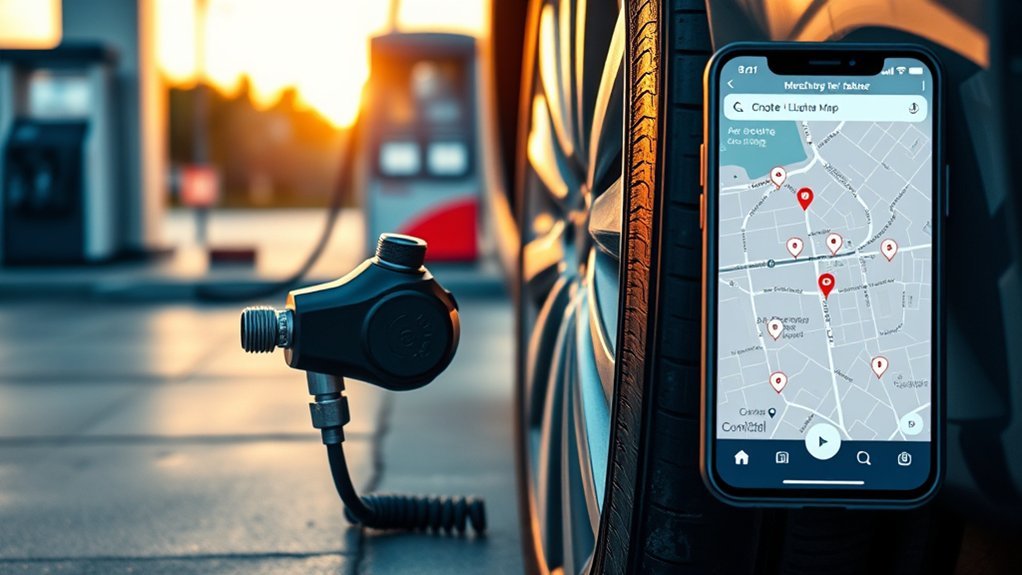
A portable tire inflator is not free at first, but it can save time, fees, and stress. It is especially useful if you drive at night, commute long distances, live far from service stations, or travel with kids, trailers, bikes, or sports gear.
Look for these features:
- Automatic shutoff: Lets you set the target PSI and reduces the risk of overinflation.
- Readable gauge: Digital displays are easier to read in low light, but accuracy matters more than style.
- Power options: A 12V plug works from your vehicle. Battery-powered models are convenient but need charging.
- Long enough hose and cord: Make sure the inflator can reach all four tires.
- Storage size: Choose a compact unit that fits in your trunk or cargo area.
- Duty cycle: Small inflators may need cooldown time between tires.
If you only need air once or twice a year, public free air may be enough. If you check tires monthly or drive in areas with few working pumps, a portable inflator is worth considering.
[Products Worth Considering]
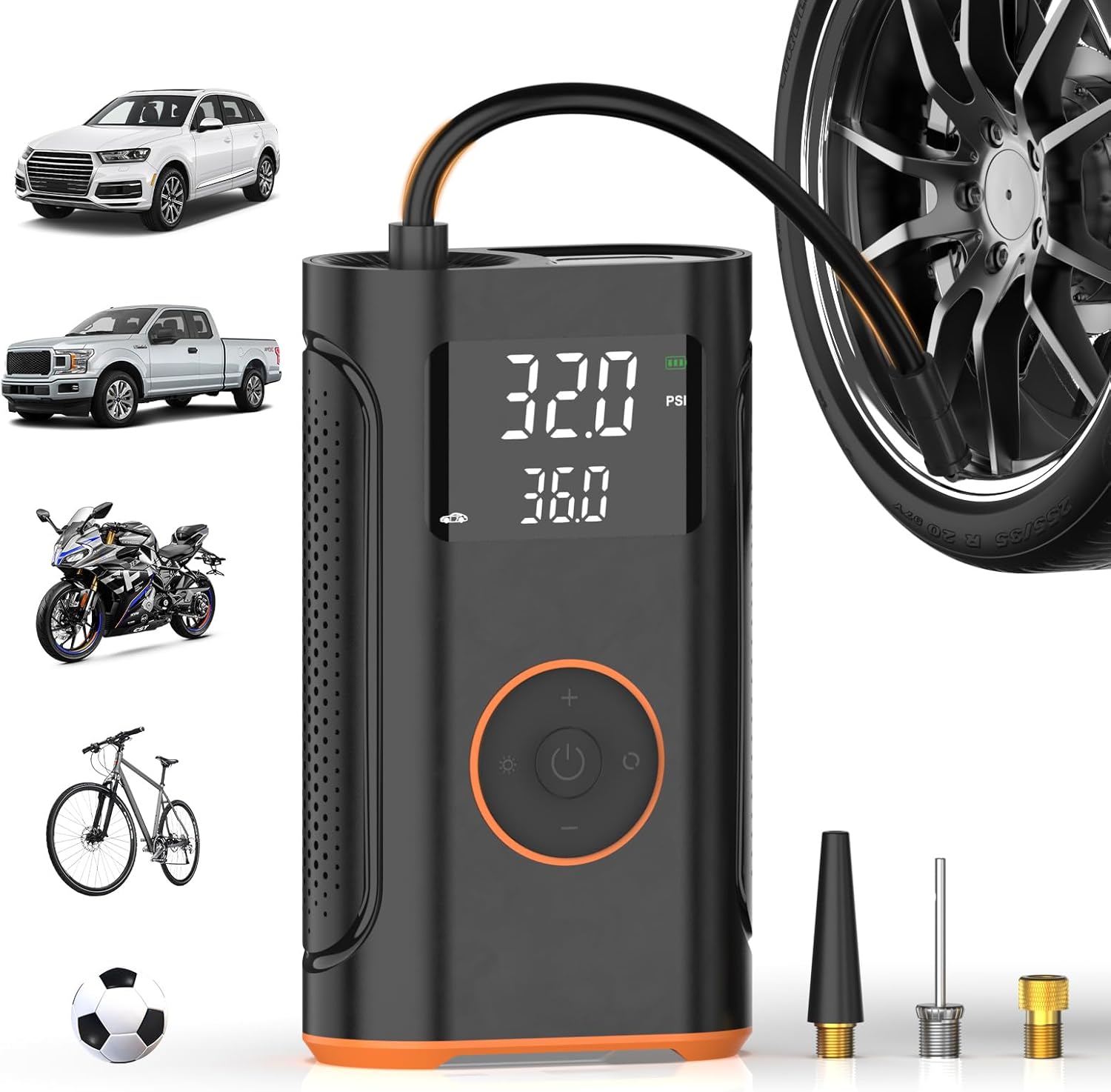
This portable tire inflator delivers fast inflation up to 160 PSI for car tires, bike tires, and sports inflatables. A dual-screen display shows preset and current pressure with 1 PSI accuracy, while the memory function stores your preferred settings for quick repeat use. It also includes emergency LED lighting modes and USB power bank output for charging devices when you need it.

This portable cordless tire inflator delivers fast, efficient inflation for cars, motorcycles, bikes, and sports balls with a digital pressure gauge. Use the one-click PSI preset with auto shut-off for accurate, hands-free topping to your target pressure up to 150 PSI. It’s compact and rechargeable with a built-in emergency LED light plus valve adapters and accessories for quick, ready-to-go use.

AstroAI H2 Pro cordless tire inflator delivers up to 150 PSI for fast inflation and reliable roadside performance with dual power options. Use the rechargeable battery for cordless convenience or connect to your vehicle via 12V DC for longer runtime. It features an auto shut-off system with an accurate digital pressure gauge and a bright LED for easy use in low light.
How to Add a Free Air Spot to the Map
When you find a reliable free-air location, you can help other drivers by adding it to a community map. FreeAirPump.com’s add-location form asks for the location name, type, address, city, state, ZIP code, and comments.
Submit Location Details
- Confirm the air pump is actually free and open to the public.
- Write down the exact business name and street address.
- Note whether the pump is for automobiles, bicycles, or both.
- Add helpful comments, such as hours, broken-card-reader issues, token requirements, or where the pump is located on the property.
Pin It on Map
Use the most accurate address you can find. If the pump is behind the building, near a tire center, or beside a car wash, include that in the comments. Clear notes help people avoid circling the lot or blocking traffic while they search.
| Field | What to enter |
| Name | Business, station, shop, or facility name |
| Address | Exact street address, city, state, and ZIP code |
| Access | Free, purchase required, member-only, token required, or public |
| Notes | Hours, pump location, gauge condition, and recent issues |
Help Grow Coverage
Free-air maps are only useful when people keep them current. If a pump is removed, starts charging, or stays broken for weeks, submit an update or comment when the map allows it. That helps the next driver avoid a wasted trip.
Free Tire Air Tips That Save Money
Free air saves more than a small pump fee. Proper tire pressure also helps your vehicle use fuel more efficiently and helps tires wear more evenly. FuelEconomy.gov says properly inflated tires can improve gas mileage by 0.6% on average and up to 3% in some cases.
- Check pressure monthly: Do not wait for the TPMS light. A tire can be low before the warning appears.
- Check before long trips: Highway driving on underinflated tires can build heat and increase risk.
- Watch temperature swings: Tire pressure commonly changes with weather, so check again after big seasonal changes.
- Keep a gauge in the car: A small gauge helps you avoid relying on worn public pump gauges.
- Use a backup plan: Save a tire shop, gas station, and portable inflator option so one broken pump does not leave you stuck.
Frequently Asked Questions
Which gas stations have free air for your tires?
Free air varies by station. Independent gas stations, some convenience stores, and some service stations offer it, while others charge. In Connecticut, licensed fuel retailers that sell motor fuel to the public must provide free public air during business hours. In California, service stations must provide free air and water to customers who purchase fuel.
Can you inflate your tires for free?
Yes. Try tire shops, repair shops, bike shops, selected gas stations, Costco Tire Centers, and community-listed pumps. Availability can change, so verify the pump is working and confirm whether a purchase, membership, or attendant activation is required.
Which gas stations in Florida have free air?
Florida free-air availability is location-specific. Check community maps, call nearby stations, and look for tire shops or repair shops if the gas station pump charges. Do not assume every rest area or service plaza has free tire air; verify the exact facility before relying on it.
What tire pressure should I use for a Kia Forte?
Use the cold tire pressure printed on your Kia Forte’s driver-side door placard or in the owner’s manual. Many passenger cars use pressure in the low-30 PSI range, but the correct number depends on model year, trim, tire size, and load. The placard is the safer source than a generic chart.
Should I check tire pressure when tires are hot or cold?
Check tires cold whenever possible. A cold tire reading means the vehicle has been parked long enough for the tires to cool, usually at least three hours. If you must add air while tires are warm, recheck the pressure cold later.
Is nitrogen better than regular air for tire inflation?
Nitrogen can reduce pressure loss slightly in some situations, but regular compressed air is fine for normal driving when tires are checked regularly. The most important step is keeping the tire at the vehicle manufacturer’s recommended cold PSI.
Conclusion
Finding free tire air is easiest when you know where to look and what rules apply. Start with nearby tire shops, repair shops, gas stations, warehouse-club tire centers, bike shops, and community maps. Then confirm the pump is working before you drive over. Once you arrive, use the PSI on your door placard, check tires cold when possible, and add air slowly. A few minutes of pressure maintenance can improve safety, reduce wasted fuel, and help your tires last longer.
Sources
- NHTSA TireWise — cold tire-pressure checks, placard PSI, and tire safety guidance
- FuelEconomy.gov Gas Mileage Tips — fuel-economy benefits of proper tire inflation
- California Department of Food and Agriculture — California service-station air and water complaint rules
- Connecticut General Statutes § 14-325a — free public-use air compressor requirement for licensed fuel retailers
- Costco Tire Center FAQ — Costco tire-center services including nitrogen inflation
- FreeAirPump.com Add Location — community submission form for free-air pump locations

