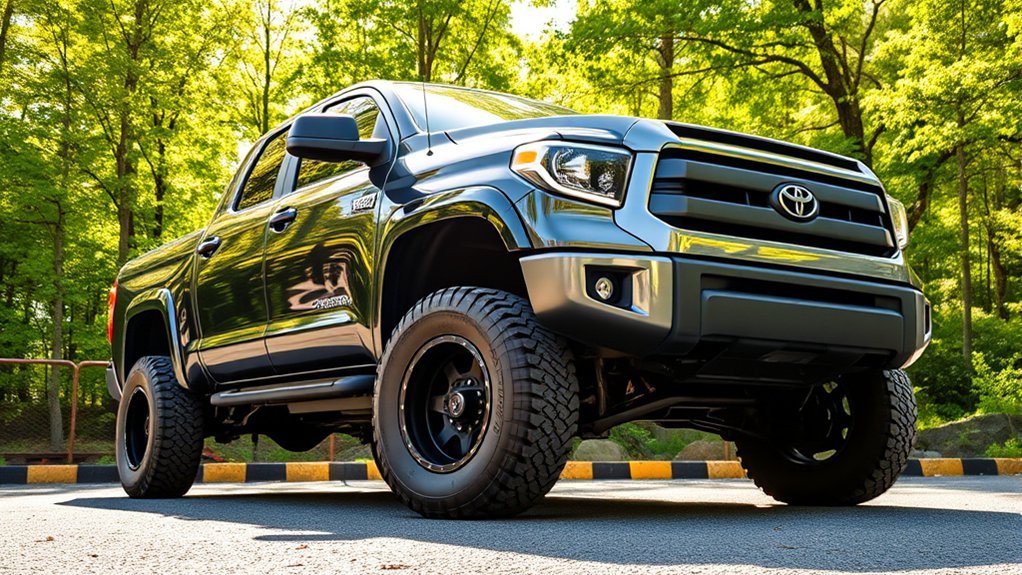
A Toyota Tundra leveling kit raises the front of the truck so it sits closer to the height of the rear. That cleaner stance is the main reason many owners install one, but the real decision comes down to tire fitment, wheel offset, alignment, and how much trimming you are willing to do.
Quick Answer
A leveling kit lifts the front of a Toyota Tundra to reduce factory rake, improve stance, and create more room for larger tires. Mild kits can keep the truck close to stock-feeling when aligned correctly, but tire size, wheel offset, trim level, and driver-assist systems must be checked before and after installation.
Key Takeaways
- A leveling kit usually raises only the front of the Tundra; it does not increase Toyota’s official payload or towing rating.
- A 295/60R20 tire may fit some leveled Tundras, but it is not a universal fit. Kit height, wheel width, offset, tire shoulder shape, and generation matter.
- Alignment is not optional. Caster, camber, toe, and steering wheel centering should be checked immediately after installation.
- Larger tires can affect rubbing, TPMS behavior, speedometer accuracy, headlight aim, and Toyota driver-assist systems.
At a Glance
| Time Required | About 2–4 hours for a professional shop; longer for a careful DIY install, plus alignment time. |
| Difficulty | Intermediate to advanced. Suspension work requires safe lifting, torque specs, and alignment knowledge. |
| Tools Needed | Floor jack or lift, rated jack stands, metric sockets and wrenches, torque wrench, trim tools, and professional alignment equipment. |
| Cost | Common spacer and strut-style kits range from budget to premium pricing; expect extra cost for labor, alignment, tire mounting, balancing, trimming, or upper control arms. |
What’s a Leveling Kit and How Does It Work?
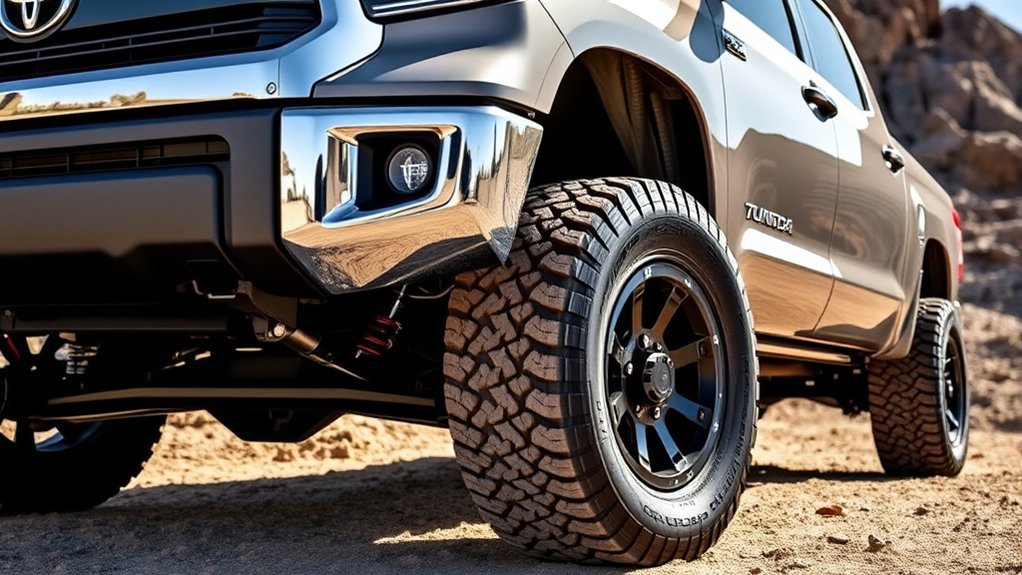
A leveling kit is a suspension upgrade that raises the front of your Toyota Tundra to reduce the nose-down factory rake. Toyota builds rake into trucks so the rear still has usable suspension travel when cargo or tongue weight is added. A leveling kit changes that stance, making the truck look flatter from front to rear.
Most Tundra leveling kits use one of these designs:
- Strut spacer or strut extension kits: These add height at the top or bottom of the front strut assembly. They are popular because they are simple and cost-effective.
- Preload spacer kits: These add preload to the front coil spring. They can create lift, but they may feel firmer than a basic top spacer.
- Replacement strut or coilover kits: These replace more of the front suspension and usually offer better control, adjustability, or durability.
- Rear/load-leveling kits: These are different from a front leveling kit. They help the rear handle load or restore height when towing or hauling.
A mild front leveling kit can improve stance and front ground clearance, but it also changes suspension geometry. That is why alignment and clearance checks matter as much as the kit itself.
Warning: Suspension work must be done on a level surface with a rated lift or jack stands. Do not rely on a floor jack alone, and always torque hardware to the correct specification for your model year and kit.
What Common Issues Arise With Leveling Kits?
Installing a leveling kit on your Toyota Tundra can improve its stance, but the most common problems show up after the truck is back on the road. Most issues are avoidable if you choose the right kit, wheel, and tire combination before installation.
Alignment and Tire Wear
The biggest issue is alignment. After the front suspension is raised, caster, camber, and toe can move out of spec. If the truck is not aligned, you may see outer-edge tire wear, wandering, poor steering return, or a steering wheel that sits off-center.
Some leveled Tundras can be aligned with stock upper control arms. Others, especially trucks running larger tires or more lift, may benefit from aftermarket upper control arms to regain caster and improve tire clearance.
Tire Rubbing at Full Lock
Rubbing usually happens at full steering lock, in reverse, or when the suspension compresses. Common contact points include the front mud flaps, fender liner, bumper bracket area, body mount area, and sway-bar or upper-control-arm clearance depending on the wheel offset.
Minor trimming or heat-forming plastic liners may solve light rubbing. Heavy rubbing means the tire, wheel offset, alignment, or lift height needs to be reconsidered.
Driver-Assist and Stability Systems
Toyota warns that ABS, TRAC, Trailer Sway Control, and VSC may not function correctly if different tires are installed, and that modifying the suspension can affect driving assist systems. Review Toyota’s guidance in the Tundra owner’s manual section on driving assist systems before changing tire size or suspension height.
Note: If warning lights appear after a leveling kit or tire change, do not ignore them. Have the steering angle, wheel-speed sensors, TPMS, alignment, and tire sizing checked by a qualified shop or Toyota dealer.
Headlight Aim and Towing Feel
Raising the front changes the truck’s stance, so the headlights may point higher than before. Recheck headlight aim after installation, especially if you tow at night.
A leveling kit also does not increase Toyota’s official tow rating or payload rating. Toyota lists stock Tundra towing capability by configuration, with current models offering up to 12,000 pounds when properly equipped, but your own rating depends on the exact truck, door-jamb labels, equipment, and load. Review Toyota’s official Tundra brochure and your owner’s manual before towing.
How a Leveling Kit Affects Tire Fitment on Your Tundra
A leveling kit gives the front tires more room, but it does not make every large tire fit. Tire fitment depends on model year, trim, lift height, wheel width, offset, tire diameter, tire width, tread shoulder shape, and alignment settings.
For example, ReadyLIFT lists its 2022–2026 Toyota Tundra front leveling kit as supporting larger tires up to 34 inches, with a no-trim maximum of 295/60R20 on a 20×9 wheel with +18 offset for that specific kit and application. That does not mean every Tundra with every leveling kit will clear that tire without rubbing.
Pro Tip: Before buying tires, test fit or compare real-world setups from the same Tundra generation, same lift height, same wheel width, and similar offset. A 295 tire from one brand may rub differently than another because tread shoulders vary.
[Products Worth Considering]

This ALL-TOP auto-stop tire deflator valve kit lets you air down off-road tires quickly without watching pressure, automatically stopping when your preset PSI is reached. Each valve is individually calibrated for reliable performance with an acceptable +/- 2 PSI tolerance. The adjustable deflator range covers 10 to 30 PSI and includes four valves plus valve caps and a zipper pouch for easy setup on trucks, SUVs, RVs, UTVs, and powersports.

This spare tire tool kit is designed for the 2004 to 2018 Ford F-150 to help you loosen and tighten wheel lug nuts and manage the spare tire and provided jack functions from underneath the vehicle. It includes the lug nut wrench and extension pieces plus a convenient storage carrying case for organized transport. The jack itself is not included.

These universal tire valve stem caps help protect valve cores from dust, debris, and moisture while helping maintain stable tire pressure. The corrosion-resistant metal construction and sealed design provide reliable protection in road grime, mud, and winter conditions. Twist-on installation makes them quick to fit on cars, SUVs, trucks, and motorcycles.
Common Tire Size Options
| Tire Size | Approx. Use Case | Fitment Notes |
|---|---|---|
| 275/65R20 | Mild upgrade | Usually easier to fit than wider 295 options, but still depends on offset and tire model. |
| 285/65R20 | Popular leveled-truck size | May require alignment optimization and minor plastic trimming on some wheel offsets. |
| 295/60R20 | Aggressive 34-inch-class fitment | Can fit certain leveled setups, but wheel width, offset, tire brand, and trimming determine the result. |
| 35-inch-class tires | Maximum stance/off-road look | Often needs more lift, trimming, positive-offset wheels, or other modifications. Not a safe assumption for a basic level. |
Speedometer, Load, and Tire Pressure Checks
Changing overall tire diameter can change speedometer and odometer accuracy because the truck travels a different distance per tire revolution. Tire Rack explains that taller tires can make the actual road speed higher than the speedometer reading. Review a trusted speedometer accuracy guide or use a tire-size calculator before making a large jump in diameter.
Also check tire load index, wheel width, and inflation requirements. NHTSA’s TireWise guidance recommends maintaining proper tire pressure, observing vehicle and tire load limits, and inspecting tires for damage. For tire and rim compatibility, the Tire and Rim Association is the U.S. standardizing body for tire, rim, valve, and related interchangeability standards.
Benefits of Installing a Leveling Kit on Your Tundra
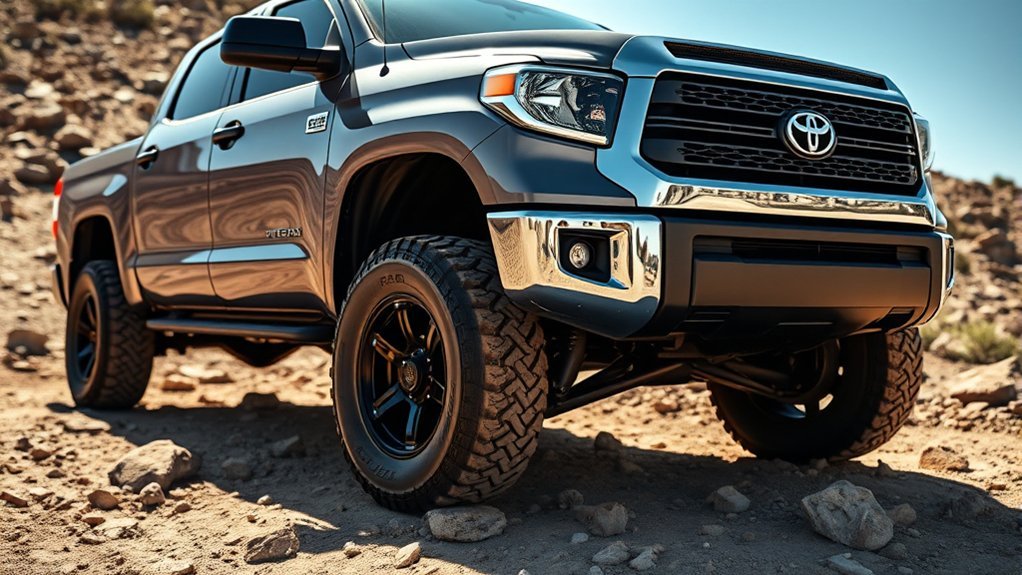
Enhancing your Toyota Tundra with a leveling kit can make the truck look more balanced and create useful front-end clearance. The benefits are strongest when the kit is matched to the way you actually use the truck.
| Benefit | What It Really Means |
|---|---|
| Balanced stance | Reduces the front-down factory rake for a cleaner side profile. |
| More front clearance | Helps with approach angle and gives more room near the front fender area. |
| Larger tire potential | Allows certain larger tires when wheel offset, alignment, and trimming are right. |
| Lower cost than a full lift | A mild leveling kit is usually simpler than a full suspension lift, though premium kits and labor can still add up. |
A leveling kit is best treated as a stance and clearance upgrade, not a towing-capacity upgrade or a shortcut around proper wheel and tire fitment.
[Products Worth Considering]

The Tymate TM2 RV tire pressure monitoring system keeps you informed with a color LCD display, automatic backlight, and solar charging for dependable operation. It supports up to 10 tire positions with four pre-paired sensors, while offering multiple alarm modes for fast leak detection, pressure extremes, temperature alerts, and low-signal warnings. Built-in monitoring uses accurate readings and reliable 433.92MHz communication to help protect your RV, trailer, truck, or SUV.

These aluminum alloy tire valve stem caps with an O-ring seal help protect valve stems from corrosion while adding a clean, stylish look to your vehicle. The universal fit works across cars, trucks, motorcycles, bicycles, and more, making them an easy upgrade for everyday driving and off-road use. Installation is quick, and the included four-pack keeps all your tires dressed and protected.

Measure tire tread depth quickly and accurately with this LUMITECO dial gauge that reads in 1/32" increments up to 14/32". The color-coded green/yellow/red zones make it easy to judge tire wear and know when replacement is needed. A rugged, compact design with a protective pouch helps keep the gauge ready for use on cars, trucks, motorcycles, and more.
Selecting the Ideal Rim Offset and Tire Size
Wheel offset is the distance between the wheel’s mounting surface and its centerline. More positive offset pulls the tire inward. Less positive offset pushes the tire outward. On a Tundra, that small number can decide whether a tire clears the upper control arm, fender liner, mud flap, or bumper area.
For many leveled Tundras, owners look at offsets around the positive teens to mid-20s on a 20×9 wheel because that can provide a wider stance without pushing the tire too far outside the fender. But there is no single “best” number. A +18 wheel, +20 wheel, and +25 wheel can all behave differently depending on wheel width and tire shape.
If you are working with a 2019 Tundra, remember that it belongs to the previous generation, so current 2022–2026 fitment notes should not be copied blindly. A +20 offset can be a strong starting point for an aggressive look on some 2007–2021 setups, but you still need to verify brake clearance, upper-control-arm clearance, fender-liner clearance, and full-lock rubbing with the exact tire you plan to run.
[Products Worth Considering]

Replace or upgrade your zero-turn lawn mower tires with a universal fit flat-free tire and wheel assembly in a convenient 2-pack. Smooth tread front-caster style helps turning with reduced turf damage, while flat-free design eliminates the maintenance and downtime of air-filled flats. The included adapter kit supports 5/8-inch axles and hub lengths from 3.4 to 5 inches for compatibility across most ZTR mowers.

These M14x1.5 closed-end chrome lug nuts are a one-piece replacement designed for secure fitment on compatible GM, Ford, and select Chrysler/Dodge models. Featuring a 60-degree conical seat and anti-rust chrome plating, they help resist corrosion and maintain a bright look for everyday driving. Built for long-term durability, they include OEM-style part references and are backed by 12 months of support.

This wheel brush kit delivers pro-level cleaning at home, lifting dirt, grime, and brake dust to help restore wheel appearance. It includes multiple brush styles and applicator pads for tackling different wheel surfaces, with gentle, metal-free bristles designed to reduce scratching risk. The flat and double-ended brushes are built for comfort and reach, making wheel care easier for cars, trucks, and RVs.
How to Check Fitment Before You Buy
- Measure your current rake: Measure from the center of the wheel hub to the fender lip at all four corners before choosing lift height.
- Confirm your trim: TRD Pro, rear air suspension, AVS, hybrid, 2WD, and 4WD models may require different kits.
- Check wheel width and offset together: Offset alone is incomplete. A 20×9 +20 and a 20×10 +20 will not sit the same.
- Match tire load rating: Choose a tire with a suitable load index for your truck and use the correct cold inflation pressure.
- Plan for alignment: Budget for a professional alignment immediately after the kit is installed.
- Test at full lock: Turn both directions, check reverse, and inspect clearance with the suspension compressed if possible.
Note: If you tow or carry heavy loads often, consider whether you need rear load support instead of, or in addition to, a front leveling kit. A front level can look great unloaded but may make rear squat more obvious when the truck is loaded.
Post-Install Checklist
After the leveling kit, wheels, or tires are installed, do these checks before treating the truck as finished:
- Get a professional alignment: Confirm caster, camber, toe, and steering wheel centering.
- Recheck torque: Re-torque suspension and wheel hardware after the first short driving period according to the kit maker’s instructions.
- Inspect brake lines and ABS wires: Make sure nothing is stretched, pinched, or rubbing.
- Check tire clearance: Look at fender liners, mud flaps, bumper brackets, sway bar, and upper control arms.
- Verify TPMS: Make sure tire pressure sensors read correctly after new wheels or tires.
- Check warning lights: Resolve ABS, traction control, VSC, or steering warnings right away.
- Adjust headlights: Re-aim headlights if the beam pattern is now too high.
- Road test carefully: Listen for clunks, feel for vibration, and check for tire rub in parking-lot turns before highway driving.
Frequently Asked Questions
What are the downsides of a leveling kit?
The main downsides are alignment changes, possible tire rubbing, added CV or ball-joint angle, headlight aim changes, and possible effects on ABS, TRAC, VSC, Trailer Sway Control, and TPMS behavior. A mild, quality kit with the right alignment is usually easier to live with than an aggressive setup.
What does a Tundra leveling kit do?
A Tundra leveling kit raises the front suspension to reduce factory rake. It improves stance, adds front clearance, and can help fit larger tires, but it does not increase Toyota’s official payload or towing rating.
How much does a leveling kit usually cost?
Costs vary by kit type. Basic spacer kits are usually the least expensive, while replacement strut, coilover, or premium kits cost more. Professional installation, alignment, tire mounting, balancing, trimming, and upper control arms can add several hundred dollars or more to the final total.
What size tires will fit on a Tundra with a leveling kit?
Many owners move into 33-inch or 34-inch-class tires after leveling, and 295/60R20 can work on certain setups. Fitment depends on Tundra generation, kit height, wheel width, offset, tire brand, alignment, and trimming. Do not assume one tire size fits every leveled Tundra.
Do I need an alignment after installing a Tundra leveling kit?
Yes. A front leveling kit changes suspension geometry, so a professional alignment should be done immediately after installation. Ask the shop to check caster, camber, toe, steering wheel centering, and tire clearance at full steering lock.
Will a leveling kit void my Toyota warranty?
A leveling kit does not automatically void the entire vehicle warranty, but a dealer or manufacturer may deny coverage for a failure caused by an aftermarket part or related modification. Keep receipts, use a reputable kit, and ask your dealer how they handle suspension and tire modifications before installing.
Conclusion
A leveling kit can make your Toyota Tundra look cleaner, sit more evenly, and fit larger tires when the parts are chosen carefully. The best setup is not just the tallest kit or widest tire; it is the combination that clears properly, aligns correctly, keeps the truck safe, and matches how you drive.
If you want a simple daily-driver upgrade, choose a mild kit, a conservative tire size, and a wheel offset with proven clearance for your Tundra generation. If you want a more aggressive 295/60R20 or larger setup, plan for alignment work, possible trimming, speedometer checks, and careful inspection of Toyota driver-assist systems.
Sources
- Toyota Tundra Owner’s Manual: Driving Assist Systems — backs warnings about tires, suspension modifications, ABS, TRAC, Trailer Sway Control, and VSC behavior.
- Toyota 2026 Tundra Brochure — backs official stock Tundra towing-capacity context.
- ReadyLIFT Toyota Tundra 2-Inch Front Leveling Kit — backs current 2022–2026 kit fitment notes, 295/60R20 example, and offset guidance for that product.
- NHTSA TireWise — backs tire pressure, tire safety, load-limit, and inspection guidance.
- The Tire and Rim Association — backs tire, rim, valve, and allied-parts standardization context.
- Tire Rack Speedometer Accuracy Guide — backs the note that changing tire diameter affects speedometer readings.