

Overinflated tires have more air pressure than your vehicle manufacturer recommends for cold tires. Too much pressure can change the tire’s contact with the road, increase center-tread wear, make the ride harsher, and reduce its ability to absorb pothole and debris impacts. The correct target is the pressure on your vehicle placard or in the owner’s manual, not the maximum number molded into the tire sidewall.
Quick Answer
Overinflated tires flex less than intended and can concentrate more load near the center of the tread. That can cause center wear, a firmer ride, reduced grip on imperfect surfaces, altered steering response, and greater vulnerability to pothole or debris damage. Check and adjust pressure when the tires are cold.
Key Takeaways
- The vehicle placard gives the correct cold tire pressure; the sidewall number is not your everyday inflation target.
- Chronic overinflation commonly shows up as faster wear through the center of the tread.
- Higher pressure reduces tire compliance, so bumps feel sharper and pothole impacts can be more damaging.
- A warm tire normally reads higher than a cold tire, so do not treat every higher hot reading as true overinflation.
- TPMS is mainly a low-pressure warning system, so a pressure gauge is still necessary.
What Overinflated Tires Do
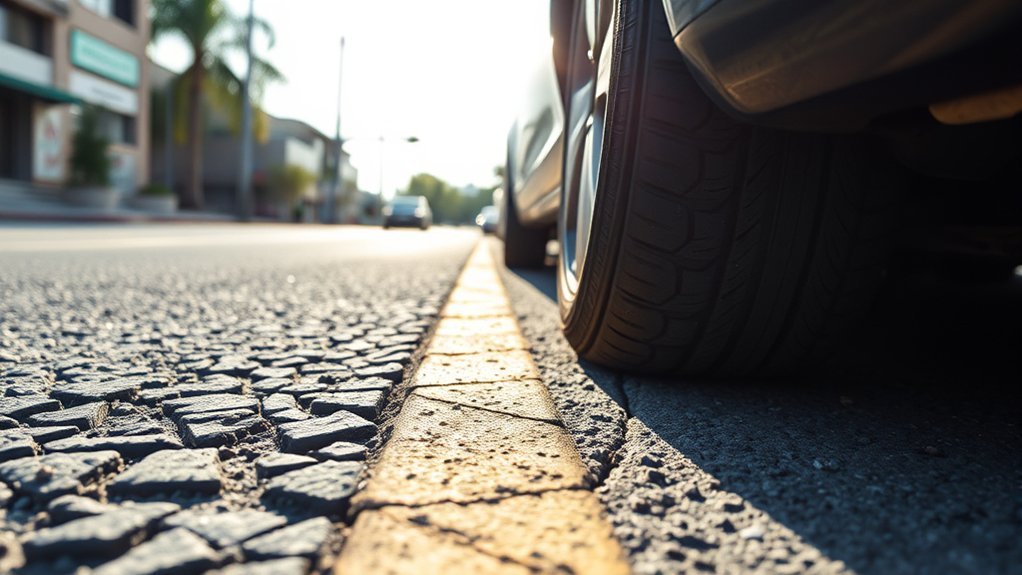
When you overinflate a tire, you raise its cold pressure above the vehicle manufacturer’s specification. The tire then flexes less and its tread may carry the vehicle’s load less evenly across the road surface.
That change can make the steering feel quicker at first, but quicker response does not necessarily mean better grip or greater control. Michelin notes that an overinflated tire can develop a smaller, harder contact patch that provides less grip area for braking in demanding conditions, while Michelin’s handling guidance recommends maintaining the vehicle-specified pressure.
The tire also becomes less compliant. Instead of absorbing small bumps and road texture, it sends more of that movement into the suspension, steering, and cabin.
| Effect | What You May Notice | Why It Happens |
|---|---|---|
| Road contact | Less grip margin on rough, wet, or uneven pavement | The tire is stiffer and the effective contact area can become less favorable |
| Tread wear | Center tread wears faster | More of the load is concentrated through the center area |
| Ride quality | Sharper bumps and more vibration | The tire flexes less over road irregularities |
| Impact resistance | Greater vulnerability to potholes and debris | The tire has less ability to deform and cushion a sudden impact |
Signs Your Tires Are Overinflated
The surest sign of overinflation is a cold gauge reading above the pressure specified for your vehicle. Driving feel and tread wear can provide clues, but neither is as reliable as actually measuring the pressure.
Look for faster wear through the center ribs while the shoulders retain more tread. Michelin identifies center-focused wear as a typical overinflation pattern in its center-tread wear guidance.
You may also notice a firmer or more jarring ride, more vibration over broken pavement, or unusually sensitive steering. These symptoms can have other causes, so confirm the pressure with a gauge before blaming the tires.
Do not rely on how a tire looks while parked. A visual inspection is useful for finding cuts, bulges, or unusual wear, but it cannot tell you the pressure accurately.
How Overinflated Tires Affect Handling
Overinflated tires can make steering feel sharper because the tire flexes less when you turn the wheel. At the same time, excessive pressure can reduce the tire’s ability to conform to the road and can leave less traction in reserve during braking, cornering, or sudden maneuvers.
Reduced Contact Patch
Excess pressure changes the shape and pressure distribution of the contact patch, which is the area of tread touching the road. With severe overinflation, the effective contact area can become smaller and more concentrated near the center.
That matters most when the road is wet, rough, or uneven. A tire needs enough compliance to stay in useful contact as the surface changes beneath it.
During hard braking or cornering, a poorly distributed contact patch gives the tire less margin before grip starts to fall away. NHTSA research notes that severe overinflation may increase stopping distance because of reduced road contact and non-optimal traction.
Quicker Steering Response
Higher pressure can reduce tire deformation during the first part of a steering input. The front end may therefore feel quicker or lighter when you change direction.
That response can be misleading. A tire that reacts quickly can still have less compliance and less grip on bumps, broken pavement, or other imperfect surfaces.
Instead of using extra pressure to change steering feel, use the manufacturer’s specified cold PSI for normal road driving. The suspension, steering, tires, and stability systems are designed to work around that specification.
How Overinflation Affects Tire Wear
Chronic overinflation can shorten tread life by making the center portion of the tread carry more of the load than intended. The most recognizable pattern is therefore center wear with relatively deeper shoulders.
Center Tread Wear
The center ribs of an overinflated tire can wear faster than the tread near the edges. Over time, the difference may become visible or measurable with a tread-depth gauge.
- Measure tread depth at the center of the tire.
- Measure comparable points toward the inner and outer shoulders.
- Compare the readings for a consistent center-wear pattern.
- Check the tire pressure cold and correct it to the vehicle specification.
Correcting the pressure can prevent the inflation error from continuing, but it cannot restore rubber that has already worn away. If the center has reached the replacement limit or the tire has other damage, pressure adjustment alone is not enough.
Uneven Contact Patch
Overinflation changes how load is distributed through the tread. Instead of the tread working evenly across its width, the middle can carry a larger share.
This is why pressure and tread wear should be checked together. Center wear points toward overinflation, while wear concentrated on both shoulders is more commonly associated with underinflation.
Wear on only one shoulder, feathering, or cupping can indicate other problems such as alignment, balance, or suspension issues. Do not assume every uneven pattern is caused by tire pressure.
Why Overinflated Tires Are More Vulnerable to Road-Hazard Damage
Overinflation reduces the tire’s ability to flex and cushion a sudden impact. As a result, potholes, curbs, and road debris can place greater stress on the tire than they would at the correct pressure.
This is a more precise concern than saying every overinflated tire is simply going to blow out. Transport Canada’s tire-inflation guidance notes that excessive pressure reduces road contact, creates a harsher ride, affects handling, and increases wear on tires and suspension components.
A hard impact can damage the tread, sidewall, internal cords, or wheel even if the tire does not immediately lose air. Damage may become visible as a cut, bulge, vibration, or recurring pressure loss.
Note: If a tire develops a bulge, deep cut, exposed cords, persistent vibration, or pressure loss after a pothole or curb impact, have it inspected by a qualified tire professional before returning to normal driving.
Maintaining the correct pressure gives the tire the flexibility and load-carrying behavior its manufacturer and vehicle maker intended.
How Overinflated Tires Hurt Ride Comfort
Correctly inflated tires act as part of the vehicle’s cushioning system. When pressure is too high, the tire deforms less over pavement joints, patches, stones, and small potholes, so more of that movement reaches the suspension and cabin.
You may feel this as sharper impacts through the seat or steering wheel. Tire noise and vibration can also become more noticeable on coarse pavement.
A very firm ride does not prove the tires are overinflated, because suspension setup, tire construction, wheel size, and road surface also matter. Check the pressure before making a diagnosis.
Long-term excessive pressure may also make the suspension handle more impact energy than it would with correctly inflated tires. However, it is too broad to assume that modest overinflation automatically damages shocks, struts, or other components.
Find Your Car’s Recommended PSI
Your correct tire pressure is the vehicle manufacturer’s recommended cold inflation pressure. It is normally listed on the Tire and Loading Information label near the driver’s door and in the owner’s manual.
NHTSA TireWise says the specified pressure should be checked at least monthly with the tires cold. NHTSA defines cold for this purpose as the vehicle not having been driven for at least three hours.
- Find the vehicle’s tire-pressure label.
- Check whether the front and rear pressures are different.
- Use the pressure specified for your vehicle and loading condition.
- Measure and adjust the tires when cold whenever possible.
Do not use the tire sidewall maximum as your normal target. The sidewall marking and the vehicle’s recommended operating pressure serve different purposes.
Also remember that replacement tires do not automatically change the required vehicle pressure. If tire size, load rating, wheels, or vehicle loading has changed substantially, use specifications approved for that setup rather than guessing.
[Products Worth Considering]

The SAFELIFE dial tire tread depth gauge measures tread depth in 1/32 inch increments with clear, easy-to-read 2-inch dial face. Color zones using a traffic light system help you quickly judge whether tread is low, marginal, or ample for safer driving. Built with a durable zinc cast body and a metal detect probe for precise, comfortable use across cars, motorcycles, trucks, and buses.

Monitor tire tread wear with a smart, color-coded depth gauge that shows clear condition ranges at a glance. The bar is range marked for fast, easy readings, helping you maintain safer traction and performance. Each gauge is portable with a pocket clip, and the set includes 20 units for daily use and sharing.

Steelman white tire marking crayons provide high-contrast, semi-permanent marks for repairing and inspecting tires and equipment. They write on wet or dry, smooth or coarse surfaces including rubber, metal, glass, and wood, making them ideal for puncture location and damage outlining. The lead- and zinc-free crayons resist weather and fading yet wipe away when you no longer need the marks.
How to Check Tire Pressure Correctly
Check tire pressure with a reliable gauge while the tires are cold. Using the same gauge for all four tires helps you compare them consistently and makes it easier to spot an unusual reading.
- Park the vehicle and allow the tires to become cold.
- Find the recommended front and rear PSI on the vehicle label.
- Remove the valve cap from the first tire.
- Press the gauge squarely onto the valve stem until you get a stable reading.
- Compare the reading with the specified cold pressure.
- Repeat the process on every road tire and the spare, if applicable.
- Reinstall each valve cap when finished.
Check pressure at least once a month and before extended driving. A dashboard tire-pressure warning does not replace these checks because TPMS is designed primarily to warn about significant underinflation.
Ambient temperature also changes pressure. Continental’s tire-pressure guidance explains that warmer conditions raise pressure while colder conditions lower it. Michelin similarly uses a rule of thumb of about 1 PSI change for each 10°F change in ambient temperature.
Warning: Do not bleed a normally inflated tire down to its cold-pressure target immediately after driving. Driving heats the tire and naturally raises its pressure; releasing that extra pressure can leave the tire underinflated after it cools.
[Products Worth Considering]

Keep your tires properly inflated with this analog VONDIOR tire pressure gauge, designed for fast, easy readings without batteries. The swiveling, two-axis hose and large glow dial help you measure at any tire angle with instant visibility. Built with a protective rubber shield, it supports durable, low-maintenance use for cars and trucks.

The Topeak SmartGauge D2 delivers precise digital tire pressure readings for bikes, motorcycles, and sports equipment up to 250 psi (17 bar). Its rotating SmartHead works with both Presta and Schrader valves, so you can check pressure quickly without adapters. The LCD display makes it easy to read results in psi, bar, or kg/cm² with an included CR2032 battery for immediate use.

Milton S-921 pencil tire pressure gauge helps you maintain optimal tire pressure for passenger cars with accurate readings in PSI and kPa. It features a built-in deflator valve for convenient pressure adjustments, plus a single chuck head and nylon indicator bar for easy use on the go. Built from durable plated brass and designed for reliable performance, it’s a practical road trip and cold-weather maintenance tool.
How to Fix Overinflated Tires Safely
If a cold tire is genuinely above the manufacturer’s recommended pressure, release air gradually until the gauge matches the specified PSI. Make small adjustments and recheck after each one so you do not remove too much.
- Let the tires cool before making the final adjustment.
- Check the current pressure with a reliable gauge.
- Remove the valve cap.
- Press the valve pin briefly to release a small amount of air.
- Measure the pressure again.
- Repeat until you reach the specified cold PSI.
- Reinstall the valve cap and check the other tires.
If one tire repeatedly ends up much higher or lower than the others, check your gauge and inflation equipment. A recurring pressure difference can also justify an inspection for a valve, wheel, or tire problem.
After correcting the pressure, inspect the tread. Long-term overinflation may already have produced center wear that cannot be reversed.
[Products Worth Considering]

This tire inflator with pressure gauge delivers long-lasting performance with a durable rubber-protected gauge and sturdy build. The longer hose and 360 swivel air chuck help you seal the valve securely and keep your hands free while measuring, inflating, or deflating. It’s battery-free for reliable use and provides ±2 PSI accuracy in the mid-range for most typical tires, with universal compatibility for 1/4 NPT compressor outputs.

Measure tire tread depth quickly and accurately with this LUMITECO dial gauge that reads in 1/32" increments up to 14/32". The color-coded green/yellow/red zones make it easy to judge tire wear and know when replacement is needed. A rugged, compact design with a protective pouch helps keep the gauge ready for use on cars, trucks, motorcycles, and more.

The Big Rig Defense Tire Thumper is a truck tire pressure checker that lets you quickly check multiple tires by giving them a firm whack. Listen for a reassuring thump and feel the stick bounce when a tire is fully inflated, helping you get back on the road safely. It features a comfortable, glove-friendly handle and a secure wrist strap for confident use on busy routes.
Frequently Asked Questions
Can Overinflated Tires Affect Fuel Economy?
Yes, tire pressure affects rolling resistance, but deliberately overinflating your tires is not a recommended fuel-saving strategy. Any possible reduction in rolling resistance comes with tradeoffs in ride, wear, traction, and impact resistance. For normal road use, keep the tires at the vehicle manufacturer’s specified cold pressure.
Do Overinflated Tires Damage Suspension Components?
Overinflated tires can transmit more road impact into the suspension because the tire itself absorbs less movement. That can increase the loads felt by suspension components, but it does not mean modest overinflation automatically damages shocks, struts, or bushings. Correct the pressure and investigate persistent noises, vibration, or harshness separately.
Are Winter Tires More Sensitive to Overinflation?
Winter tires still need the pressure specified by the vehicle manufacturer; there is no general rule that they should be deliberately overinflated or that a few extra PSI affects every winter tire more dramatically. The bigger seasonal issue is cold weather lowering tire pressure, so check the tires cold as temperatures change.
Can Temperature Changes Increase Tire Pressure?
Yes. Tire pressure rises as the air inside becomes warmer and falls as it cools. A common rule of thumb is about 1 PSI for every 10°F change in ambient temperature. Driving also warms tires, so compare pressure with the vehicle’s cold specification whenever possible.
How Often Should Tire Pressure Be Checked?
Check tire pressure at least once a month and before extended driving. Measure it when the tires are cold and compare each reading with the vehicle placard. Regular checks also help you spot a slow leak, an inaccurate previous adjustment, or pressure changes caused by large swings in ambient temperature.
Will TPMS Warn Me if My Tires Are Overinflated?
Usually not. The federally required TPMS function is designed to warn drivers when a tire becomes significantly underinflated, not to serve as a precise high-pressure gauge. Some vehicles display individual pressure readings, but you should still compare those readings with the cold PSI on the vehicle placard.
Should I Let Air Out if the Tires Read High After Driving?
Not simply because the hot reading is above the cold specification. Pressure normally rises as a tire warms during driving. If the tires were correctly set while cold, let them cool before deciding they are overinflated; bleeding a warm tire to the cold target can leave it underinflated later.
Conclusion
If your tires are overinflated, correct them to the vehicle manufacturer’s recommended cold PSI rather than the tire’s sidewall maximum. Proper pressure restores the intended balance of grip, ride comfort, tread wear, steering response, and impact cushioning.
Check all tires with a reliable gauge while cold, release excess air gradually, and inspect the tread for center wear or impact damage. If abnormal wear or damage remains after the pressure is corrected, have the tire inspected professionally.
Sources
- NHTSA TireWise: Recommended cold pressure, monthly checks, TPMS limitations, tread inspection, and tire maintenance guidance.
- Michelin USA — Wear in Center: Center-tread wear caused by overinflation and correcting excessive pressure.
- Michelin USA — Car Handling Problems: Effects of tire pressure on road contact, braking grip, and handling.
- Continental — Tire Pressure: Cold-pressure checking, temperature effects, pressure adjustment, and sidewall maximum versus vehicle recommendation.
- Transport Canada — Inflating Your Tires: Effects of overinflation on grip, ride, steering, stopping, tire wear, and suspension loading.

