What Happens If Toyota Camry Tires Are Overinflated? Risks Explained
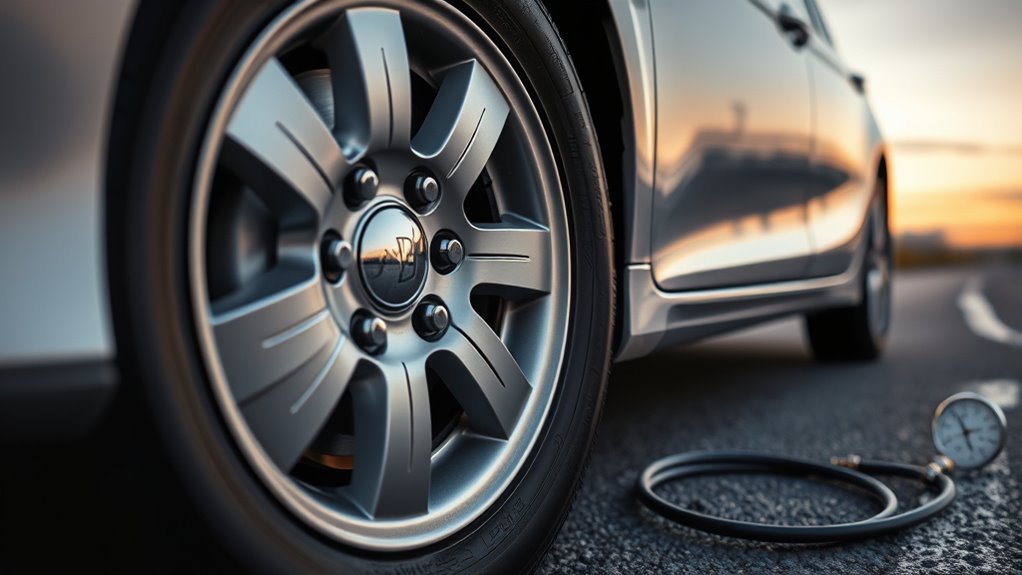
If your Toyota Camry tires are overinflated, the car may feel harsher, less settled, and less predictable than it should. Too much air pressure can reduce the tire’s footprint, speed up center tread wear, and make potholes or sharp road edges feel more severe. The safest target is the cold tire pressure listed on your Camry’s driver-side door-jamb placard or in the correct Toyota owner’s manual.
Quick Answer
Overinflated Toyota Camry tires can cause a harsher ride, faster center tread wear, reduced road contact, and less predictable grip. Check pressure when the tires are cold, compare each tire with the door-jamb placard, and release air in short pulses until each tire matches Toyota’s recommended PSI.
Key Takeaways
- Use the Camry’s door-jamb placard or owner’s manual as your PSI target, not the maximum pressure printed on the tire sidewall.
- Check pressure when tires are cold, ideally before driving or after the car has been parked for at least three hours.
- Overinflation often shows up as a stiff ride, faster center tread wear, reduced grip, and sharper impact harshness.
- Release air in short pulses, recheck with a reliable gauge, and stop when the tire reaches the recommended cold PSI.
- Have a tire inspected if you see bulges, cuts, cracks, exposed cord, rapid air loss, severe vibration, or uneven tread wear.
At a Glance
| Time Required | 5 to 10 minutes for all four tires |
| Difficulty | Easy |
| Tools Needed | Reliable tire pressure gauge; air compressor if pressure is low |
| Cost | Usually free if you already own a gauge; many air stations cost a small fee |
What Does Overinflated Mean for a Toyota Camry?
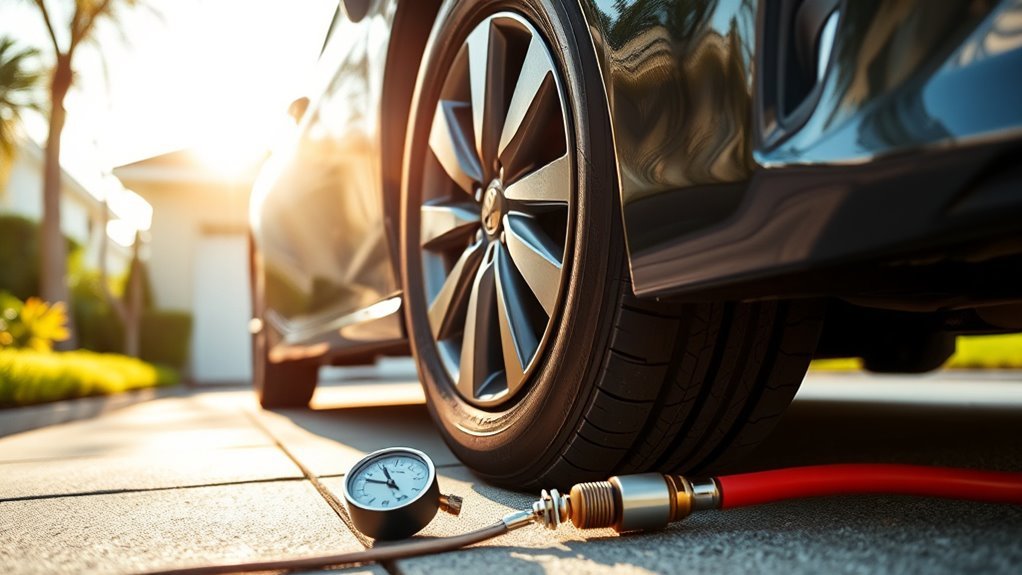
For a Toyota Camry, overinflated tires are tires filled above the recommended cold PSI listed for that exact vehicle. You can usually find that number on the Tire and Loading Information Label on the driver-side door edge or door jamb. You can also confirm it in the correct Toyota owner’s manual.
Do not use the maximum PSI printed on the tire sidewall as your normal driving target. That sidewall number is a tire limit, not Toyota’s recommended pressure for your Camry’s weight, suspension tuning, and tire size.
Pressure readings should be checked when the tires are cold. NHTSA recommends checking all tires, including the spare, at least once a month when the car has not been driven for at least three hours. Heat from driving can raise the reading, so a warm tire may look higher than it will be after cooling.
Note: A tire that reads slightly above the placard right after driving may not be truly overinflated when cold. Recheck after the car has been parked long enough for the tires to cool.
How Much Overinflation Is Too Much?
Any cold reading above the placard should be corrected, but a small difference is not the same as severe overinflation. For example, a cold reading that is 1 or 2 PSI high usually calls for a simple adjustment. A tire that is far above the placard, keeps changing pressure compared with the others, or looks damaged deserves closer attention.
Do not bleed a warm tire down aggressively just because the gauge reads a little high after highway driving. If possible, wait until the tire is cold, then adjust it to the placard pressure. If the tire is clearly overinflated even when cold, release air slowly and recheck often.
What Overinflation Does to Camry Tires
When you overinflate your Camry tires, the tire becomes stiffer and the tread may not sit on the road as evenly. The center of the tread can carry more of the load, while the shoulders do less work. Over time, that can create faster center wear and reduce the useful life of the tire.
Higher pressure can also reduce the tire’s footprint. That smaller contact area can affect steering feel, ride comfort, and available grip, especially when the road is wet, broken, or uneven.
Reduced Road Contact
Overinflated Toyota Camry tires can push the center tread outward and reduce the amount of tread working against the road. You may notice a lighter, more nervous steering feel on rough pavement, wet roads, or during quick lane changes. The car may still feel normal in easy driving, but your safety margin can shrink when you need strong grip.
The tire is the only part of the car touching the road, so contact quality matters. If the tread does not sit evenly, braking, turning, and ride comfort can all suffer.
Center Tread Wear
Too much air pressure can make the center rib of the tire wear faster than the inner and outer shoulders. Look across the tread from shoulder to shoulder. If the middle looks smoother, flatter, or more worn than both edges, overinflation may be one cause.
- Check all four tires with a gauge before assuming one tire is normal.
- Compare the wear pattern across the full tread width.
- Inspect for other causes too, including alignment problems, worn suspension parts, missed rotations, or aggressive driving.
Keeping tire pressure at the recommended cold PSI helps the tread share the load more evenly and can help your tires last longer.
Impact and Blowout Safety Risks
Overinflation does not guarantee a blowout, but it can reduce the tire’s ability to absorb potholes, sharp road edges, and debris. A tire that is already worn, cracked, overloaded, or damaged has less margin for error. If it strikes a hard object while overinflated, the impact can stress the tread, belts, sidewall, or bead area.
Warning: Do not keep driving on a tire with a bulge, exposed cord, deep cut, rapid air loss, severe vibration, or visible tread separation. Install the spare if safe to do so and have the tire inspected by a qualified tire professional.
How Overinflation Affects Safety
Overinflated Camry tires can affect safety because they change how the tire meets the road. A smaller or uneven contact patch can reduce available traction, especially on wet, rough, or uneven pavement. That can make steering corrections feel sharper but less settled.
Braking can also feel less consistent. Avoid exact percentage claims unless they come from a controlled test using the same vehicle, tire, road surface, tire model, and load. The practical point is simpler: your Camry stops and turns best when the tires match Toyota’s recommended cold pressure.
Blowout Hazard
A blowout is a rapid loss of tire air pressure that can make a vehicle hard to control. NHTSA advises drivers to keep the vehicle balanced, avoid panic braking, gradually release the accelerator, and steer to stabilize the vehicle if a blowout occurs.
Prevention starts before the drive. Check pressure monthly, inspect tread and sidewalls, and correct any tire that is above the placard PSI when cold. If one tire repeatedly gains or loses pressure compared with the others, inspect the valve stem, wheel, and tire.
Longer Stopping Distance
Extra tire pressure can reduce the contact area available during braking. On dry pavement, you may not notice a large difference during gentle stops. During a panic stop, a wet-road stop, or a stop on uneven pavement, reduced grip can make braking less predictable.
Proper inflation gives the braking system a better tire footprint to work with. It also helps the tire maintain its intended shape under load, which supports more consistent braking response.
Reduced Control
Overinflated tires can make your Camry feel stiff, jumpy, or skittish over rough surfaces. The steering may feel quick at first, but the car may not settle as well after bumps or abrupt inputs. That matters most during emergency lane changes, highway ramps, wet turns, and broken pavement.
Correct pressure helps the tire absorb road irregularities while keeping enough tread in contact with the road. That balance supports predictable handling and a more comfortable ride.
Why Camry Tires Wear Down the Center
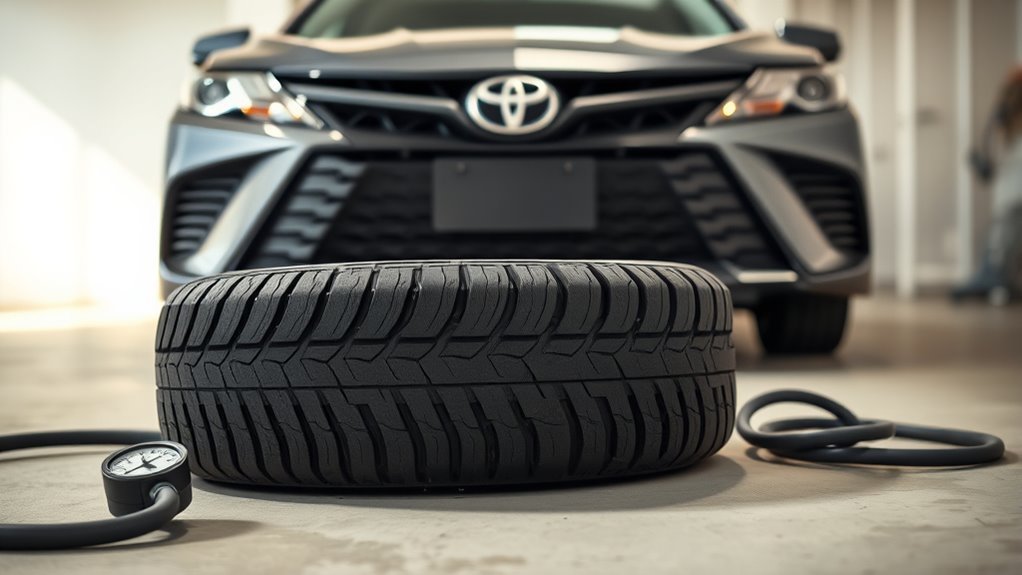
Camry tires can wear down the center when pressure is too high because the crown of the tread carries more load than the shoulders. Instead of the tread wearing evenly from edge to edge, the middle strip wears faster.
Center wear does not always mean pressure is the only cause. Tire design, wheel alignment, rotation habits, road surface, speed, and driving style can also affect wear. Still, if all four tires show center wear and your cold readings are above the placard, overinflation is a strong suspect.
Check tread depth across the inner shoulder, center, and outer shoulder. NHTSA says tires are not safe and should be replaced when tread is worn to 2/32 of an inch. If the center is much lower than the shoulders, correct the pressure and ask a tire shop whether the tire still has safe remaining tread.
How Overinflation Changes Ride Comfort
Overinflated tires feel harder because the sidewall and tread do not flex as much over bumps. In a Toyota Camry, that can make a normally smooth ride feel sharp, noisy, or unsettled. You may feel road seams through the floor, sharper impacts through the seats, and more vibration on coarse pavement.
That extra harshness can also make small road imperfections feel larger than they are. Correct tire pressure helps the tire work with the suspension instead of forcing the suspension to absorb more impact on its own.
A properly inflated Camry tire should feel controlled, not harsh. If the ride suddenly becomes stiff after adding air, recheck the cold PSI against the door-jamb placard.
How Overinflation Affects Handling and Braking
When you overinflate your Toyota Camry’s tires, the tire can become less compliant. That means it may not conform to the road surface as well, especially over rough or wet pavement. The result can be reduced grip, more steering nervousness, and less stable braking feel.
Correct pressure keeps the tire closer to the shape Toyota intended. That supports steering response, braking consistency, tire wear, fuel economy, and ride comfort.
Reduced Road Grip
Reduced road grip does not always feel dramatic. It may show up as a slight loss of confidence in rain, a harder impact over potholes, or a twitchy feel during fast lane changes. If the tire is also worn, old, or damaged, the effect can become more serious.
Check the tread pattern and pressure together. Pressure alone is not the whole story, but it is one of the easiest safety items to control.
Emergency Braking Feel
During emergency braking, tires need to transfer braking force to the road. If pressure is too high, the tire’s footprint can become smaller and less even. That can leave the braking system with less available grip, especially on wet or uneven roads.
Do not try to tune braking feel by guessing PSI. Use the placard pressure, then solve remaining braking problems by checking tire condition, tread depth, brake condition, alignment, and suspension wear.
What Tire Damage Overinflation Can Cause
Excess air pressure can contribute to several tire problems on a Toyota Camry:
- Center tread wear: The center of the tread wears faster than the shoulders.
- Impact damage: A stiffer tire may absorb potholes and road edges less effectively.
- Ride vibration: A harsh ride can make existing tire or wheel problems more noticeable.
- Reduced wet grip: Uneven contact can make wet-road traction less predictable.
- Earlier replacement: Uneven wear can shorten the tire’s useful service life.
Also inspect for unrelated but serious problems, including sidewall bulges, cracking, exposed cords, punctures, and tread separation. These conditions need professional attention even if the tire pressure is now correct.
How to Check Toyota Camry Tire Pressure
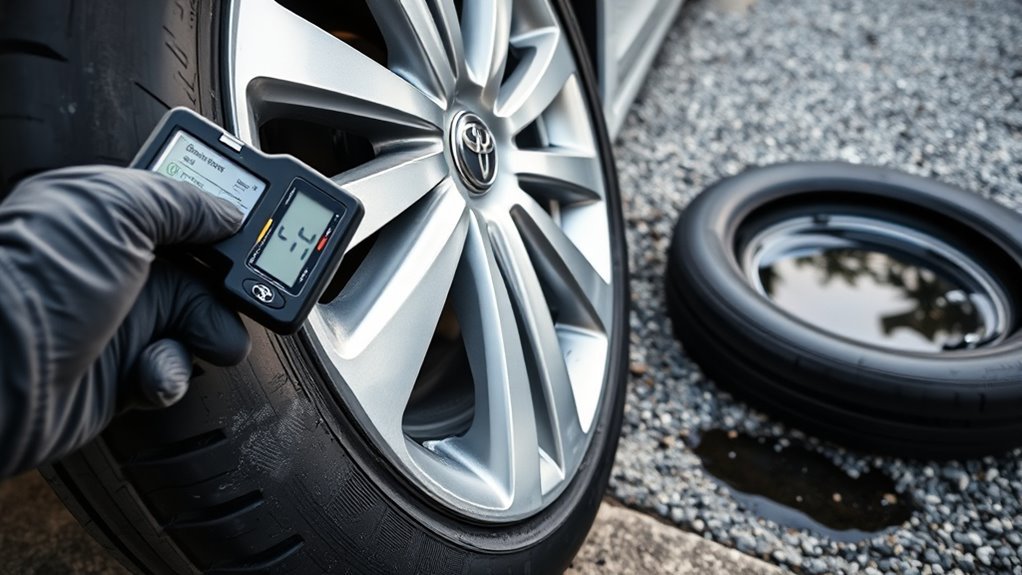
Follow these steps to check your Toyota Camry’s tire pressure accurately:
- Park long enough for cold tires. For the most accurate reading, check before driving or after the car has been parked for at least three hours.
- Find the recommended PSI. Look at the driver-side door-jamb label or the correct owner’s manual for your Camry year and tire size.
- Remove the valve cap. Keep it somewhere clean so dirt does not enter the valve area.
- Press the gauge squarely onto the valve stem. A brief hiss is normal, but a long hiss usually means the gauge is not sealed correctly.
- Read the PSI. Compare the number with the placard value for the front and rear tires.
- Adjust slowly. Add or release air as needed, then recheck with the gauge.
- Replace the valve cap. Tighten it by hand to protect the valve stem from dirt and moisture.
Pro Tip: Keep a quality tire gauge in the glove box. TPMS can warn you about low pressure, but NHTSA says it is not a substitute for regular pressure checks with a gauge.
How to Let Air Out of Camry Tires
To release air from your Toyota Camry tires, start with cold tires and your pressure gauge nearby. Remove the valve cap, then press the small valve pin with the edge of your gauge or a tire-pressure tool. Release air in short pulses instead of holding the valve open for a long time.
Start with cold tires, then release air in small pulses, checking pressure often for precise, controlled adjustment.
- Press the valve pin briefly until you hear air escape.
- Stop and recheck the PSI with your gauge.
- Repeat until the reading matches the placard pressure.
- Reinstall the valve cap by hand.
If you release too much air, add air back in small amounts and recheck. Do not drive on an underinflated tire just because you were trying to correct overinflation.
When Not to Release Air Right Away
Be careful when the tires are hot from driving. A warm tire can read higher than its true cold pressure. If the tire is only slightly above the placard after a drive, let the Camry sit and recheck it cold before you release air.
If a tire is dramatically high, damaged, or causing the car to feel unstable, park in a safe place and correct it carefully. If you are not sure whether the tire is safe, do not keep driving at highway speed. Ask a tire shop or roadside service for help.
How to Keep Camry Tires Properly Inflated
Keep your Toyota Camry tires properly inflated by building a simple monthly routine. Check all four tires when cold, use the door-jamb placard as your target, and include the spare if your Camry has one. Pressure can change with temperature, slow air loss, valve leaks, punctures, and seasonal weather shifts.
FuelEconomy.gov notes that properly inflated tires are safer, last longer, and can support better gas mileage. NHTSA also says proper tire pressure affects tire safety, durability, and fuel consumption.
Season changes matter. When outside temperatures drop, tire pressure usually drops too. When temperatures rise or after highway driving, pressure readings may be higher. That is why the cold placard pressure is the standard reading to trust.
What to Do If You Drove With Overinflated Tires
If you drove with overinflated Camry tires, do not panic. Park safely, let the tires cool, and check the pressure again when cold. If the reading is still above the placard, release air slowly and recheck.
Then inspect the tires. Look for center wear, bulges, sidewall cuts, cracks, punctures, exposed cords, or vibration at speed. If you recently hit a pothole or curb, get the tire and wheel inspected even if the pressure now looks correct. Damage from an impact may not be obvious right away.
Can TPMS Warn About Overinflated Tires?
Do not rely on TPMS to catch overinflation. Many systems focus on warning you when a tire is significantly underinflated. Some vehicles may display individual pressure readings, but a manual gauge is still the safest way to confirm the actual cold PSI.
If the TPMS light flashes and then stays on, the system may have a fault. Check your owner’s manual and have the system inspected if the warning does not clear after pressure is corrected.
Frequently Asked Questions
Is having Toyota Camry tires inflated to 40 PSI bad?
It can be bad if 40 PSI is above the cold pressure listed on your Camry’s door-jamb placard. Some tires list a higher maximum pressure on the sidewall, but that is not the normal target for your vehicle. Recheck when the tires are cold and adjust to the placard value.
What happens if you overinflate a tire by 2 PSI?
A cold reading 2 PSI above the placard is usually not the same risk as severe overinflation, but you should still adjust it back to the recommended pressure. If the tire was checked warm after driving, let it cool and measure again before releasing air.
Should I use the PSI on the tire sidewall?
No. Use the Toyota-recommended cold PSI on the Tire and Loading Information Label or in the owner’s manual. The sidewall number is a tire limit, not the recommended pressure for everyday Camry driving.
Can TPMS tell me if my tires are overinflated?
Do not rely on TPMS alone. Many systems focus on warning when a tire is significantly underinflated. A manual gauge check is still the best way to confirm whether your tires are above the recommended cold PSI.
Can overinflated tires cause center tread wear?
Yes. Overinflation can make the center of the tread carry more load than the shoulders, which can wear the middle faster. Alignment, rotation, suspension condition, and driving style can also affect tread wear, so inspect the full tire before blaming pressure alone.
Should I lower tire pressure after highway driving?
Usually, no. Highway driving heats the tire and can raise the pressure reading. If the tire is only slightly high after driving, let it cool and recheck it cold. Adjust the tire only after you have a reliable cold reading, unless the pressure is clearly unsafe.
When should I replace an overinflated tire?
Replace or professionally inspect the tire if tread is at 2/32 inch, the center is severely worn, or you see bulges, exposed cord, deep cuts, cracking, tread separation, rapid air loss, or strong vibration. Correct pressure cannot repair structural tire damage.
Conclusion
If you overinflate your Toyota Camry tires, the fix is usually simple: check the pressure cold, compare it with the door-jamb placard, and release air slowly until each tire reaches the recommended PSI. Do not use the sidewall maximum as your normal target, and do not rely on TPMS alone.
After correcting the pressure, inspect the tires for center wear, sidewall damage, bulges, cracks, exposed cord, or vibration. If anything looks unsafe, have the tire checked by a qualified tire professional before you keep driving.
Sources
- NHTSA TireWise — tire pressure, cold-pressure checks, TPMS limits, tread-depth safety, and blowout guidance.
- Toyota Owner’s Manuals and Warranties — official Toyota manual lookup for model-year-specific tire-pressure information.
- FuelEconomy.gov: Keeping Your Vehicle in Shape — proper tire pressure, sidewall-pressure warning, fuel economy, safety, and tire-life guidance.

Related Articles

Toyota Camry Tire Performance in Hot Weather: Heat Effects on Tires
Watch how heat affects your Toyota Camry's tire performance and discover essential tips to safeguard your tires from potential hazards.
Read More
Toyota Camry Tire Performance in Cold Weather: What You Need to Know
Learn how cold weather affects your Toyota Camry's tire performance and discover essential tips to ensure your safety this winter. Don't miss out!
Read More
How to Improve Toyota Camry Wet Road Handling: Tire Tips That Work
Improve your Toyota Camry's wet road handling with essential tire tips that enhance grip and safety—discover the secrets to optimal performance.
Read More