A Toyota Tundra can carry heavy cargo and tow substantial loads, but those jobs also place extra demand on its tires. You can reduce the risk of a blowout by using the correct cold tire pressure, staying within the truck’s load limits, checking for damage and irregular wear, and responding quickly to pressure loss or vibration. Maintenance lowers the risk, although it cannot prevent every failure caused by road debris, hidden impact damage, or a tire defect.
Quick Answer
To prevent tire blowouts on your Toyota Tundra, check every tire cold at least monthly, use the pressure on the driver-door label, inspect tread and sidewalls, stay within the listed payload limits, rotate tires on schedule, and have leaks, bulges, vibration, or uneven wear inspected promptly.
Key Takeaways
- Use the cold PSI on your Tundra’s Tire and Loading Information label, not the maximum pressure molded into the tire sidewall.
- Check pressure, tread, sidewalls, valve stems, and the spare at least monthly and before towing or taking a long trip.
- Count passengers, bed cargo, accessories, and transferred trailer load when checking the truck’s available carrying capacity.
- Replace a tire for unsafe tread, bulges, deep cracks, exposed cords, repeated pressure loss, or damage that cannot be safely repaired.
- If a blowout occurs, avoid sudden braking or steering, stabilize the truck, slow gradually, and pull off the road when it is safe.
At a Glance
| Time Required | About 10–15 minutes for a monthly inspection |
| Difficulty | Easy visual and pressure checks |
| Tools Needed | Accurate tire-pressure gauge, tread-depth gauge or penny, flashlight, and an air source |
| Cost | No added cost when you already have a gauge and access to compressed air; professional repair or replacement costs vary |
Understanding Tire Blowouts: What Happens on a Tundra?
A tire blowout is a rapid loss of air pressure that can make your Tundra pull, vibrate, lean, or become harder to control. A front-tire failure is usually felt more strongly through the steering wheel, while a rear-tire failure may feel like movement through the seat or body of the truck.
Underinflation is especially dangerous because it allows the tire’s sidewall to flex more than intended. That flex creates heat and internal stress, particularly during highway driving, hot weather, towing, or heavy hauling. Overinflation creates a different problem: a harder tire has less ability to absorb an impact and may be more vulnerable to pothole, curb, cut, or puncture damage.
Road debris, deep potholes, aging rubber, previous impact damage, unsuitable replacement tires, overloaded axles, and neglected pressure loss can also contribute to a failure. A properly maintained tire can still be damaged unexpectedly, so prevention and emergency preparation both matter.
The National Highway Traffic Safety Administration reported 511 traffic fatalities in tire-related crashes during 2024. Proper pressure, tread, load, and damage checks are basic safety steps, not optional cosmetic maintenance.
Top Causes of Tire Blowouts in Tundras
Incorrect Tire Pressure
Using too little air is a leading tire-failure risk. It increases flex, heat, rolling resistance, shoulder wear, and internal damage. Excess pressure can create harsh handling, uneven center wear, and greater sensitivity to road impacts.
Find the correct pressure on the Tire and Loading Information label inside the driver-side door area or in the owner’s manual for your exact model year. The number molded into a tire’s sidewall is its maximum permitted pressure under specified conditions, not the normal pressure recommendation for your Tundra.
Overloading the Truck or an Axle
Do not exceed the vehicle’s total load capacity, Gross Vehicle Weight Rating, or Gross Axle Weight Ratings. Occupants, bed cargo, tools, aftermarket accessories, a camper, and load transferred from a trailer all reduce the remaining carrying capacity.
Overloading can increase tire deflection and heat while reducing steering and braking control. Check the certification and loading labels on your truck because payload and axle limits vary by cab, bed, drivetrain, trim, equipment, and model year.
Worn, Damaged, or Unsuitable Tires
Low tread, exposed cords, bulges, cuts, deep cracks, punctures, previous impact damage, and repeated pressure loss require attention. Replace tires when the treadwear indicators are level with the tread. NHTSA identifies 2/32 inch as the minimum tread depth at which a tire should be replaced.
Replacement tires must match the approved size and provide enough load capacity for the truck. Do not rely on brand name alone. Confirm the tire size, load index or load range, speed rating, wheel compatibility, intended terrain, and towing or hauling requirements.
Heat, Speed, and Road Hazards
Long highway trips, hot pavement, heavy loads, low pressure, and sustained speed can combine to increase tire temperature. Potholes, curbs, construction debris, sharp stones, and road-edge impacts can damage the tread, sidewall, belt package, or wheel even when the tire does not lose air immediately.
Tire Age
Mileage alone does not determine tire life. Check the DOT Tire Identification Number on the sidewall. Its final four digits identify the production week and year. For example, “2323” means the tire was manufactured during the twenty-third week of 2023.
Five years is not an automatic replacement deadline for every tire. NHTSA notes that some vehicle and tire manufacturers recommend age-based replacement between six and ten years, regardless of remaining tread. Follow the instructions from Toyota and the tire manufacturer, and have aging tires inspected by a qualified technician.
Easy Maintenance Tips to Avoid Blowouts
- Locate the correct specifications: Check your driver-door label and model-year owner’s manual for the original tire size, cold inflation pressure, total load capacity, and axle ratings.
- Check pressure when the tires are cold: Measure all road tires and the spare after the truck has been parked for at least three hours. Check at least monthly and before towing or starting a long trip.
- Do not bleed pressure from a hot tire: Pressure normally rises while driving. Recheck and make final adjustments when the tire is cold.
- Inspect the entire visible tire: Look for nails, screws, cuts, bulges, cracks, missing rubber, exposed material, uneven wear, and damage near the bead or valve stem.
- Measure tread depth: Check several points across each tread. Uneven readings may indicate pressure, alignment, balance, suspension, or rotation problems.
- Rotate tires on schedule: Follow the maintenance guide for your exact Tundra. NHTSA gives a general 5,000–8,000-mile range when rotation is recommended by the manufacturer, but your truck’s schedule and tire arrangement take priority.
- Correct alignment or balance symptoms: Have pulling, steering-wheel shake, vibration, cupping, or rapid uneven wear inspected instead of repeatedly rotating the affected tires.
- Stay within load limits: Recalculate available capacity after adding passengers, cargo, accessories, towing equipment, or trailer load.
- Inspect the spare: A spare can lose pressure and age even when it has never been used. Confirm its pressure and condition before a trip.
- Check for recalls: Use the DOT tire identification information to search for open tire recalls and respond to manufacturer notices.
Pro Tip: Keep a quality pressure gauge, flashlight, reflective warning device, gloves, and the tools needed to access your spare in the truck. Confirm that the jack and wheel tools are present before a towing trip rather than discovering a missing part on the roadside.
[Products Worth Considering]

These universal tire valve stem caps help protect valve cores from dust, debris, and moisture while helping maintain stable tire pressure. The corrosion-resistant metal construction and sealed design provide reliable protection in road grime, mud, and winter conditions. Twist-on installation makes them quick to fit on cars, SUVs, trucks, and motorcycles.

Milton S-921 pencil tire pressure gauge helps you maintain optimal tire pressure for passenger cars with accurate readings in PSI and kPa. It features a built-in deflator valve for convenient pressure adjustments, plus a single chuck head and nylon indicator bar for easy use on the go. Built from durable plated brass and designed for reliable performance, it’s a practical road trip and cold-weather maintenance tool.
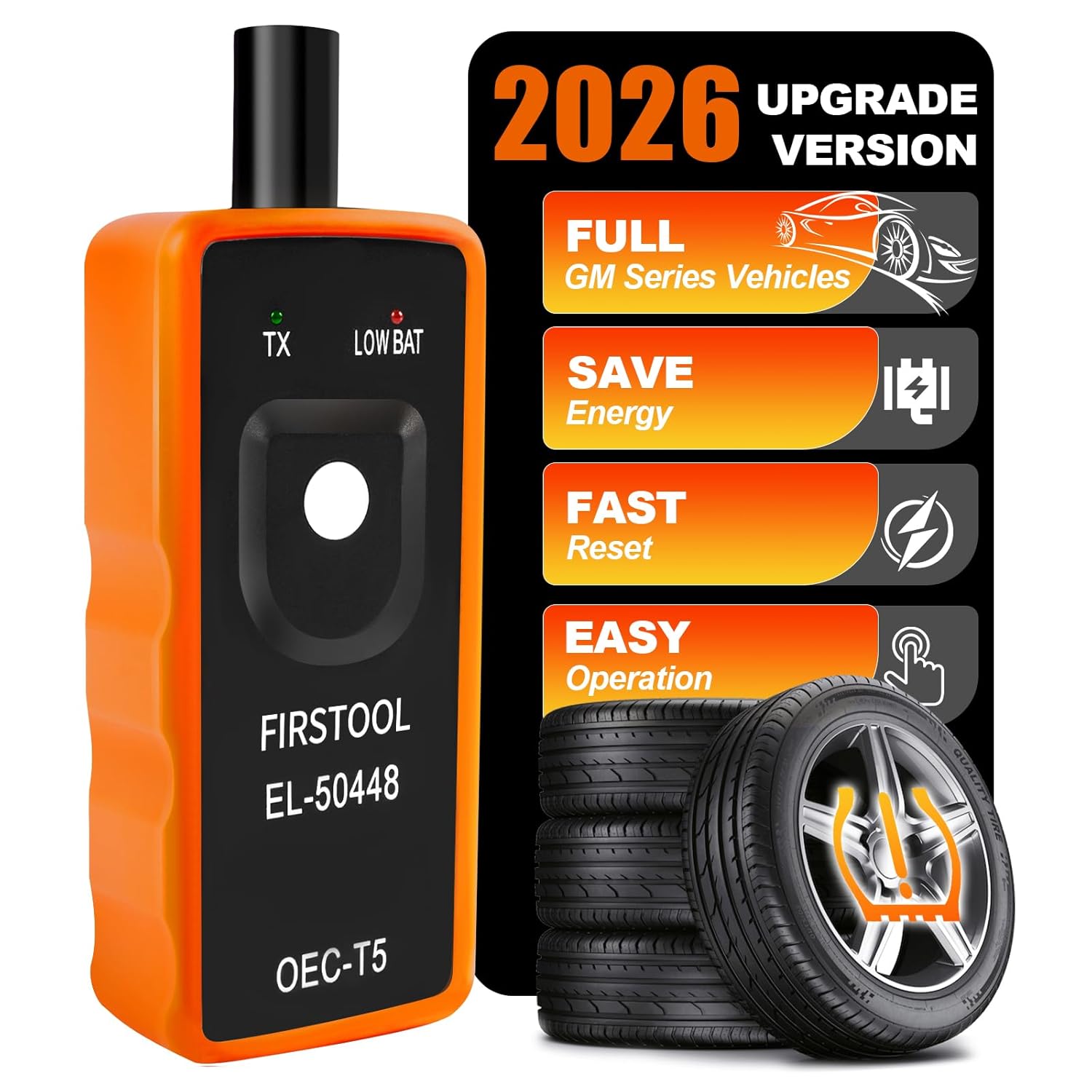
This TPMS relearn tool helps you quickly activate, match, and reset GM tire pressure sensors to keep the vehicle monitoring system working properly. It clears tire pressure alarms and dashboard warning lights after sensor replacement or tire rotation, and supports learning for common 315/433 MHz TPMS sensors. Designed for simple one-button operation, it can help you avoid unnecessary trips to repair shops.
How to Check Tundra Tire Pressure Correctly
- Park the Tundra for at least three hours so the tires are cold.
- Read the recommended front and rear pressures on the driver-door Tire and Loading Information label. Do not assume all Tundras use the same PSI.
- Remove the valve cap and press an accurate gauge squarely onto the valve stem.
- Add air when the reading is low. Release air in small amounts when a cold tire is above the placard specification.
- Measure again until the reading matches the specified cold pressure.
- Check the remaining tires and the spare.
- Reinstall every valve cap and inspect for leakage if a tire repeatedly loses pressure.
Note: A TPMS warning means at least one tire may already be significantly underinflated. The system does not replace monthly gauge checks, and Toyota warns that it may not provide an immediate warning during sudden air loss.
[Products Worth Considering]

These universal tire valve stem caps help protect your valve core from dust, debris, moisture, and corrosion, supporting more stable tire pressure. The aluminum alloy design resists long-term wear, while the sealing construction helps help prevent air leakage. They twist on easily for quick installation and help safeguard driving safety across cars, SUVs, trucks, and motorcycles.

These aluminum alloy tire valve stem caps protect the valve core from corrosion and help prevent air leakage for more stable tire pressure. The rubber ring design helps support a secure, safe seal while adding a stylish look to your Honda wheels. Easy to install by hand, these caps are ideal for everyday driving and weather exposure.

The TYAMATE TM8 solar-powered wireless TPMS delivers real-time tire pressure and temperature monitoring with six alarm modes for safer driving. A vibrant color LCD display shows readings clearly while windshield mounting keeps it hands-free and easy to read. With a wide 0–87 PSI range, strong 433.92 MHz signal transmission, and quick sensor pairing, it’s ideal for RV, sedan, SUV, MPV, and truck use.
Pre-Trip Tire Checklist for Towing or Heavy Loads
- Confirm the truck’s available payload from its own loading label.
- Include occupants, bed cargo, tools, accessories, hitch equipment, and transferred trailer load in the calculation.
- Confirm that each tire has the correct size and adequate load capacity.
- Check all tire pressures cold, including the spare.
- Inspect tread and sidewalls under bright light.
- Look for fresh damage after hitting a curb, pothole, or trail obstacle.
- Confirm that wheel fasteners have been serviced according to Toyota’s procedures.
- Do not begin the trip with a pressure leak, bulge, severe vibration, exposed cord, or TPMS malfunction that has not been diagnosed.
[Products Worth Considering]

Accurately measure tire tread depth with a calibrated gauge marked from 0 to 1 inch in 1/32 inch increments. The color-coded bar helps you quickly identify tread condition ranges, supporting safe driving for trucks, motorcycles, automobiles, and passenger vehicles.

Monitor tire tread wear with a smart, color-coded depth gauge that shows clear condition ranges at a glance. The bar is range marked for fast, easy readings, helping you maintain safer traction and performance. Each gauge is portable with a pocket clip, and the set includes 20 units for daily use and sharing.

Measure tire tread depth quickly and accurately with this LUMITECO dial gauge that reads in 1/32" increments up to 14/32". The color-coded green/yellow/red zones make it easy to judge tire wear and know when replacement is needed. A rugged, compact design with a protective pouch helps keep the gauge ready for use on cars, trucks, motorcycles, and more.
Recognizing Signs of Tire Blowouts

A blowout itself is sudden, but many dangerous tire conditions produce earlier warning signs. Inspect the truck or arrange professional service when you notice any of the following:
- A tire that repeatedly loses pressure.
- A TPMS warning that returns after inflation.
- A bulge, blister, split, deep crack, exposed cord, or distorted tread.
- Tread separation, a raised section, or an unusual wave in the tread surface.
- Steering-wheel shake, seat vibration, rhythmic thumping, or a new humming noise.
- Strong pulling to one side on a level road.
- One shoulder or the center of the tread wearing much faster than the rest.
- Damage after striking a pothole, curb, object, or trail obstacle.
- Tread at or below the wear indicators.
Warning: Do not continue driving on a flat tire or on a tire with a bulge, exposed cord, tread separation, severe vibration, or rapid pressure loss. Move to a safe location without abrupt steering or braking and arrange repair, spare-tire installation, or towing.
What to Do if a Tundra Tire Blows Out
Your first goal is to keep the truck balanced and pointed in a safe direction. Do not react by slamming the brakes or making a sharp steering correction.
- Hold the steering wheel with both hands.
- Look where you want the truck to go and make only the steering corrections needed to keep it stable.
- Avoid sudden braking. Abrupt braking can transfer weight and increase instability.
- Maintain speed briefly if necessary and safe while you regain control. Do not accelerate aggressively.
- Release the accelerator gradually after the truck is stable.
- Allow the vehicle to slow progressively.
- Move off the roadway only when you have a safe shoulder, parking area, or exit.
- Turn on the hazard flashers and stop as far from moving traffic as practical.
Front and rear blowouts can feel different, but the basic control steps remain the same. A front failure is commonly felt through the steering, while a rear failure may be felt more through the seat or body.
What to Do After You Stop Safely
- Set the parking brake and keep passengers away from moving traffic.
- Do not stand beside the damaged tire when traffic is passing close to the truck.
- Inspect from a safe position without crawling beneath an unsupported vehicle.
- Use the spare only according to the instructions and limitations in your Tundra owner’s manual.
- Arrange roadside assistance when the surface is soft, sloped, narrow, unstable, or too close to traffic for a safe tire change.
- Have the damaged tire and wheel inspected. A pothole or blowout can also damage the rim, suspension, wheel well, brake components, or nearby bodywork.
- Check the remaining tires for matching wear, pressure, age, size, and load capacity before returning to normal use.
When to Seek Professional Help for Tire Issues
Arrange prompt inspection by a qualified tire technician when you find a structural defect or cannot explain a change in pressure, noise, vibration, or wear.
- Repeated pressure loss: A tire that needs frequent inflation may have a puncture, valve leak, bead leak, damaged wheel, or internal problem.
- Bulges, exposed material, or tread separation: These conditions can indicate structural damage and require immediate removal from service.
- Uneven or rapid wear: A professional should check pressure history, alignment, balance, suspension, wheel condition, and rotation practices.
- Persistent vibration or noise: Do not assume every vibration is harmless imbalance. Tire or wheel damage can worsen with continued driving.
- Impact damage: Arrange inspection after a severe pothole, curb, debris, or off-road impact, even if the tire still holds air.
- Unsuitable replacement tires: Get help confirming size, wheel fit, load capacity, speed rating, and compatibility with the truck’s TPMS.
- Aging tires: Have older tires evaluated according to Toyota and tire-manufacturer guidance, especially when their history is unknown.
- TPMS malfunction: A warning light that flashes before remaining illuminated can indicate a system fault that requires diagnosis.
Frequently Asked Questions
How can I check my tire pressure accurately?
Use an accurate gauge after the truck has been parked for at least three hours. Compare the reading with the cold pressure printed on the driver-door Tire and Loading Information label. Check every road tire and the spare, then reinstall the valve caps.
What should I do immediately after a blowout?
Hold the wheel with both hands, avoid sudden braking or steering, and stabilize the Tundra. Maintain speed briefly if needed and safe, then release the accelerator gradually. Slow down and pull off the road only when you have a safe place to stop.
Are there specific tire brands recommended for Tundras?
No single brand is best for every Tundra. Choose a tire that matches the approved size, wheel, load capacity, speed rating, climate, terrain, towing needs, and driving style. Verify the specifications in your model-year manual and loading label before buying.
How often should I rotate my tires?
Follow the maintenance guide for your exact Tundra and tire arrangement. NHTSA gives a general range of 5,000 to 8,000 miles when rotation is recommended, but uneven wear may require earlier inspection and some tire arrangements need a specific rotation pattern.
Can weather conditions affect tire blowouts?
Yes. Cold weather lowers inflation pressure, while hot weather, sustained speed, heavy loads, and underinflation can increase operating heat. Check pressure cold when seasons change and before long summer trips, towing, or heavy hauling.
What PSI should I use in a Toyota Tundra?
Use the cold front and rear pressures shown on your truck’s driver-door label. Tundra pressure can vary by year, configuration, tire size, and equipment, so a universal PSI answer is unsafe. Do not use the maximum sidewall pressure as the normal setting.
Does TPMS prevent a tire blowout?
No. TPMS can alert you to significant underinflation, but it does not inspect tread, detect every type of structural damage, or guarantee an immediate warning during rapid pressure loss. Continue checking tire pressure manually every month.
Should I replace every tire after five years?
Not automatically. Inspect the tire’s condition and DOT date, then follow Toyota’s guidance and the tire manufacturer’s service-life policy. NHTSA notes that some manufacturers recommend age-based replacement between six and ten years, regardless of remaining tread.
Conclusion
Preventing a Toyota Tundra tire blowout starts with accurate cold-pressure checks, proper loading, regular tread and sidewall inspections, and tires that match the truck’s specifications. Do not use arbitrary mileage or five-year rules to judge every tire. Condition, age, pressure history, load, damage, and manufacturer guidance all matter.
Check the truck before towing, hauling, or taking a long highway trip. If you notice repeated air loss, a bulge, severe vibration, tread separation, exposed material, or a TPMS warning that will not clear, stop treating it as routine maintenance and arrange professional inspection. If a blowout occurs, stay calm, stabilize the truck, slow gradually, and move away from traffic when it is safe.
Sources
- NHTSA TireWise — tire pressure, tread depth, rotation, aging, TPMS, tire-related fatalities, and blowout-response guidance
- NHTSA Summer Driving and Road Trip Tips — cold-pressure checks, sidewall-pressure clarification, and pre-trip damage inspections
- Toyota Tundra Manuals and Warranties — model-year owner’s manuals, maintenance guides, tire specifications, loading information, and emergency procedures
- Toyota Tundra Tire-Pressure Warning Guidance — TPMS warnings, rapid pressure loss, cold-pressure checks, and system limitations
- U.S. Tire Manufacturers Association Tire Care Essentials — underinflation heat buildup, overinflation impact risk, rotation, pressure, and alignment guidance