
95H on a tire is the tire’s service description. The number 95 is the load index, and the letter H is the speed rating. In plain English, a 95H tire can carry 1,521 pounds per tire when properly inflated and is rated for speeds up to 130 mph under specified test conditions. Before buying one, match the full tire size, load index, and speed rating to your vehicle’s door-jamb placard or owner’s manual.
Quick Answer
95H means the tire has a load index of 95, which equals 1,521 pounds or 690 kg per tire, and an H speed rating, which equals 130 mph or 210 km/h. It is common on many passenger cars, but it must match your vehicle’s required tire size, load rating, and speed rating.
Key Takeaways
- 95 is the tire’s load index and equals 1,521 pounds or 690 kg per tire when properly inflated.
- H is the tire’s speed rating and equals 130 mph or 210 km/h under rated conditions.
- A 95H tire can be a good fit for many passenger vehicles, but only if the full tire size and ratings match the vehicle manufacturer’s specifications.
- Never treat the H rating as permission to drive 130 mph; always follow speed limits, road conditions, and your vehicle’s limits.
- Replace tires when tread reaches 2/32 inch, or sooner if there are cracks, bulges, puncture damage, age concerns, or uneven wear.
What Does 95H Mean on a Tire?
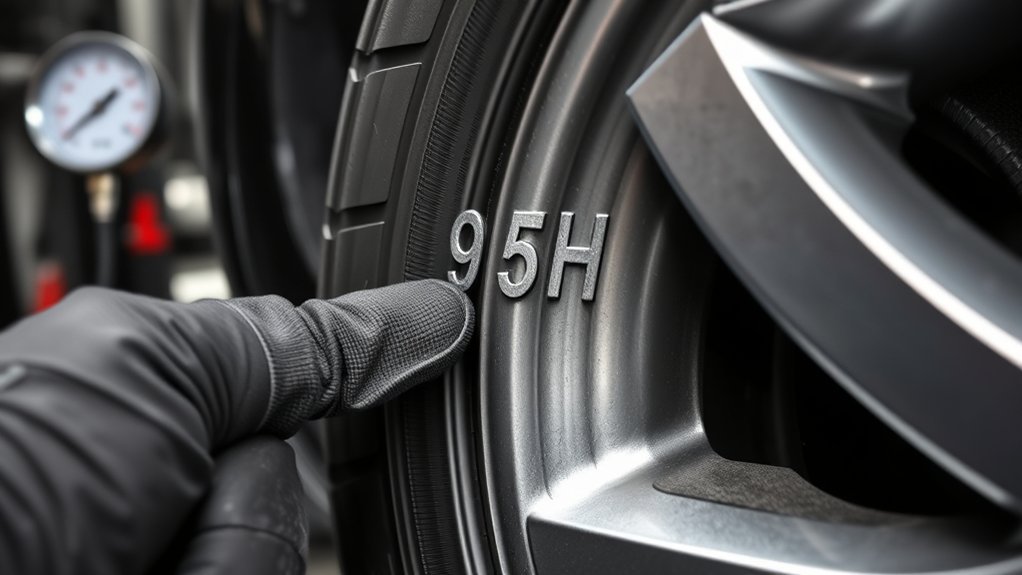
When you see 95H on a tire sidewall, it tells you two important things about the tire’s rated capacity and performance. The 95 is the load index, which tells you how much weight the tire can carry. The H is the speed rating, which tells you the maximum sustained speed the tire is designed to handle under specified conditions.
| 95 | Load index. A 95-rated tire can carry 1,521 lb or 690 kg per tire when properly inflated. |
| H | Speed rating. An H-rated tire is rated up to 130 mph or 210 km/h under specified test conditions. |
Together, 95H is not a random code. It is part of the tire’s service description and helps you choose a replacement tire that can support the vehicle’s weight, manage heat at highway speeds, and preserve predictable handling.
Warning: A speed rating is not permission to drive at that speed. It is a tire capability rating under controlled conditions. Always obey posted speed limits and reduce speed for weather, load, tire condition, and road hazards.
How to Read 95H on the Sidewall
You usually find 95H near the end of the tire size code. For example, in 205/65R16 95H, the size is 205/65R16 and the service description is 95H.
- 205 means the tire is 205 millimeters wide.
- 65 means the sidewall height is 65% of the tire’s width.
- R means radial construction.
- 16 means the tire fits a 16-inch wheel.
- 95 is the load index.
- H is the speed rating.
Do not replace a tire by looking at 95H alone. You need the complete tire size, load index, speed rating, and any special markings such as XL, Extra Load, run-flat, or winter-service symbols.
Load Index 95
A load index of 95 means one tire can carry up to 1,521 pounds or 690 kg when it is properly inflated and used within its design limits. Four 95-rated tires do not automatically mean your vehicle can safely carry 6,084 pounds of passengers and cargo. The vehicle’s suspension, axle ratings, wheels, and manufacturer load limits still control how much weight the vehicle can safely carry.
Note: Load index depends on correct inflation. An underinflated tire may overheat, wear faster, handle poorly, and fail even if the number on the sidewall looks correct.
Speed Rating H
An H speed rating means the tire is rated up to 130 mph or 210 km/h under specified load and inflation conditions. H-rated tires are common on many sedans, coupes, crossovers, and passenger vehicles that need a balance of everyday comfort and highway stability.
The speed rating also reflects how the tire is built to handle heat and stress. That matters even if you never drive near 130 mph, because highway driving, hot weather, heavy loads, and low pressure can all increase tire temperature.
Why 95H Matters for Safety
A tire’s load index and speed rating affect how the vehicle carries weight, brakes, corners, and responds during emergency maneuvers. If the tire’s load index is too low, it can be overloaded. If the speed rating is below the manufacturer’s requirement, the tire may not provide the heat resistance, construction, or handling characteristics the vehicle was designed around.
A correct 95H tire supports the vehicle only when the full tire size, load index, speed rating, pressure, and condition all match the manufacturer’s requirements.
The safest approach is simple: match or exceed the load index and speed rating listed by your vehicle manufacturer, unless the owner’s manual gives an approved alternative.
How to Know If 95H Fits Your Vehicle
To know whether 95H is right for your vehicle, check the Tire and Loading Information Label, usually on the driver’s doorjamb, door edge, fuel door, or in the owner’s manual. That label lists the original equipment tire size and the recommended cold tire pressure.
Pro Tip: Match the tire placard first, not the old tire alone. A previous owner may have installed the wrong size, load index, or speed rating.
Use this quick check before buying:
- Size: Match the full size, such as 205/65R16, not just 95H.
- Load index: Choose a load index that meets or exceeds the manufacturer’s required rating.
- Speed rating: Choose a speed rating that meets or exceeds the manufacturer’s required rating unless the manual allows a specific exception.
- Inflation pressure: Use the vehicle placard’s cold PSI, not the maximum PSI printed on the tire sidewall.
- Tire type: Choose the right tire for your climate and use, such as all-season, winter, summer, touring, performance, or light-truck-rated tires.
[Products Worth Considering]

Measure tire tread depth quickly and accurately with this LUMITECO dial gauge that reads in 1/32" increments up to 14/32". The color-coded green/yellow/red zones make it easy to judge tire wear and know when replacement is needed. A rugged, compact design with a protective pouch helps keep the gauge ready for use on cars, trucks, motorcycles, and more.

Keep your tires properly inflated with this analog VONDIOR tire pressure gauge, designed for fast, easy readings without batteries. The swiveling, two-axis hose and large glow dial help you measure at any tire angle with instant visibility. Built with a protective rubber shield, it supports durable, low-maintenance use for cars and trucks.

Accurately measure tire tread depth with a calibrated gauge marked from 0 to 1 inch in 1/32 inch increments. The color-coded bar helps you quickly identify tread condition ranges, supporting safe driving for trucks, motorcycles, automobiles, and passenger vehicles.
Can You Use a Higher or Lower Rating Than 95H?
You can often use a tire with a higher load index or higher speed rating if the size, fitment, and vehicle requirements are correct. For example, a 95V tire has the same load index as 95H but a higher speed rating. However, a higher rating does not automatically mean the tire will ride better, last longer, or grip better in rain or snow.
Using a lower load index than specified is not recommended because it can reduce the tire’s load-carrying capacity. Using a lower speed rating than specified can also affect handling, heat resistance, and vehicle speed capability.
| Rating | Load Capacity | Speed Rating | Best Use |
| 95T | 1,521 lb / 690 kg | 118 mph / 190 km/h | Only if your vehicle allows a T rating. |
| 95H | 1,521 lb / 690 kg | 130 mph / 210 km/h | Common balanced rating for many passenger vehicles. |
| 95V | 1,521 lb / 690 kg | 149 mph / 240 km/h | Often used where the vehicle calls for a higher speed rating. |
[Products Worth Considering]

The SAFELIFE dial tire tread depth gauge measures tread depth in 1/32 inch increments with clear, easy-to-read 2-inch dial face. Color zones using a traffic light system help you quickly judge whether tread is low, marginal, or ample for safer driving. Built with a durable zinc cast body and a metal detect probe for precise, comfortable use across cars, motorcycles, trucks, and buses.

Monitor tire tread wear with a smart, color-coded depth gauge that shows clear condition ranges at a glance. The bar is range marked for fast, easy readings, helping you maintain safer traction and performance. Each gauge is portable with a pocket clip, and the set includes 20 units for daily use and sharing.

A concentrated tire and tube mounting compound designed to help simplify mounting rubber tires and tubes on passenger, semi truck, construction, and OTR applications. Its ultra-thick formula packs beads effectively and includes rust inhibitors to help protect against corrosion during use.
Can You Mix 95H With Other Ratings?
It is best to use tires with the same size, load index, speed rating, construction, and similar tread pattern on all four wheel positions unless your vehicle manufacturer specifies a staggered setup. Mixing ratings can change handling balance, traction, braking feel, and stability-control behavior.
If you install a tire with a lower speed rating than the others, the vehicle’s maximum tire speed capability is limited by the lowest-rated tire. If you must mix tires because of an emergency replacement, keep it temporary and ask a tire professional or your vehicle manufacturer for the safest placement and replacement plan.
Warning: Do not mix passenger tires with light-truck tires, run-flat tires with conventional tires, or different tire sizes unless your vehicle manufacturer specifically approves that setup.
How 95H Affects Ride, Handling, and Wear
A 95H tire usually offers a practical balance of load capacity, comfort, and highway performance. The load index supports the vehicle’s weight needs, while the H speed rating indicates the tire is built to manage sustained highway heat and stress better than a lower-rated tire of the same type.
That does not mean every 95H tire feels the same. Ride comfort, noise, grip, tread life, and wet braking depend on the tire’s tread design, compound, casing construction, UTQG ratings, and how well it is maintained. Two tires with the same 95H service description can still perform very differently.
For longer tire life, keep pressure correct, rotate tires on schedule, balance new tires when installed, and fix alignment problems if you see uneven wear.
What Else to Check Before Buying Tires
Before buying 95H tires, check more than the service description. A tire can have the right 95H rating and still be wrong for your vehicle if the size, load range, tire type, or seasonal design does not match your needs.
| Check | What to Look For | Why It Matters |
| Tire size | Example: 205/65R16 | Controls wheel fitment, clearance, speedometer accuracy, and handling. |
| Load index | 95 or higher if required | Helps the tire carry the vehicle’s rated load safely. |
| Speed rating | H or higher if specified | Supports the vehicle’s intended heat resistance and handling characteristics. |
| UTQG | Treadwear, traction, temperature grades | Helps compare treadwear, wet stopping traction, and heat resistance among passenger tires. |
| Tire type | All-season, winter, summer, touring, performance | Affects grip, braking, ride comfort, snow performance, and tread life. |
| Date and condition | DOT date code, cracks, bulges, repairs, uneven wear | Old or damaged tires can be unsafe even if the tread depth looks acceptable. |
[Products Worth Considering]

Protect tire valves from water, dust, and sand to help prevent leaks and support safe driving. These universal stem caps install quickly by hand and feature durable aluminum alloy construction with an inner sealing ring for better air retention. Compatible with cars, SUVs, trucks, motorcycles, and bicycles for everyday convenience.

Milton S-921 pencil tire pressure gauge helps you maintain optimal tire pressure for passenger cars with accurate readings in PSI and kPa. It features a built-in deflator valve for convenient pressure adjustments, plus a single chuck head and nylon indicator bar for easy use on the go. Built from durable plated brass and designed for reliable performance, it’s a practical road trip and cold-weather maintenance tool.

The Airmoto portable tire inflator quickly and accurately fills car, truck, SUV, motorcycle, and bicycle tires up to 120 PSI with auto shut-off when your target pressure is reached. Its large LCD, multi-unit pressure display, and digital gauge make it easy to dial in settings and verify readings, while the built-in LED flashlight helps in low light. The included polyurethane hard carrying case and storage mesh pocket keep the inflator and accessories protected and organized.
When to Replace Tires With 95H
Replace a 95H tire when the tread reaches 2/32 inch, when the treadwear indicators are flush with the tread, or when the tire shows damage such as cracks, sidewall bulges, exposed cords, punctures that cannot be repaired safely, or severe uneven wear.
You should also check tire pressure and tread at least once a month and before long road trips. If your vehicle vibrates, pulls to one side, loses pressure repeatedly, or makes unusual tire noise, have the tires inspected by a qualified technician.
Age matters too. Some vehicle and tire manufacturers recommend replacing tires after six to 10 years regardless of tread depth. Check the DOT Tire Identification Number on the sidewall to find the tire’s manufacture week and year.
Frequently Asked Questions
Which tire rating is better, H or T?
H is the higher speed rating. A T-rated tire is rated up to 118 mph, while an H-rated tire is rated up to 130 mph. That does not automatically make H better for every vehicle. The better choice is the rating your vehicle manufacturer specifies on the tire placard or in the owner’s manual.
What is the difference between 95T and 95H?
95T and 95H have the same load index, so both can carry 1,521 pounds or 690 kg per tire when properly inflated. The difference is speed rating: T is rated up to 118 mph, and H is rated up to 130 mph. Use the rating your vehicle requires.
What is the difference between 95H and 95V tires?
95H and 95V share the same load capacity of 1,521 pounds or 690 kg per tire. The V rating is higher for speed: V is rated up to 149 mph, while H is rated up to 130 mph. A 95V tire may be acceptable where a 95H tire is specified, but always confirm size, fitment, and manufacturer guidance.
What does 205/65R16 95H mean?
205/65R16 95H means the tire is 205 mm wide, has a sidewall height equal to 65% of its width, uses radial construction, fits a 16-inch wheel, has a 95 load index, and has an H speed rating. The 95H part means 1,521 pounds per tire and a 130 mph speed rating under specified conditions.
Can I replace a 95H tire with a 94H tire?
Do not use a 94H tire unless your vehicle manufacturer specifically allows that lower load index. A 94 load index carries less weight than a 95 load index, so it may reduce the tire’s load-carrying capacity below the vehicle’s requirement.
Does 95H affect fuel economy?
The 95H service description mainly tells you load capacity and speed capability. Fuel economy depends more on tire pressure, rolling resistance, tread design, size, vehicle alignment, driving style, and tire condition. Keep tires properly inflated for the best safety, tread life, and efficiency.
Conclusion
95H means the tire has a 95 load index and an H speed rating. That equals 1,521 pounds per tire and a rated speed of 130 mph under specified conditions. For safe replacement, do not shop by 95H alone. Match the complete tire size, load index, speed rating, tire type, and cold inflation pressure to the vehicle placard or owner’s manual. If the tire is worn, damaged, underinflated, too old, or below the required rating, replace it before it affects safety and handling.
Sources
- Michelin — Tire Load Rating & Speed Rating Explained — supports H speed rating and load/speed definitions.
- Bridgestone — Speed and Load Rating Charts Explained — supports 95 load index and H speed symbol values.
- NHTSA TireWise — Tire Safety Ratings and Awareness — supports tire pressure, tread, UTQG, maintenance, and tire-safety guidance.
- Tire Rack — How Do I Read My Tire Placard? — supports tire placard and manufacturer fitment guidance.
- Bridgestone Americas — Tire Replacement Guidance — supports tread depth, sidewall damage, and replacement guidance.
- U.S. Tire Manufacturers Association — Tire Care and Safety Guide — supports replacement-tire selection and tire-mixing cautions.
