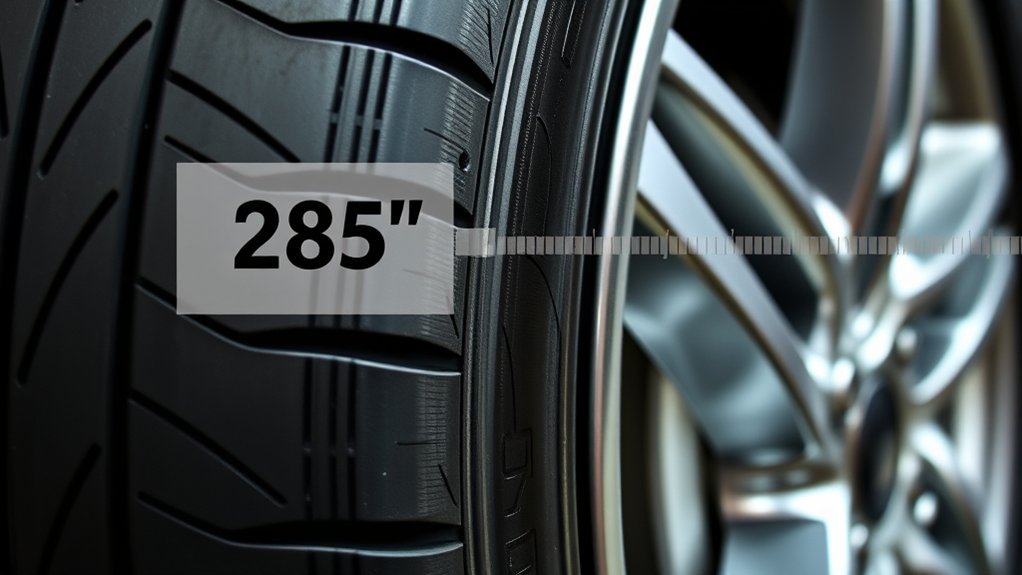
A tire marked 285 uses a metric tire-size code. The number 285 means the tire has a nominal section width of 285 millimeters, measured from sidewall to sidewall. It does not mean the tread alone is exactly 285 millimeters wide. To choose the right tire, you also need to read the aspect ratio, construction letter, wheel diameter, load index, speed rating, and vehicle fitment requirements.
Quick Answer
On a tire, 285 means the tire’s nominal section width is 285 millimeters from sidewall to sidewall. In a full size like 285/70R17, 70 is the sidewall aspect ratio, R means radial construction, and 17 is the wheel diameter in inches.
Key Takeaways
- “285” refers to the tire’s nominal section width: 285 millimeters from sidewall to sidewall.
- A full tire size, such as 285/70R17, also includes aspect ratio, construction type, and wheel diameter.
- A 285 tire is about 11.2 inches wide, but actual measured width can vary by brand, model, and rim width.
- Load index and speed rating must meet or exceed your vehicle manufacturer’s requirements.
- Before upsizing to 285 tires, check wheel-well clearance, rim width, offset, speedometer impact, and the tire placard.
What Does 285 Mean on a Tire?
The “285” in a tire size tells you the tire’s section width, measured in millimeters from one sidewall to the other. In a tire size like 285/70R17, the number 285 is only one part of the full code. According to Bridgestone’s tire-size guide, the first number in a metric tire size identifies width in millimeters.
This width is not the same as tread width. Section width includes the sidewalls, and the actual mounted width can change slightly depending on the tire model and the wheel width used for measurement. That is why two 285 tires from different brands may not measure exactly the same once installed.
Note: A tire’s published section width is a nominal size. Always check the manufacturer’s spec sheet for the exact mounted width, approved rim-width range, overall diameter, and load rating.
How to Read 285/70R17
A size like 285/70R17 gives you the tire’s width, sidewall height ratio, construction, and wheel diameter. Each part matters for fitment, ride height, handling, and speedometer accuracy.
| 285 | Nominal section width in millimeters, measured from sidewall to sidewall. |
| 70 | Aspect ratio. The sidewall height is 70% of the tire’s section width. |
| R | Radial construction, the common construction type on modern passenger and light-truck tires. |
| 17 | Wheel diameter in inches. The tire must be mounted on a 17-inch wheel. |
Using the formula, a 285/70R17 tire has an approximate sidewall height of 199.5 millimeters, or about 7.85 inches. The approximate overall diameter is about 32.7 inches because you add two sidewalls to the 17-inch wheel diameter.
Formula: 285 mm ÷ 25.4 = about 11.2 inches wide. For 285/70R17, sidewall height is 285 × 0.70 = 199.5 mm, or about 7.85 inches.
Section Width vs. Tread Width vs. Diameter
A 285 tire can confuse shoppers because width, tread width, and diameter are different measurements. The 285 number describes section width. Tread width is the part of the tire that contacts the road, and it is usually narrower than the section width. Overall diameter is the tire’s total height from the ground to the top of the tire.
| Section width | Sidewall-to-sidewall width. This is what the 285 number describes. |
| Tread width | The contact area across the tread face. It varies by tire design. |
| Overall diameter | The total tire height. It depends on width, aspect ratio, and wheel diameter. |
This difference matters when you compare tire sizes. A 285/70R17 is much taller than a 285/45R22, even though both start with 285. The aspect ratio and wheel diameter decide the final height.
How 285 Tire Width Affects Fit
A 285 tire can give your vehicle a wider stance and a larger contact patch, but it also needs more room inside the wheel well. Wider tires may rub the fender liner, control arms, sway bar, mud flaps, or bodywork during full steering lock or suspension compression.
- Measure inner fender and suspension clearance.
- Check clearance at full steering lock in both directions.
- Verify wheel offset and backspacing before buying.
- Confirm the rim width is approved for the exact tire model.
- Inspect alignment after installation to help prevent uneven wear.
Wheel offset is especially important. A wheel with too much positive offset can push the tire inward toward suspension parts. A wheel with too much negative offset can push the tire outward toward the fender. If you drive on trails, tire flex and suspension movement can create rubbing that does not appear while the vehicle is parked. For more off-road context, you can compare how aggressive tread patterns affect traction and clearance.
Warning: Do not choose 285 tires just because they fit another vehicle online. Use your owner’s manual, the Tire and Loading Information Label, and a qualified tire professional before changing from the original size.
[Products Worth Considering]

This manual duck head tire changer kit makes tire installation and removal simpler by letting you embed the duck head into the tire with applied pressure. The integrated design and durable steel construction help reduce friction and improve efficiency and safety during use. Suitable for 16–21 inch wheels, it’s convenient for cars, trucks, SUVs, and ATV tires, with 24-hour after-sales support.

Keep your tires properly inflated with this analog VONDIOR tire pressure gauge, designed for fast, easy readings without batteries. The swiveling, two-axis hose and large glow dial help you measure at any tire angle with instant visibility. Built with a protective rubber shield, it supports durable, low-maintenance use for cars and trucks.

Measure tyre tread depth precisely with a digital gauge that reads in both MM and inches, helping you monitor safe driving conditions. The large LCD screen is easy to operate, and the compact tool fits for cars, trucks, and motorcycles. It provides high accuracy with a 0-25.4mm range and includes a 1-year warranty for added peace of mind.
What the Load Index Means
Load index tells you how much weight a tire can carry when it is used correctly and inflated to the required pressure. The number appears after the tire size, often next to the speed rating. For example, in 285/70R17 121/118Q, the 121/118 portion is the load index.
Goodyear’s load-index guide explains that load-index numbers correspond to specific weight capacities on a chart. Passenger tires usually show one load-index number. LT tires may show two numbers, with the first for single-tire use and the second for dual-tire use.
- Find the tire size, load index, and speed rating on the sidewall.
- Compare them with your vehicle’s tire placard and owner’s manual.
- For LT tires, check both load index and load range.
- Do not exceed the tire’s rated load capacity.
As a common chart example, load index 94 is rated at about 1,477 pounds per tire. Load index 121 is commonly rated at about 3,197 pounds in single-tire service. Always verify the exact value in the tire manufacturer’s published specs, especially for LT tires used for towing, hauling, or off-road driving.
Note: Load index is not the same as load range. Load range, such as C, D, or E on light-truck tires, describes construction strength and inflation capability. The load index gives the actual chart-based carrying capacity.
Also remember that UTQG ratings are separate from load capacity. UTQG ratings help compare treadwear, traction, and temperature grades on many passenger tires, while load index tells you how much weight the tire can carry.
How Tire Speed Ratings Work
The speed rating is the letter after the load index. It shows the tire’s speed capability under rated conditions. A speed rating is not permission to exceed posted speed limits, and it does not guarantee safe handling in every weather, load, or road condition.
Bridgestone explains that an S-rated tire is rated up to 112 mph, while an R-rated tire is rated up to 106 mph. It also notes that replacement tires should have the same or higher speed rating as the vehicle’s original equipment, and the lowest speed rating in a mixed set limits the vehicle’s tire speed capability. You can also review Goodyear’s speed-rating chart for common rating letters.
| R | Up to 106 mph |
| S | Up to 112 mph |
| T | Up to 118 mph |
| H | Up to 130 mph |
| V | Up to 149 mph |
If your vehicle came with H-rated tires, installing a lower-rated tire may reduce the tire speed capability and may not meet the manufacturer’s recommendation. Match the speed rating to the vehicle placard, owner’s manual, and intended use.
Can You Fit Larger Tires?
Yes, you can often fit larger tires, but only when the size stays safe for your vehicle. NHTSA says new tires should be the same size as the original tires or another size recommended by the vehicle manufacturer. If you are unsure, consult a tire dealer or qualified tire professional.
Larger or wider tires can improve ground clearance and off-road traction, but they can also change steering feel, braking response, fuel economy, gearing, and speedometer accuracy. Discount Tire’s tire-size comparison guide recommends checking clearance at turn-to-lock and full suspension travel, matching or exceeding original load and speed ratings, and checking speedometer impact when diameter changes.
- Compare the new size with your original tire size.
- Check wheel-well clearance at full lock and compression.
- Confirm rim width, offset, and backspacing.
- Match or exceed the original load index and speed rating.
- Check whether the diameter change affects the speedometer or odometer.
- Recheck alignment and rubbing after installation.
Pro Tip: Use a tire-size calculator before buying. Compare section width, sidewall height, diameter, circumference, and revolutions per mile so you can estimate clearance and speedometer change.
[Products Worth Considering]

Monitor tire tread wear with a smart, color-coded depth gauge that shows clear condition ranges at a glance. The bar is range marked for fast, easy readings, helping you maintain safer traction and performance. Each gauge is portable with a pocket clip, and the set includes 20 units for daily use and sharing.

Upgrade your 2024-2026 Tesla Model 3 Highland with REEVAA all-weather mud flaps designed for seamless fit along the original body lines. The set of four delivers strong splash protection against mud, gravel, and road debris while using OEM-grade durable materials. Installation is non-destructive with original hole positions and snap-in clips, and the aerodynamic design helps minimize impact on efficiency.

Replace worn or missing TPMS sensors with a pre-programmed 4-pack designed for compatible GM vehicles. These 315MHz sensors provide real-time tire pressure monitoring and alert you if pressure is too high, too low, or if a rapid air leak occurs. Most installations are ready with minimal relearn effort after mounting, helping improve safety and driving confidence.
How to Choose the Right 285 Tire
To choose the right 285 tire, start with your vehicle’s approved tire sizes. Check the tire placard on the driver’s door edge or doorjamb, then confirm the same information in the owner’s manual. NHTSA also reminds drivers that the correct tire pressure is the vehicle manufacturer’s recommended cold tire pressure, not the maximum pressure printed on the tire sidewall.
[Products Worth Considering]

Measure tire tread depth quickly and accurately with this LUMITECO dial gauge that reads in 1/32" increments up to 14/32". The color-coded green/yellow/red zones make it easy to judge tire wear and know when replacement is needed. A rugged, compact design with a protective pouch helps keep the gauge ready for use on cars, trucks, motorcycles, and more.

This tire inflator with pressure gauge delivers long-lasting performance with a durable rubber-protected gauge and sturdy build. The longer hose and 360 swivel air chuck help you seal the valve securely and keep your hands free while measuring, inflating, or deflating. It’s battery-free for reliable use and provides ±2 PSI accuracy in the mid-range for most typical tires, with universal compatibility for 1/4 NPT compressor outputs.

Milton S-921 pencil tire pressure gauge helps you maintain optimal tire pressure for passenger cars with accurate readings in PSI and kPa. It features a built-in deflator valve for convenient pressure adjustments, plus a single chuck head and nylon indicator bar for easy use on the go. Built from durable plated brass and designed for reliable performance, it’s a practical road trip and cold-weather maintenance tool.
Match Load and Speed
A 285 tire’s width can affect grip and stance, but safety depends on the full service description. Match the load index and speed rating to your vehicle’s requirements. For towing, hauling, or off-road use, pay close attention to LT construction, load range, maximum load, and recommended inflation.
- Read the tire placard and owner’s manual.
- Match or exceed the original load index.
- Match or exceed the original speed rating.
- Confirm whether you need P-metric, LT-metric, or another tire type.
- Verify the manufacturer’s approved rim-width range.
R-rated tires handle up to 106 mph, while S-rated tires handle up to 112 mph under rated conditions. Choose based on the vehicle manufacturer’s requirement, not only the tire size printed in the listing.
Confirm Vehicle Fitment
Before you buy a 285 tire, make sure your vehicle can physically and mechanically support it. A 285 tire is about 11.2 inches wide by nominal section width, but the exact mounted width and diameter vary by tire model. Confirm the tire’s published overall diameter, recommended rim width, load index, speed rating, and tread design.
Fitment also depends on suspension height, wheel offset, fender shape, mud flaps, brake clearance, and whether the vehicle carries heavy cargo. If you are comparing all-season or touring tire choices, you can use UTQG ratings as one extra comparison point, but never use UTQG in place of load index, speed rating, and fitment specs.
Check Real-World Driving Needs
The best 285 tire depends on how you drive. A highway all-season tire may feel quieter and last longer on pavement. An all-terrain tire may add trail grip but create more road noise. A mud-terrain tire may help in deep mud but reduce comfort and wet-road refinement. Match the tire to your actual driving, not just the largest size that fits.
For a broader look at tire features, review related tire specifications and compare treadwear, traction needs, climate, road noise, and warranty coverage. A treadwear warranty can help you compare expected longevity, but it does not guarantee the tire will fit your vehicle.
Frequently Asked Questions
Are 285 tires the same as 33-inch tires?
Not exactly. A common size like 285/70R17 measures about 32.7 inches tall, so many people casually call it a 33-inch tire. The exact diameter depends on the aspect ratio, wheel diameter, tread depth, tire model, and inflation. Always compare the published overall diameter before buying.
Which tire is taller, 285 or 275?
A 285 tire is wider than a 275 tire, but it is only taller when the aspect ratio and wheel diameter are the same. For example, a 285/70R17 is taller than a 275/70R17. But a 285 with a lower aspect ratio may be shorter than a 275 with a higher aspect ratio.
Is a 285 a 31-inch tire?
Usually, no. A 285/70R17 is about 32.7 inches tall, while a 285/75R16 is about 32.8 inches tall. But “285” alone does not tell you diameter. You need the aspect ratio and wheel diameter to calculate the tire’s total height.
Is a 285 tire bigger than a 265?
A 285 tire is 20 millimeters wider than a 265 tire by nominal section width. It is not always taller, though. Overall height depends on aspect ratio and wheel diameter. Compare the full size, such as 285/70R17 vs. 265/70R17, before deciding.
How wide is a 285 tire in inches?
A 285 tire is about 11.2 inches wide by nominal section width. The quick conversion is 285 ÷ 25.4 = 11.22 inches. Actual mounted width can vary by tire design and rim width.
Will 285 tires affect my speedometer?
They can if the overall diameter changes from your original tire size. A taller tire travels farther per rotation, so your speedometer may read lower than your actual speed. Use a tire-size calculator and ask a tire professional whether recalibration is needed.
Conclusion
The 285 on a tire tells you the tire’s nominal section width in millimeters, but it does not tell the whole story. A full size like 285/70R17 also includes the sidewall ratio, radial construction, and wheel diameter. You still need to check load index, speed rating, rim width, offset, clearance, and speedometer impact before buying.
For the safest choice, start with your vehicle’s tire placard and owner’s manual. Then compare the tire manufacturer’s published specs. A 285 tire can be a useful upgrade on the right vehicle, but only when the fitment, load capacity, speed rating, and real-world driving needs all line up.
Sources
- Bridgestone Americas: How to Read and Determine Tire Size — supports tire width, aspect ratio, construction, rim diameter, load index, and speed rating definitions.
- NHTSA TireWise — supports tire placard, owner’s manual, tire pressure, tire size, maintenance, and safety guidance.
- Goodyear: Tire Load Index and Chart — supports load-index explanation and chart-based load capacity guidance.
- Goodyear: Tire Speed Rating Chart — supports common speed-rating definitions and speed-rating comparison.
- Discount Tire: Tire Size Comparison Tips — supports upsizing checks, clearance, speedometer impact, and load/speed matching.