A tire marked 111T is showing its service description: 111 is the tire’s load index, and T is its speed rating. In plain terms, a 111T tire can carry up to 2,403 pounds per tire when properly inflated, and the T rating means it is rated for speeds up to 118 mph under specified test conditions. Those numbers only matter if the complete tire specification matches what your vehicle requires, so compare the tire size, load index, speed rating, tire/load designation, and recommended pressure with the tire placard and owner’s manual before buying replacement tires.
Last updated: August 18, 2026
Quick Answer
111T on a tire means the tire has a load index of 111 and a T speed rating. Load index 111 equals 2,403 pounds per tire when properly inflated. T means the tire is rated up to 118 mph. Use 111T only when the full tire size and specification meet your vehicle manufacturer’s requirements.
Key Takeaways
- 111 is the load index, meaning each tire is rated for 2,403 pounds or 1,090 kilograms when properly inflated.
- T is the speed rating, meaning the tire is rated up to 118 mph or 190 km/h under specified conditions.
- A 111T tire may be suitable for SUVs, crossovers, vans, and other vehicles only when the full size, load index, speed rating, tire class, and load designation satisfy the vehicle requirements.
- Do not use a lower load index or speed rating than your vehicle manufacturer requires unless the manufacturer specifically permits an exception.
- A higher tire load index does not increase your vehicle’s GVWR, GAWR, payload, or towing limit.
| At a Glance | What to know |
| 111 | Load index: 2,403 lb / 1,090 kg per tire when properly inflated |
| T | Speed rating: up to 118 mph / 190 km/h under specified conditions |
| Fitment rule | Match the complete tire size and satisfy the vehicle’s required load index, speed rating, tire class/load designation, and cold inflation guidance. |
What Does 111T Mean on a Tire?
A tire marked 111T gives you two pieces of information in one short code. The number 111 is the load index, which tells you the tire’s maximum load capacity. The letter T is the speed rating, which identifies its rated maximum speed under specified conditions.
You usually see this code near the end of a full tire size. For example, in 265/70R17 111T, the 265/70R17 portion describes the tire size, while 111T describes the load and speed capability. The 111T code by itself does not tell you whether the tire is SL, XL, P-metric, LT, all-season, winter, or otherwise correct for a specific vehicle.
| Code | Meaning | Practical limit |
| 111 | Load index | 2,403 lb / 1,090 kg per tire when properly inflated |
| T | Speed rating | Up to 118 mph / 190 km/h under specified conditions |
Think of 111T as a quick safety summary rather than a complete fitment specification. It tells you the tire’s load-and-speed category, but the complete size and other markings still determine whether the tire is appropriate for your vehicle.
What Does Load Index 111 Mean?
Load index 111 means one tire is rated to support up to 2,403 pounds, or 1,090 kilograms, when properly inflated and used within the tire manufacturer’s specified conditions. That is the tire’s rated load capacity, not 2,403 pounds of cargo capacity for your vehicle.
Your vehicle’s actual carrying ability is still limited by its GVWR, GAWR, payload rating, towing rating, suspension, brakes, wheels, and manufacturer specifications. Installing a tire with a higher load index does not raise those vehicle limits.
Warning: Do not install tires with a lower load index or lower load-carrying capacity than your vehicle requires. An under-rated tire may be overloaded in normal vehicle use and can experience excessive heat or damage.
A single 111 load index can appear on larger passenger, crossover, SUV, van, and similar tire applications. Do not assume that makes every 111-rated tire interchangeable. LT-metric tires may use dual load indexes for single-wheel and dual-wheel applications, while passenger-oriented tires may use other load designations such as SL or XL.
If your tire placard calls for 111T, replacing it with another tire in the approved size and with the required load and speed capability is the safest starting point. If the placard calls for a higher number, such as 112T, do not downgrade to 111T unless your vehicle manufacturer specifically permits the alternative.
What Does the T Speed Rating Mean?
The T speed rating means the tire is rated for speeds up to 118 mph or 190 km/h under specified test conditions. It is a capability rating, not a recommendation to drive that fast. Road conditions, tire condition, load, inflation pressure, heat, vehicle condition, and legal speed limits still control safe operation.
Speed ratings also relate to a tire’s ability to withstand heat and stress under sustained operation. That is why replacement tires should normally meet the vehicle manufacturer’s specified speed rating. For the wider set of rating letters and limits, see TubeTyre’s complete tire speed rating guide.
Note: If tires with different speed ratings are installed, the vehicle’s speed capability is limited by the lowest-rated tire. For consistent handling and performance, use matching tires and follow the vehicle manufacturer’s replacement guidance.
For comparison, an H speed rating is higher than T. A T-rated tire is rated up to 118 mph, while an H-rated tire is rated up to 130 mph. That does not automatically make H the better tire for every vehicle. The correct choice is the complete specification approved for the vehicle.
Is 111T Right for Your Vehicle?
A 111T tire is right for your vehicle only if the complete tire size is approved and its load index, speed rating, tire class, load designation, and other required specifications satisfy the vehicle manufacturer’s requirements. Check the driver-side tire placard, owner’s manual, or manufacturer fitment information rather than judging by 111T alone.
Use this five-part check before choosing 111T tires:
- Match the complete tire size. A 111T tire in the wrong width, aspect ratio, construction, or wheel diameter can still be incompatible.
- Match the required load capacity. If the vehicle requires load index 111, do not substitute 110 or another lower-capacity rating.
- Match the required speed rating. If the vehicle requires H, V, or another higher rating, do not assume a T-rated tire is an acceptable downgrade.
- Check tire class and load designation separately. P-metric and LT tires follow different application conventions, while SL, XL, and lettered LT load ranges describe additional load-related characteristics. A matching 111T code does not make every construction interchangeable.
- Confirm inflation and operating needs. Follow the vehicle manufacturer’s cold-pressure guidance, and verify the correct setup for towing, heavy cargo, AWD, or 4WD use.
Pro Tip: Take a photo of your tire placard before shopping. Compare the full tire size and required load information against the candidate tire, then check the owner’s manual for any speed-rating, load-range, towing, or seasonal-tire rules.
[Products Worth Considering]

The TYAMATE TM8 solar-powered wireless TPMS delivers real-time tire pressure and temperature monitoring with six alarm modes for safer driving. A vibrant color LCD display shows readings clearly while windshield mounting keeps it hands-free and easy to read. With a wide 0–87 PSI range, strong 433.92 MHz signal transmission, and quick sensor pairing, it’s ideal for RV, sedan, SUV, MPV, and truck use.

This professional wheel and rim brush kit makes it easy to lift brake dust, grime, and dirt from wheels and tires without scratching finishes. The brushes feature soft, metal-free wool heads and a flexible 360-degree rim brush design for reaching hard-to-clean areas. Includes multiple brush types plus accessories for thorough car, motorcycle, and general vehicle detailing.

The ETENWOLF T600 digital tire pressure gauge delivers precise, manually calibrated readings to ANSI B40.7 Grade 2A standards with ±0.5% PSI accuracy. Its 360° rotating nozzle and display hold make it easy to check pressures from any angle, while a bleed button helps dial tires to the perfect level. With a 0–250 PSI range and support for PSI, BAR, and KPA, it’s a convenient tool for maintaining tire performance across many vehicles and seasons.
Where Can You Find Your Required Tire Ratings?
You can find tire and vehicle requirements in three main places:
- On the tire sidewall: Look for the service description near the end of the tire size, such as 111T. This tells you what is installed on that tire.
- On the tire placard: Usually found on the driver-side door edge or post, it identifies vehicle tire information and recommended cold inflation pressure.
- In the owner’s manual: The manual may include approved tire specifications, spare-tire rules, seasonal-tire guidance, towing information, and other replacement instructions.
The tire sidewall may also show MAX LOAD and MAX PRESS. These are not the same thing as the vehicle manufacturer’s recommended everyday inflation pressure. According to NHTSA TireWise, use the vehicle manufacturer’s recommended cold tire pressure from the tire information label or owner’s manual rather than treating the sidewall maximum as your normal target pressure.
[Products Worth Considering]
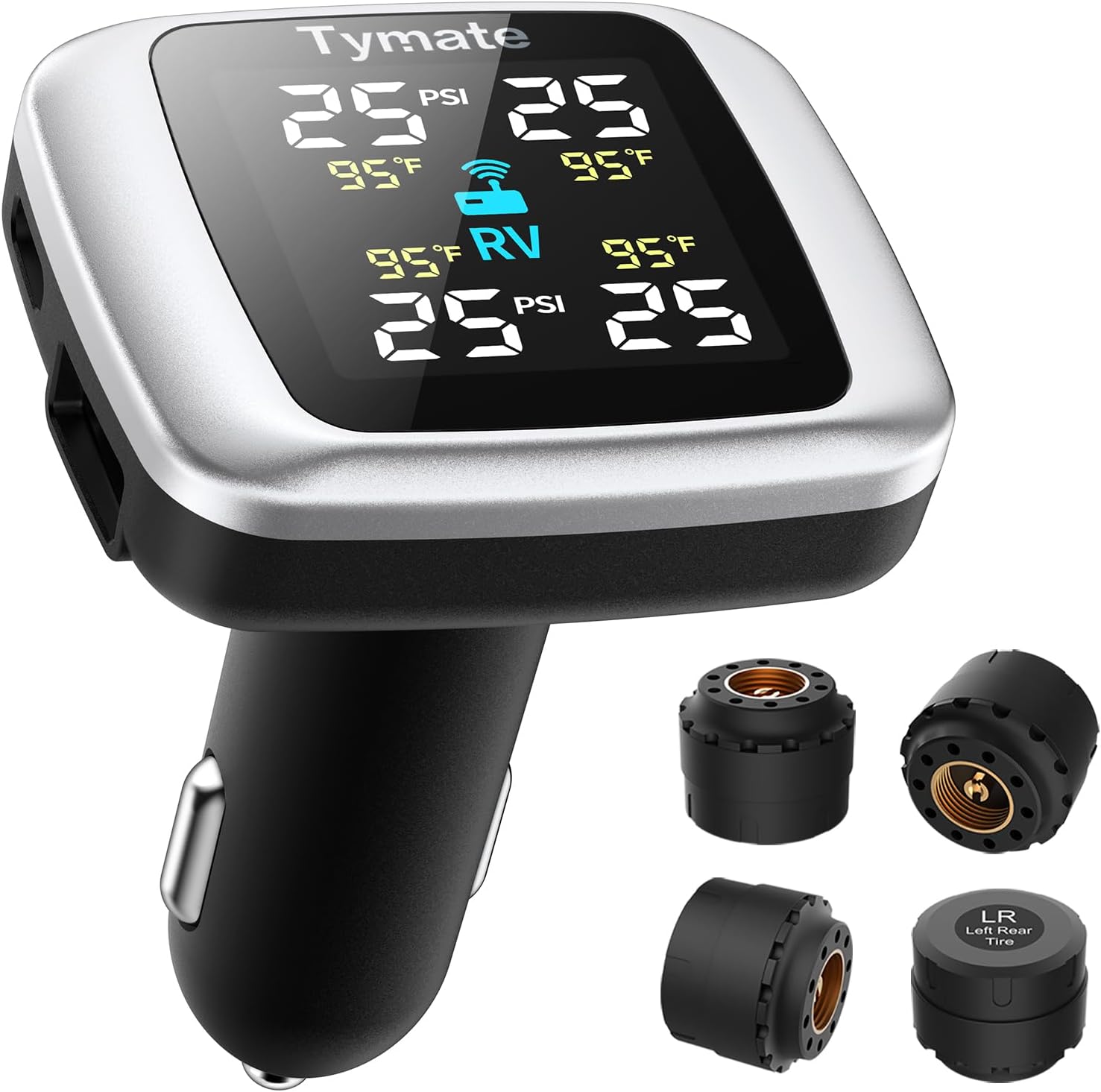
Tymate TM7 is a wireless tire pressure monitoring system that delivers real-time pressure and temperature readings for safer driving. It includes four external sensors, a bright color LCD display with adjustable backlight, and six alarm modes for high/low pressure, fast leakage, high temperature, and sensor signal or battery issues. The system covers a wide 0–144 PSI range and plugs into your vehicle’s cigarette lighter socket for quick DIY setup.

Upgrade your wheels with MIKKUPPA closed-end lug nuts designed for reliable fit and corrosion resistance. The one-piece, cold-forged and heat-treated steel construction helps resist rust and stripping, while the integrated finish delivers a durable black appearance. Built to OEM standards with a conical 60-degree seat, these nuts provide a secure solution for compatible Ford, Honda, Jeep, and Chevrolet models.

Secure your vehicle during transport with this 4-pack of heavy-duty tire tie down straps designed for trailers and hauling. The ratchet system with flat hooks and D-rings helps you tension the straps quickly, while the wheel-friendly design protects tires. With high break strength and corrosion-resistant hardware, these straps provide reliable, confidence-inspiring tie-down security for cars, trucks, and UTVs.
How Does 111T Compare With 111H, 112T, and 110T?
Nearby service descriptions can look almost identical while changing either the load capacity or speed capability. The table below shows the practical difference among common comparisons.
| Rating | Load capacity per tire | Speed rating | Main difference |
| 111T | 2,403 lb | 118 mph | Baseline rating in this article |
| 111H | 2,403 lb | 130 mph | Same load index, higher speed rating |
| 112T | 2,469 lb | 118 mph | Higher load index, same speed rating |
| 110T | 2,337 lb | 118 mph | Lower load index, same speed rating |
If your vehicle requires 111T, a 112T or 111H may provide at least the same numerical load or speed capability, but those higher numbers do not prove the tire is an approved replacement. The complete tire size, tire class, load designation, inflation requirements, wheel compatibility, and vehicle manufacturer guidance still apply. Moving down to 110T from a required 111 load index reduces load capacity and should not be done unless the vehicle manufacturer specifically approves the alternative.
Note: A higher load index or speed rating does not automatically make a tire the best replacement. Seasonal traction, construction, load designation, ride characteristics, wheel fitment, and vehicle approval still matter.
[Products Worth Considering]

These aluminum alloy tire valve caps help protect valve stems from road damage during everyday driving and long-term use. The hexagon, stylish design adds a clean look while fitting most cars, trucks, SUVs, motorcycles, and bicycles. Easy hand installation and periodic inspection help prevent slow air leaks and reduce risk of TPMS sensor wear.

ETENWOLF’s tire pressure gauge helps you quickly and accurately check tire PSI across cars, trucks, motorcycles, bikes, and more. It’s manually calibrated to ANSI B40.1 Grade A for reliable readings, includes a large glow dial for easy nighttime viewing, and features a 360-degree swivel chuck for use at any valve angle. The gauge also works consistently in extreme hot or cold weather.

Cristal Products Untouchable Tire Shine Spray delivers a deep, wet-look gloss that enhances your vehicle’s tires. It’s quick-drying and spreads smoothly for consistent, streak-free coverage, while forming a protective coating against UV rays, road grime, and weather. Suitable for all tire types, it helps restore dull, faded tires to a showroom-quality finish.
Common Mistakes to Avoid
When reading a 111T tire rating, avoid these common mistakes:
- Reading only the tire size. Two tires can share the same dimensional size but carry different load, speed, or load-designation markings.
- Assuming 111T fits every SUV or truck. Requirements vary by vehicle, trim, drivetrain, wheel size, axle rating, payload package, and towing configuration.
- Confusing 111T with SL or XL. The 111T service description identifies load index and speed rating; SL or XL is a separate load-related designation.
- Using sidewall maximum pressure as the normal pressure. Follow the vehicle manufacturer’s recommended cold pressure from the placard or manual.
- Thinking tire capacity raises payload. Higher-capacity tires do not increase the vehicle’s GVWR, GAWR, payload, or towing limit.
- Mixing ratings casually. Different tire specifications can affect handling and vehicle systems, and the lowest speed-rated tire limits the vehicle’s speed capability.
- Ignoring LT dual-load markings. Some LT tires show two load indexes, such as 120/116, because single-wheel and dual-wheel applications use different ratings.
Frequently Asked Questions
What is the difference between 111T and 111H?
111T and 111H have the same 111 load index, so each tire is rated for 2,403 pounds when properly inflated. The difference is the speed rating. T is rated up to 118 mph, while H is rated up to 130 mph. Use a complete tire specification approved for your vehicle rather than choosing by the higher speed letter alone.
Which speed rating is better, H or T?
H is the higher numerical speed capability: 130 mph versus 118 mph for T. That does not automatically make H the better replacement for every vehicle. Use the vehicle manufacturer’s required specification, and do not downgrade a required H rating to T unless the manufacturer permits it.
What is the difference between 111T and 112T tires?
Both use a T speed rating of up to 118 mph, but their load indexes differ. A 111T tire is rated for 2,403 pounds per tire, while a 112T tire is rated for 2,469 pounds per tire when properly inflated.
What does load index 111 mean?
Load index 111 corresponds to a rated capacity of 2,403 pounds, or 1,090 kilograms, per tire under the applicable conditions. It is a tire load rating, not permission to exceed the vehicle’s GVWR, GAWR, payload, axle, or towing limits.
Can I use 111T instead of 110T or 112T?
A 111T has more load capacity than a 110T, but a higher load index alone does not prove replacement fitment. The complete tire size, tire class, load designation, inflation requirements, and vehicle specifications must also be correct. Do not replace a vehicle-required 112T with 111T unless the vehicle manufacturer specifically approves the lower load index.
Is 111T the same as XL?
No. 111T is a service description: 111 is the load index and T is the speed rating. XL means Extra Load and is a separate load/construction designation. A tire can therefore be marked 111T XL. Match the complete specification required by the vehicle rather than treating 111T and XL as interchangeable terms.
Can I mix 111T with another tire rating?
For consistent performance, use tires that meet the same vehicle-approved size, load, speed, and construction requirements. If tires with different speed ratings are installed, the vehicle’s speed capability is limited by the lowest speed-rated tire. Follow the vehicle and tire manufacturer’s guidance when replacing fewer than four tires.
Is a 111T tire good for an SUV or crossover?
It can be, because 111T appears in SUV and crossover tire sizes, but the code alone does not establish fitment. Use it only when the complete tire size, load capability, speed rating, load designation, and other vehicle requirements match the placard, owner’s manual, or manufacturer-approved fitment information.
Conclusion
When you see 111T on a tire, read it as part of the tire’s safety specification. The 111 load index corresponds to 2,403 pounds per tire, and the T speed rating corresponds to up to 118 mph under specified conditions. Before buying a replacement, check the complete size, required load capacity, speed rating, tire class or load designation, and the vehicle manufacturer’s cold-pressure guidance. If any required part of the specification does not match, do not choose the tire based on 111T alone.
Sources
- Michelin — Tire Load Rating & Speed Rating Explained — supports load/speed definitions, higher-load guidance, XL terminology, and replacement guidance.
- Goodyear — Tire Load Index & Chart — supports load-index values including 110 = 2,337 lb, 111 = 2,403 lb, and 112 = 2,469 lb.
- Bridgestone — Tire Speed Rating — supports T = 118 mph, H = 130 mph, and controlled-condition speed-rating guidance.
- U.S. Tire Manufacturers Association — Replacing Tires — supports matching replacement size, load index, speed rating, and manufacturer requirements.
- NHTSA TireWise — Tire Safety — supports tire placard, owner’s manual, tire-size, and recommended cold-pressure guidance.
- Tire Rack — What Is Load Index? — provides additional explanation of tire load-index terminology.
- Continental Tires — Tire Size Guide — provides additional guidance on reading tire size and service-description markings.