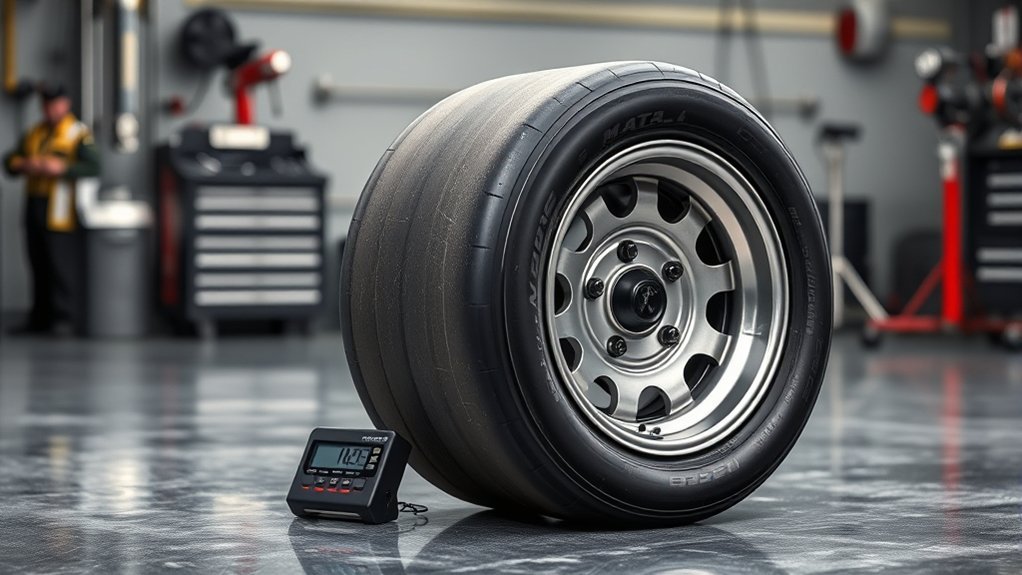
A NASCAR Cup Series tire is usually reported at about 26 pounds without the wheel and about 48 pounds when mounted on the 18-inch wheel. Treat those as practical estimates, not a public rulebook number, because the exact weight can vary by tire code, track, corner position, compound, and inflation setup.
Quick Answer
A modern NASCAR Cup tire weighs about 26 pounds by itself. Once mounted on the wheel, the tire-and-wheel assembly is commonly estimated at about 48 pounds. That means two mounted assemblies are about 96 pounds, while a full four-tire change represents about 192 pounds of wheel-and-tire mass.
Key Takeaways
- A NASCAR Cup tire is commonly estimated at about 26 pounds before the wheel is added.
- A mounted Cup tire-and-wheel assembly is commonly estimated at about 48 pounds.
- Four mounted assemblies are about 192 pounds, not 96 pounds; 96 pounds is closer to two mounted assemblies.
- The “18-inch tire” phrase refers to the 18-inch wheel or bead diameter, not the tire’s full outside height.
- NASCAR Cup cars use 18-inch forged-aluminum wheels, replacing the former 15-inch steel-wheel package.
How Much Does a NASCAR Tire Weigh?
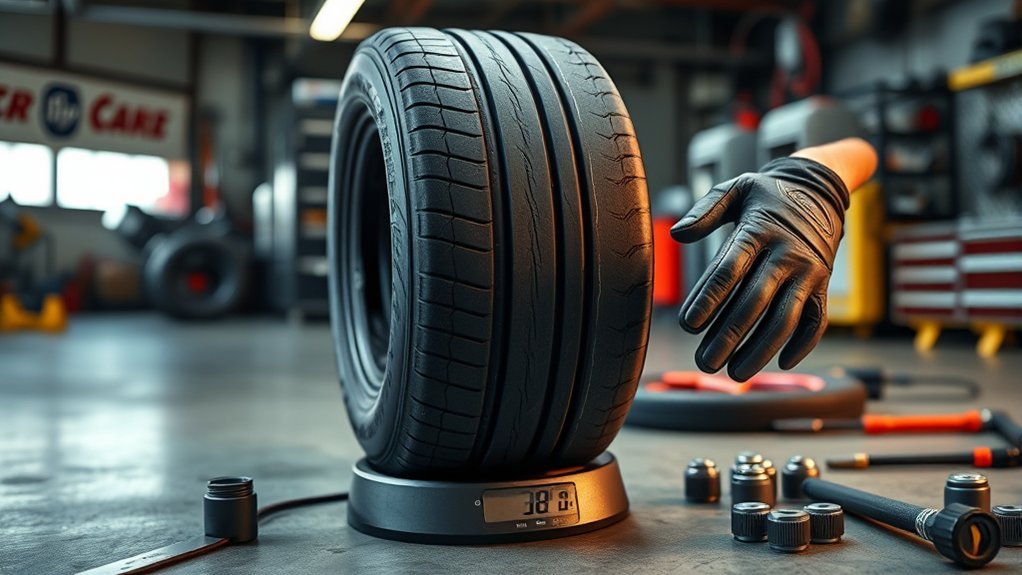
A modern NASCAR Cup tire is commonly listed at about 26 pounds without the wheel. When the tire is mounted on the current 18-inch wheel, the complete assembly is commonly estimated at about 48 pounds.
The mounted number is the one that matters most on pit road because that is what the tire carrier and changer actually move. If each mounted assembly is about 48 pounds, then a two-tire load is about 96 pounds and a full four-tire change involves about 192 pounds of mounted tire-and-wheel assemblies.
| Cup tire only | About 26 lb, commonly reported estimate |
| Mounted tire and wheel | About 48 lb, commonly reported estimate |
| Two mounted assemblies | About 96 lb |
| Four mounted assemblies | About 192 lb |
Note: NASCAR and Goodyear publicly describe the current Cup tire package as an 18-inch wheel/bead setup, but public-facing official pages do not list one fixed race tire weight. Use 26 pounds and 48 pounds as practical estimates, not as universal rulebook values.
NASCAR Tire Weight by Series
The Cup Series uses the current Next Gen wheel-and-tire package. NASCAR’s second-tier series is now the NASCAR O’Reilly Auto Parts Series, formerly the Xfinity Series, and the Truck Series uses its own tire package. Because each series has different cars, wheels, and tire codes, you should not assume every NASCAR national-series tire weighs exactly the same.
| Cup Series | Current Next Gen package with 18-inch forged-aluminum wheels and wider tire footprint. |
| O’Reilly Auto Parts Series | Formerly the Xfinity Series. Tire and wheel packages differ from Cup, so avoid applying Cup weights as exact series-wide numbers. |
| Craftsman Truck Series | Uses a separate truck-specific package. Track, tire code, and construction matter more than a single generic NASCAR weight. |
For most readers, the clean answer is this: if you are asking about a modern NASCAR Cup Series tire, remember about 26 pounds tire-only and about 48 pounds mounted. If you are comparing series, treat those numbers as Cup-focused estimates.
Cup vs. O’Reilly Auto Parts Series Tire Weight
Cup cars use the Next Gen platform, which brought a major wheel-and-tire change: 18-inch forged-aluminum wheels, a lower-profile tire, and a wider footprint than the previous Cup setup. NASCAR announced the move from 15-inch steel wheels to 18-inch forged aluminum wheels as part of the Next Gen car, with tire width increasing from 10 inches to 12 inches.
The second-tier series, formerly called the Xfinity Series and now called the O’Reilly Auto Parts Series, should not be described with one unsupported “heavier than Cup” number. Tire weight can change with construction, wheel size, tire code, and track-specific requirements. If a source does not state the exact series, year, wheel, and tire code, treat the number as a rough estimate.
[Products Worth Considering]

Adam’s Pro Tire Hex Grip applicators are molded foam sponges designed for precise, even tire dressing application. The ergonomic grip helps you spread product without overapplying, reducing sling that can splash onto paint and helping keep your hands clean during wheel and trim detailing. They’re durable, washable, and reusable for repeated detailing sessions.

Upgrade your wheels with MIKKUPPA M12x1.5 mag seat lug nuts built for secure, corrosion-resistant performance. These closed-end chrome lug nuts are a direct replacement for select Toyota models, including Camry, Corolla, RAV4, Sienna, Avalon, Highlander, Matrix, Venza, and Prius. Triple-chromium plating and cold-forged, heat-treated steel help deliver strength for daily driving and replacement needs.

These M14x1.5 closed-end chrome lug nuts are a one-piece replacement designed for secure fitment on compatible GM, Ford, and select Chrysler/Dodge models. Featuring a 60-degree conical seat and anti-rust chrome plating, they help resist corrosion and maintain a bright look for everyday driving. Built for long-term durability, they include OEM-style part references and are backed by 12 months of support.
Cup Tire Weight
For the current Cup Series, the most useful working estimate is about 26 pounds for the tire alone and about 48 pounds for the mounted assembly. The mounted assembly affects pit-stop handling, wheel speed, braking response, and unsprung mass.
Lower-Series Weight Caution
Lower-series NASCAR tires may look similar to casual fans, but they are not automatically the same as Cup tires. Different cars and rules can mean different wheels, tire codes, construction, and operating pressures. Use Cup weight numbers only when the discussion is clearly about Cup cars.
Does Air Pressure Change Tire Weight?
Air does add a small amount of mass, but it does not usually add several pounds to a tire. The big weight difference comes from the tire carcass, wheel, bead area, sidewall construction, and any series-specific hardware. Pressure matters hugely for grip and handling, but it should not be used to explain large weight jumps by itself.
Why NASCAR Tires Weigh So Much
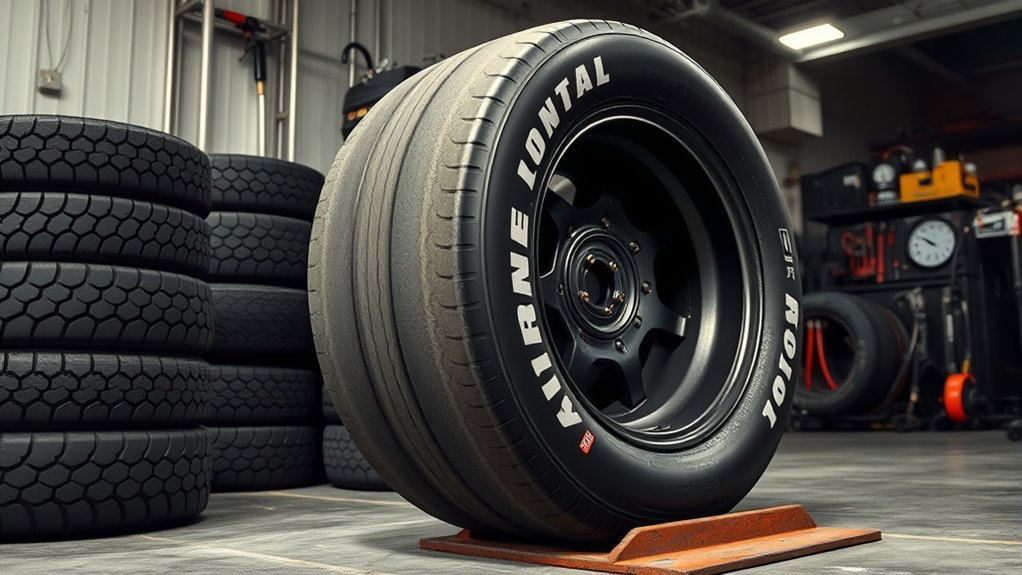
NASCAR tires are heavy because they are built for short, brutal service lives at racing speed. They must survive high cornering loads, heat cycles, aggressive braking, hard acceleration, and track-specific grip demands. A racing tire is not designed for road comfort, treadwear warranties, or quiet highway use.
Heavy-Duty Construction
The tire carcass, bead area, sidewall, and compound package all add strength. That strength keeps the tire stable when the car loads the right-side tires in a high-speed corner or leans on the left-side tires on certain tracks. The tire needs to build grip quickly, hold its shape, and wear in a predictable way over a run.
Wheel and Tire Mass
When people ask how much a NASCAR tire weighs, they often mean the full mounted assembly. The tire may be about 26 pounds by itself, but the wheel turns it into a much heavier object for the pit crew. That mounted mass is also rotating mass, so engineers care about how it affects acceleration, braking, steering response, and suspension movement.
Safety and Performance
The weight is not random. NASCAR tires must balance grip, durability, heat control, and safety. A tire that is too light for its job could be more vulnerable to heat, fatigue, or deformation. A tire that is too heavy can slow response and make pit work harder. The goal is not the lightest tire possible; it is the best tire for the car, track, and race conditions.
Warning: NASCAR racing tires and wheels are not consumer tire projects. Goodyear warns that race tire changing and inflation should be handled by trained personnel using proper tools and procedures.
How Rims Change NASCAR Tire Weight
The rim is a major part of the mounted weight. On the current Cup car, NASCAR moved away from the older 15-inch steel wheel and adopted an 18-inch forged-aluminum wheel. That change was part of the broader Next Gen platform and helped modernize the car’s mechanical grip, braking package, and wheel design.
Wheel weight matters because it is both unsprung mass and rotating mass. Unsprung mass is the weight the suspension has to control at the wheel. Rotating mass is the weight the car has to spin up and slow down. Less unnecessary mass can help the car react more sharply, but the wheel still has to be strong enough for NASCAR loads.
Pro Tip: When comparing NASCAR tire weights, always ask whether the number is tire-only or the full mounted tire-and-wheel assembly. Most pit-stop discussions are really about the mounted assembly.
Next Gen Tire Weight and 18-Inch Rims
The current Cup Series tire is often casually called an “18-inch tire,” but that wording can confuse readers. The 18-inch figure refers to the wheel or bead diameter. It does not mean the complete tire is only 18 inches tall from the ground to the top of the tire.
Goodyear described the NASCAR Next Gen tire as having an 18-inch wheel diameter, a shorter sidewall, and a wider contact patch. NASCAR also described the Next Gen move as a shift from a 15-inch steel wheel to an 18-inch forged-aluminum wheel, with wider tires than the previous Cup package.
That lower-profile design changed the look and behavior of the Cup car. The shorter sidewall can sharpen response, while the wider footprint helps mechanical grip. The tradeoff is that the wheel-and-tire assembly is still a substantial piece of equipment for pit crews to handle at speed.
The number to remember: about 26 pounds for a Cup tire alone, about 48 pounds mounted, about 96 pounds for two mounted assemblies, and about 192 pounds for four.
[Products Worth Considering]

Upgrade your wheels with MIKKUPPA closed-end lug nuts designed for reliable fit and corrosion resistance. The one-piece, cold-forged and heat-treated steel construction helps resist rust and stripping, while the integrated finish delivers a durable black appearance. Built to OEM standards with a conical 60-degree seat, these nuts provide a secure solution for compatible Ford, Honda, Jeep, and Chevrolet models.

Black Magic Intense Foam Wheel & Tire Cleaner uses a high-foaming action to lift away dirt, grime, and brake dust without scrubbing. The color-changing formula helps show contaminants being dissolved as foam turns from white to brown. Safe for all wheel types and even wheel wells, it leaves a like-new, slick finish with a fresh cherry scent.

P&S Dressed Tire Finish is a premium, water-based tire dressing that delivers a deep, rich high-gloss look without the greasy residue. Its polymer blend is designed to mimic the durability and shine of traditional solvent-based dressings while staying non-hazardous and eco-friendly. Apply with a brush or spray bottle for even coverage and a professional, factory-fresh finish.
How Tire Weight Affects Pit Stops
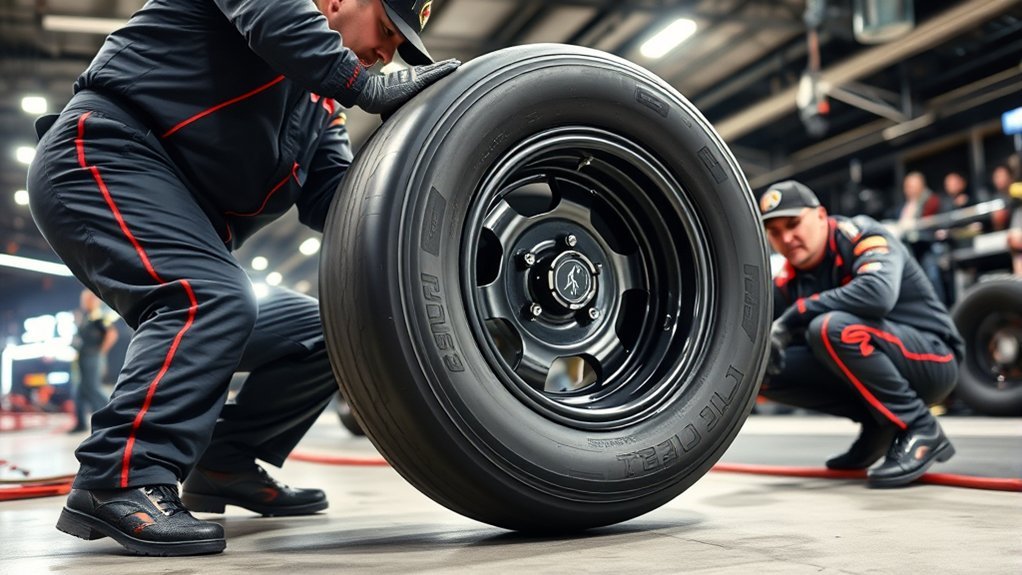
During a pit stop, the mounted assembly matters more than the bare tire. A crew member is not carrying loose rubber; they are moving a tire mounted on a wheel. If one mounted assembly is about 48 pounds, two are about 96 pounds. That is why tire carriers train for speed, balance, footwork, and clean handoffs.
The weight affects more than strength. A heavy assembly is harder to accelerate, stop, rotate, and place accurately. A small mistake can cost time, and a loose wheel can create a safety issue. That is why modern NASCAR pit stops depend on choreography as much as raw athleticism.
The single-lug Next Gen system also changed pit-road rhythm. Instead of five lug nuts per wheel, Cup teams use one center-locking lug nut. The mounted tire still has to be carried, aligned, seated, and secured correctly, so weight and precision both matter.
NASCAR Tire Sizes and Dimensions
NASCAR tire dimensions are easy to misunderstand because racing tire language often separates three measurements: outside diameter, tread width, and bead diameter. Goodyear’s racing tire technical information explains that size designations show nominal outside diameter, tread width, and bead diameter, with dimensions measured on an inflated tire under no load.
For the current Cup car, the key public-facing spec is the 18-inch wheel/bead diameter. The tire itself has a much larger outside diameter once mounted and inflated. NASCAR also stated that the Next Gen tire package increased tire width from 10 inches to 12 inches compared with the previous Cup setup.
- 18-inch: wheel or bead diameter, not total tire height
- Wider Cup package: NASCAR described the Next Gen tire width as up from 10 inches to 12 inches
- Shorter sidewall: part of the Next Gen tire design
- Wet-weather tires: use grooves to move water, unlike dry slicks
[Products Worth Considering]

The Trivd Frol 1/2" air impact wrench delivers high performance torque up to 1500 ft-lbs with a twin hammer impact mechanism for strong, balanced blows. It features an ergonomic grip, compact lightweight design, and quick-stop control with 3 forward speeds up to 8000 RPM plus a reverse speed. Built for demanding automotive repair and tire shop work, the rear exhaust helps keep debris away from the surface.

This 1/2-inch drive breaker bar delivers powerful leverage for loosening and tightening stubborn lug nuts and automotive fasteners. The 180-degree flex head helps you reach tight spaces at the angle you need, making tire and brake jobs easier. A spring-loaded ball detent design holds 1/2-inch sockets securely while the chrome-moly head provides durable strength for everyday use.

The Airmoto portable tire inflator quickly and accurately fills car, truck, SUV, motorcycle, and bicycle tires up to 120 PSI with auto shut-off when your target pressure is reached. Its large LCD, multi-unit pressure display, and digital gauge make it easy to dial in settings and verify readings, while the built-in LED flashlight helps in low light. The included polyurethane hard carrying case and storage mesh pocket keep the inflator and accessories protected and organized.
What NASCAR Tires Are Made Of
NASCAR tires are specialized Goodyear Eagle racing tires built for controlled competition, not public-road use. Dry NASCAR tires are slicks, meaning they do not use the deep tread grooves found on street tires. Wet-weather tires are different because they need grooves to evacuate water.
The materials and construction vary by track type and tire code. Goodyear builds tires for different surfaces, loads, speeds, and weather conditions. A superspeedway tire, short-track tire, road-course tire, and wet-weather tire do not all do the same job, so the construction is tuned around the event.
Goodyear says it produces more than 100,000 tires annually for NASCAR’s top three series, with each one hand-built by Goodyear associates in Akron, Ohio. That level of specialization is one reason exact tire weight should be treated as a range or estimate unless the tire code and event are known.
How Goodyear Tests NASCAR Tire Weight and Performance
Weight is only one part of a NASCAR tire’s performance. Goodyear’s Next Gen tire development included thousands of testing miles, simulations with manufacturers, and lab research and development. The goal was not simply to make a tire that fit an 18-inch wheel; it had to work with the entire Next Gen vehicle system.
During development and race preparation, engineers care about heat, wear, compound behavior, grip fall-off, load capacity, and how the tire responds on a specific track surface. A tire that is perfect for one track may not be ideal for another.
That is why the safest answer to “how much does a NASCAR tire weigh?” is specific but cautious: about 26 pounds tire-only and about 48 pounds mounted for a modern Cup tire, with exact values depending on the specific tire and wheel package.
Common NASCAR Tire Weight Myths
Myth: Four NASCAR tires weigh 96 pounds
That is only true if you are talking about two mounted assemblies at about 48 pounds each. Four mounted assemblies are about 192 pounds. Four tire-only NASCAR Cup tires would be about 104 pounds if each tire is about 26 pounds.
Myth: An 18-inch NASCAR tire is 18 inches tall
The 18-inch number refers to the wheel or bead diameter. The full inflated tire is much taller than 18 inches overall.
Myth: Air pressure adds several pounds
Inflation pressure is critical for grip, heat, and handling, but air mass is not the main reason a mounted assembly weighs close to 48 pounds. Tire construction and wheel weight are the main drivers.
Frequently Asked Questions
How much does each NASCAR tire cost?
NASCAR tire prices are not usually published as one fixed official consumer-style price. A common public estimate is several hundred dollars per tire, often around the $350–$500 range, but the true cost can vary by series, event, allocation, tire code, and supplier arrangement.
How much does 1 gallon of NASCAR fuel weigh?
Sunoco lists Green E15 at 6.2 pounds per gallon. That fuel weight matters because fuel load changes during a run, affecting total car weight and balance.
How much do four NASCAR wheel-and-tire assemblies weigh?
If one mounted NASCAR Cup tire-and-wheel assembly is about 48 pounds, four mounted assemblies weigh about 192 pounds. Two mounted assemblies weigh about 96 pounds.
Is an 18-inch NASCAR tire 18 inches tall?
No. In the current Cup package, 18 inches refers to the wheel or bead diameter. The tire’s full outside diameter is larger once it is mounted and inflated.
Can you buy NASCAR race tires for street use?
NASCAR race tires are specialized competition tires, not normal street tires. They are designed for race conditions, controlled use, and specific wheel/tire procedures, so they should not be treated like consumer replacement tires.
Conclusion
A NASCAR Cup tire weighs about 26 pounds by itself and about 48 pounds when mounted, based on common working estimates. The mounted number is the one pit crews care about most because that is what they carry and install during a stop. Just remember the corrected math: two mounted assemblies are about 96 pounds, and four mounted assemblies are about 192 pounds.
The other key point is sizing. The current Cup tire package uses an 18-inch wheel/bead diameter, not an 18-inch-tall tire. That 18-inch forged-aluminum wheel was part of NASCAR’s Next Gen shift, and it changed the way the tire behaves, the way the car responds, and the way pit crews handle each stop.
Sources
- NASCAR — Next Gen models unveiled for 2022 — supports the move from 15-inch steel wheels to 18-inch forged-aluminum wheels and wider tires.
- Goodyear — NASCAR Next Gen tire debut — supports the 18-inch wheel diameter, shorter sidewall, wider contact patch, and testing/development details.
- Goodyear — NASCAR partnership continuation — supports Goodyear as NASCAR’s official tire supplier and hand-built Akron production details.
- Goodyear Racing — Technical information — supports racing tire sizing terminology and safety guidance.
- Sunoco Race Fuels — Green E15 — supports Green E15 fuel specifications, including 6.2 lb/gal.
- NASCAR — O’Reilly Auto Parts Series sponsorship — supports the 2026 rename of NASCAR’s second-tier series from Xfinity to O’Reilly Auto Parts Series.