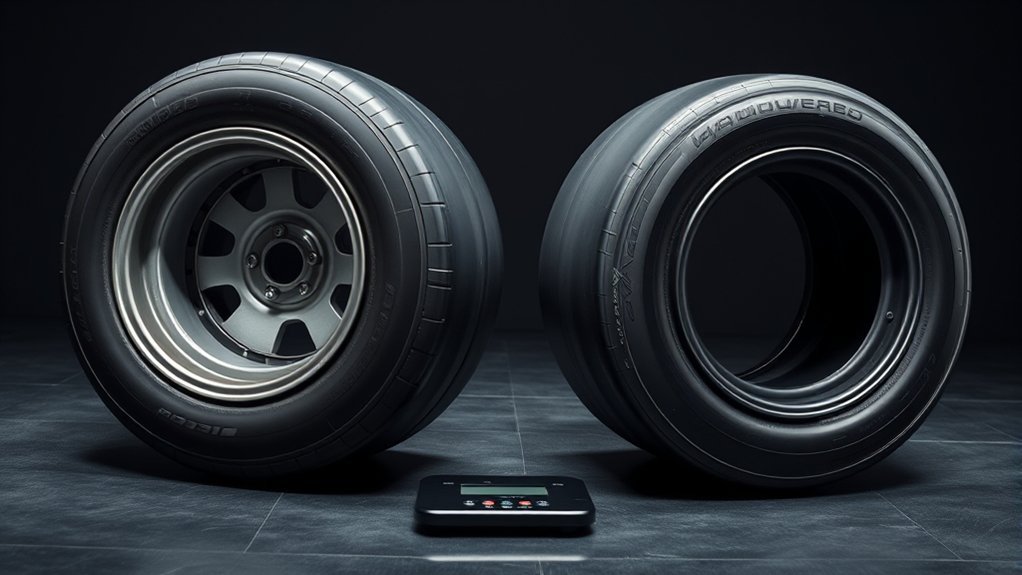
An F1 tire looks simple from the outside, but its weight depends on what you are counting: the rubber tire alone, a full set of four dry-weather tires, or the complete wheel-and-tire assembly handled during a pit stop. For 2026, the safest answer is to separate those numbers because Formula 1 now uses updated tire dimensions and an official FIA “Nominal Tyre Mass” process.
Quick Answer
A modern F1 tire by itself is roughly in the 10 kg range, with the rear heavier than the front. Older public tire-only figures often quote about 9.5 kg for a front and 11.5 kg for a rear. For 2026, Formula 1 has reported an estimated 46 kg for a set of four tires, while the FIA determines the official nominal tire mass from Pirelli measurements.
Key Takeaways
- Do not confuse tire-only weight with the full wheel-and-tire assembly; the assembly includes the rim and other hardware.
- For 2026, F1 tires remain on 18-inch rims but are narrower and slightly smaller in diameter than the 2025 tires.
- Pirelli says the four 2026 tires on each car are 1.6 kg lighter than the previous season’s set.
- The FIA no longer treats tire mass as one casual number; it uses a measured Nominal Tyre Mass for dry-weather tires.
- Tire mass affects acceleration, braking, steering response, heat buildup, degradation, and pit-stop handling.
How Much Does an F1 Tire Weigh?
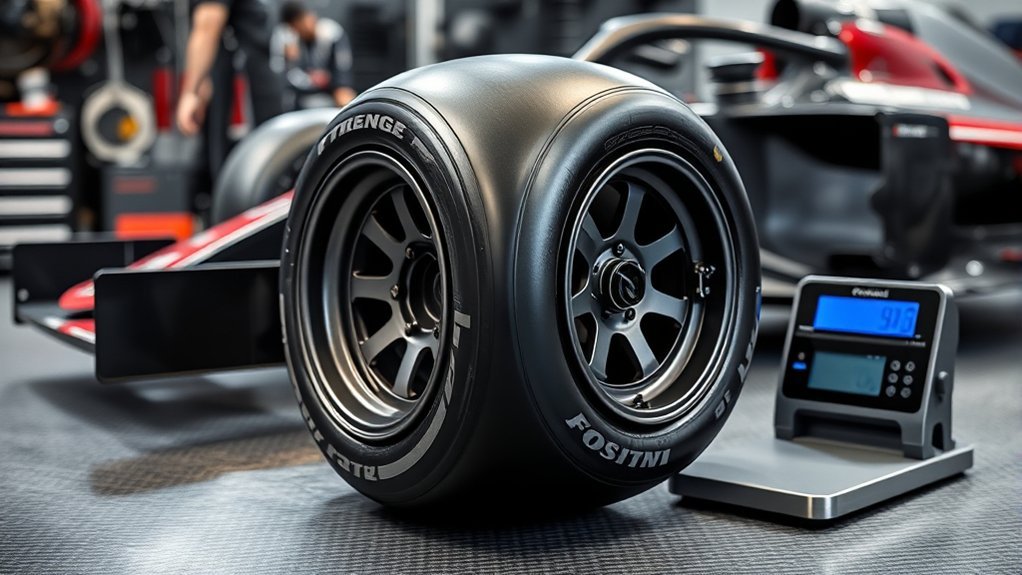
The cleanest answer is that an F1 tire alone is much lighter than a complete wheel package. Public figures from the 18-inch era often put a front tire at about 9.5 kg and a rear tire at about 11.5 kg, excluding the wheel rim. Those figures are useful as a baseline, but they should not be treated as the final official 2026 number because the 2026 tires are smaller and lighter.
For the current rules, the FIA 2026 Formula 1 Technical Regulations define car minimum mass using a Nominal Tyre Mass. That number is based on the measured mass of new, production, dry-weather tires supplied by the tire provider, using a sample of 50 tires per axle. Formula 1 has also described the 2026 car as 722 kg plus an estimated 46 kg of tires, for a headline 768 kg total.
| What you are weighing | Best public estimate | What it means |
|---|---|---|
| One front F1 tire only | Around 9–10 kg in recent public references | Rubber tire only, not the wheel rim. |
| One rear F1 tire only | Around 11 kg in recent public references | Rear tires are wider and carry more drive load. |
| Four 2026 dry-weather tires | About 46 kg estimated by Formula 1 | This is the set-level number used in public 2026 car-weight explanations. |
| Complete wheel-and-tire assembly | Heavier than the tire alone | Includes rim and related hardware, so it should not be compared directly with tire-only mass. |
Note: If someone says an F1 tire weighs 10 kg, they usually mean the tire itself. If someone is talking about what a mechanic lifts in a pit stop, they are usually talking about the heavier wheel-and-tire assembly.
What Changed for 2026 F1 Tires?
The 2026 F1 tires are not simply a repeat of the 2022–2025 18-inch tires. According to Pirelli’s 2026 tire release, the wheel rim diameter remains 18 inches, but the front tread is 25 mm narrower and the rear tread is 30 mm narrower. The total tire diameter is also 15 mm smaller at the front and 10 mm smaller at the rear.
Pirelli also says the four tires on each 2026 car are 1.6 kg lighter than the previous season’s set. That reduction comes from the narrower tread and smaller diameter, both of which support the wider 2026 goal of smaller, lighter, more agile Formula 1 cars.
For 2026, tire weight is best understood as a controlled performance variable, not a single fixed number copied from older F1 eras.
What Affects F1 Tire Weight?
F1 tire weight is shaped by size, axle position, construction, compound, and tire type. Rear tires are wider than front tires because they must handle drive traction, braking stability, and large lateral loads. That extra width is the main reason rear tires weigh more.
Construction matters too. An F1 tire is not just rubber. It includes a carcass, bead area, compound layers, and internal reinforcement designed to survive high loads, high temperatures, and repeated acceleration and braking. The exact construction is proprietary, so any article that claims a full public recipe should be treated carefully.
Compound choice can also affect mass slightly, but the bigger performance difference is how the compound behaves. Softer compounds warm up quickly and deliver more grip for a shorter time. Harder compounds usually last longer but give less peak grip. Wet and intermediate tires add tread patterns, which changes both behavior and structure compared with slicks.
Pro Tip: When comparing F1 tire weights, always ask three questions first: tire alone or mounted assembly, front or rear, and which season’s regulations?
[Products Worth Considering]

The Continental Grand Prix 5000 is an allround road bike tire engineered for faster rolling, improved ride comfort, and enhanced puncture protection. It features a Vectran Breaker cut-protection layer, Lazer Grip micro-profile tread for confident cornering control, and Active Comfort Technology to damp vibration for smoother rides. BlackChili compound optimizes grip and speed for everyday performance and long-lasting confidence.

This metal-free wheel and tire cleaning brush uses dense, fluffy synthetic wool to safely clean rims, spokes, fenders, and engine areas without worrying about damaging surfaces. Its flexible, comfortable design helps you reach detailed areas while maintaining durability, and the extra absorbent fibers work well with wheel spray cleaners for faster cleanup. Reusable and washable performance helps prevent grime and build-up for cleaner vehicles and easier maintenance at home.

Measure tire tread depth quickly and accurately with this LUMITECO dial gauge that reads in 1/32" increments up to 14/32". The color-coded green/yellow/red zones make it easy to judge tire wear and know when replacement is needed. A rugged, compact design with a protective pouch helps keep the gauge ready for use on cars, trucks, motorcycles, and more.
How F1 Tire Compounds Compare
The current Pirelli Formula 1 range for 2026 uses five slick compounds, numbered C1 to C5. C1 is the hardest and most durable slick. C5 is the softest and highest-grip slick. Pirelli selects three slick compounds for each Grand Prix and marks them as hard, medium, and soft for that weekend.
The color system is simple for fans: white is hard, yellow is medium, and red is soft. For wet conditions, green marks the intermediate tire and blue marks the full wet tire. Intermediates are used on a damp or drying track without heavy standing water. Full wets are for heavier rain and better aquaplaning resistance.
| Tire type | Use case | Performance tradeoff |
|---|---|---|
| C1 slick | High-energy, abrasive circuits | Longest life, lowest peak grip. |
| C3 slick | Middle of the slick range | Balanced grip and durability. |
| C5 slick | Lower-severity tracks and qualifying-style grip | Highest grip, shortest life. |
| Intermediate | Damp track or light rain | Useful crossover between slicks and full wets. |
| Full wet | Heavy rain and standing water | More water clearance, slower on a drying track. |
[Products Worth Considering]

Monitor tire tread wear with a smart, color-coded depth gauge that shows clear condition ranges at a glance. The bar is range marked for fast, easy readings, helping you maintain safer traction and performance. Each gauge is portable with a pocket clip, and the set includes 20 units for daily use and sharing.

The Chemical Guys Gerbil Wheel & Rim Brush is designed to safely clean wheels, rims, exhaust tips, tires, and engine bay components without scratching delicate finishes. Its soft natural bristles help lift brake dust, grime, and buildup while conforming to tight spaces and intricate contours. A comfort grip handle delivers control for extended detailing sessions.

Clean wheels and rims with soft feathered bristles that safely remove dirt and road grime while helping restore original luster. The short non-slip handle makes it easy to scrub in tight wheel wells, and the brush is suitable for vehicles and hard-to-reach areas. It can also be soaked and rubbed to help restore bristles to their shape after use.
Why F1 Wheel-and-Tire Packages Feel So Heavy
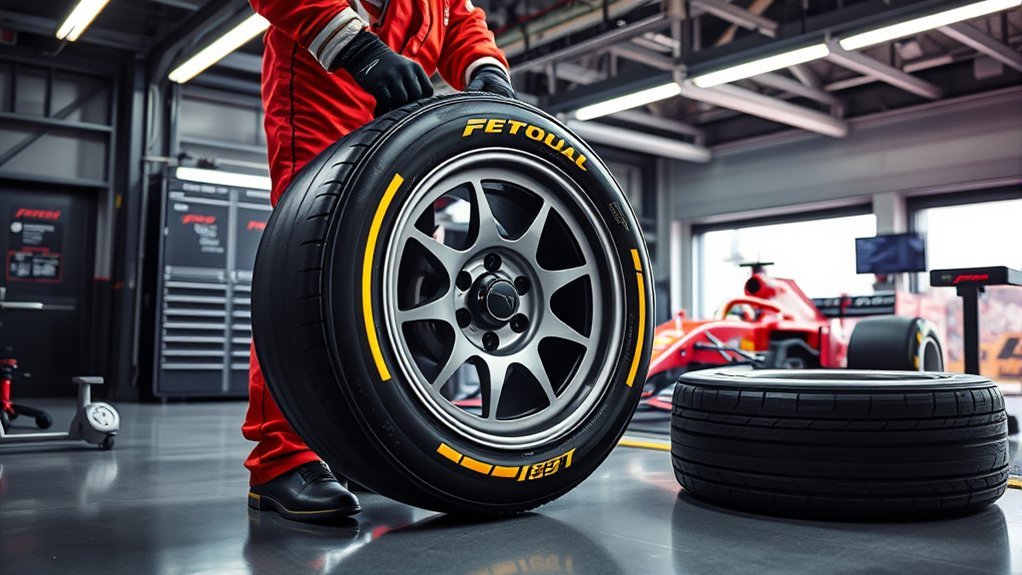
A bare tire is only part of what a pit crew handles. During a stop, the crew changes a mounted wheel-and-tire assembly. That means the rim and tire move together, and the package has to be lifted, aligned, fitted, and secured in seconds.
That weight matters because it is unsprung and rotating mass. Unsprung mass is harder for the suspension to control. Rotating mass also affects how much energy is needed to speed up or slow down the wheel. Engineers care about every gram because tire and wheel mass affect acceleration, braking, steering response, tire temperature, and wear.
This is why the 2026 tire weight reduction matters. A 1.6 kg saving across four tires sounds small next to a 768 kg Formula 1 car, but it is located at the corners of the car, where mass has an outsized effect on response.
[Products Worth Considering]

Black Magic Tire Wet delivers a deep wet-look shine that makes tires appear dark, rich, and freshly detailed. Its long-lasting formula helps resist rain, dust, and road grime for weeks of glossy protection, not days. Apply by spraying onto clean, dry tires—no buffing or wiping required—with a low-sling design to reduce splatter on paint and wheels.

Suds Lab WB Premium Detailing Wheel Brush delivers a scratch-free clean using ultra-soft microfiber bristles that lift brake dust, dirt, and grime without swirling. The ergonomic non-slip handle helps you deep-clean rims, wheels, and tires with reduced hand fatigue while reaching tight contours. It’s reusable and machine washable for long-term detailing, and works across cars, trucks, SUVs, and motorcycles plus multi-purpose cleaning tasks.
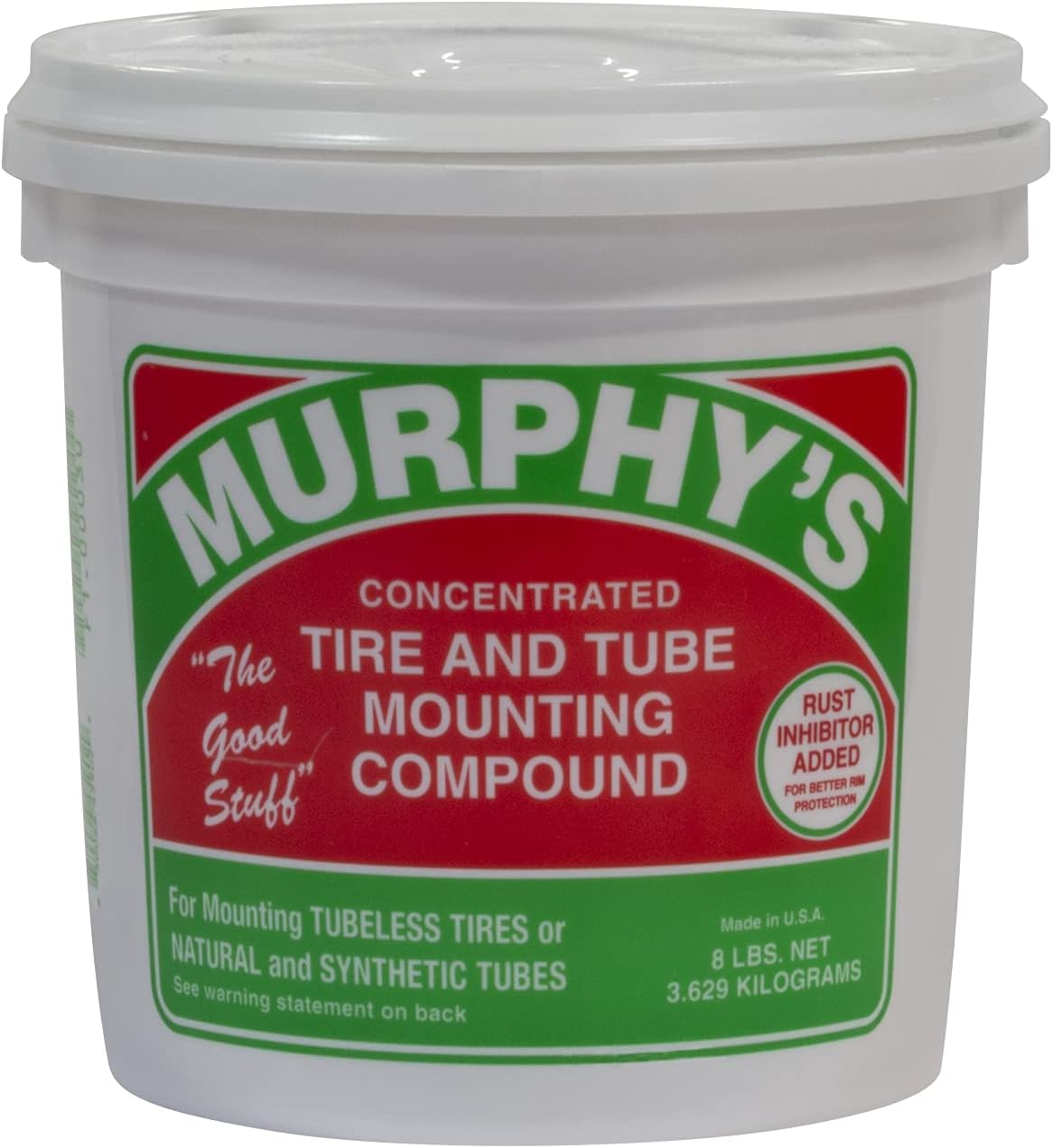
A concentrated tire and tube mounting compound designed to help simplify mounting rubber tires and tubes on passenger, semi truck, construction, and OTR applications. Its ultra-thick formula packs beads effectively and includes rust inhibitors to help protect against corrosion during use.
How F1 Tire Weight Affects Performance
Tire weight affects performance in three main ways: rotational inertia, grip balance, and degradation. A lighter tire-and-wheel package can respond faster to braking and throttle inputs, while a heavier package stores more rotational energy and can be harder to change direction quickly.
Rotational Inertia Effects
Rotational inertia is the resistance of a rotating object to speeding up or slowing down. In simple terms, a heavier tire-and-wheel package needs more energy to accelerate and more braking force to slow. That can influence launch, corner exit, braking stability, and energy use over a lap.
This does not mean the lightest possible tire is always best. F1 tires also need strength, heat resistance, predictable flex, and structural safety. The target is not minimum weight at all costs; it is the best compromise between mass, load capacity, grip, durability, and consistency.
Cornering and Grip
Front and rear tire weight differences connect directly to tire size and car balance. Front tires help the car turn in and hold a line. Rear tires put power to the road and stabilize the car under acceleration. Because the rear tires are wider, they carry more rubber and structure, which adds mass.
More tire mass can make direction changes feel less immediate, but a larger rear tire also gives the car the traction it needs to deploy huge power. That is the tradeoff F1 regulations and Pirelli’s tire design must balance.
Tire Wear Management
Weight also plays into tire degradation. Heavier rotating components can add energy to the tire, and more energy usually means more heat. Heat is useful up to the tire’s working range, but too much heat can cause sliding, blistering, graining, or rapid performance drop-off.
Teams manage this by tracking tire temperatures, pressures, wear, lap times, and driver feedback. The driver helps by avoiding unnecessary sliding, smoothing steering inputs, managing traction out of slow corners, and changing pace when engineers see temperature spikes.
How Teams Manage F1 Tire Wear
F1 teams manage tire wear with a mix of simulation, live telemetry, driver technique, and strategy. Before a race weekend, engineers model expected degradation based on track layout, asphalt roughness, corner energy, weather, and Pirelli’s nominated compounds. During the weekend, they compare that model with real data from practice, qualifying, and race stints.
On track, the driver must keep the tire in the right temperature window. Push too hard too early and the tire can overheat. Go too slowly and it may cool below its best operating range. The fastest race stint is often not the stint with the fastest single lap; it is the stint where tire life and lap time are balanced.
Strategy then decides when to stop. If tire degradation is low, a one-stop race may work. If degradation is high, two or more stops can be faster even with the time lost in the pit lane. That is why tire weight, compound choice, and wear are never just engineering details; they shape the whole race.
What Happens to Used F1 Tires?
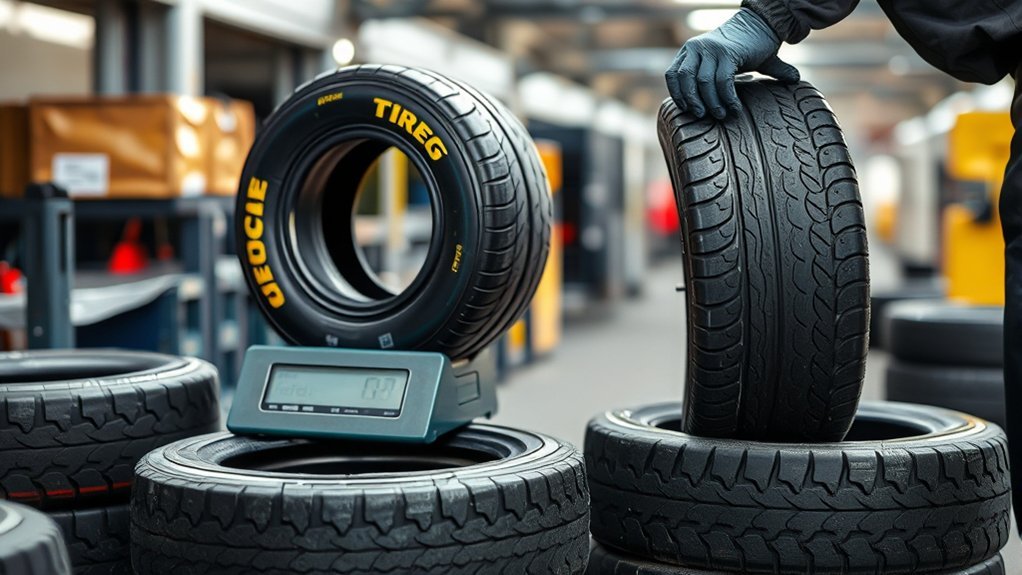
F1 teams do not keep used race tires for reuse on road cars or future events. The tires are controlled by Pirelli and Formula 1’s tire allocation rules, then returned after use for inspection, data control, and post-use processing.
Pirelli’s current sustainability material says its motorsport tires are transformed after use into secondary raw materials for multiple uses. That is a better way to describe the current process than saying every tire simply gets thrown away. The aim is controlled recovery, not fan resale or uncontrolled reuse.
Tire Disposal Process
After a race weekend, returned tires are handled through Pirelli’s controlled logistics process. This protects tire technology, prevents teams from keeping extra data-sensitive material, and supports environmental tracking. The exact handling route can vary, but the key point is that used F1 tires are not put back into normal service.
Recycling and Fuel Use
End-of-life tires can be recovered in different ways, including use as secondary raw materials or energy recovery. Pirelli’s broader circular-economy information notes that old and used tires can have second-life uses such as sports surfaces, rubber products, acoustic insulation, road materials, and energy recovery.
Frequently Asked Questions
How much is a Formula 1 tire worth?
There is no official public retail price for a current F1 tire because teams do not buy them like consumer tires. Public estimates often place a single F1 tire in the low-thousands of dollars or pounds, but that is only an estimate. The real value includes development, manufacturing, transport, fitting, trackside support, data, and disposal.
How heavy is a NASCAR tire compared with an F1 tire?
A modern NASCAR Cup tire is generally estimated at roughly 24–28 lb by itself, while a mounted wheel-and-tire assembly is much heavier, often estimated around the high-40 lb range. NASCAR Cup’s Next Gen tire also uses an 18-inch wheel diameter, but it is built for a very different car, racing format, and load profile than an F1 tire.
What is the 798 kg rule in F1?
The 798 kg figure refers to the older recent-era minimum car mass before later adjustments. In 2025, the public minimum was 800 kg. For 2026, Formula 1 describes the minimum as 768 kg, while the FIA technical rules define session-specific minimum mass as a base car mass plus the official Nominal Tyre Mass.
How thick is the rubber on an F1 tire?
There is no single public thickness number that applies to every current F1 tire. Slicks have a smooth outer tread surface, but the usable rubber and construction vary by specification and compound. Treat simple “10–15 mm” claims as rough guesses unless they come from a specific measured tire or official technical source.
Can F1 tires be reused?
Teams can use tire sets within the rules of a race weekend, but they do not keep used F1 tires for future races or road use. Tires are returned to Pirelli for control, inspection, and post-use processing.
Are 2026 F1 tires smaller than 2025 F1 tires?
Yes. The 18-inch rim stays, but the 2026 front tread is 25 mm narrower and the rear tread is 30 mm narrower. The total diameter is also reduced by 15 mm at the front and 10 mm at the rear.
Conclusion
An F1 tire usually weighs around the 10 kg range by itself, with the rear tire heavier than the front. But the most accurate 2026 answer is more careful than a single number: Formula 1 has described the four-tire set as an estimated 46 kg, and the FIA uses a measured Nominal Tyre Mass for official car-weight calculations. Once the wheel rim and hardware are included, the assembly is heavier again. That difference matters because tire and wheel mass affect acceleration, braking, steering response, heat buildup, degradation, pit stops, and race strategy.
Sources
- Formula 1 — The beginner’s guide to F1 tyres — 2026 tire dimensions, compounds, allocations, and Pirelli supplier context.
- Pirelli — 2026 F1 tyre range release — C1–C5 range, tread width reductions, diameter reductions, and wet tire colors.
- Pirelli — 2026 F1 rule changes — 1.6 kg reduction across four tires and 2026 car/tire changes.
- FIA — 2026 Formula 1 Technical Regulations, Section C — minimum mass and Nominal Tyre Mass method.
- Pirelli — Sustainable Formula 1 tire initiatives — FSC-certified natural rubber and post-use transformation of motorsport tires.
- Goodyear — NASCAR Next Gen tire debut — NASCAR 18-inch tire comparison context.