Finding the correct Toyota Camry 4-cylinder tire size starts with your exact model year, trim, wheel package, and the tire label on the car—not a guess from a generic chart. Camry tire sizes have changed a lot over the years, and recent models can use different sizes on LE, SE, XLE, XSE, Hybrid, and Nightshade trims.
Quick Answer
Your Toyota Camry’s correct tire size is listed on the driver-side Tire and Loading Information label and in the owner’s manual. Use that label as the final answer because tire size changes by year, trim, wheel size, and hybrid or gas powertrain.
Key Takeaways
- Check the driver-side door jamb label first; it shows the factory tire size and cold tire pressure for your exact Camry.
- Do not rely on model year alone. A Camry LE, SE, XLE, XSE, Hybrid, or V6 can use different tire sizes in the same year.
- Match the tire size, load index, speed rating, and wheel diameter unless Toyota or a qualified tire professional confirms an approved alternative.
- After installation, check cold tire pressure, TPMS operation, alignment, and tire clearance.
At a Glance
| Time Required | 2–5 minutes to read the door label; 10–15 minutes to compare replacement tire specs |
| Difficulty | Easy |
| Tools Needed | Flashlight, tire pressure gauge, owner’s manual or Toyota Owners manual page |
| Cost | Free to verify; replacement tire cost depends on size, brand, and season rating |
Why Correct Tire Size Matters for Your Toyota Camry
The correct tire size helps your Camry handle, brake, steer, and ride the way Toyota designed it to. Tire size also works together with the wheel diameter, load rating, speed rating, suspension clearance, anti-lock brakes, traction control, and tire pressure monitoring system.
The National Highway Traffic Safety Administration recommends buying replacement tires in the same size as the vehicle’s original tires or another size recommended by the vehicle manufacturer. That is why the door label and owner’s manual matter more than a broad online chart.
Warning: Do not install a different tire size just because it fits the wheel. A non-OEM size can affect clearance, load capacity, speedometer accuracy, ABS behavior, ride quality, and tire wear. Ask a qualified tire professional before changing size.
How to Identify Your Camry’s Correct Tire Size
Use this order when checking your Toyota Camry tire size:
- Open the driver-side door. Look for the Tire and Loading Information label on the door jamb, door edge, or B-pillar.
- Find the tire size line. It may show a code such as P205/65R16, P215/55R17, P235/45R18, or P235/40R19.
- Check the cold tire pressure. Use the pressure on the door label, not the maximum pressure molded into the tire sidewall.
- Confirm in the owner’s manual. Toyota’s digital owner’s manual pages explain that the recommended tire size and inflation pressure are shown on the Tire and Loading Information label.
- Compare the current tire sidewall. If the current tire does not match the label, verify whether the wheels were changed before buying replacements.
You can also use the Toyota Owners manuals and warranties page to look up manuals by Camry model year.
Pro Tip: Take a photo of the door label before shopping. It helps you compare tire size, pressure, load details, and trim-specific information without walking back to the car.
How to Read a Camry Tire Size Code
A tire code looks confusing at first, but each part tells you something useful. For example, in P205/65R16:
| Code Part | What It Means |
|---|---|
| P | Passenger vehicle tire |
| 205 | Tire width in millimeters |
| 65 | Sidewall height as a percentage of tire width |
| R | Radial construction |
| 16 | Wheel diameter in inches |
Some tires also show a load index and speed rating after the size, such as 95H or 94V. Match or exceed the original load and speed rating unless Toyota or a tire professional recommends otherwise.
Common Tire Sizes Across Different Model Years
The table below gives common U.S. Toyota Camry examples, but it is not a replacement for your door label. Toyota changed tire sizes by generation, trim, wheel package, and powertrain.
| Model Years | Common Camry 4-Cylinder Tire Size Examples | Important Note |
|---|---|---|
| 1996 | 195/70R14 on many 4-cylinder trims | V6 and some wheel packages can differ. |
| 1997–2001 | 195/70R14, 205/65R15, and some 205/60R16 fitments depending on trim and year | Do not assume 205/60R16 fits every 1997–2001 Camry. |
| 2002–2006 | 205/65R15 and 215/60R16 are common examples | SE, XLE, and V6 trims may use different wheel sizes. |
| 2007–2011 | 215/60R16 and 215/55R17 are common examples | Sport trims and larger wheel packages can differ. |
| 2012–2017 | 205/65R16, 215/55R17, and 225/45R18 are common examples | Hybrid and sport trims may not share the same size. |
| 2018–2024 | 215/55R17, 235/45R18, 235/40R19, and Hybrid LE 205/65R16 examples | 2023–2024 gas and hybrid trims use different sizes. |
| 2025–2026 | P205/65R16 on LE; P235/45R18 on SE and XLE; P235/40R19 on XSE and Nightshade-style 19-inch packages | The current U.S. Camry lineup uses a 2.5-liter hybrid 4-cylinder powertrain. |
For current models, Toyota’s 2025 Camry brochure lists all-season tire sizes by trim: P205/65 R16 for LE, P235/45 R18 for SE and XLE, and P235/40 R19 for XSE. Toyota’s 2026 Camry brochure should be checked for the latest trim-specific details before buying tires for a new model.
Note: If your Camry has aftermarket wheels, the door label may no longer match the wheels installed on the car. In that case, confirm wheel width, diameter, offset, load rating, and clearance with a tire shop before ordering.
Impact of Tire Size on Performance
Tire size affects more than appearance. A smaller wheel with a taller sidewall often gives a softer ride and better pothole comfort. A larger wheel with a shorter sidewall can sharpen steering feel, but it may ride more firmly and cost more to replace.
The safest choice for most drivers is the factory size listed on the Tire and Loading Information label. Changing the overall tire diameter can affect speedometer and odometer readings, tire clearance, and how the vehicle’s safety systems interpret wheel speed.
Proper tire pressure is one of the most important tire-maintenance habits because it affects safety, tire durability, and fuel consumption.
[Products Worth Considering]
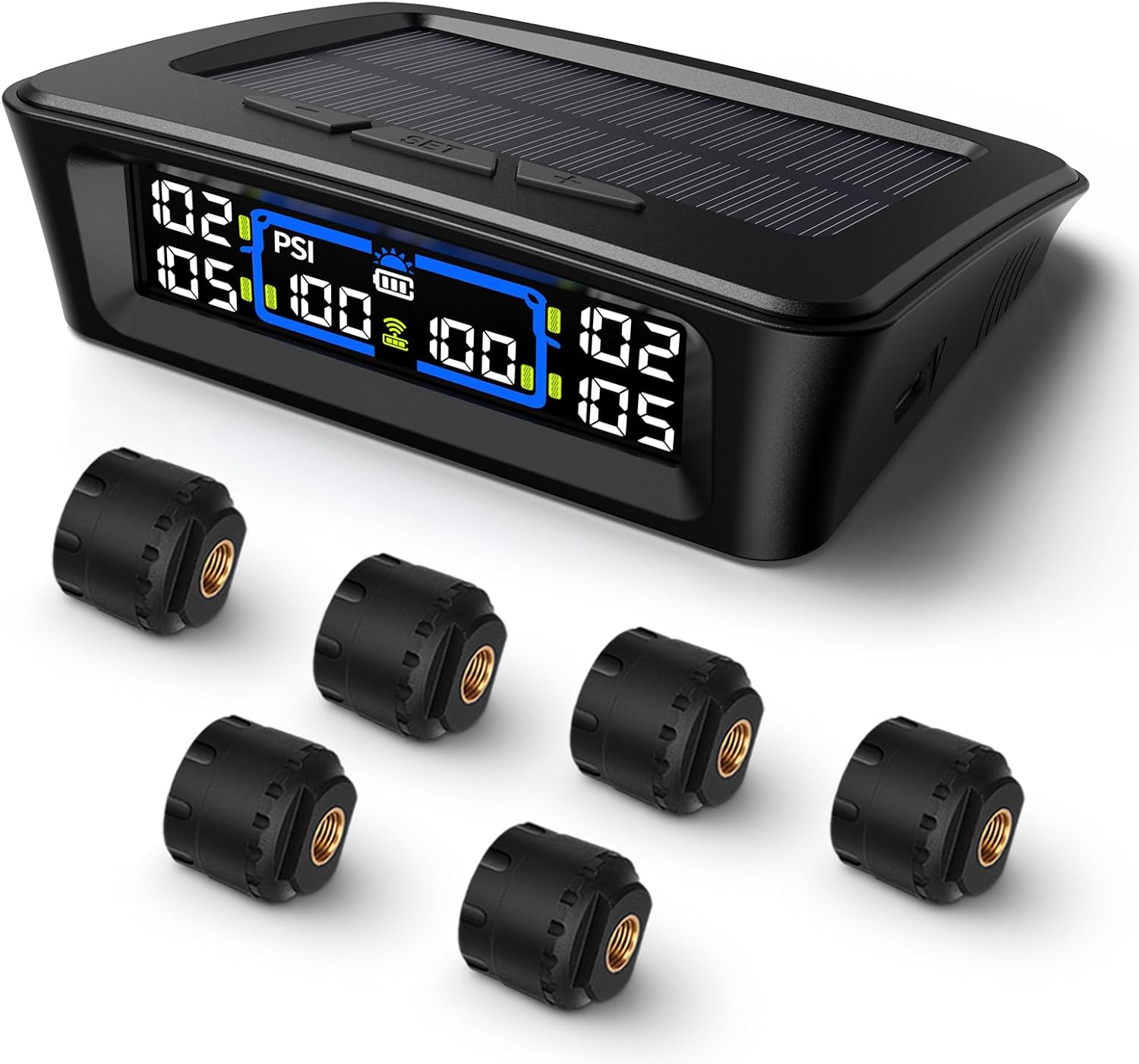
The Tymate TM12 RV TPMS delivers real-time tire pressure and temperature monitoring with a stable 433Hz display for safer long-distance driving. It supports simultaneous monitoring across vehicle and trailer zones, includes six alarm modes for pressure, temperature, leakage, battery, and signal loss, and features easy DIY installation with auto calibration. Power is supplied via USB-C charging or solar recharging, with a wide 0–144 PSI range and up to 50 ft signal coverage for RVs and towable trailers.

Monitor tire tread wear with a smart, color-coded depth gauge that shows clear condition ranges at a glance. The bar is range marked for fast, easy readings, helping you maintain safer traction and performance. Each gauge is portable with a pocket clip, and the set includes 20 units for daily use and sharing.

Replace your worn or missing TPMS sensors with pre-programmed, direct-fit sensors for compatible Ford, Lincoln, and select Mazda models. Each sensor comes ready to activate with a scan tool, helping restore accurate tire pressure monitoring and trouble-free installation. Built with a long-life CR2032 battery and tested before factory release, this set provides dependable performance with a one-year warranty.
Tips for Selecting Replacement Tires for Your Camry
When you are buying replacement tires for a Toyota Camry 4-cylinder, use this checklist before checkout:
- Match the size on the door label. Examples include P205/65R16, P215/55R17, P235/45R18, and P235/40R19, depending on year and trim.
- Match the wheel diameter. A 16-inch tire will not fit a 17-, 18-, or 19-inch wheel.
- Check the load index. Do not choose a tire with a lower load capacity than the original tire.
- Check the speed rating. Match or exceed the original rating unless a tire professional confirms a safe alternative.
- Choose the right season type. All-season tires fit many drivers, but winter tires are safer in regular snow, ice, and freezing temperatures.
- Replace in matched sets when needed. At minimum, tires on the same axle should match in size, type, and construction.
- Check cold pressure after installation. NHTSA recommends checking all tires, including the spare, at least once a month when cold.
- Ask about alignment. Uneven wear, pulling, vibration, or steering-wheel shake may mean the car needs alignment or balancing.
Also remember that newer Camrys use TPMS, but the warning light is not a substitute for regular pressure checks. NHTSA notes that TPMS warns when a tire is significantly underinflated, so you should still inspect pressure monthly with a gauge.
[Products Worth Considering]

Replace worn or missing TPMS sensors with a pre-programmed 4-pack designed for compatible GM vehicles. These 315MHz sensors provide real-time tire pressure monitoring and alert you if pressure is too high, too low, or if a rapid air leak occurs. Most installations are ready with minimal relearn effort after mounting, helping improve safety and driving confidence.

Check tire pressure quickly and accurately with the Accutire MS-4021B digital gauge, featuring a large backlit LCD for easy visibility. The angled head and rubber-coated handle make it comfortable to grip, while unit switching lets you read psi, bar, kPa, or kg/cm2. An automatic shutoff helps preserve battery life, and it measures 5–150 PSI in small increments for confident tire maintenance.

Measure tire tread depth quickly and accurately with this LUMITECO dial gauge that reads in 1/32" increments up to 14/32". The color-coded green/yellow/red zones make it easy to judge tire wear and know when replacement is needed. A rugged, compact design with a protective pouch helps keep the gauge ready for use on cars, trucks, motorcycles, and more.
What If the Current Tires Do Not Match the Door Label?
If the tires on your Camry do not match the door label, do not automatically buy the same size again. First, figure out why they are different:
- Aftermarket wheels may have been installed. The car may need a different approved tire size for the new wheel diameter and width.
- A previous owner may have installed the wrong size. This is common on used vehicles.
- A temporary spare may be installed. Temporary spares are not meant to be used as regular tires.
- The trim may have an optional wheel package. Some trims came with larger wheels from the factory.
When in doubt, give the tire shop your VIN, trim, current tire size, wheel diameter, and a photo of the door placard. That information helps confirm the safest replacement size.
[Products Worth Considering]

ETENWOLF T300 is a calibrated digital tire pressure gauge for accurate readings from 3 to 200 PSI across light and heavy-duty vehicles. It includes thermal compensation for reliable performance in extreme cold or heat, with an auto shut-off to extend battery life and an LED for easier reading. The sturdy design supports rugged everyday use, making it ideal for pickups, RVs, and industrial applications.

Replace worn or malfunctioning GM TPMS sensors with this 433MHz pre-programmed sensor set designed for compatibility with many Chevrolet, Buick, GMC, and Cadillac models. It includes guidance for proper OBDII relearning/pairing after installation and supports reliable long-term operation with a high-performance CR2032 battery. Quality tested for durability and performance to help restore accurate tire pressure monitoring.

The ETENWOLF T600 digital tire pressure gauge delivers precise, manually calibrated readings to ANSI B40.7 Grade 2A standards with ±0.5% PSI accuracy. Its 360° rotating nozzle and display hold make it easy to check pressures from any angle, while a bleed button helps dial tires to the perfect level. With a 0–250 PSI range and support for PSI, BAR, and KPA, it’s a convenient tool for maintaining tire performance across many vehicles and seasons.
Frequently Asked Questions
What is my OEM Toyota Camry tire size?
Your OEM tire size is listed on the Tire and Loading Information label on the driver-side door jamb and in the owner’s manual. Use that label as the final source because the correct size depends on model year, trim, wheel package, and powertrain.
Where is the tire size on a Toyota Camry?
Open the driver-side door and look on the door jamb, B-pillar, or door edge for the Tire and Loading Information label. You can also read the tire size molded into the tire sidewall, but the door label is the better source for the original factory size.
Can I use a different tire size on my Camry?
Only use a different size if Toyota or a qualified tire professional confirms it is compatible with your wheels, load rating, suspension clearance, speedometer accuracy, and safety systems. For most owners, the factory size is the safest choice.
What tire size does a 2025 Toyota Camry use?
According to Toyota’s 2025 Camry brochure, the LE uses P205/65 R16 all-season tires, SE and XLE use P235/45 R18, and XSE uses P235/40 R19. Always verify your own door label before buying.
Should I use the tire pressure on the tire sidewall?
No. The tire sidewall usually shows the tire’s maximum pressure, not the vehicle’s recommended cold pressure. Use the cold tire pressure on the Camry’s door label or in the owner’s manual.
When should Camry tires be replaced?
Replace tires when tread reaches 2/32 inch, when there are cracks, bulges, cuts, vibration, repeated pressure loss, or when the tires are too old for safe service. NHTSA also recommends monthly checks for pressure, treadwear, and damage.
Conclusion
Choosing the right tire size for your Toyota Camry is about safety, fitment, comfort, and efficiency—not just appearance. Start with the driver-side door label, confirm the size in the owner’s manual, and match the load index, speed rating, and cold tire pressure. If your Camry has aftermarket wheels or a tire size that does not match the placard, have a tire professional verify the fit before you buy.
Sources
- NHTSA TireWise — tire size, tire pressure, tread depth, TPMS, tire aging, and monthly tire maintenance guidance
- Toyota Owners: 2025 Camry Hybrid tire inflation pressure — Toyota guidance that recommended tire inflation pressure and tire size are shown on the Tire and Loading Information label
- Toyota Owners manuals and warranties — official Toyota manual lookup by Camry model year
- Toyota 2025 Camry eBrochure — current-generation Camry trim and all-season tire-size examples
- Toyota 2026 Camry eBrochure — latest Camry model-year reference for current trim details