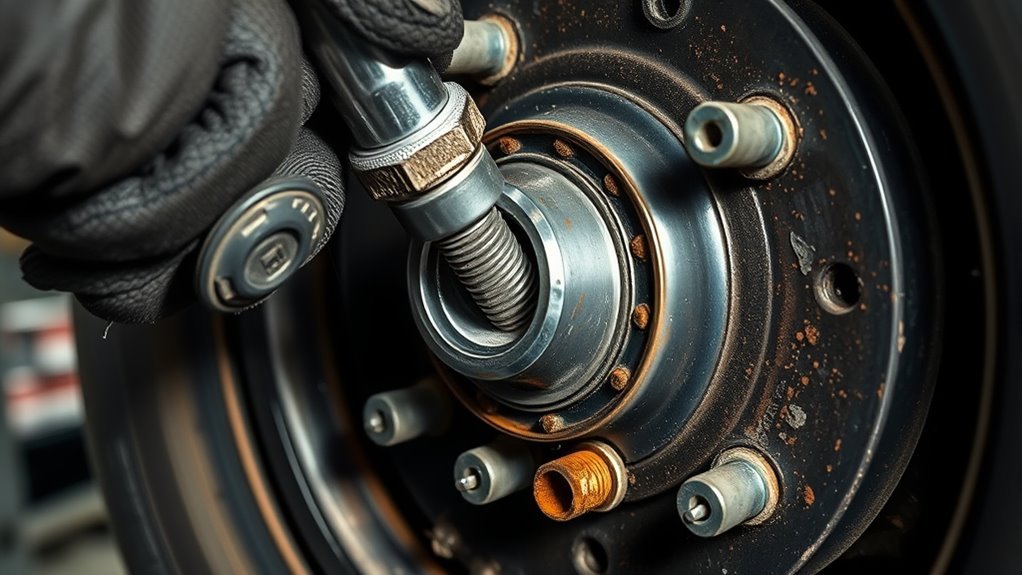
Replacing a seized or rusted wheel stud on a Toyota 4Runner is a manageable driveway repair when the hub, brakes, and wheel are still in good condition. The key is to support the vehicle safely, match the replacement stud correctly, seat the new stud fully, and verify the final lug-nut torque from your exact model year and wheel type.
Quick Answer
To replace a seized 4Runner wheel stud, lift the vehicle on jack stands, remove the wheel, move the brake caliper and rotor for access, drive the damaged stud out from the front of the hub, feed the new stud in from the back, pull it fully seated with washers and a throwaway lug nut, then torque the wheel by spec.
Key Takeaways
- Use jack stands and wheel chocks; never work on a 4Runner supported only by a hydraulic jack.
- Use a 21 mm socket for the lug nuts on common 5th-gen 4Runner procedures; 17 mm is typically for the caliper mounting bolts, not the lug nuts.
- Keep lug-nut threads and seating surfaces clean and dry unless Toyota or the stud manufacturer says otherwise.
- Do not use one universal torque value for every 4Runner. Verify the wheel-nut torque by model year, wheel material, and your owner’s manual or service data.
- Replace the stud if threads are stretched, stripped, badly corroded, or broken; do not try to “repair” a damaged wheel stud.
At a Glance
| Time Required | 45–90 minutes for one stud, depending on rust, wheel position, and brake access |
| Difficulty | Moderate DIY; harder if the rotor, parking-brake hardware, or stud is badly seized |
| Tools Needed | Floor jack, jack stands, wheel chocks, 21 mm lug socket, 17 mm socket, 12 mm socket where needed, torque wrench, hammer, washers, throwaway open lug nut, bungee cord, magnetic pickup, brake cleaner |
| Cost | Usually one replacement stud plus one new lug nut; higher if replacing a full set or using extended/performance studs |
Warning: Wheel studs and brakes are safety-critical parts. If the hub hole is enlarged, the stud will not seat tightly, the brake hose is damaged, the rotor will not sit flat, or the lug nut will not hand-thread smoothly, stop and inspect the parts before driving.
Verify Your 4Runner Year, Wheel Type, and Stud Fitment First
Do not begin by copying a torque number from a forum or a different 4Runner generation. Toyota 4Runner wheel-nut torque can vary by model year and wheel material. Many 2010–2024 service references list different torque values for aluminum and steel wheels, and the 2025+ 4Runner generation uses different values again. Always confirm your exact wheel-nut torque in the Toyota owner’s manual lookup, Toyota TIS, or year-specific service data.
Match the replacement stud before the old one comes out. Use a Toyota OEM stud or an exact-fit aftermarket stud such as a correctly matched Dorman, ARP, or equivalent part. Confirm the model year, front or rear position, thread pitch, knurl diameter, shoulder length, and overall length. If you have wheel spacers or aftermarket wheels, verify that the new stud gives proper thread engagement with the lug nut.
Note: Keep the lug-nut threads and lug-seat surfaces clean and dry unless the vehicle or fastener manufacturer specifically instructs otherwise. Oil or anti-seize on the threads can change the torque reading and over-stretch the stud.
[Products Worth Considering]

Upgrade your wheels with MIKKUPPA M12x1.5 mag seat lug nuts built for secure, corrosion-resistant performance. These closed-end chrome lug nuts are a direct replacement for select Toyota models, including Camry, Corolla, RAV4, Sienna, Avalon, Highlander, Matrix, Venza, and Prius. Triple-chromium plating and cold-forged, heat-treated steel help deliver strength for daily driving and replacement needs.

The 22800 wheel stud installer makes replacing wheel studs quick and secure, saving time and effort during tire service. It uses a ratchet or impact wrench to pull new studs firmly into place, helping when existing studs are too long. Compatible with most automotive wheels and light-duty truck wheel studs, it’s designed for easy, tool-assisted installation.

These M14x1.5 closed-end chrome lug nuts are a one-piece replacement designed for secure fitment on compatible GM, Ford, and select Chrysler/Dodge models. Featuring a 60-degree conical seat and anti-rust chrome plating, they help resist corrosion and maintain a bright look for everyday driving. Built for long-term durability, they include OEM-style part references and are backed by 12 months of support.
Remove a Seized 4Runner Wheel Stud Without Full Brake Disassembly
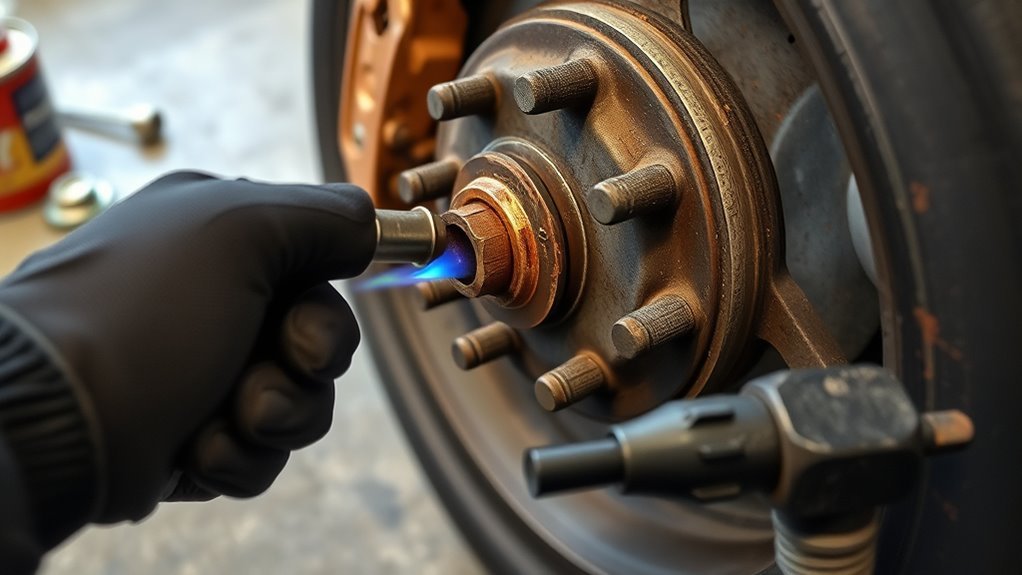
You can often replace a seized 4Runner wheel stud without removing the entire brake assembly, but you still need enough room behind the hub for the old stud to exit and the new stud to slide in. On the front, the clearance issue is usually the dust shield and rotor area. On the rear, the parking-brake shoes inside the rotor hat can also limit room.
Rotate the hub until the damaged stud lines up with the best clearance point. If the stud is only cross-threaded, try removing the lug nut carefully first. If the stud is broken, stripped, or severely corroded, plan to replace it. Do not drive on a missing or loose stud longer than necessary, and do not reuse a lug nut that damaged the old stud.
Lift and Secure Your 4Runner for Hub Access
Park on flat, solid ground. Set the parking brake when working on the front wheels, chock the opposite wheels, and loosen the lug nuts slightly before raising the vehicle. For rear wheel-stud work, release the parking brake before removing the rear rotor, but keep the vehicle secured with wheel chocks and jack stands.
- Place the floor jack under the correct lift point from your owner’s manual.
- Lift only high enough to remove the wheel and work safely.
- Set properly rated jack stands under approved frame or support points.
- Lower the 4Runner gently onto the stands.
- Shake-test the vehicle lightly before reaching near the hub.
Warning: A hydraulic jack is for lifting, not supporting. Use jack stands and follow the jack, stand, and Toyota placement instructions before putting any part of your body near or under the vehicle.
[Products Worth Considering]

Upgrade your wheels with MIKKUPPA closed-end lug nuts designed for reliable fit and corrosion resistance. The one-piece, cold-forged and heat-treated steel construction helps resist rust and stripping, while the integrated finish delivers a durable black appearance. Built to OEM standards with a conical 60-degree seat, these nuts provide a secure solution for compatible Ford, Honda, Jeep, and Chevrolet models.

This 1/2-inch drive breaker bar delivers powerful leverage for loosening and tightening stubborn lug nuts and automotive fasteners. The 180-degree flex head helps you reach tight spaces at the angle you need, making tire and brake jobs easier. A spring-loaded ball detent design holds 1/2-inch sockets securely while the chrome-moly head provides durable strength for everyday use.

The Trivd Frol 1/2" air impact wrench delivers high performance torque up to 1500 ft-lbs with a twin hammer impact mechanism for strong, balanced blows. It features an ergonomic grip, compact lightweight design, and quick-stop control with 3 forward speeds up to 8000 RPM plus a reverse speed. Built for demanding automotive repair and tire shop work, the rear exhaust helps keep debris away from the surface.
Essential Tools and Parts
Gather everything before the wheel comes off. The job becomes much easier when you are not searching for washers or a throwaway lug nut while the hub is open.
| Item | Purpose |
|---|---|
| 21 mm lug socket | Removes and installs the wheel lug nuts on common 4Runner setups |
| 17 mm socket | Removes front caliper mounting bolts on common 5th-gen procedures |
| 12 mm socket | Removes the brake-line bracket where applicable |
| Torque wrench | Applies final wheel and brake fastener torque accurately |
| Washers and throwaway open lug nut | Pulls the new stud into the hub without damaging your good lug nuts |
| Hammer or small sledge | Drives the old stud out after you protect the surrounding parts |
| Bungee cord or wire | Supports the caliper so it does not hang from the brake hose |
| Magnetic pickup | Retrieves dropped washers, lug nuts, and clips from tight spaces |
[Products Worth Considering]

MaxxHaul solid rubber wheel chocks provide dependable vehicle stabilization for cars, trucks, trailers, and RVs across driveways, slopes, garages, and campsites. The molded non-slip traction surface helps prevent tire movement on pavement, gravel, and smooth floors, while the solid rubber resists cracking, crushing, deformation, and weather wear. A built-in handle enables quick, tool-free placement and removal for convenient use in all seasons.

This car D-wheel lock nut key provides an anti-theft solution for D-shaped wheel lock bolts, helping keep your wheels secure. It features a flower-shaped internal pattern that resists micro-adjustment theft while allowing removal and mounting of compatible locking nuts. Made for reliable performance under high torque, it’s easy to use with standard socket wrench turning for quick tire maintenance and emergency repairs.

This spare tire tool kit is designed for the 2004 to 2018 Ford F-150 to help you loosen and tighten wheel lug nuts and manage the spare tire and provided jack functions from underneath the vehicle. It includes the lug nut wrench and extension pieces plus a convenient storage carrying case for organized transport. The jack itself is not included.
Remove the Wheel, Caliper, and Rotor in Sequence
Remove the remaining lug nuts and take the wheel off. Set the wheel flat so it cannot roll away. If the damaged lug nut is stuck, work slowly; forcing it can snap the stud, damage the wheel seat, or gall the threads further.
Front Brake Access
For front wheel-stud replacement, remove the brake-line bracket if it blocks caliper movement, then remove the caliper mounting bolts. Hang the caliper from the upper control arm or frame with a bungee cord. Never let the caliper hang by the rubber brake hose.
Slide the rotor off the hub. If it is stuck, tap the rotor hat with a rubber mallet or dead-blow hammer. Avoid striking the wheel studs you plan to keep, and do not pry against the brake shield or ABS wiring.
Rear Brake Access
For rear wheel-stud work, make sure the parking brake is released before trying to remove the rotor. The rear rotor contains the parking-brake drum surface, so rust or shoe drag can hold it in place. If the rotor will not slide off, use the proper service holes or adjuster method for your model year instead of forcing it.
Pro Tip: Before removing the rotor, thread two good lug nuts on backward by a few turns. This can keep the rotor from falling suddenly once rust breaks loose.
Knock Out the Old Stud
Rotate the hub until the damaged stud has the best path out the back. Thread a throwaway lug nut onto the damaged stud until the nut is nearly flush with the end of the stud. This gives the hammer a larger target and can reduce mushrooming.
- Check that the back of the stud has clearance from the dust shield, parking-brake hardware, and hub parts.
- Strike the throwaway lug nut squarely with a hammer until the stud breaks free from the hub splines.
- Remove the lug nut and pull the old stud out from the back.
- Inspect the hub hole. The splines should be sharp enough to hold the new stud tightly.
- Clean rust and debris from the hub face so the rotor and wheel sit flat.
If the stud will not move after several controlled hits, apply penetrating oil to the back side of the stud and let it soak. Do not keep swinging harder and harder. Excessive force can damage the bearing, hub flange, or parking-brake parts.
Feed and Seat the New Stud
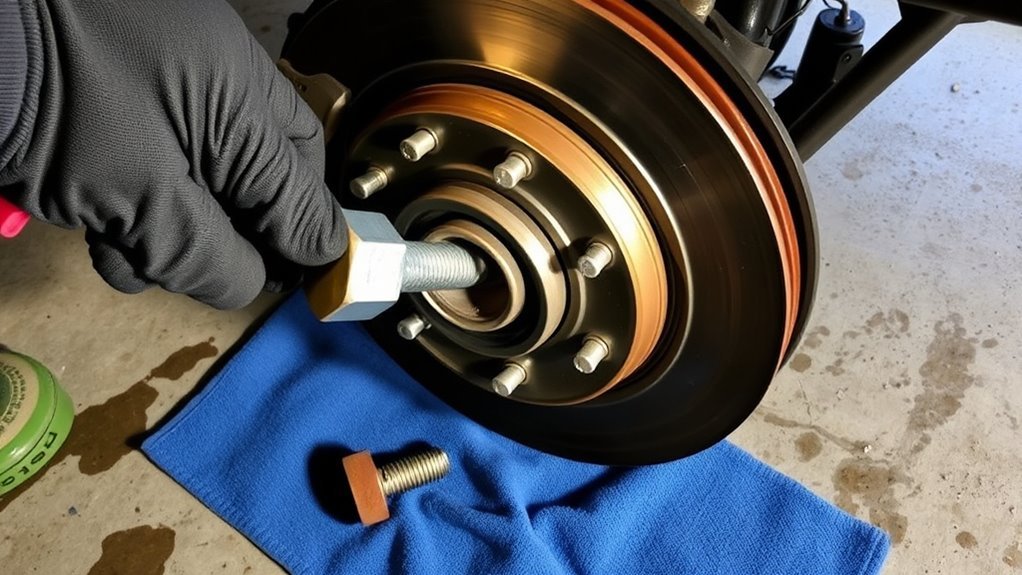
Insert the new stud from the back side of the hub. The head of the stud must sit flat against the back of the hub once it is fully seated. If the stud is too long to fit through the available gap, rotate the hub to a better clearance point. On some front setups, a small amount of dust-shield clearance may be needed; on rear setups, check the parking-brake hardware instead of forcing the stud through it.
Do not hammer the new stud in from the front. Pull it into place from the wheel side so the splines draw straight into the hub. If the stud enters crooked, stop and reset it before the splines cut the hub hole incorrectly.
Pull It Tight With the Washer Stack Method
Slide a stack of flat washers over the new stud on the wheel side. Add a throwaway open lug nut with the flat side facing the washers. The washers create a smooth pull surface and protect the new stud threads from the force needed to seat the splines.
- Hand-thread the throwaway lug nut several full turns to confirm the threads are clean.
- Hold the stud straight from the back if you can reach it.
- Tighten the throwaway lug nut gradually to pull the stud into the hub.
- Pause often and look behind the hub to confirm the stud head is seating flat.
- Stop once the stud head is fully seated against the back of the hub with no gap.
An impact wrench can speed this step, but use it carefully. Do not hammer on it after the stud bottoms out. Over-pulling can damage the new stud, distort the hub hole, or ruin the throwaway lug nut.
Note: The washer-stack nut is only an installation tool. It is not the final wheel torque step. Remove the washers and throwaway nut after the stud is seated.
Reinstall the Rotor, Caliper, and Wheel
Clean the hub face and rotor mounting surface with brake cleaner. The rotor must sit flat against the hub. Reinstall the rotor, then reinstall the caliper and any brake-line bracket you removed. Torque brake fasteners using year-specific service data. Many front 4Runner/Tacoma procedures use about 90 ft-lb for the main front caliper mounting bolts, but rear and model-year values can differ.
Put the wheel back on and hand-thread every lug nut before using any tool. If a lug nut does not spin on by hand, stop. Cross-threading the new stud can ruin the repair immediately.
Torque the Lug Nuts Correctly
Snug the lug nuts in a star pattern while the wheel is still off the ground. Lower the tire until it just touches the ground and cannot spin, then apply final torque with a calibrated torque wrench. Use the torque value from your owner’s manual or service data for your exact 4Runner year and wheel type.
For older 5th-gen 4Runner references, aluminum and steel factory wheels may have different torque values. For 2025+ 4Runners, do not assume older torque numbers apply. Always verify the value before tightening.
Final tightening belongs to the torque wrench, not the impact gun. Hand-thread first, snug evenly, torque in a star pattern, then recheck after driving.
Reassembly Checkpoints Before You Lower the Vehicle Fully
- Confirm the new stud head is fully seated against the back of the hub.
- Confirm the rotor sits flat on the clean hub face.
- Confirm the caliper is bolted on and the brake hose is not twisted or stretched.
- Confirm every lug nut hand-threaded smoothly.
- Torque the lug nuts in a star pattern to the verified spec.
- Press the brake pedal a few times before driving if you moved the caliper or pads.
- Drive slowly at first and listen for rubbing, clicking, vibration, or brake noise.
- Recheck lug-nut torque after a short drive and again after 50–100 miles.
When the Stud Won’t Budge
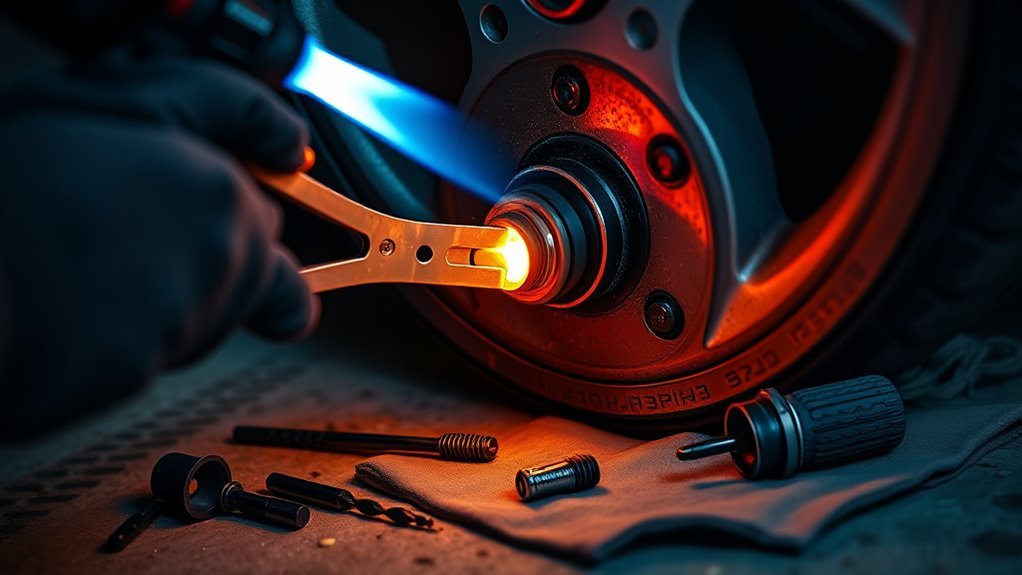
A wheel stud that has lived through years of road salt, heat cycles, and over-torquing can seize tightly in the hub. Start with penetrating oil and controlled strikes. If it still does not move, stop and inspect your access angle. Sometimes the issue is not the stud itself but the dust shield, parking-brake hardware, or rotor clearance blocking the exit path.
If the stud is fused, badly mushroomed, or broken too close to the hub, cutting and drilling may be required. That is where the risk goes up. A damaged hub flange or enlarged stud hole means the new stud may never hold proper clamping force. In that case, replace the damaged hub or have a qualified technician inspect it.
| Problem | Best Fix |
|---|---|
| Stud threads are rusty but intact | Clean lightly and inspect; replace if the lug nut does not thread smoothly |
| Stud is cross-threaded or stretched | Replace the stud and lug nut |
| Stud hole splines are damaged | Inspect hub flange; hub replacement may be needed |
| Rotor will not sit flat after repair | Clean mating surfaces and check for debris, rust scale, or bent parts |
| Lug nut will not hand-thread | Stop; replace the nut, inspect the stud threads, and do not force it |
Frequently Asked Questions
How do you fix rusty 4Runner wheel studs?
Light surface rust can be cleaned with a wire brush, but a stud with damaged threads, severe corrosion, stretching, or cross-threading should be replaced. Wheel studs are not a good place for guesswork because they provide the clamping force that holds the wheel to the hub.
Can I replace one wheel stud or should I replace all of them?
You can replace one damaged stud if the other studs are clean, straight, and thread smoothly. Replace more than one if several were over-torqued, rusted, stretched, or damaged by the same stuck lug nut or wheel spacer issue.
Should I put anti-seize on 4Runner lug studs?
Do not put anti-seize or oil on lug-nut threads or lug-seat surfaces unless Toyota or the fastener maker specifically instructs it. Most wheel torque specs assume clean, dry threads. Lubrication can change the torque reading and over-stretch the stud.
Can I use an impact wrench to install the new stud?
You can use an impact wrench carefully to pull the new stud into the hub with washers and a throwaway lug nut, but stop as soon as the stud head seats fully. Do not use an impact wrench for final wheel torque. Use a torque wrench.
What torque should I use for 4Runner lug nuts?
Use the wheel-nut torque listed for your exact 4Runner year, wheel material, and wheel hardware. Older 5th-gen references and 2025+ 4Runner references do not use the same values, so verify the specification in your Toyota owner’s manual or service data before tightening.
Conclusion
A seized 4Runner wheel stud is frustrating, but the fix is straightforward when you slow down and treat the job like safety-critical brake and wheel work. Support the vehicle correctly, match the new stud by fitment, keep lug threads dry, pull the stud in straight, and torque the wheel with verified specs. Once everything is seated and rechecked, your 4Runner is ready to drive with confidence again.
Sources
- Toyota Owners — Manuals and Warranties — model-year owner’s manual lookup and Toyota manual access
- Tire Rack — Properly Torque Wheel Lug Nuts or Bolts — dry-thread torque, hand-starting, star pattern, and impact-gun cautions
- Dorman Wheel Hardware — aftermarket wheel-stud and lug-nut testing and coverage information
- ARP Wheel Stud Kit Reference — example of verifying performance-stud fitment by exact kit and application
- AdventureTaco — Installing Extended Wheel Studs on a Tacoma or 4Runner — tool sizes, washer-stack method, and 4Runner/Tacoma procedure notes
- OSHA — Jack Stand Guidance — follow jack and manufacturer instructions for support and placement