

Yes, fat tire bikes can be harder to pedal on pavement, but they are not “hard” in every situation. Their wide tires add grip, comfort, and float on snow, sand, mud, and rough trails. On smooth roads, though, the same wide contact patch, soft pressure, heavy tread, and extra bike weight can make them feel slower than a standard bike.
Quick Answer
Fat tire bikes are harder to pedal on pavement because wide tires, low pressure, aggressive tread, and extra rotating weight can increase drag. They feel easier and more controlled on loose terrain, where the wider tire spreads your weight, improves traction, and helps the bike float instead of sinking.
Key Takeaways
- Fat tire bikes usually feel slower on pavement because wide tires and low pressure can add rolling resistance.
- They shine on snow, sand, mud, and rough trails because the tire spreads your weight over a larger contact patch.
- Tire pressure matters more on a fat bike than on many standard bikes; small PSI changes can change grip, comfort, and speed.
- Fat tire e-bikes feel easier because motor assist offsets much of the tire drag and extra bike weight.
- Never inflate beyond the maximum PSI printed on the tire or allowed by the rim manufacturer.
Are Fat Tire Bikes Harder to Pedal?
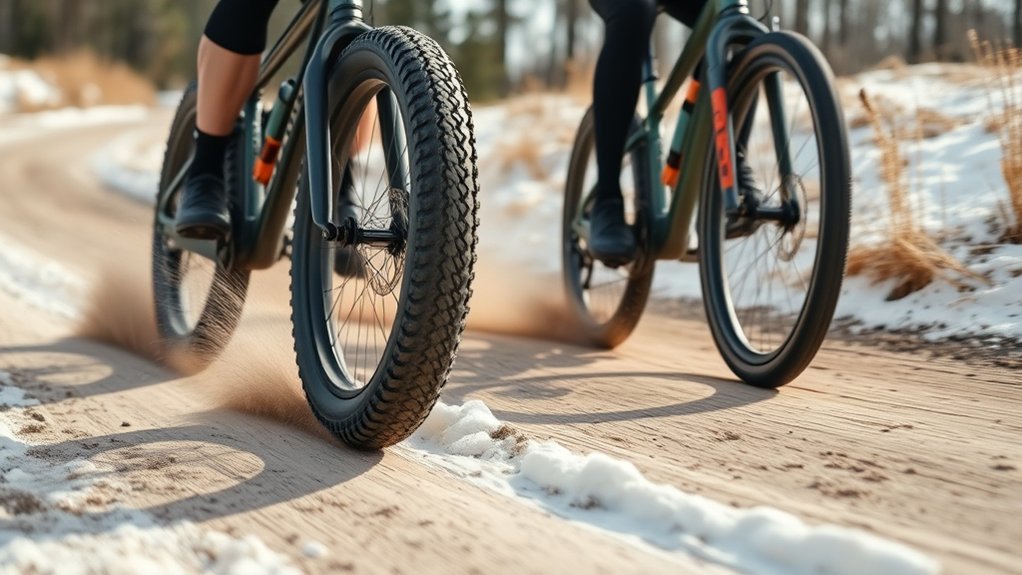
Fat tire bikes are usually harder to pedal on pavement than standard bikes because the tires are much wider, often around 3.7 inches to 5 inches or more. That extra width creates a larger contact patch with the ground. On soft terrain, that is helpful. On pavement, it can feel like extra drag.
The effort comes from four main things:
- More rolling resistance: A larger, softer tire deforms more as it rolls.
- More rotating weight: Bigger tires and wider rims take more energy to accelerate.
- More tread drag: Knobby tires grip well off-road but can feel slow on smooth roads.
- Lower tire pressure: Low PSI improves grip and comfort, but it can make each pedal stroke feel heavier on hard surfaces.
That does not mean fat bikes are inefficient everywhere. On snow, sand, mud, and loose dirt, the wide tire can keep the bike moving where a narrow tire would dig in, slip, or stop. Surly compares the effect to a snowshoe: the tire spreads weight over more surface area so it stays on top of soft ground instead of sinking into it.
Why Fat Tire Bikes Feel Slower on Pavement
On pavement, traction is usually not the problem. Efficiency is. A narrow road, hybrid, or gravel tire does not need a huge footprint to stay upright on smooth asphalt. A fat tire still carries that big footprint, so more rubber touches the road and more energy can be lost through tire deformation.
That is why a fat bike can feel slow when you:
- start from a stop,
- climb a hill,
- ride into wind,
- try to hold a steady high speed, or
- run very low pressure on hard ground.
Tire setup is not as simple as “higher pressure is always faster.” A 2025 cycling tire study found that tire width, tire pressure, surface condition, and rider-system mass all affect rolling resistance and vibration. The practical lesson is simple: use the pressure that matches the surface, not one fixed PSI for every ride.
Warning: Do not inflate fat bike tires to a random high PSI just to make them faster. Check the maximum pressure printed on the tire and the rim limit. For example, some fat bike tires list a maximum around 25 PSI, so 30 PSI may be unsafe for that setup.
How Tire Pressure Changes Pedaling Effort
Tire pressure is one of the biggest reasons a fat bike can feel either smooth and fun or slow and exhausting. Because fat tires hold a large volume of air, even a small change of 1–2 PSI can be noticeable on snow, sand, and trails.
Low Pressure: More Grip, More Drag
Lower pressure lets the tire flatten slightly. That gives you more ground contact, better traction, and more float. It is useful on snow, sand, mud, roots, and loose dirt.
The trade-off is that the tire flexes more. On pavement, that flex can steal momentum. You may feel like the bike wants to crawl instead of roll.
- Snow: Low pressure helps the tire float over soft layers.
- Sand: Low pressure helps prevent the tire from digging in.
- Mud: Low pressure can improve grip, but too low may feel squirmy.
- Pavement: Too-low pressure usually feels slow and heavy.
Higher Pressure: Easier on Firm Ground
Higher pressure reduces tire squirm and can make a fat bike easier to pedal on pavement, hardpack, and smooth gravel. The tire deforms less, so the bike can hold speed better.
Use the higher end of your tire’s safe range for pavement, but do not exceed the tire or rim limit. For mixed rides, start in the middle of the safe range and adjust from there. For snow and sand, lower the pressure gradually until the bike floats and grips without bouncing or folding the tire in corners.
Pro Tip: Carry an accurate low-pressure gauge. Many floor pumps are not precise at fat-bike pressures, and a 1 PSI change can matter on snow or sand.
Best Fat Bike Tire Pressure by Surface
There is no single perfect PSI for every rider. Your weight, tire size, rim width, tube or tubeless setup, and terrain all matter. Use these ranges only as starting points, then adjust by feel while staying inside the tire and rim limits.
| Pavement / hardpack | Use the higher end of the safe range printed on your tire. This reduces squirm and helps the bike roll faster. |
| Gravel / mixed paths | Use a middle setting that gives comfort without making the tire bounce or drag. |
| Snow | Lower pressure helps the tire spread out and stay on top. Adjust often because snow can change from firm to soft during one ride. |
| Sand | Lower pressure helps flotation. If the tire digs in, lower pressure slightly; if it folds in turns, add pressure. |
| Rocky trails | Use enough pressure to protect the rim from hard hits, especially if you ride with tubes. |
[Products Worth Considering]
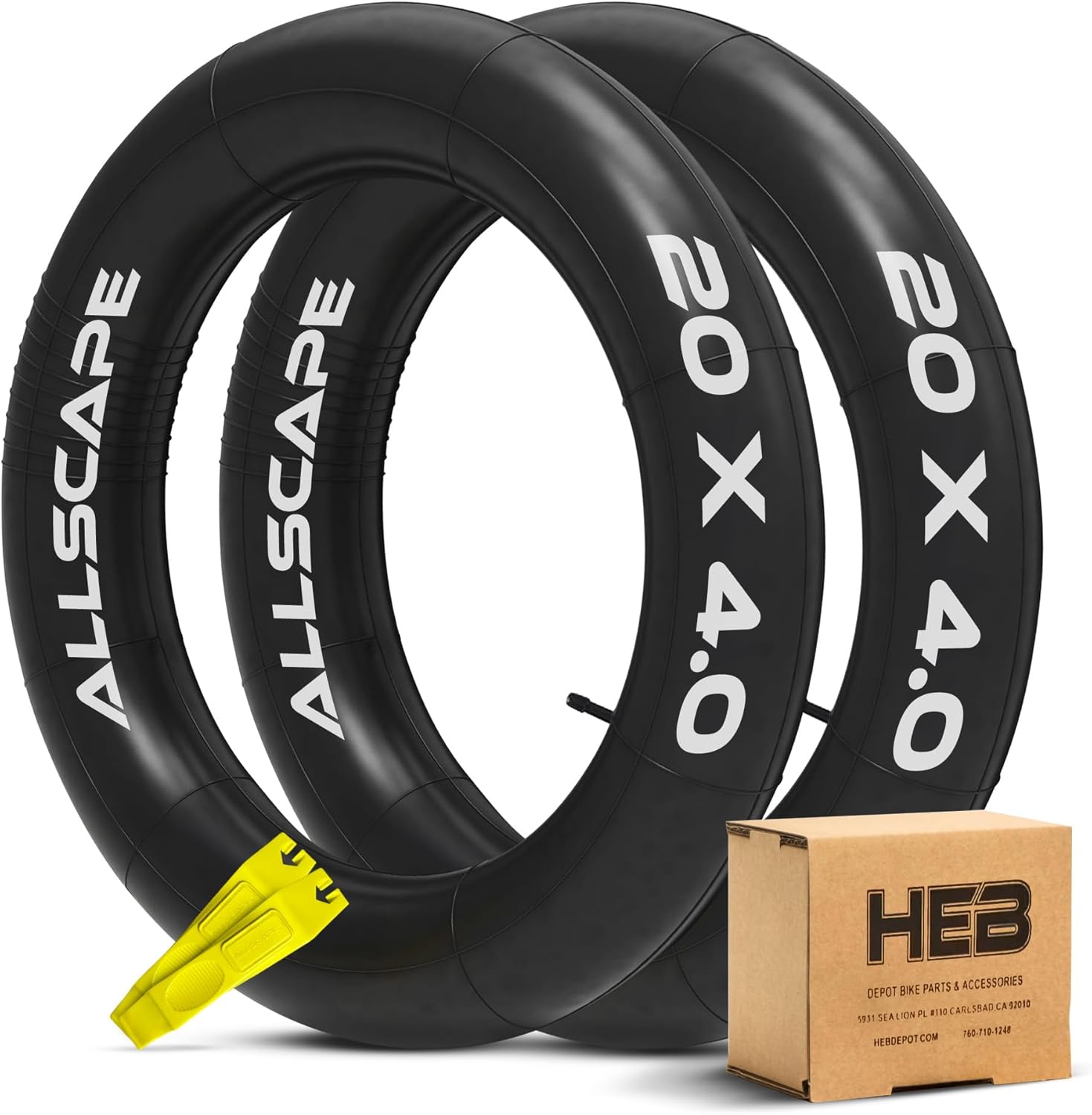
HEB heavy duty inner tubes deliver reliable puncture resistance for fat tire electric bikes and mountain bikes running 20x4 or 26x4 tires. Built for rugged backcountry trails, they help prevent flats from rocks and thorns while providing stability and traction. Choose a single tube or multi-packs for better value and keep your ride running smoothly in all seasons.

The TANX hitch bike rack securely fits any 2-inch receiver and carries up to two bikes, including heavy-duty e-bikes and fat tires up to 5 inches wide. Its foldable, smart tilting design lets you access your trunk or tailgate without removing the bikes. An anti-wobble hitch tightener and locking hitch pin help keep the ride stable, while padded, adjustable cradles and straps protect bike finishes during transport.

Upgrade your ride with a 2-pack set of 26x1.95 folding mountain bike tires built for dependable traction on mud, rocks, and trail surfaces. A reinforced puncture-resistant layer helps protect against sharp debris, while included butyl inner tubes provide strong sealing and shock absorption. Ready for fast swaps with included tire levers and universal sizing for most bikes.
Why Fat Tire E-Bikes Feel Easier to Ride
A fat tire e-bike can feel much easier than a regular fat bike because the motor offsets the extra tire drag and bike weight. Pedal assist helps when you start from a stop, climb hills, or ride through soft ground.
The motor does not erase physics. Wide tires still create drag, and low pressure can still reduce battery range. But instead of your legs doing all the work, the motor helps keep the bike moving.
Motor Assist Reduces Effort
Pedal assist adds power when you pedal, so the bike feels smoother under load. This is especially helpful on climbs, soft trails, beach sand, and winter routes where a non-electric fat bike can feel demanding.
In the United States, a low-speed electric bicycle is federally defined as having fully operable pedals, a motor under 750 watts, and a motor-only top speed under 20 mph on a paved level surface. Higher-powered models may be regulated differently, and trail rules can vary by state, city, park, or land manager.
Weight Feels Less Noticeable
Fat tire e-bikes are usually heavier than non-electric fat bikes because they add a battery, motor, controller, display, and stronger frame parts. That weight is most noticeable when lifting the bike, loading it onto a rack, or pedaling with the battery off.
When the motor is on, the extra weight feels less obvious. The bike still has mass, but assist helps with acceleration and climbing. For commuting or casual mixed-terrain riding, that can make a fat tire e-bike feel more practical than a non-electric fat bike.
Hills Become Easier to Climb
Hills are where the difference is easiest to feel. A regular fat bike asks your legs to overcome tire drag, bike weight, and gravity at the same time. A fat tire e-bike adds power while the wide tire keeps traction, so climbing loose dirt, snow, or rough paths feels more controlled.
Use lower assist on flat pavement to save battery. Use higher assist for hills, headwinds, cargo, or soft terrain. Keep in mind that low tire pressure, heavy throttle use, cold weather, and steep climbs can all reduce range.
Where Fat Tire Bikes Beat Standard Bikes
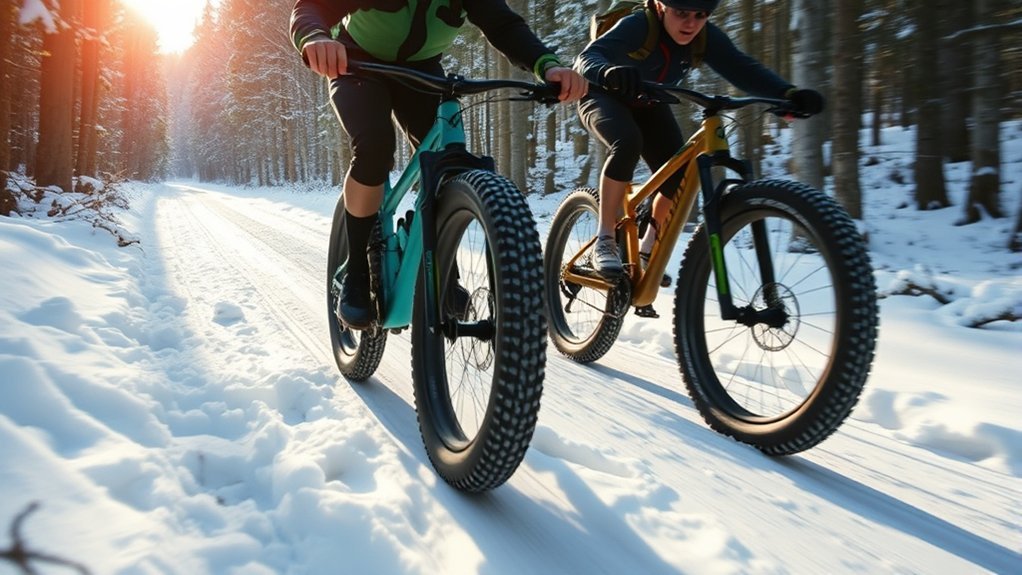
Fat tire bikes beat standard bikes on loose, unstable, or rough ground. Their wide tires spread your weight over a larger area, which improves float and grip. That helps the bike keep rolling through conditions where a narrower tire may sink, slide, or bounce.
They are strongest on:
- Snow: Better flotation and control on packed or soft winter trails.
- Sand: Less digging and more stability on beaches or sandy paths.
- Mud: More contact area for grip, although very sticky mud can still clog tread.
- Loose dirt: Better traction when climbing or cornering.
- Rough trails: More air volume helps absorb bumps and chatter.
Fat tires trade road speed for grip, comfort, and float. That trade-off is a weakness on smooth pavement but a major advantage on snow, sand, and rough trails.
When Fat Tire Bikes Work Best
Fat tire bikes work best when the surface changes often. If your ride moves from pavement to gravel, then to dirt, snow, sand, or broken trail, a fat bike gives you control and confidence.
They are also useful for riders who care more about stability than speed. Beginners often like the planted feel. Bikepackers may like the comfort and cargo stability. Winter riders like being able to ride when standard mountain bike tires struggle.
On the other hand, a fat bike is not the fastest choice for long paved commutes, road fitness rides, or group rides where speed matters. For those uses, a hybrid, gravel bike, road bike, or narrower mountain bike tire will usually feel easier.
How to Make a Fat Tire Bike Easier to Pedal
You can make a fat tire bike feel much easier without changing the whole bike. Start with setup before blaming the tires.
- Set pressure for the surface. Use more pressure on pavement and less on soft terrain, while staying within safe limits.
- Choose faster tires for road use. A smoother center tread rolls easier than tall, aggressive knobs.
- Use tubeless if your wheels and tires support it. Tubeless setups can reduce pinch flats and let you tune pressure more confidently.
- Shift earlier on climbs. A lower gear keeps cadence smooth and reduces the “grinding” feeling.
- Keep the drivetrain clean. A dirty chain, worn cassette, or dragging brake makes any bike harder to pedal.
- Check brake rub. Wide tires are easy to blame, but a rubbing rotor can make the bike feel slow.
- Match tire width to terrain. Wider is not always better. Use the tire size that fits your main riding surface.
Note: If your fat bike suddenly feels harder to pedal than usual, check tire pressure, brake rub, chain lubrication, and bearing drag before assuming the tires are the only problem.
[Products Worth Considering]

Upgrade your 20x4.0 fat tire ebike with these perfectly fitting inner tubes designed for 20-inch fat tires. The Schrader valve makes inflation easy and the premium butyl construction helps resist everyday wear. Each pack includes two tubes, making it simple to be ready for flats and keep your ride moving.

Ride with confidence using these fat tire inner tubes designed for 26-inch e-bikes and bikes. The butyl rubber construction delivers good airtightness, durability, and shock absorption for a smoother ride. Each tube fits 26x3.5 to 4.0 tires with an AV 32mm Schrader valve, and the kit includes tire levers for easier installation.
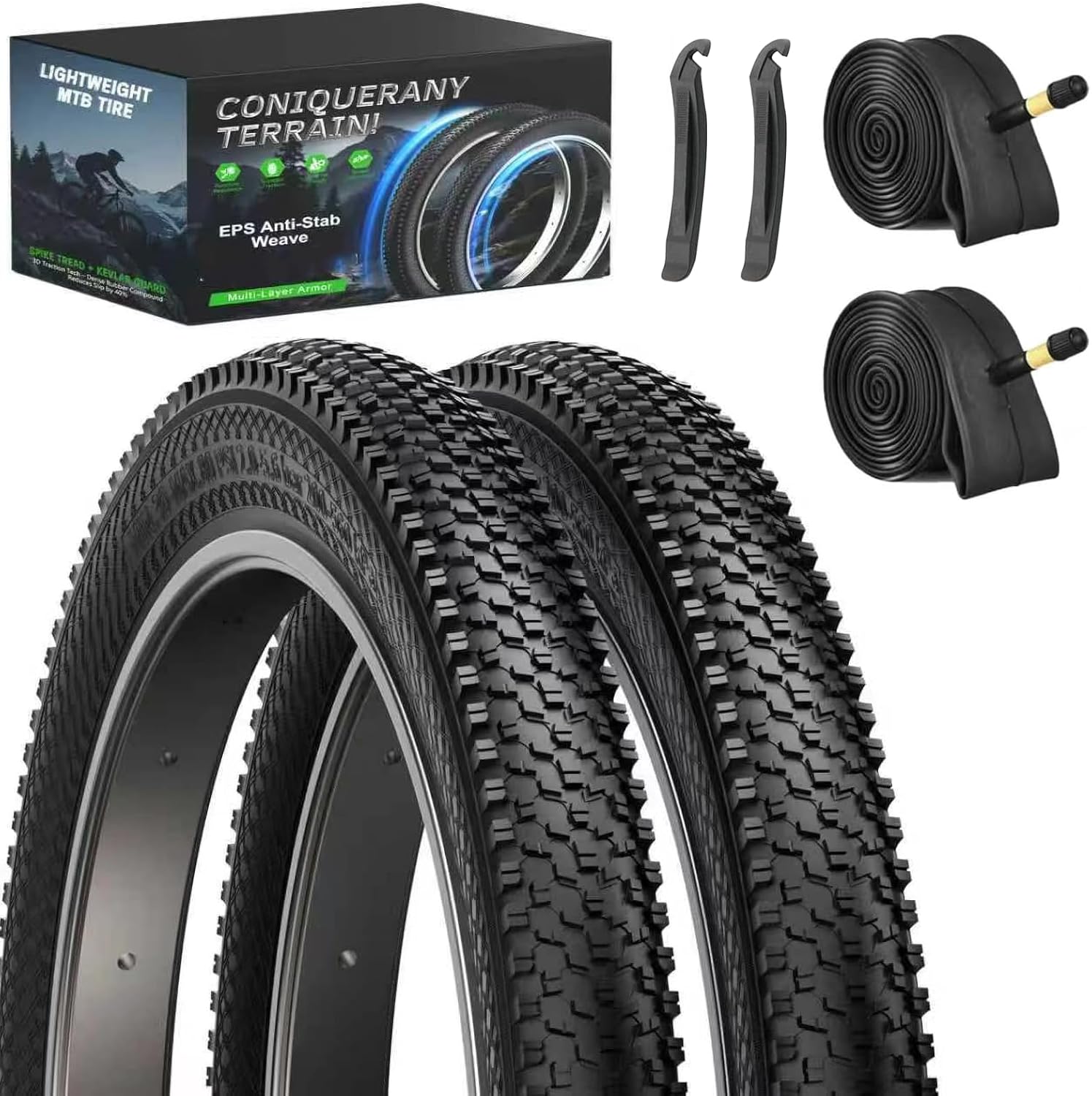
This 2-pack set includes two folding mountain bike tires, two inner tubes, and two tire levers for quick, budget-friendly replacements. The tires feature an anti-stab weave for added protection, plus strong grip and durable construction to help you stay stable across common trail and road conditions. Foldable design makes storage and travel convenient, while the included tubes provide a matched fit for smoother setup.
How to Choose a Fat Tire Bike
Choose a fat tire bike based on where you will ride most often. Tire width, tread, pressure range, gearing, and bike weight all matter.
- For snow and sand: Look for wider tires, strong flotation, and low-pressure capability.
- For mixed trails: A 3.8″ to 4.5″ tire may feel more efficient than the widest option.
- For pavement plus light trails: Choose a faster-rolling tread with a smoother center pattern.
- For hills: Prioritize low gearing, good brakes, and reasonable bike weight.
- For e-bikes: Check motor class, battery range, total bike weight, rack compatibility, and local rules.
- For heavy riders or cargo: Check the manufacturer’s total weight limit, not just tire size.
Also check tire clearance before changing sizes. A frame that fits a 3.8″ tire may not safely fit a much wider tire with enough mud and snow clearance.
[Products Worth Considering]

This heavy-duty fat bike inner tube is built for secure fit on 20-inch wheels with 3.5 to 4.0 inch wide tires, including e-bikes and mountain bikes. It uses thick butyl rubber for improved durability, air tightness, and a smoother, more comfortable ride. A standard Schrader valve makes inflation easy and helps keep pressure stable for safer rides, with tire levers included for simpler installation.

This Hycline 2-pack mountain bike tire set delivers durable, puncture-resistant performance with a high-grip, aggressive tread designed for traction on hard surfaces and confident handling through mud and soil. Includes matching inner tubes and tire levers for easier everyday maintenance and quicker installation after folding storage. Built for a range of riding conditions with reinforced rubber and nylon cord for wear-resistant reliability.

This hitch-mounted bike rack securely carries two bikes with soft padded hooks that help prevent swaying and frame scratches. It folds up when not in use and tilts down for easy trunk access without removing the bikes. Designed for a 2-inch receiver, it provides a wobble-free fit and supports bikes up to a total capacity of 200 lb, including fat tires up to 5 inches.
Common Mistakes That Make Fat Bikes Feel Sluggish
- Running snow pressure on pavement: Great for float, terrible for road speed.
- Using aggressive knobs for daily road riding: Knobs add vibration and drag on asphalt.
- Ignoring tire limits: Too much pressure can damage equipment or cause a blowout.
- Pedaling in too hard a gear: Fat bikes reward smooth cadence, not grinding.
- Buying more tire than you need: The widest tire is not always the best tire for your route.
- Forgetting battery impact on e-bikes: Low pressure and high assist can shorten range.
Frequently Asked Questions
What are the disadvantages of fat bikes?
Fat bikes are usually slower on pavement, heavier than comparable narrow-tire bikes, and more expensive to equip with replacement tires. They can also feel sluggish if you use low pressure or aggressive tread on smooth roads. Their advantages show up most clearly on snow, sand, mud, and rough trails.
How much harder is it to pedal a fat tire bike?
There is no reliable single percentage because effort depends on tire width, tread, pressure, surface, rider weight, gearing, and speed. On pavement, a fat bike usually feels noticeably slower than a standard bike. On soft ground, it may feel easier because it floats and grips instead of sinking.
Are fat bike tires harder to pedal?
Yes, fat bike tires can be harder to pedal on firm surfaces because they are wide, heavy, and often run at low pressure. They are not always harder on soft terrain, though. On snow or sand, a fat tire can roll better than a narrow tire because it does not sink as much.
Is it easier to balance on a fat tire bike?
Many riders find fat bikes easier to balance at low speeds because the tires feel planted and stable. The wide contact patch improves confidence on loose or uneven surfaces. The bike may still feel slower to steer than a lighter, narrower-tire bike.
Can you ride a fat tire bike on pavement?
Yes, you can ride a fat tire bike on pavement. It will usually be slower than a road, hybrid, or gravel bike, but it can work for casual riding. For pavement, use a safe higher pressure, smoother tread, and a comfortable cadence.
What PSI should fat bike tires be?
Use the tire and rim limits first. In general, firmer surfaces need more pressure, while snow and sand need less. Start with the manufacturer’s recommended range, then adjust in small steps until the bike rolls well without slipping, bouncing, or folding the tire in turns.
Are fat tire e-bikes easier to pedal?
Yes, fat tire e-bikes are usually easier to pedal because motor assist offsets much of the tire drag and bike weight. They still need correct tire pressure, and low pressure can reduce battery range, especially on pavement or hills.
Do fat bike tires wear faster on pavement?
They can, especially if they use soft rubber or aggressive knobs designed for trail, snow, or sand. Pavement can round off knobs and make the tire noisier or less grippy off-road. If you ride mostly pavement, choose a faster-rolling fat tire with a smoother center tread.
Conclusion
So, are fat tire bikes harder to pedal? On pavement, usually yes. Their wide, soft tires create more drag than narrower tires, especially at low pressure. But on snow, sand, mud, and rough trails, that same wide tire gives you traction, float, stability, and comfort that standard bikes cannot match as easily.
The best setup depends on where you ride. Use higher safe pressure for pavement, lower pressure for soft terrain, choose tread that matches your route, and consider motor assist if you want fat-tire control without as much leg effort.
Sources
- REI Expert Advice: Choosing Mountain Bike Tires — supports fat bike tire width ranges, traction, and air-volume benefits.
- Surly Bikes: Pugsley — explains how low-pressure fat tires increase contact and float over soft surfaces.
- 45NRTH: Rules of Fat — Dialing in Tire Pressure — supports tuning fat bike pressure for changing snow conditions.
- Trek: Bontrager Hodag Fat Bike Tire — example fat tire specifications, including listed maximum pressure.
- 15 U.S.C. 2085: Low-Speed Electric Bicycles — supports U.S. federal e-bike definition and motor-power caveat.
- Journal of Science & Cycling: The Impact of Tyre Width, Pressure and Surface Condition on Rolling Resistance and Vibration Transmission of Bicycle Tyres — supports the relationship between tire width, pressure, surface, rolling resistance, and vibration.
