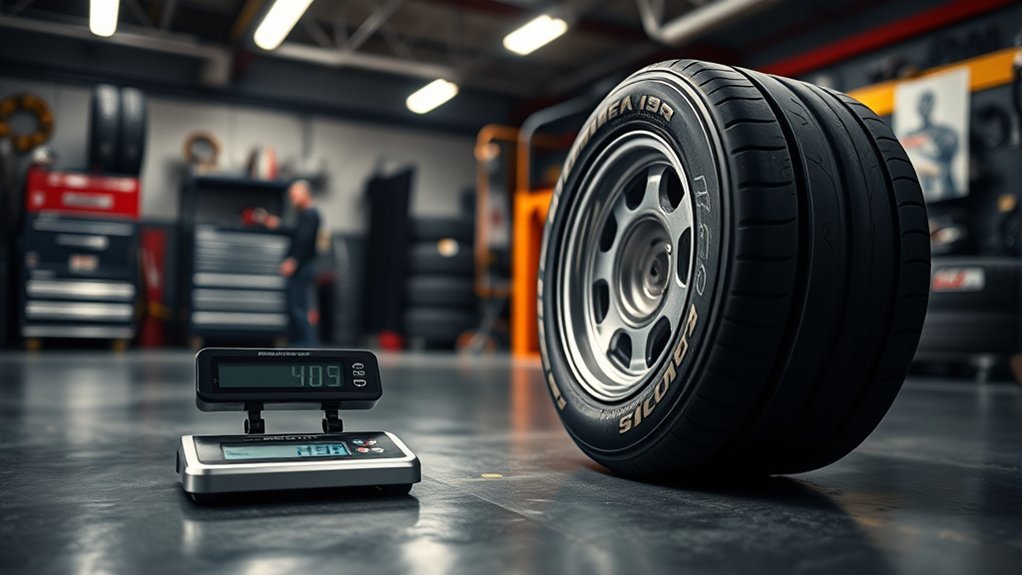
A modern NASCAR Cup Series tire weighs about 26 pounds by itself. Once it is mounted on the 18-inch wheel, the full wheel-and-tire assembly is about 48 pounds. That means four bare tires are about 104 pounds, while four mounted assemblies are about 192 pounds. The mounted number matters most on pit road because that is what the crew handles during a stop.
Quick Answer
A current NASCAR Cup tire weighs about 26 lb without the wheel and about 48 lb as a mounted wheel-and-tire assembly. Two mounted assemblies weigh about 96 lb, which is why that number often appears in pit-road discussions. A full set of four mounted assemblies is about 192 lb.
Key Takeaways
- A NASCAR Cup tire weighs about 26 lb before it is mounted.
- A Cup wheel-and-tire assembly weighs about 48 lb.
- Four bare tires weigh about 104 lb; four mounted assemblies weigh about 192 lb.
- The common 96-lb figure usually refers to two mounted assemblies, not a full set of four.
- Cup cars use an 18-inch Goodyear racing tire package, while the NASCAR O’Reilly Auto Parts Series may use different tire packages by event.
How Much Does a NASCAR Tire Weigh?
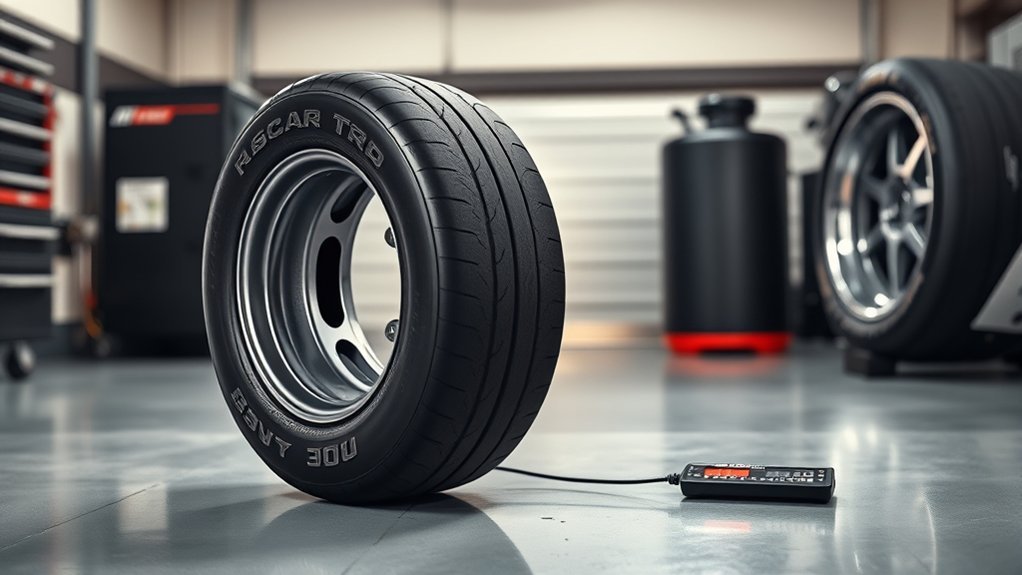
A NASCAR Cup Series tire weighs about 26 pounds before it is mounted to the wheel. With the 18-inch wheel included, the mounted assembly is about 48 pounds. These are useful working estimates, not one fixed number for every tire at every track.
The distinction matters because people often mix up the bare tire weight with the mounted assembly weight. The tire-only number describes the rubber, carcass, belts, and air chamber. The mounted number describes what the tire carrier moves across pit road and what the car has to rotate at speed.
| Tire only | About 26 lb |
| Wheel-and-tire assembly | About 48 lb |
| Four bare tires | About 104 lb |
| Two mounted assemblies | About 96 lb |
| Four mounted assemblies | About 192 lb |
Note: NASCAR tire weights can vary slightly by tire code, left-side or right-side construction, dry or wet-weather design, air pressure, and whether an inner liner is used. Use the 26-lb and 48-lb figures as practical Cup Series estimates, not lab-certified weights for every event.
What Makes NASCAR Tires So Heavy?
NASCAR tires are built for racing loads that normal street tires never see. They have to handle high speed, heavy braking, sustained cornering force, track heat, curb strikes on road courses, and fast pit-road handling. That strength adds weight, but the tire still has to stay light enough to respond quickly.
The current Cup Series tire package is part of the Next Gen car system. Goodyear says the Next Gen racing tire uses an 18-inch wheel diameter, shorter sidewall, and wider contact patch compared with the previous Cup tire. Those changes help the car feel closer to modern performance-car tire design while still surviving oval racing loads.
Weight also depends on the job each tire has to do. Right-side tires on many ovals take the hardest cornering load. Wet-weather tires add tread pattern and water-management needs. Some series and tracks also use inner liners. That is why one single number should not be treated as the exact weight of every NASCAR tire.
Cup vs. NASCAR O’Reilly Auto Parts Series Tire Weight
The safest comparison is this: Cup Series tires and NASCAR O’Reilly Auto Parts Series tires do not always use the same package. NASCAR’s secondary national series was formerly known as the Xfinity Series, but NASCAR announced that the NASCAR O’Reilly Auto Parts Series would officially debut in 2026.
For current Cup racing, the common estimate is about 26 lb for the tire and about 48 lb mounted. For the O’Reilly Auto Parts Series, exact public tire weights are not published as one universal number. The package can differ by track, series, tire code, and inner-liner requirements. For example, NASCAR’s 2026 Pocono tire note stated that the O’Reilly Auto Parts Series would use 15-inch Goodyear tires with inner liners at that event.
That means the article should not simply say one series has heavier tires unless a specific event tire code and mounted setup are being compared. A better rule is to separate the series, check the event tire notes, and avoid treating Cup numbers as automatic O’Reilly Auto Parts Series numbers.
[Products Worth Considering]

Upgrade your wheels with MIKKUPPA M12x1.5 mag seat lug nuts built for secure, corrosion-resistant performance. These closed-end chrome lug nuts are a direct replacement for select Toyota models, including Camry, Corolla, RAV4, Sienna, Avalon, Highlander, Matrix, Venza, and Prius. Triple-chromium plating and cold-forged, heat-treated steel help deliver strength for daily driving and replacement needs.
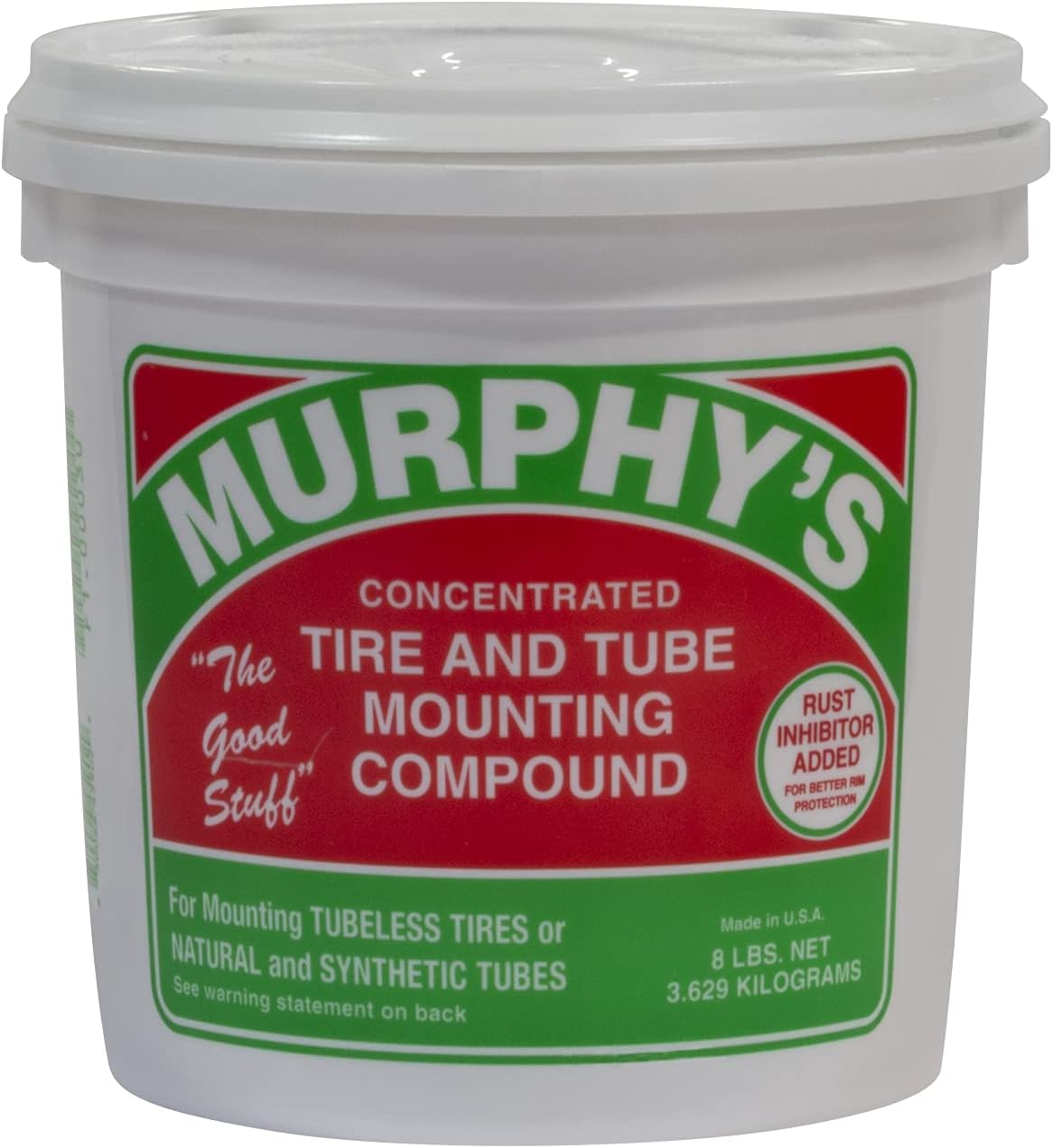
A concentrated tire and tube mounting compound designed to help simplify mounting rubber tires and tubes on passenger, semi truck, construction, and OTR applications. Its ultra-thick formula packs beads effectively and includes rust inhibitors to help protect against corrosion during use.

This 1/2-inch drive breaker bar delivers powerful leverage for loosening and tightening stubborn lug nuts and automotive fasteners. The 180-degree flex head helps you reach tight spaces at the angle you need, making tire and brake jobs easier. A spring-loaded ball detent design holds 1/2-inch sockets securely while the chrome-moly head provides durable strength for everyday use.
How Much Do NASCAR Tires Weigh With Rims?
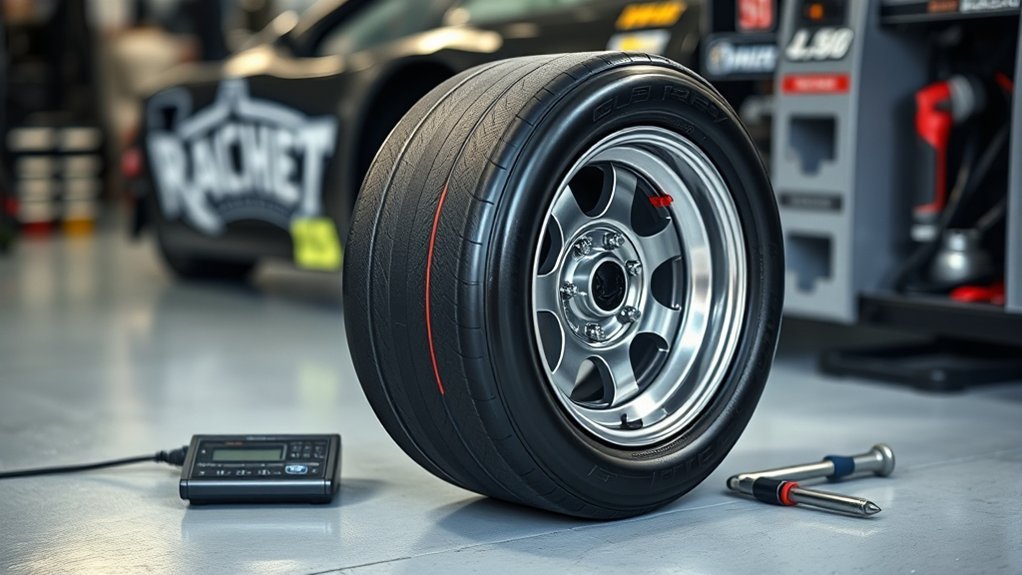
With the wheel included, a current NASCAR Cup tire-and-wheel assembly weighs about 48 pounds. The tire itself accounts for about 26 pounds, while the wheel makes up the rest of the mounted assembly.
- Tire only: about 26 pounds.
- Mounted assembly: about 48 pounds.
- Two mounted assemblies: about 96 pounds.
- Four mounted assemblies: about 192 pounds.
This is the number pit crews care about most. A tire carrier is not just moving rubber; he is moving a mounted racing part that has to be carried, placed, seated, and cleared in seconds.
The common 96-pound figure is not a full four-tire set. It is about two mounted wheel-and-tire assemblies at roughly 48 pounds each.
[Products Worth Considering]

Adam’s Pro Tire Hex Grip applicators are molded foam sponges designed for precise, even tire dressing application. The ergonomic grip helps you spread product without overapplying, reducing sling that can splash onto paint and helping keep your hands clean during wheel and trim detailing. They’re durable, washable, and reusable for repeated detailing sessions.

The Trivd Frol 1/2" air impact wrench delivers high performance torque up to 1500 ft-lbs with a twin hammer impact mechanism for strong, balanced blows. It features an ergonomic grip, compact lightweight design, and quick-stop control with 3 forward speeds up to 8000 RPM plus a reverse speed. Built for demanding automotive repair and tire shop work, the rear exhaust helps keep debris away from the surface.

Black Magic Tire Wet delivers a deep wet-look shine that makes tires appear dark, rich, and freshly detailed. Its long-lasting formula helps resist rain, dust, and road grime for weeks of glossy protection, not days. Apply by spraying onto clean, dry tires—no buffing or wiping required—with a low-sling design to reduce splatter on paint and wheels.
Why NASCAR Switched to 18-Inch Wheels
NASCAR moved the Cup Series to an 18-inch wheel as part of the Next Gen car. NASCAR said the shift away from the old 15-inch steel wheel was tied to production-car relevance and the need for a durable aluminum wheel and single center-lock fastener. The larger wheel also allowed Goodyear to build a shorter-sidewall tire with a wider footprint.
[Products Worth Considering]

P&S Dressed Tire Finish is a premium, water-based tire dressing that delivers a deep, rich high-gloss look without the greasy residue. Its polymer blend is designed to mimic the durability and shine of traditional solvent-based dressings while staying non-hazardous and eco-friendly. Apply with a brush or spray bottle for even coverage and a professional, factory-fresh finish.

These M14x1.5 closed-end chrome lug nuts are a one-piece replacement designed for secure fitment on compatible GM, Ford, and select Chrysler/Dodge models. Featuring a 60-degree conical seat and anti-rust chrome plating, they help resist corrosion and maintain a bright look for everyday driving. Built for long-term durability, they include OEM-style part references and are backed by 12 months of support.

The JACO FlowPro Tire Inflator measures, inflates, and airs down tires up to 100 PSI with battery-free operation and ±2% accuracy after calibration. It features a glowing pressure dial for night visibility, a heavy-duty steel build with a hybrid hose, and a precision push-to-inflate thumb trigger. The patented Lightning Air Chuck locks on for a secure seal, and the kit includes quick-connect hardware for easy inline use with your air compressor.
Production-Car Similarity
The 18-inch wheel gives the Cup car a look and tire profile closer to modern performance cars. Goodyear said the Next Gen tire was designed to resemble its high-performance passenger-car tire approach more closely, with a shorter sidewall and wider contact patch.
Weight and Handling
The switch was not just about appearance. The Next Gen wheel-and-tire package changed rotating mass, sidewall behavior, contact patch, and steering response. A shorter sidewall can make the tire feel more direct, while the wider contact patch helps the car put more rubber on the track.
That does not mean lighter is always better in every situation. A race tire still has to be strong enough to handle heat, load, and abuse. Teams want the tire to be light, but not fragile.
Safety and Pit Strategy
The single center-lock lug changed how teams fasten the wheel. NASCAR said the larger single lug requires more torque, and officials did not expect the basic over-the-wall choreography to disappear. The main goal is a secure wheel that can survive race conditions.
Pro Tip: When comparing old NASCAR clips to current pit stops, remember that pre-Next Gen Cup cars used a different wheel size and five-lug setup. Old pit-road weight and timing claims may not match the current Cup package.
How Tire Weight Changes Pit Stops
Tire weight affects how quickly and cleanly a pit crew can work. A 48-pound mounted assembly has to be moved fast, lined up with the hub, secured, and cleared before the car drops off the jack. Even a small weight difference can affect rhythm and fatigue over a long race.
The weight also changes how fans should understand pit-road numbers. A full four-tire stop involves about 192 pounds of mounted wheel-and-tire hardware total, but the crew handles that weight in pieces. When people mention 96 pounds, they are usually talking about two mounted assemblies, not all four corners.
| Pit-road item | Approximate weight |
| One bare Cup tire | 26 lb |
| One mounted assembly | 48 lb |
| Two mounted assemblies | 96 lb |
| Four mounted assemblies | 192 lb |
Why NASCAR Tire Weight Matters
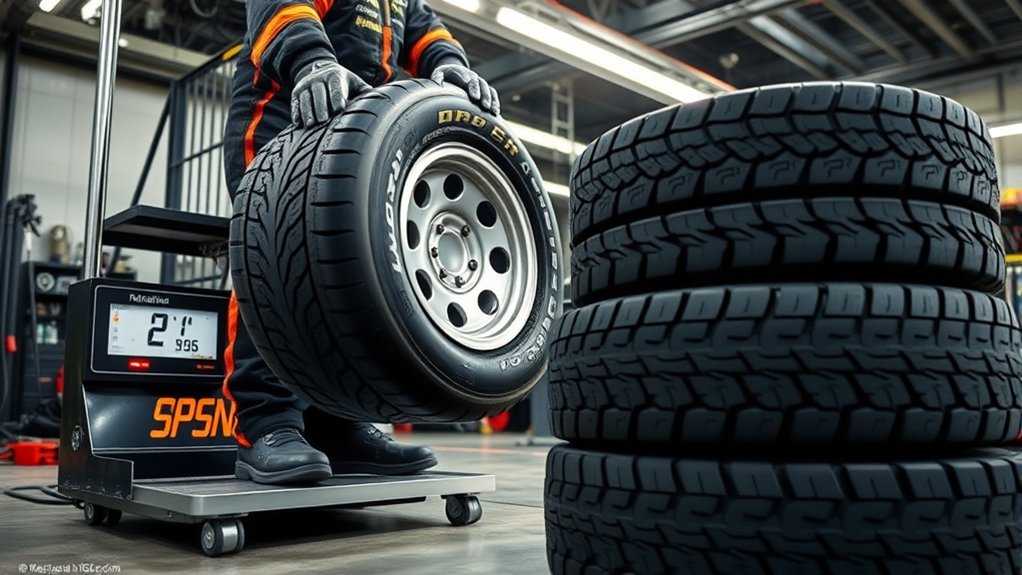
NASCAR tire weight matters because tires are rotating mass. The heavier the mounted assembly, the more work the car has to do to accelerate, brake, and change direction. Teams also care about how the tire loads the suspension, how it reacts over bumps, and how it wears across a run.
On pit road, tire weight affects speed and control. On the track, it affects response and balance. In the garage, it affects setup choices. That is why the best answer is not just “26 pounds.” The useful answer is:
- 26 lb for the tire itself.
- 48 lb for the mounted Cup wheel-and-tire assembly.
- 104 lb for four bare tires.
- 192 lb for four mounted assemblies.
Those numbers explain why NASCAR tires look simple from the grandstands but are treated like precision racing parts by teams.
Frequently Asked Questions
How much does each NASCAR tire cost?
Public estimates often place a NASCAR race tire in the several-hundred-dollar range, commonly around $400 to $500 per tire, but exact team costs can vary by contract, series, event, and tire allocation. NASCAR race tires are not normal retail tires, and teams work through the sanctioned Goodyear racing tire program rather than buying them like consumer tires.
How much does 1 gallon of NASCAR fuel weigh?
NASCAR uses Sunoco Green E15 race fuel. Sunoco’s current technical data lists the fuel at 6.2 lb per gallon. Fuel density can shift slightly with temperature, but 6.2 lb/gal is the better current figure to use.
Who is the wealthiest NASCAR driver of all time?
There is no official NASCAR wealth leaderboard, and net-worth figures are estimates. Dale Earnhardt Jr., Jeff Gordon, Jimmie Johnson, and Tony Stewart are often discussed among the wealthiest NASCAR figures because of race earnings, endorsements, ownership stakes, media work, and licensing income. Treat any exact net-worth number as an estimate, not a confirmed NASCAR statistic.
What race car does Michael Jordan own?
Michael Jordan co-owns 23XI Racing, which fields Toyota Camry entries in the NASCAR Cup Series. The team’s No. 23 Toyota Camry is associated with Bubba Wallace, while 23XI also fields other Cup entries.
Why do some people say NASCAR tires weigh 96 pounds?
The 96-pound number usually comes from two mounted wheel-and-tire assemblies at about 48 pounds each. It is not the weight of four bare tires and not the weight of four mounted assemblies. Four bare Cup tires are about 104 pounds, while four mounted assemblies are about 192 pounds.
Are NASCAR tires the same as street tires?
No. NASCAR race tires are purpose-built competition tires. Dry Cup tires are slicks made for racetrack grip, heat, and load, while wet-weather tires use tread to help manage damp conditions. They are not designed or approved for normal public-road use.
Conclusion
A NASCAR Cup tire weighs about 26 pounds by itself and about 48 pounds when mounted on the wheel. The most important fix is to keep the numbers separate: four bare tires are about 104 pounds, two mounted assemblies are about 96 pounds, and four mounted assemblies are about 192 pounds. That weight affects pit stops, rotating mass, handling, braking, and race strategy, which is why teams care about every pound.
Sources
- Goodyear Next Gen NASCAR tire announcement — supports the 18-inch wheel diameter, shorter sidewall, wider contact patch, and Next Gen tire development.
- NASCAR single-lug Next Gen wheel article — supports the move to an 18-inch aluminum wheel and single center-lock lug nut.
- NASCAR O’Reilly Auto Parts Series announcement — supports the 2026 secondary-series name update.
- NASCAR Pocono 2026 Goodyear tire setup — supports current event-specific tire package differences between Cup and O’Reilly Auto Parts Series.
- Sunoco Green E15 technical data — supports the 98 octane, 15% ethanol, and 6.2 lb/gal fuel-weight specification.
- 23XI Racing official site — supports the No. 23 Toyota Camry and current 23XI team information.