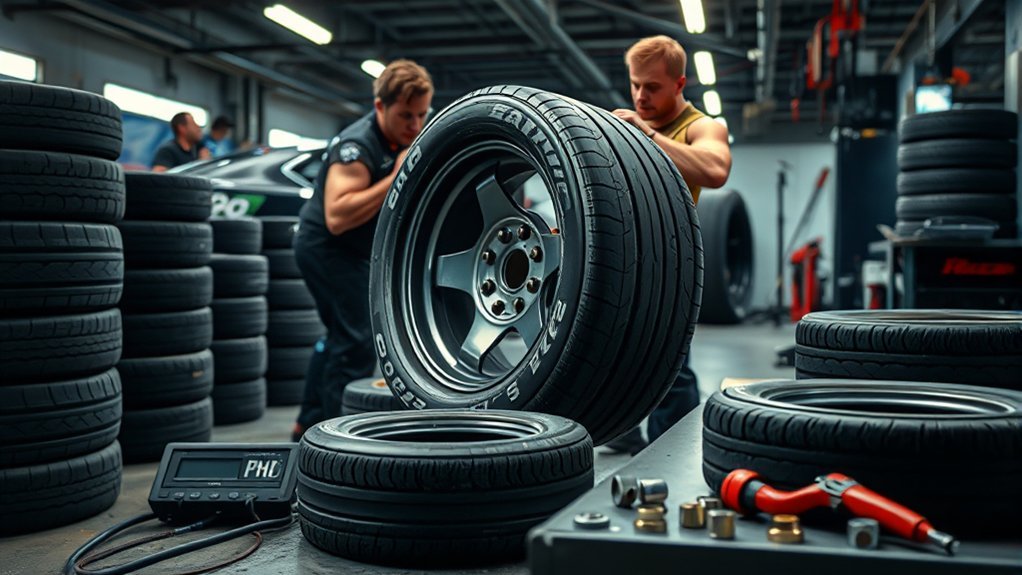
A NASCAR tire does not have one fixed weight. Non-official NASCAR tire references commonly cite roughly 24–28 pounds for the tire itself. The familiar 50-plus-pound wheel-and-tire figure comes from the older 15-inch Cup package, while a 2026 Hendrick Motorsports tire specialist described some 15-inch inner-liner tires at about 60 pounds. Current Cup cars use a different 18-inch package, and the official NASCAR and Goodyear sources reviewed for this update do not publish one universal current Cup assembly weight.
Last updated: August 18, 2026
Quick Answer
A NASCAR tire by itself is commonly estimated around 24–28 pounds in non-official references. The older 15-inch Cup wheel-and-tire package was 50-plus pounds, and a 2026 Hendrick Motorsports profile describes some 15-inch inner-liner tires at about 60 pounds. Current Cup cars use an 18-inch package, so there is no single weight that should be applied to every NASCAR tire or assembly.
Key Takeaways
- A bare NASCAR tire and a mounted wheel-and-tire assembly are not the same thing.
- The widely repeated 50-plus-pound assembly figure describes the older 15-inch Cup package, not a universal current Cup specification.
- The air inside the tire does not add 30 pounds. Pressure matters because it changes tire shape, stiffness, heat, and grip.
- Cup Series cars use an 18-inch Next Gen wheel-and-tire package. The O’Reilly Auto Parts Series and Craftsman Truck Series use separate 15-inch tire packages at many events.
- Tire weight affects pit-stop speed, steering feel, braking, acceleration, and how the car responds over a run.
How Heavy Is a NASCAR Tire?
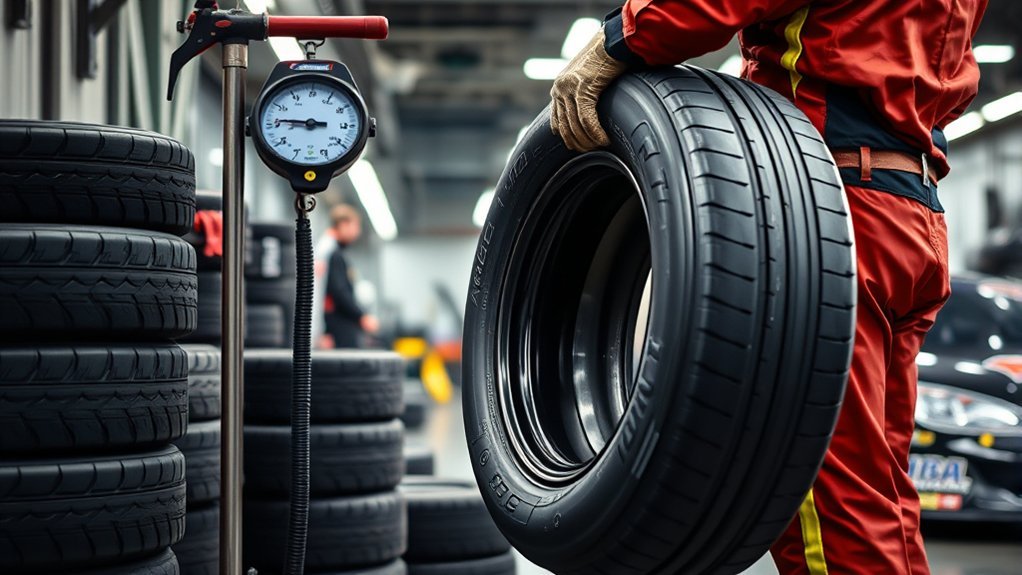
The most useful answer depends on what you are weighing. A NASCAR tire by itself is the rubber racing tire. A mounted wheel-and-tire assembly includes the tire, wheel, valve hardware, and air. Pit crews handle the mounted assembly, so that is the number many fans hear during broadcasts and pit-stop discussions.
| What You Are Weighing | Typical Fan-Friendly Estimate | What Changes It |
| Bare racing tire | About 24–28 pounds in non-official NASCAR references | Series, tire code, construction, compound, and whether an inner liner is used |
| Older 15-inch Cup wheel-and-tire package | 50-plus pounds in a pre-Next Gen technical breakdown | A 27-pound steel wheel plus roughly 24 pounds of tire before inner-liner or lug weight |
| Current 18-inch Cup assembly | No single official event-independent weight found in the NASCAR/Goodyear sources reviewed | 18-inch forged-aluminum wheel, current tire code, and event setup |
| 15-inch inner-liner tire package | About 60 pounds in a 2026 Hendrick Motorsports tire-specialist description | Inner liner, tire code, wheel, and series/track requirements |
| Air inside the tire | A small fraction of the total, not 30 pounds | Tire volume, temperature, and pressure |
NASCAR and Goodyear do not publish one universal tire weight that applies to every race and series. Tire construction and wheel packages change by series and event. For the Cup Series Next Gen car, NASCAR moved from a 15-inch steel wheel to an 18-inch forged-aluminum wheel with a single center-locking lug nut. NASCAR also widened the Cup tire from 10 inches to 12 inches.
Note: Tire-only, mounted-assembly, and inner-liner figures are often mixed together online. A 50-plus-pound figure is useful historical context for the old 15-inch Cup package, but it should not be presented as one official current Cup weight.
What Does a NASCAR Tire Weigh With Air?
With air added, the weight changes only slightly. The bigger change is not weight. It is how the tire behaves. Air pressure shapes the sidewall, changes the contact patch, changes how quickly the tire builds heat, and affects how the car feels to the driver.
That is why teams treat pressure as a major setup tool. A small pressure change can affect grip, tire wear, and balance from the first lap of a run to the last. But the air itself does not turn a mid-20-pound tire into a 50- or 60-pound package. The wheel, tire construction, and any inner-liner hardware account for nearly all of that difference.
Tire Weight With Air
A fully mounted NASCAR wheel-and-tire assembly can be heavy enough that tire changers train for speed, grip, and repeatable body movement. The air inside the tire adds only a small amount of mass. The pressure setting matters because it changes how that assembly works under load.
- Higher pressure can make the tire feel stiffer.
- Lower pressure can increase tire flex and heat buildup.
- Track temperature changes pressure during a run.
- Left-side and right-side tires may have different jobs on an oval.
- Teams follow event-specific Goodyear and NASCAR requirements.
Air Pressure Impact
Air pressure changes the tire’s shape and feel. A lower-pressure setup can create more flex and more heat. A higher-pressure setup can sharpen response, but it can also reduce the usable contact patch if the setup is wrong for that track. Teams do not use one universal pressure for every NASCAR race.
Warning: Do not copy NASCAR tire pressures for a street vehicle. Use the pressure on your vehicle’s door placard or owner’s manual. Racing slicks, NASCAR loads, and street tires are completely different use cases.
Why Does NASCAR Tire Weight Matter?
NASCAR tire weight matters because the tire and wheel are part of the car’s unsprung mass. That means the assembly moves with the suspension over bumps and track surface changes. More weight can affect how quickly the suspension reacts, how the car turns, and how fast a pit crew can change tires.
Tire Weight and Speed
Weight at the wheels affects acceleration, braking, and steering response. A heavier wheel-and-tire assembly takes more effort to speed up and slow down. On a race car, even small changes matter because the car is operating near the limit of grip.
- More rotating mass can reduce acceleration response.
- More unsprung mass can affect suspension control.
- Weight changes can affect braking feel.
- Different tire constructions can change steering response.
- Race strategy changes when tires wear quickly or lose grip.
Grip and Pit Stops
Tire weight also matters on pit road. A tire changer has to lift, position, secure, and clear the assembly in seconds. A few pounds can affect rhythm over a long race, especially when a crew performs several four-tire stops.
On track, the tire has to survive heat, cornering load, braking load, and repeated force cycles. That is why NASCAR tires are not built like street tires. They are built for short, intense use, not for thousands of road miles.
Air Pressure Effects
Pressure can change grip more than weight does. Too little pressure can make the tire flex too much and build heat. Too much pressure can reduce compliance and hurt the way the tire loads the track. The best setting depends on the tire code, track, car setup, temperature, and NASCAR’s event rules.
The air in a NASCAR tire changes performance far more than it changes weight.
How Do Cup and O’Reilly Auto Parts Series Tires Compare?
Cup and O’Reilly Auto Parts Series tires should not be treated as identical. The NASCAR Xfinity Series became the NASCAR O’Reilly Auto Parts Series on January 1, 2026. Cup cars use the 18-inch Next Gen wheel-and-tire package, while the O’Reilly Auto Parts Series and Craftsman Truck Series continue with separate 15-inch packages at many events.
The useful comparison is not simply “lighter” or “heavier.” Each package is built around different cars, loads, wheel dimensions, tire codes, and track demands. Goodyear can also change left-side and right-side constructions or compounds from one event to another.
[Products Worth Considering]

This 100-piece set of snap-in tubeless tire valve stems is designed for standard 0.453 in (11.5 mm) rim holes and helps maintain reliable, steady tire pressure. Made with ozone-resistant rubber and brass cores, the valves are built for durability and long-term use. Easy to install by hand, they support safe driving and are suitable for cars, light trucks, trailers, and more.

Monitor tire tread wear with a smart, color-coded depth gauge that shows clear condition ranges at a glance. The bar is range marked for fast, easy readings, helping you maintain safer traction and performance. Each gauge is portable with a pocket clip, and the set includes 20 units for daily use and sharing.

Measure tire tread depth quickly and accurately with this LUMITECO dial gauge that reads in 1/32" increments up to 14/32". The color-coded green/yellow/red zones make it easy to judge tire wear and know when replacement is needed. A rugged, compact design with a protective pouch helps keep the gauge ready for use on cars, trucks, motorcycles, and more.
What Size Are NASCAR Cup Series Tires?
Current Cup Series cars use 18-inch forged-aluminum wheels with a single center-locking lug nut. NASCAR’s Next Gen specifications also widened the tire footprint from 10 inches to 12 inches compared with the previous Cup package. The lower-profile design makes the modern Cup tire visually and mechanically different from the older 15-inch setup.
That is also why old NASCAR tire-weight figures can be misleading. A weight quoted for the former steel-wheel package should not automatically be treated as the weight of a current Cup assembly.
Inner liners create another source of confusion. When the 18-inch Next Gen tire launched, Cup cars did not use the inner liners found in some older packages. Current 2026 NASCAR tire notes still show inner liners on 15-inch O’Reilly Auto Parts Series and Craftsman Truck Series tires at tracks one mile or longer. A 2026 Hendrick Motorsports tire specialist also described an inner-liner tire as weighing about 60 pounds. That figure should be understood as an inner-liner package example, not a universal current Cup tire weight.
Which Goodyear Tires Do NASCAR Teams Use?
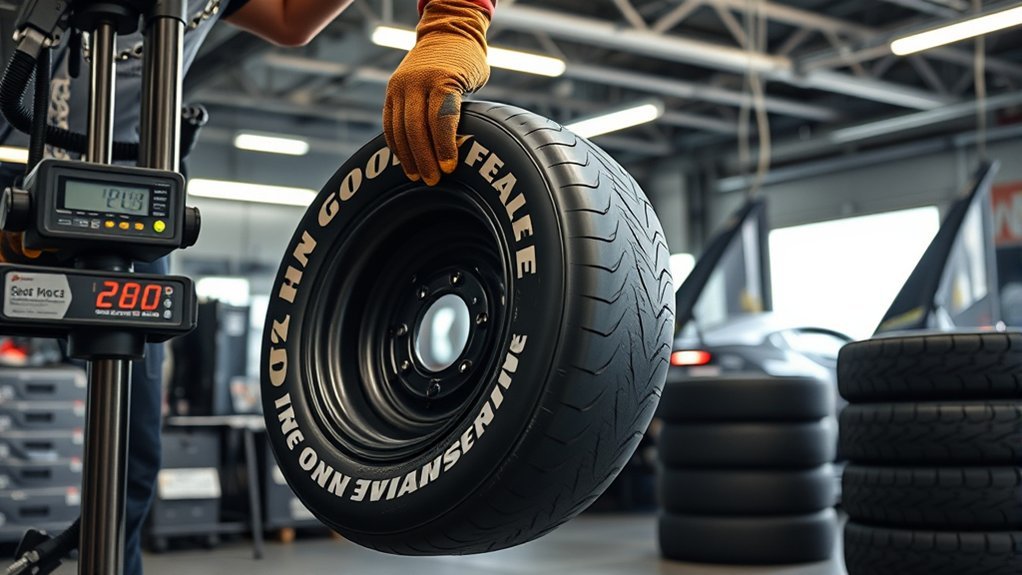
NASCAR’s three national series use Goodyear racing tires. NASCAR reported in March 2026 that Goodyear was in its 30th season as the sole tire supplier for all three national series. The exact tire package still changes by track, surface, banking, expected loads, and event rules.
Modern NASCAR tire categories include dry-weather slicks and wet-weather tires. Wet-weather tires are used on road and street courses and on selected shorter ovals when NASCAR determines conditions and procedures allow them. For example, Cup teams had four wet-weather sets available at Richmond in August 2026.
- Slick tires: Used in dry conditions where NASCAR approves them.
- Wet-weather tires: Used only where the series and event rules allow them.
- Left-side and right-side tires: Often built for different loads on oval tracks.
- Track-specific tire codes: Chosen to match surface, banking, heat, and expected wear.
[Products Worth Considering]

This 1/2-inch drive breaker bar delivers powerful leverage for loosening and tightening stubborn lug nuts and automotive fasteners. The 180-degree flex head helps you reach tight spaces at the angle you need, making tire and brake jobs easier. A spring-loaded ball detent design holds 1/2-inch sockets securely while the chrome-moly head provides durable strength for everyday use.

This 12-inch LUMITECO dual head tire pressure gauge features an integrated straight-on chuck and a 30° reverse chuck to reach hard-to-access dual wheel valves. Its 10–150 PSI / 1–10 BAR range with a clear, two-sided scale helps you quickly check tire pressure for safer, smoother driving. Heavy-duty construction and a simple no-battery design make it a reliable tool for trucks, cars, RVs, and motorcycles.

This manual duck head tire changer kit makes tire installation and removal simpler by letting you embed the duck head into the tire with applied pressure. The integrated design and durable steel construction help reduce friction and improve efficiency and safety during use. Suitable for 16–21 inch wheels, it’s convenient for cars, trucks, SUVs, and ATV tires, with 24-hour after-sales support.
How Do Pit Crews Handle Heavy Tires?
NASCAR pit crews handle tire weight through training and repetition. A 2026 Hendrick Motorsports profile described an inner-liner tire as weighing about 60 pounds, illustrating how much heavier some 15-inch packages can be than a bare tire. Tire changers and carriers practice footwork, hand position, body angle, and timing so assemblies move smoothly from the wall to the car and back out of the way.
The move looks simple on TV, but it is a fast athletic task. A crew member must control a large assembly, avoid wasting motion, and hit the same marks again and again. The single center-locking lug nut used on the Cup Series Next Gen car changed the motion compared with the older five-lug pattern, but the job still demands strength, speed, and precision.
Pro Tip: If you are trying to picture NASCAR tire weight, think of the full assembly a pit crew throws onto the hub, not only the rubber tire sitting by itself.
What Affects NASCAR Tire Weight on Race Day?
Several things can affect NASCAR tire weight or the weight of the assembly the crew handles. Some are physical weight changes. Others change how heavy or light the tire feels to the driver because they affect response, grip, and heat.
- Wheel package: The wheel contributes a large part of the full assembly weight.
- Tire construction: Carcass, sidewall, belts, tread thickness, and compound all matter.
- Series rules: Cup, O’Reilly Auto Parts Series, and Truck setups are not identical.
- Track type: Short tracks, intermediates, superspeedways, and road courses stress tires differently.
- Wet-weather design: Wet tires have tread patterns and construction needs that differ from slicks.
- Wear: A used tire can lose rubber over a run, especially on abrasive tracks.
- Temperature and pressure: These change tire behavior more than they change total mass.
Race teams care about all of these variables because a tire is not just a round piece of rubber. It is one of the main tools for controlling speed, balance, and safety.
How Does Tire Pressure Change Performance?
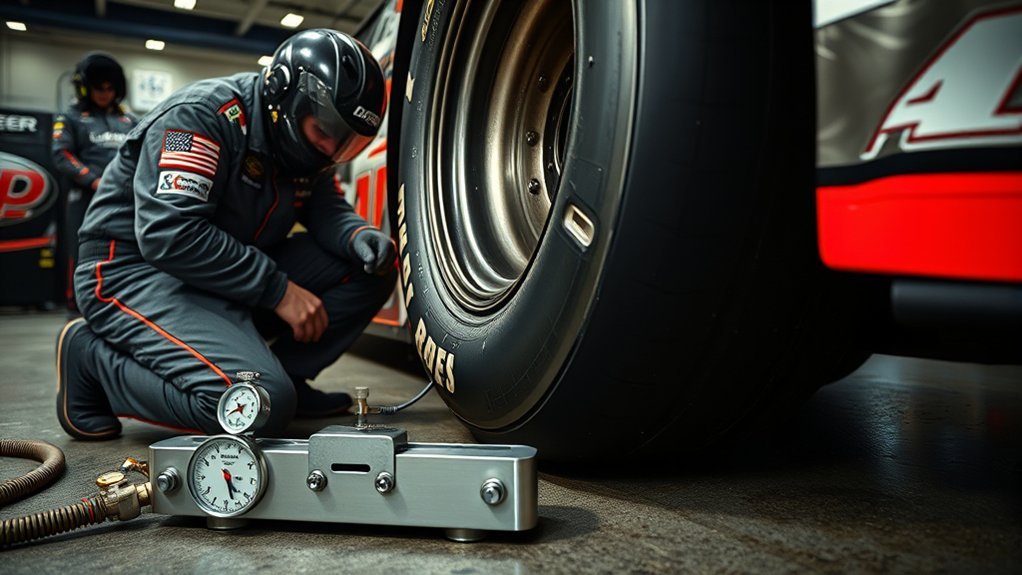
Tire pressure changes how a NASCAR tire contacts the track. That affects grip, steering response, tire temperature, and wear. The right setting is event-specific. Teams work from NASCAR and Goodyear requirements, then tune the car based on practice data, driver feedback, track temperature, and race conditions.
Tire Pressure and Grip
Lower pressure can help a tire take a different shape under load, but it can also create more flex. More flex can build heat. Higher pressure can make the tire feel more responsive, but it can also reduce compliance. The right answer depends on the tire, corner, track, and setup.
Pressure and Wear
Pressure affects where the tire works hardest. If the setup overloads part of the tread or sidewall, the tire can lose performance quickly. On abrasive tracks, wear can be part of the show because drivers must manage pace instead of running every lap at the same speed.
For street cars, the lesson is simple: use the recommended cold tire pressure listed by your vehicle manufacturer. The National Highway Traffic Safety Administration warns that tire pressure affects safety, wear, and performance, but NASCAR race pressures are not street-car guidance.
Air Weight Impact
The air inside the tire does add some mass, but not enough to explain a 50-pound assembly. The real reason pressure matters is performance. Pressure changes the tire’s shape, temperature, stiffness, contact patch, and wear rate. Those changes can decide whether a car is fast, tight, loose, or hard on tires.
How Have NASCAR Tire Specs Changed?
NASCAR tire specs have changed most clearly in the Cup Series with the Next Gen car. Cup moved from the older 15-inch wheel style to an 18-inch aluminum wheel package with a single center-locking lug nut. That change affected pit stops, wheel design, tire sidewall dimensions, and the way fans discuss NASCAR tire weight.
NASCAR has also expanded wet-weather options for selected events. Wet-weather tires do not mean NASCAR races every oval in heavy rain. They mean NASCAR has more tools for certain tracks and conditions when officials decide the package is safe and appropriate.
What Should Tire Buyers Learn From NASCAR?
NASCAR teaches a simple tire lesson: match the tire to the job. Race teams do not choose tires by brand name alone. They care about construction, compound, temperature, wear, pressure, and track surface. Street-tire buyers should use the same mindset, but with street-driving needs.
- Choose tires that match your climate and road conditions.
- Check the correct size and load rating for your vehicle.
- Keep tire pressure at the vehicle manufacturer’s recommended setting.
- Watch tread depth, uneven wear, cracking, and damage.
- Do not judge a tire by one performance label without checking real-world use.
NASCAR tires are built for short, extreme race runs. Your vehicle tires are built for braking, rain, potholes, comfort, tread life, and daily safety. The shared lesson is that tire details matter.
[Products Worth Considering]

The SAFELIFE dial tire tread depth gauge measures tread depth in 1/32 inch increments with clear, easy-to-read 2-inch dial face. Color zones using a traffic light system help you quickly judge whether tread is low, marginal, or ample for safer driving. Built with a durable zinc cast body and a metal detect probe for precise, comfortable use across cars, motorcycles, trucks, and buses.
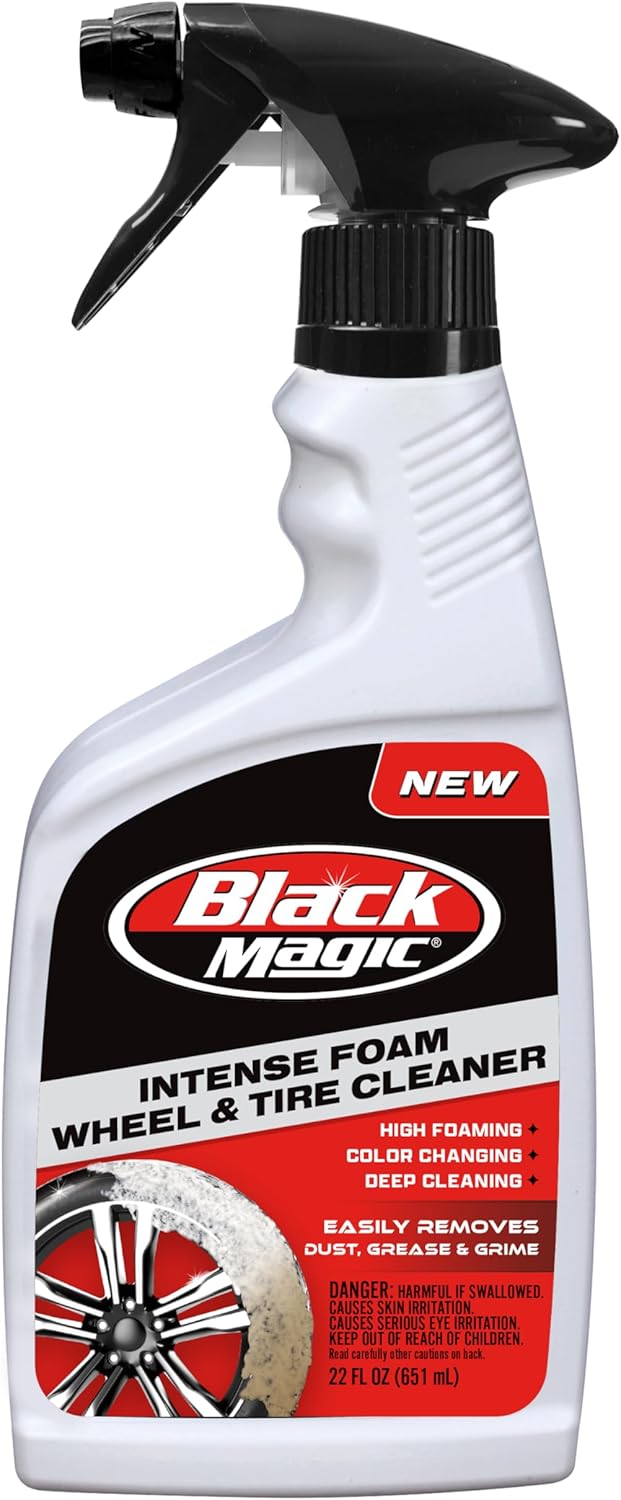
Black Magic Intense Foam Wheel & Tire Cleaner uses a high-foaming action to lift away dirt, grime, and brake dust without scrubbing. The color-changing formula helps show contaminants being dissolved as foam turns from white to brown. Safe for all wheel types and even wheel wells, it leaves a like-new, slick finish with a fresh cherry scent.
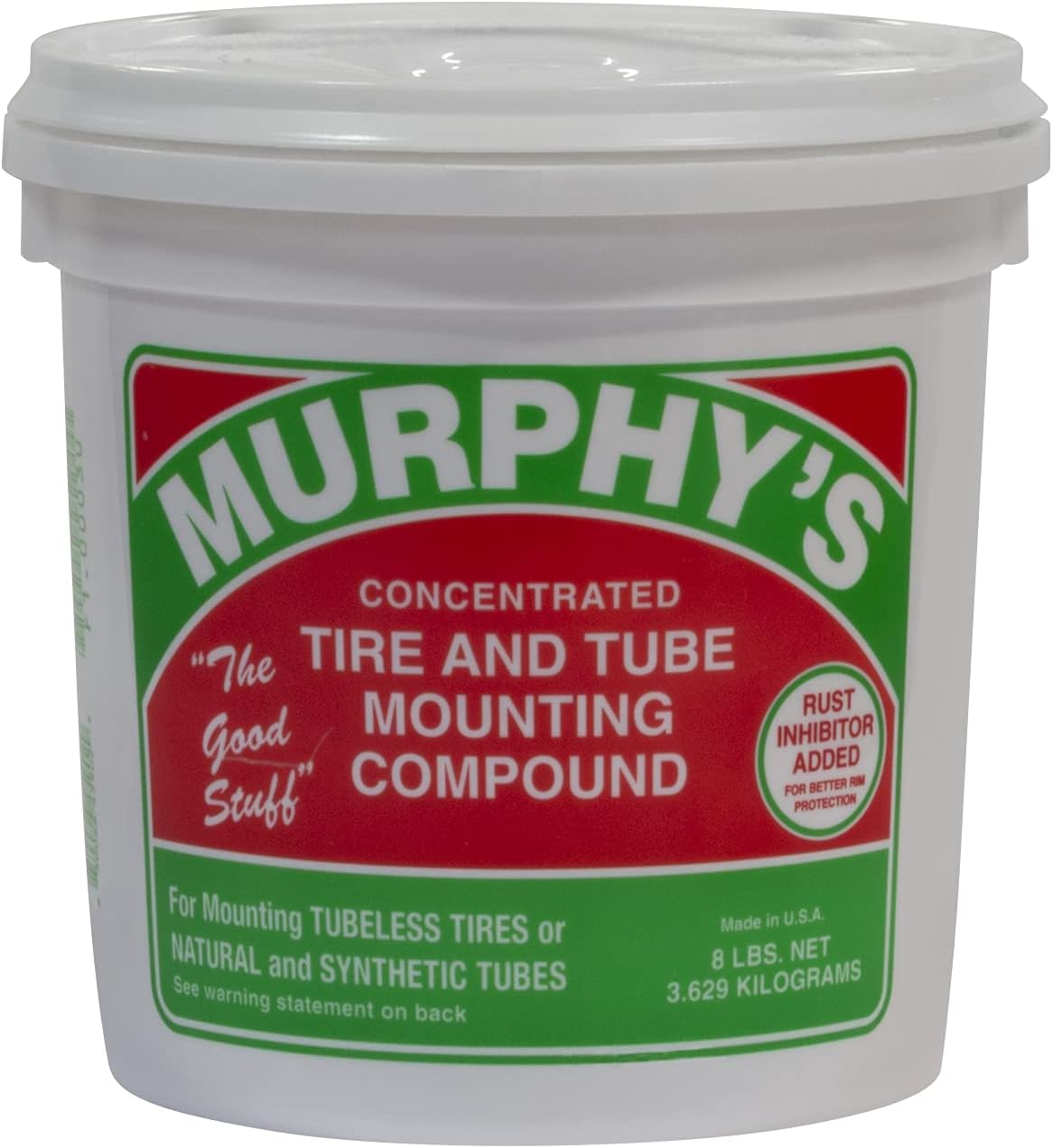
A concentrated tire and tube mounting compound designed to help simplify mounting rubber tires and tubes on passenger, semi truck, construction, and OTR applications. Its ultra-thick formula packs beads effectively and includes rust inhibitors to help protect against corrosion during use.
Frequently Asked Questions
How heavy is a NASCAR tire?
There is no single official weight for every NASCAR tire. Non-official references commonly cite roughly 24–28 pounds for a bare racing tire, but the exact number changes with the series, tire code, construction, and whether an inner liner is part of the package.
How much does a NASCAR wheel and tire weigh together?
The familiar 50-plus-pound figure comes from the older 15-inch Cup package: a roughly 27-pound steel wheel plus a roughly 24-pound tire already exceeded 50 pounds before some additional hardware. Current Cup cars use an 18-inch forged-aluminum package, and the official sources reviewed here do not publish one universal current assembly weight.
Why do some NASCAR tires weigh about 60 pounds?
A 2026 Hendrick Motorsports tire specialist described an inner-liner tire as weighing about 60 pounds. Current NASCAR tire notes show inner liners on some 15-inch O’Reilly Auto Parts Series and Craftsman Truck Series packages at tracks one mile or longer. That 60-pound example should not be treated as one universal Cup tire weight.
Does the air inside a NASCAR tire add 30 pounds?
No. The air adds only a small amount of mass. Tire pressure matters because it changes stiffness, heat, contact patch, grip, and wear, not because the air itself adds dozens of pounds.
What size wheels do NASCAR Cup Series cars use?
Cup Series Next Gen cars use 18-inch forged-aluminum wheels with a single center-locking lug nut. NASCAR also widened the Cup tire footprint from 10 inches to 12 inches when the Next Gen package was introduced.
Do NASCAR teams use one tire pressure at every track?
No. Goodyear and NASCAR issue event-specific tire information, and teams work within those requirements. The appropriate pressure changes with tire code, track, position on the car, temperature, and setup.
Conclusion
NASCAR tire weight is easiest to understand when you separate the bare tire, the wheel-and-tire assembly, and inner-liner packages. Non-official references commonly place a bare tire around 24–28 pounds. The old 15-inch Cup assembly was 50-plus pounds, while a 2026 Hendrick Motorsports profile gives about 60 pounds for an inner-liner tire. Current Cup cars use a different 18-inch package, so no single legacy number should be presented as the official weight for every NASCAR tire today. For street vehicles, use the tire size and cold pressure specified by the vehicle manufacturer.
Sources
- Hendrick Motorsports: Work that wins — tire specialist Lisa Smokstad — gives a 2026 team example of an inner-liner tire at about 60 pounds.
- Mavis: The Ultimate Guide to NASCAR Tires — non-official reference for the commonly cited 24–28-pound tire range.
- Building Speed: NASCAR Next Gen wheels — technical historical breakdown of the 15-inch steel wheel and tire package that exceeded 50 pounds.
- NASCAR: Next Gen specifications — supports the 18-inch forged-aluminum wheel, single center-locking lug, and wider Cup tire footprint.
- NASCAR: 2022 Next Gen tire notes — documents that the 18-inch Cup package launched without inner liners.
- NASCAR: O’Reilly Auto Parts Series naming — supports the January 1, 2026 series-name change.
- NASCAR: 2026 Pocono tire setup — documents current 15-inch O’Reilly Auto Parts Series inner-liner use at a track one mile or longer.
- NASCAR: 2026 Goodyear tire notes — supports Goodyear’s 30th season as sole tire supplier for NASCAR’s three national series and event-specific tire packages.
- NASCAR: 2026 Richmond tire setup — supports current wet-weather tire availability.
- NHTSA Tire Safety — supports road-vehicle tire pressure, wear, and safety guidance.