Choosing Toyota Hilux tires and wheels is not just about finding a size that looks right. The correct setup must match your exact model year, market, trim, axle loads, driving surface, and local modification rules. A well-chosen package can improve traction and durability without causing rubbing, steering problems, speedometer error, poor braking, or lost payload.
Quick Answer
The best Toyota Hilux tire and wheel setup is the factory size or a professionally verified alternative that preserves load rating, clearance, braking, steering, and legal compliance. Start with the tire placard and owner’s manual, then match tread to terrain and confirm wheel width, offset, center bore, stud pattern, TPMS, and spare-tire clearance.
Key Takeaways
- Use the tire placard, owner’s manual, and exact model code or VIN as your starting point; Hilux specifications vary by year, trim, body style, and country.
- Do not choose by diameter alone. Load index, speed rating, rim width, offset, brake clearance, axle load, TPMS, and the spare all matter.
- Highway tires suit mostly paved use, all-terrain tires balance road and trail needs, and mud-terrain tires trade noise and road manners for stronger off-road bite.
- A suspension lift does not automatically increase legal payload, GVM, GCM, axle capacity, or tire capacity.
- After fitting, check full-lock clearance, balance, alignment, tire pressure, warning lights, and the installer’s wheel-nut recheck instructions.
At a Glance
| Time Required | 30–60 minutes to verify and select; usually 1–2 hours for professional fitting, balancing, and alignment |
| Difficulty | Moderate; expert verification is recommended for non-factory sizes or wheels |
| Tools Needed | Tire placard, owner’s manual, model code or VIN, load data, tire-size calculator, pressure gauge, and professional fitting equipment |
| Cost | Varies widely by tire construction, wheel material, size, brand, installation, alignment, TPMS parts, and required modifications |
Choosing the Right Tire Size for Your Hilux
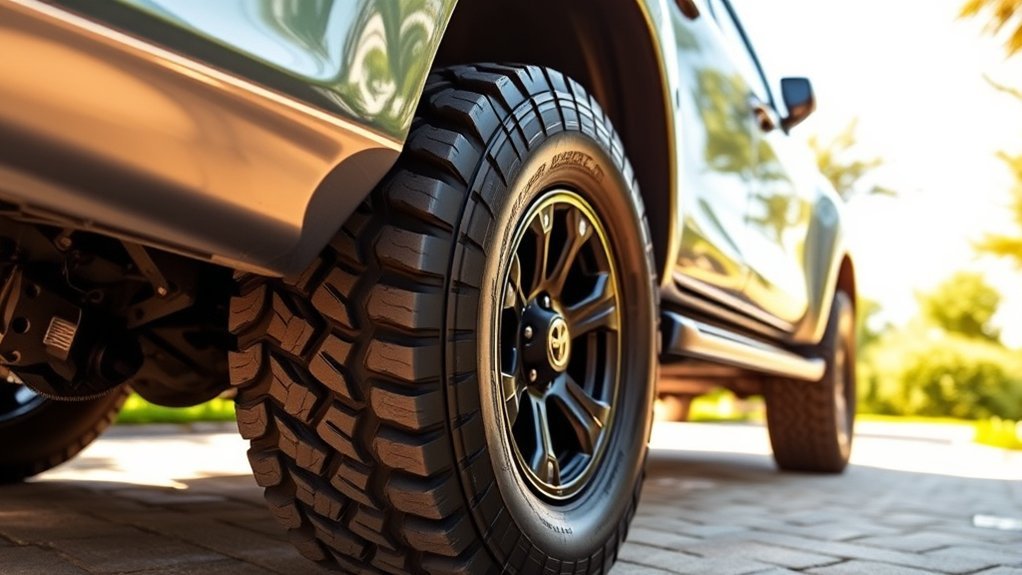
Start with the tire and loading placard and the owner’s manual for your exact Hilux. Do not rely on a generic online list. Toyota sells the Hilux in many markets and has changed its chassis, wheel packages, payload ratings, and available powertrains over time. Toyota also launched a redesigned Hilux in 2026, so an older fitment may not transfer to the new model.
As a current example, the June 2026 Toyota Australia HiLux specification sheet lists 265/65R17 and 265/60R18 tires across its range. Those sizes are useful reference points, not universal answers. Other countries, generations, and work-focused variants may use different tires and wheels.
Current Australian 2026 HiLux variants use 265/65R17 or 265/60R18 tires, but the correct size for your truck is the one listed for its exact model and market.
[Products Worth Considering]

This tire inflator with pressure gauge delivers long-lasting performance with a durable rubber-protected gauge and sturdy build. The longer hose and 360 swivel air chuck help you seal the valve securely and keep your hands free while measuring, inflating, or deflating. It’s battery-free for reliable use and provides ±2 PSI accuracy in the mid-range for most typical tires, with universal compatibility for 1/4 NPT compressor outputs.

The 22800 wheel stud installer makes replacing wheel studs quick and secure, saving time and effort during tire service. It uses a ratchet or impact wrench to pull new studs firmly into place, helping when existing studs are too long. Compatible with most automotive wheels and light-duty truck wheel studs, it’s designed for easy, tool-assisted installation.

This metal-free wheel and tire cleaning brush uses dense, fluffy synthetic wool to safely clean rims, spokes, fenders, and engine areas without worrying about damaging surfaces. Its flexible, comfortable design helps you reach detailed areas while maintaining durability, and the extra absorbent fibers work well with wheel spray cleaners for faster cleanup. Reusable and washable performance helps prevent grime and build-up for cleaner vehicles and easier maintenance at home.
How to Read a Hilux Tire Size
In a marking such as 265/65R17 112S:
- 265 is the nominal tread-section width in millimeters.
- 65 is the sidewall height as a percentage of the width.
- R means radial construction.
- 17 is the wheel diameter in inches.
- 112 is the load index.
- S is the speed rating.
A replacement must be suitable for the wheel and must meet the vehicle maker’s size, load, pressure, and speed requirements. The maximum pressure molded on a tire sidewall is not the normal on-road pressure for your Hilux; use the cold pressures specified by Toyota for the vehicle and load condition.
Compare Overall Diameter, Not Just Wheel Diameter
Overall tire diameter affects clearance, gearing, speedometer reading, braking response, and the operation of stability and traction systems. The common “stay within one inch” rule is not a fitment guarantee because width, wheel offset, suspension travel, liner shape, and brake clearance can still cause problems.
| Size | Approx. Diameter | Change vs. 265/65R17 | What It Means |
|---|---|---|---|
| 265/65R17 | 776 mm / 30.6 in | Baseline | Current factory example on many Australian 2026 variants |
| 265/70R17 | 803 mm / 31.6 in | About +3.4% | May alter indicated speed and clearance; fitment must be checked |
| 265/60R18 | 775 mm / 30.5 in | About −0.1% | Current factory example on upper Australian 2026 variants |
| 275/55R19 | 785 mm / 30.9 in | About +1.1% | Market-specific or aftermarket possibility; not a universal Hilux fitment |
Note: Nominal tire dimensions are calculated from the size code. Actual mounted diameter and width can differ by tire model, approved rim width, pressure, and load, so use the manufacturer’s specification sheet for the exact tire you are buying.
Understanding Your Driving Style and Terrain
Your best tread depends on where you drive most, not on the toughest trail you might visit once a year. The NHTSA tire guide describes all-terrain tires as a compromise between road use and off-road capability and notes that winter tires perform better than all-season tires in deep snow.
| Tire Type | Best For | Main Trade-Offs |
|---|---|---|
| Highway-terrain | Commuting, sealed roads, long-distance touring | Usually quieter and more efficient, but less capable in deep mud and loose terrain |
| All-terrain | Mixed pavement, gravel, work sites, moderate trails | Balanced choice, with more noise and rolling resistance than many highway tires |
| Mud-terrain | Frequent mud, rocks, ruts, and demanding off-road use | More noise, vibration, weight, and often weaker wet-road manners |
| Winter or 3PMSF-rated | Cold climates, packed snow, and ice | Seasonal use may be needed; warm-weather wear can increase |
For towing or heavy work, focus on load capacity, heat control, and stability rather than tread appearance. Light Truck construction may be suitable for some loaded or off-road applications, but an LT marking alone does not make a tire correct. It must still match the approved wheel, load requirement, pressure range, and vehicle use.
For sand, a very aggressive mud tread is not always best. Flotation, vehicle weight, tire construction, and a safely reduced off-road pressure can matter more. Reinflate before returning to normal road speed.
How Much Load Can Your Hilux Handle?
There is no single Hilux payload figure. Cab style, driveline, trim, accessories, tray, fuel, passengers, and market all change the available capacity. Toyota’s 2026 Japanese Hilux announcement lists cargo capacity up to 500 kg, while Australian variants use different GVM and kerb-weight combinations. This is why a broad claim that “most Hilux models carry 1,000 to 1,200 kg” is unsafe.
Payload Capacity Specifications
Toyota Australia defines payload as GVM minus vehicle weight and states that passengers, accessories, cargo, modifications, and axle distribution all affect available payload. Use these checks:
- Find the GVM and front and rear axle limits for your exact vehicle.
- Include occupants, fuel, canopy, bull bar, winch, tray, drawers, roof load, tools, cargo, and trailer downforce.
- Weigh the truck in its normal loaded condition, ideally with separate axle readings.
- Confirm each tire’s capacity at the approved pressure is sufficient for the axle load.
- Do not assume the sum of four tire ratings solves an overloaded rear axle.
Pro Tip: Visit a public weighbridge with the Hilux loaded as it is normally used. Record the front axle, rear axle, and total mass. This gives you a far better tire and suspension baseline than brochure payload alone.
Towing Capacity Insights
Towing limits also vary. In the June 2026 Australian specification sheet, 4×2 diesel variants are rated up to 2,900 kg braked, while listed 4×4 variants are rated up to 3,500 kg braked. Those maximums do not mean every Hilux in every country has the same rating.
Trailer downforce adds to vehicle load, and GCM can limit how much payload remains when towing a heavy trailer. Check the owner’s manual, towbar rating, trailer-brake rules, axle limits, and the tire placard. The tire must carry the real axle load at the specified cold pressure.
Suspension Upgrades and Legal Capacity
Heavier springs, upgraded shocks, or airbags may improve ride height or control under a repeated load, but they do not automatically raise the manufacturer’s GVM, GCM, axle ratings, or legal payload. Toyota offers a factory GVM upgrade only on selected current Australian variants, and modified vehicles may require approved engineering or certification.
Warning: Never load beyond the vehicle’s GVM, axle capacities, GCM, tow rating, wheel rating, or tire capacity. A lift or stiffer spring does not erase those limits. Check local law before changing tire diameter, wheel track, or suspension; Australia’s VSB 14 modification code also directs owners to their state or territory registration authority.
How Tread Patterns Affect Performance and Grip
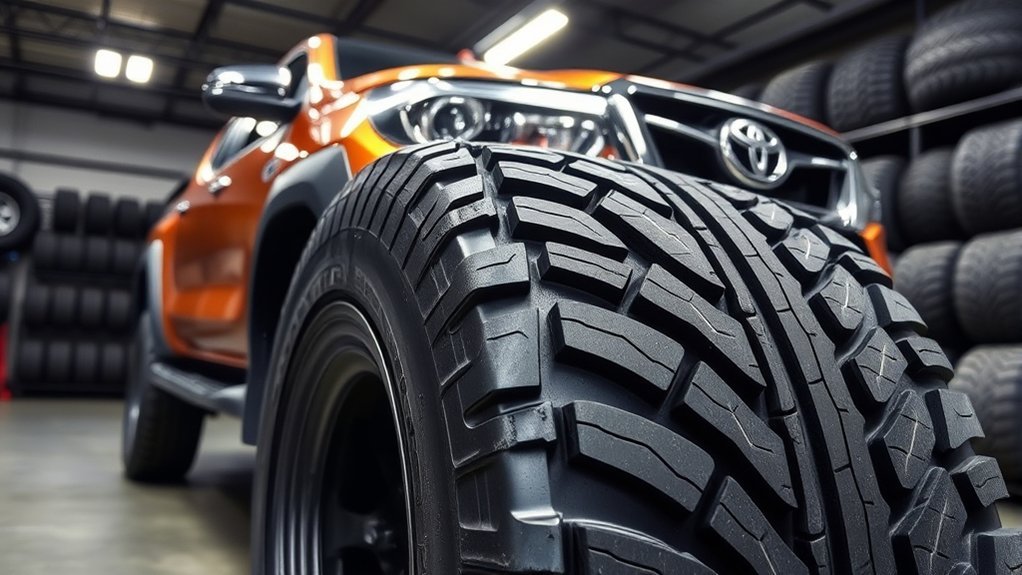
Tread pattern influences water evacuation, loose-surface grip, noise, steering feel, and rolling resistance. It is only one part of tire performance. Rubber compound, casing strength, sidewall design, tread depth, temperature, pressure, and vehicle load also matter.
[Products Worth Considering]

These pre-assembled 15x6.00-6 front tire and wheel assemblies are designed for quick replacement on riding lawn mowers and lawn tractors. Built with natural rubber pneumatic tires and turf-friendly tread for solid traction and improved shock absorption. A thickened welded rim and 3/4" sintered iron bushing help provide stable, heavy-duty support for everyday mowing use.

These aluminum alloy tire valve stem caps with an O-ring seal help protect valve stems from corrosion while adding a clean, stylish look to your vehicle. The universal fit works across cars, trucks, motorcycles, bicycles, and more, making them an easy upgrade for everyday driving and off-road use. Installation is quick, and the included four-pack keeps all your tires dressed and protected.

Upgrade your 2024-2026 Tesla Model 3 Highland with REEVAA all-weather mud flaps designed for seamless fit along the original body lines. The set of four delivers strong splash protection against mud, gravel, and road debris while using OEM-grade durable materials. Installation is non-destructive with original hole positions and snap-in clips, and the aerodynamic design helps minimize impact on efficiency.
Tread Pattern Types Explained
- Closely spaced highway blocks can reduce noise and improve paved-road stability.
- Open all-terrain blocks add loose-surface edges while keeping acceptable road manners.
- Large mud-terrain lugs clear soft material more easily but can be louder and less precise on pavement.
- Wide circumferential grooves and sipes can help manage water, although final wet performance depends on the complete tire design.
- Reinforced sidewalls can improve resistance to cuts and impacts, but “strong sidewall” is a construction feature, not a tread type.
Impact on Off-Roading
| Feature | Off-Road Benefit | Road Trade-Off |
|---|---|---|
| Open shoulder blocks | Better bite in loose soil and mud | More noise and irregular-wear risk |
| Deep, widely spaced lugs | Improved self-cleaning in soft terrain | Heavier feel and longer braking may occur on some surfaces |
| Reinforced casing or sidewall | More resistance to impacts and cuts | Extra weight and a firmer ride |
| Softer cold-weather compound | More flexibility in low temperatures | Faster wear in hot conditions |
Steel vs. Alloy Wheels: Which Is Best for Your Hilux?
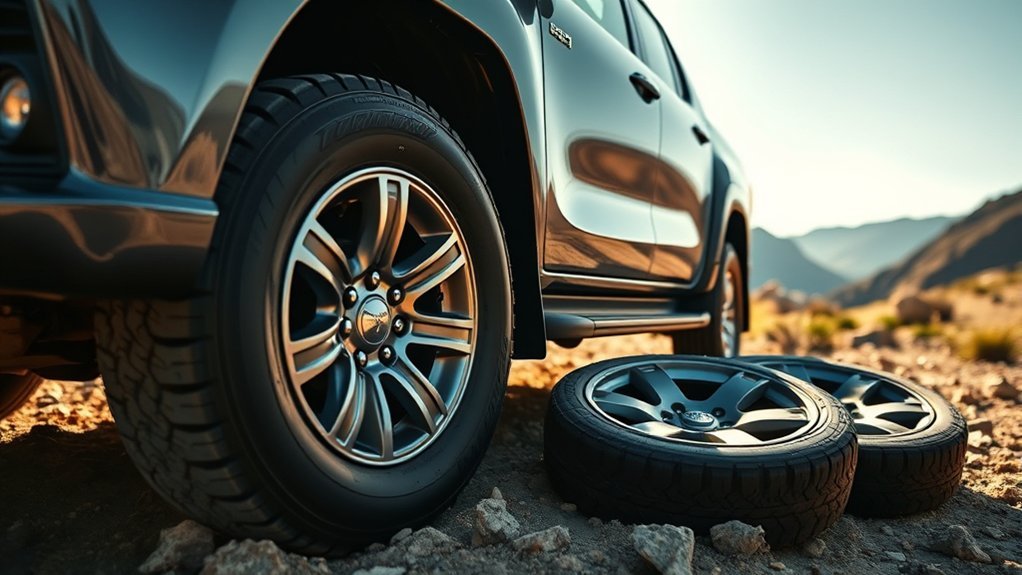
Neither material is automatically best. The wheel’s design, manufacturing quality, load rating, width, offset, and intended use matter more than a simple steel-versus-alloy label.
| Factor | Steel Wheels | Alloy Wheels |
|---|---|---|
| Weight | Often heavier | Often lighter, but not always |
| Impact behavior | May bend under a severe impact | May bend or crack depending on design and construction |
| Cost | Usually lower | Usually higher, with a wider style range |
| Cooling and styling | Simple and work-focused | Open designs may aid airflow and offer more finish choices |
| Best fit | Budget work use, remote travel, spare-wheel simplicity | Road handling, appearance, and lower unsprung mass when genuinely lighter |
Choose a wheel with a verified load rating for the Hilux and its intended axle load. A stylish passenger-vehicle wheel may not be suitable for a loaded pickup, even when the bolt holes line up.
[Products Worth Considering]

The Topeak SmartGauge D2 delivers precise digital tire pressure readings for bikes, motorcycles, and sports equipment up to 250 psi (17 bar). Its rotating SmartHead works with both Presta and Schrader valves, so you can check pressure quickly without adapters. The LCD display makes it easy to read results in psi, bar, or kg/cm² with an included CR2032 battery for immediate use.

Monitor tire tread wear with a smart, color-coded depth gauge that shows clear condition ranges at a glance. The bar is range marked for fast, easy readings, helping you maintain safer traction and performance. Each gauge is portable with a pocket clip, and the set includes 20 units for daily use and sharing.

The SAFELIFE dial tire tread depth gauge measures tread depth in 1/32 inch increments with clear, easy-to-read 2-inch dial face. Color zones using a traffic light system help you quickly judge whether tread is low, marginal, or ample for safer driving. Built with a durable zinc cast body and a metal detect probe for precise, comfortable use across cars, motorcycles, trucks, and buses.
Achieving Optimal Wheel Fitment and Offset
Correct wheel fitment requires more than matching diameter. Confirm all of the following for your exact model:
- Stud pattern or PCD: the number and spacing of wheel studs.
- Center bore: the hole that locates the wheel on the hub.
- Wheel width: must be approved for the selected tire.
- Offset: controls how far the wheel sits inward or outward.
- Brake clearance: barrel and spoke shape must clear calipers and other parts.
- Load rating: must suit the vehicle’s axle loads and use.
- Fastener seat: taper, radius, shank, and thread must match the wheel and hub.
- TPMS compatibility: required on variants equipped with tire-pressure sensors.
Less positive or negative offset usually moves the wheel outward; more positive offset moves it inward. Too much change can cause guard, liner, suspension, or steering contact and may alter scrub radius, steering feel, bearing load, and wheel track.
Do not assume the previously cited 6×139.7 bolt pattern, +12 to +25 offset range, or 106.1 mm center bore applies to every Hilux. Treat those figures only as generation-specific possibilities until Toyota or a qualified wheel supplier confirms them against your model code or VIN. The redesigned 2026 Hilux makes model-year verification especially important.
Will Larger Tires Rub?
Rubbing must be checked at full steering lock in both directions and through suspension compression, not just while parked on level ground. Inspect the front bumper edge, mud flaps, inner liner, body mount, upper control arm, sway bar, brake hose, and rear guard. Check again with the truck loaded.
A lift may create vertical space but does not always fix contact caused by tire width or offset. It can also change alignment and suspension geometry. Do not use a generic “2- to 3-inch lift” as a fitment answer.
Safe Hilux Tire and Wheel Upgrade Process
- Identify the truck: record the model year, country, cab, trim, driveline, model code, and VIN.
- Record factory specifications: photograph the tire placard and check the owner’s manual for sizes, pressures, wheel data, load limits, and rotation guidance.
- Define the job: list pavement, gravel, mud, sand, snow, towing, payload, and annual distance in order of importance.
- Measure real load: include accessories and trailer downforce; use axle-scale readings when the truck works near its limits.
- Shortlist tires: match construction, tread, load index, speed rating, and approved rim width.
- Compare dimensions: calculate diameter and circumference change, then check local limits and possible speedometer effects.
- Verify the wheel: confirm PCD, center bore, width, offset, caliper clearance, fastener type, TPMS, and load rating.
- Trial-fit professionally: check steering lock and suspension travel before approving the full set.
- Install and inspect: balance the assemblies, align the truck when needed, set cold pressure, initialize TPMS if required, and verify spare fitment.
- Road-test and recheck: listen for contact or vibration and follow the installer’s wheel-nut recheck interval.
Maintenance Tips for Your New Tires and Wheels
- Check pressure monthly when cold: include the spare and use Toyota’s placard pressure, not the maximum pressure on the tire sidewall.
- Rotate on the correct schedule: follow your market-specific manual. Toyota’s 2026 Japanese Hilux manual calls for rotation at 10,000 km, while other models or tire setups may differ.
- Inspect tread and sidewalls: look for cuts, bulges, cracks, exposed cords, punctures, stones, and uneven wear after hard trips and at least monthly.
- Watch for alignment clues: pulling, a crooked steering wheel, feathered tread, or rapid shoulder wear needs attention.
- Balance after tire fitting: investigate vibration rather than driving through it.
- Clean mud and corrosive residue: packed debris can hide damage and upset wheel balance.
- Reinflate after airing down: low off-road pressure is not suitable for normal highway speed.
- Track tire age: read the date code and follow the tire maker’s inspection and replacement guidance even when tread remains.
Toyota’s current tire guidance and the 2026 Japanese Hilux owner’s manual tire section also stress regular inspection, correct rotation procedures, and TPMS initialization after rotation where applicable.
Enhancing Your Hilux’s Look With Tires and Wheels
Tires and wheels can give a Hilux a wider, more purposeful stance, but appearance should come after load capacity and fitment. A larger wheel with a lower-profile tire can sharpen steering response, while a smaller wheel with more sidewall can improve impact protection and ride comfort off-road. Increasing tire diameter is different from increasing wheel diameter, so do not treat the two changes as the same.
Alloy finishes, steel-wheel colors, and professional powder coating can personalize the truck. Make sure refinishing does not cover mounting faces, stud seats, load markings, or areas needed for correct fastener contact. Keep the spare compatible with the rolling diameter and brake package.
The best-looking upgrade is one that clears at full lock, carries the real load, preserves safe handling, and remains legal. A wheel that sits flush in a parking photo can still rub or overload components when the Hilux is loaded and moving over rough ground.
Frequently Asked Questions
What size tires are best for a Toyota Hilux?
The best size is the factory size on your truck’s tire placard or another size approved for its exact model. Current Australian 2026 examples include 265/65R17 and 265/60R18, but older generations and other markets differ. Match load index, speed rating, wheel width, pressure, and clearance as well as size.
Which is better, the 2.4 or 2.8 Hilux?
The better engine depends on the market and job. The 2.8-liter version generally targets higher output and demanding towing or load use, while a 2.4-liter model may suit lighter work and lower operating-cost priorities. Engine choice does not determine tire fitment by itself; verify the exact trim, axle ratings, brakes, and placard.
Can you fit 33-inch tires on a Hilux?
Some Hilux generations can accept a nominal 33-inch tire with the right wheel, offset, suspension, trimming, alignment, gearing, and legal approval, but it is not a bolt-on guarantee. Check full-lock and full-compression clearance, spare storage, speedometer error, braking, TPMS, axle load, and local modification rules before buying.
Will 265/70R17 tires fit a Hilux?
They may fit some Hilux variants, but not all. A 265/70R17 is about 3.4% larger in diameter than a 265/65R17, so it can change indicated speed and may rub depending on wheel offset, suspension, liners, load, and model year. A 2- to 3-inch lift is not a universal requirement or guarantee.
Do bigger tires increase Hilux payload?
No. A higher-capacity tire may provide enough tire capacity for an approved load, but it does not raise the Hilux’s GVM, GCM, axle ratings, tow rating, wheel rating, or legal payload. Any mass-rating change must be formally approved for the vehicle and jurisdiction.
What tire pressure should I use off-road?
Use the placard pressure for normal road driving. Off-road pressure depends on tire construction, load, speed, terrain, and heat, so there is no safe universal number. Reduce pressure only with suitable guidance, drive slowly, avoid tire-to-rim damage, and reinflate before returning to highway speed.
Conclusion
A Toyota Hilux tire and wheel upgrade works best when it starts with verified vehicle data rather than appearance or a generic fitment chart. Use the placard and manual, match the tire to your real terrain and axle loads, and confirm every wheel dimension before installation. The right setup can improve traction, durability, comfort, and style without sacrificing clearance, braking, steering, payload compliance, or reliability.
Sources
- Toyota Australia HiLux Specification Table, June 2026 — current Australian tire sizes, GVM, GCM, and towing ratings
- Toyota Global Newsroom: New Hilux in Japan, May 2026 — redesigned model context and Japanese cargo-capacity example
- Toyota Australia Vehicle Payload Guide — payload definition, axle capacity, and weight-limit factors
- Toyota 2026 Hilux Owner’s Manual: Tires — inspection, rotation, and TPMS guidance
- NHTSA TireWise — replacement size, cold pressure, tread, rotation, and tire-aging guidance
- Australian Government Vehicle Standards Bulletin 14 — technical framework for light-vehicle modifications