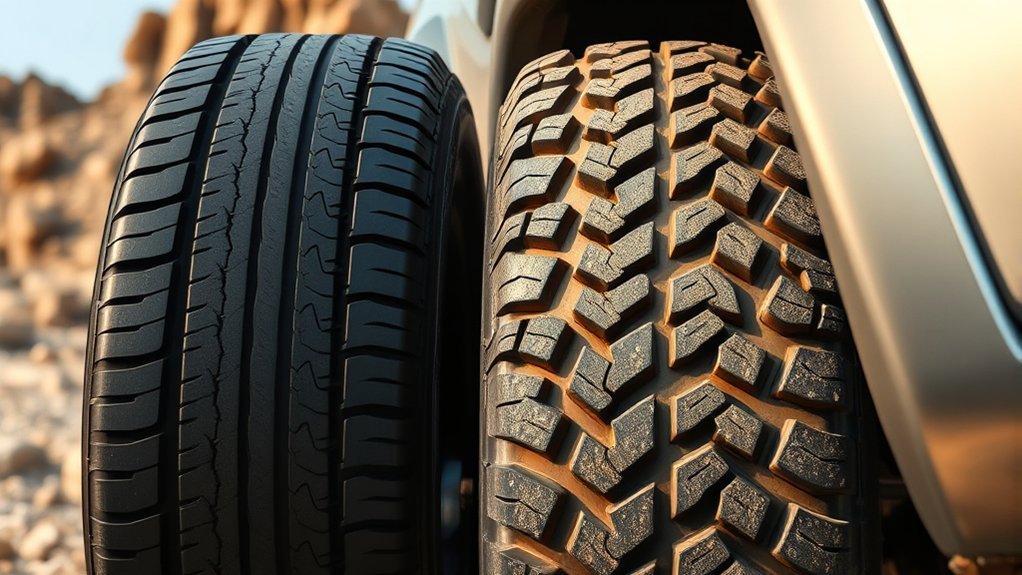
Choosing between all-season and all-terrain tires for a Toyota Tacoma is less about which category is universally “best” and more about where your truck spends most of its miles. The right tire must also match your Tacoma’s exact model year, trim, wheel size, load requirements, and driver-door placard specifications.
Quick Answer
Choose an all-season or highway-terrain tire if your Tacoma is driven mainly on pavement. Choose an all-terrain tire when gravel, dirt, mud, rough job sites, or trails are a regular part of your driving. In either case, match the door-placard size and load capacity, and look for the 3PMSF symbol if severe snow is a concern.
Key Takeaways
- All-season and highway-terrain tires generally suit commuting, highway travel, towing on pavement, and light gravel-road use.
- All-terrain tires provide more useful tread on loose or uneven surfaces but may add weight, tread hum, and firmer road manners.
- A Tacoma’s correct tire size and pressure depend on its model year, trim, wheel, drivetrain, and factory configuration.
- Do not compare tires by category alone. Check the exact size, load index, speed rating, construction, winter marking, and warranty.
- Four-wheel drive can help with acceleration, but braking and cornering still depend heavily on the tires’ grip.
All-Season vs. All-Terrain Tires for a Toyota Tacoma
The National Highway Traffic Safety Administration describes all-season tires as suitable for varied road conditions with some mud and snow capability. It describes all-terrain tires as a compromise between on-road driving and off-road capability.
| Factor | All-Season or Highway-Terrain | All-Terrain |
|---|---|---|
| Best use | Daily commuting, highways, paved towing, rain, and occasional maintained gravel | Mixed pavement and regular gravel, dirt, mud, trails, or rough work sites |
| Road comfort | Often smoother and quieter, although results vary by model and size | May produce more tread hum or a firmer feel, especially in heavier LT sizes |
| Loose-surface traction | Adequate for light-duty use but limited in deep mud, loose soil, or rocky terrain | More open tread and stronger shoulder features generally improve loose-surface capability |
| Winter use | Standard all-season tires may handle light snow; check for 3PMSF if severe snow is expected | Some models carry 3PMSF certification, while others do not |
| Fuel use | May have lower weight or rolling resistance, but there is no universal category-wide saving | Aggressive or heavier constructions may use more energy, but the exact change depends on the tire |
| Treadwear warranty | Varies by tire model, size, and construction | Also varies widely; some current models overlap highway-tire warranties |
All-Season Tires for Your Toyota Tacoma
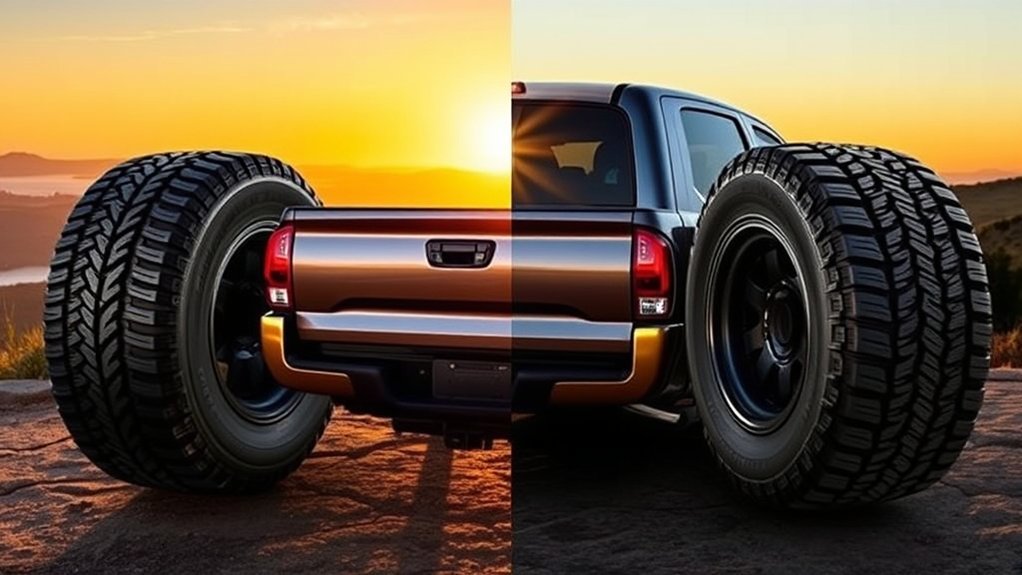
All-season and highway-terrain tires are usually the most practical choices when a Tacoma spends most of its time on streets and highways. Their tread patterns are designed around wet-road drainage, stable pavement handling, predictable wear, and everyday ride comfort.
They can also handle maintained gravel roads and occasional light-duty off-pavement driving. Their limits become more apparent in deep mud, loose sand, sharp rocks, heavily rutted trails, and other situations that demand larger voids or stronger off-road shoulder features.
Current highway-oriented examples include the Michelin Defender LTX M/S2 and Yokohama Geolandar H/T G056. These examples are not automatically compatible with every Tacoma. The exact size, load index, speed rating, and wheel fitment must match your truck.
Warranty coverage also depends on the exact tire. Michelin lists 50,000- or 75,000-mile treadwear coverage for applicable Defender LTX M/S2 sizes. Yokohama lists up to 70,000 miles for eligible Geolandar H/T G056 sizes but 50,000 miles for LT-metric versions. A warranty is subject to conditions and is not a promise that every driver will receive that mileage.
Pro Tip: Compare tires in your Tacoma’s exact size. The same product line may use different construction, load ratings, tread depth, weight, winter markings, and warranty terms across its size range.
Benefits and Drawbacks of All-Terrain Tires
All-terrain tires make sense when off-pavement driving is a normal part of ownership rather than an occasional detour. Their tread blocks, shoulder features, and groove arrangements are designed to find traction on surfaces such as gravel, packed dirt, loose soil, and moderate mud while remaining usable on pavement.
[Products Worth Considering]

These universal tire valve stem caps help protect valve cores from dust, debris, and moisture while helping maintain stable tire pressure. The corrosion-resistant metal construction and sealed design provide reliable protection in road grime, mud, and winter conditions. Twist-on installation makes them quick to fit on cars, SUVs, trucks, and motorcycles.

These aluminum alloy tire valve stem caps with an O-ring seal help protect valve stems from corrosion while adding a clean, stylish look to your vehicle. The universal fit works across cars, trucks, motorcycles, bicycles, and more, making them an easy upgrade for everyday driving and off-road use. Installation is quick, and the included four-pack keeps all your tires dressed and protected.

Marsflex brand TPMS replacement sensors help restore tire pressure monitoring for compatible Toyota, Lexus, Scion, and Pontiac models. Each sensor is pre-programmed for the vehicle application and includes a long-life battery for up to 8 years of normal use. Designed to replace common OE numbers and requires relearning using a TPMS scan tool after installation.
Enhanced Off-Road Capability
Compared with a pavement-focused tread, an all-terrain design normally provides more biting edges and more space for loose material to move through the tread. Some models also use reinforced construction or protective sidewall features to better tolerate rough surfaces.
Those features do not make a tire puncture-proof. Sharp rocks, low pressure, excess load, high speed, and sidewall impacts can still damage an all-terrain tire. Drivers who air down for off-road use must restore the correct road pressure before returning to normal-speed pavement driving.
For winter travel, look beyond the words “all-terrain.” A tire carrying the Three-Peak Mountain Snowflake symbol has passed a standardized snow-traction test. The M+S marking alone is based mainly on tread-design criteria and does not provide the same tested severe-snow designation.
Note: The 3PMSF symbol verifies a level of snow traction, but it does not guarantee exceptional braking on glare ice or make every 3PMSF tire equal to a dedicated winter tire in every condition.
Road Noise and Ride Comfort
More open tread patterns can create additional tread hum on pavement, especially as the tire wears. The difference cannot be reduced to a universal decibel figure because noise changes with tire model, size, inflation, road surface, speed, alignment, wear, and the truck’s cabin insulation.
Modern designs may use variable-pitch blocks and other features to control noise. For example, Nitto markets the Ridge Grappler as a hybrid-terrain tire with a variable-pitch tread pattern. It should not be described as a conventional all-terrain tire, and its suitability still depends on the driver’s pavement-to-trail balance.
Weight, Steering Feel, and Fuel Use
Some all-terrain tires—particularly LT-metric tires with higher load ranges—are heavier and stiffer than a standard replacement tire. Extra rotating mass and tread deformation can affect acceleration, braking feel, ride quality, and fuel use.
There is no reliable rule that every all-season tire saves a fixed percentage compared with every all-terrain tire. The U.S. Department of Energy notes that replacement-tire efficiency varies and that proper inflation and rolling resistance affect fuel economy.
Which Tire Type Should You Choose?
[Products Worth Considering]

Replace worn or malfunctioning GM TPMS sensors with this 433MHz pre-programmed sensor set designed for compatibility with many Chevrolet, Buick, GMC, and Cadillac models. It includes guidance for proper OBDII relearning/pairing after installation and supports reliable long-term operation with a high-performance CR2032 battery. Quality tested for durability and performance to help restore accurate tire pressure monitoring.

Masoll Gen 2 external TPMS sensors are a DIY replacement set of 4 for select GM vehicles made after 2006, helping you shut off the TPMS warning light quickly. Simply screw the sensors onto the tire valves and sync to your car ECU using the included EL-50448 relearn tool. Dual-frequency 315/433 MHz design provides OEM-level performance with accurate readings and replaceable batteries for about two years.

The Topeak SmartGauge D2 delivers precise digital tire pressure readings for bikes, motorcycles, and sports equipment up to 250 psi (17 bar). Its rotating SmartHead works with both Presta and Schrader valves, so you can check pressure quickly without adapters. The LCD display makes it easy to read results in psi, bar, or kg/cm² with an included CR2032 battery for immediate use.
Choose an All-Season or Highway-Terrain Tire If:
- Your Tacoma is driven mainly on paved roads.
- Cabin quietness and a compliant ride are high priorities.
- Your off-pavement use is limited to maintained gravel, campsites, or mild access roads.
- You want a lighter standard replacement rather than automatically moving to a heavy-duty LT construction.
- Your climate has rain and occasional light snow but not frequent severe winter conditions.
Choose an All-Terrain Tire If:
- You regularly drive on dirt, gravel, rutted roads, mud, ranch roads, trails, or rough job sites.
- You need more open tread and stronger off-road shoulder traction.
- You accept that some models may create more tread noise or a firmer ride.
- You have confirmed the tire’s dimensions, load capacity, wheel compatibility, and clearance.
- You have selected an appropriate winter rating for your climate rather than assuming every all-terrain tire is snow-certified.
Choose a 3PMSF-Rated or Dedicated Winter Tire If:
- You regularly drive in deep snow, packed snow, or prolonged freezing conditions.
- Your region requires winter-rated equipment on certain roads.
- Snow braking and cornering matter more than year-round treadwear or warm-weather handling.
- You understand that four-wheel drive helps deliver power but does not create extra tire grip when braking.
Warning: Do not choose tires by category or appearance alone. A tire that does not meet the required size, load capacity, wheel fitment, and pressure specification can compromise handling, braking, durability, and safety.
Understanding Tire Longevity, Warranty, and Cost
There is no dependable lifespan range that applies to every all-season or all-terrain tire. Actual wear depends on the tire model, rubber compound, construction, load, inflation, alignment, rotation, driving style, climate, towing, road surface, and off-road use.
Current warranties show why category-wide assumptions can be misleading:
- The Michelin Defender LTX M/S2 lists 50,000- or 75,000-mile coverage depending on the applicable tire.
- The Yokohama Geolandar H/T G056 lists up to 70,000 miles for eligible P-metric or Euro-metric sizes and 50,000 miles for LT-metric sizes.
- The Nitto Terra Grappler G3 lists 70,000 miles for hard-metric sizes and 55,000 miles for LT or flotation sizes.
These figures are limited warranties, not predicted service life. Coverage may require proof of purchase, documented rotations, proper inflation, correct fitment, and normal use. Off-road damage, misalignment, underinflation, overloading, or irregular wear may be excluded.
Compare the warranty attached to the exact tire size—not the largest number shown in an advertisement for the product line.
Retail tire prices change frequently, so fixed category-wide price ranges become outdated quickly. Compare the complete installed cost, including:
- Four tires and any matching spare
- Mounting and balancing
- Valve stems or TPMS service kits
- New TPMS sensors when needed
- Disposal fees and taxes
- Alignment inspection or adjustment
- Road-hazard coverage
- Future rotation costs
How to Select the Correct Tire Size for Your Tacoma
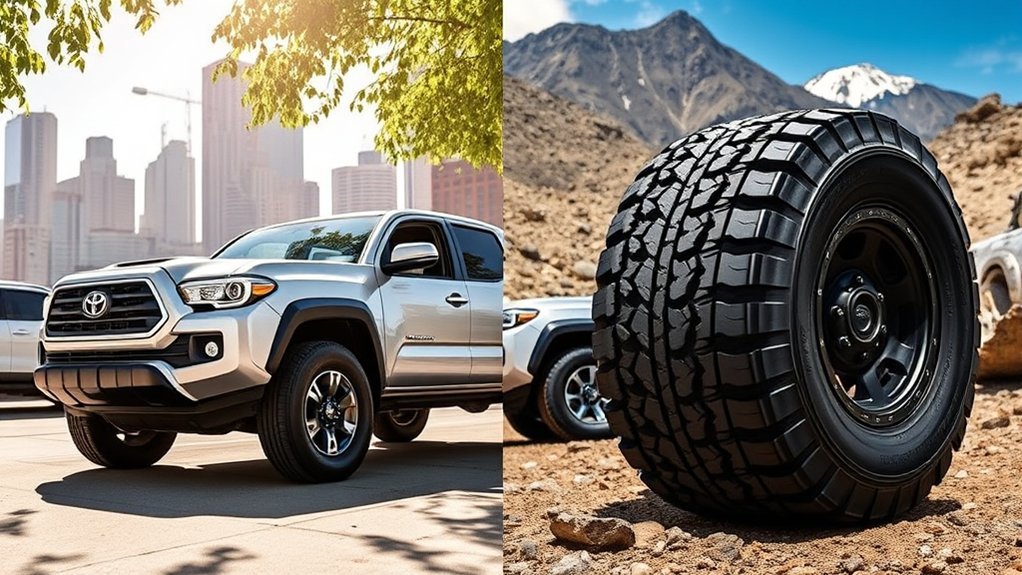
Tacoma tire sizes vary by generation, model year, trim, drivetrain, wheel, cab, and factory package. For example, Toyota’s official 2024 specifications include different applications using 245/70R17, 265/70R17, and 265/65R18 tires. That does not mean all three sizes are approved for every 2024 Tacoma, and it does not establish fitment for earlier or later trucks.
Start With the Door Placard, Owner’s Manual, and VIN
The safest starting point is the Tire and Loading Information label on the driver-side door edge or doorjamb. Confirm the information against the owner’s manual for your exact model year. Toyota provides current manuals through its Tacoma manuals and warranties portal.
Record the following before shopping:
- Model year and trim
- Two-wheel drive or four-wheel drive
- Cab and bed configuration
- Factory wheel diameter and width
- Placard tire size
- Required load index or load capacity
- Required speed rating
- Recommended cold inflation pressure
- Whether the truck has a full-size or temporary spare
Warning: Use the cold inflation pressure on the vehicle’s placard or in the exact owner’s manual. The pressure molded on the tire sidewall is a tire limit, not the Tacoma’s recommended everyday operating pressure.
How to Read a Tire Size
Using 265/70R17 as an example:
- 265 is the nominal section width in millimeters.
- 70 is the sidewall height as a percentage of the section width.
- R indicates radial construction.
- 17 is the wheel diameter in inches.
The numbers following the size normally identify the load index and speed rating. These are safety specifications, not optional marketing details. A replacement must provide adequate load capacity for the truck and its intended cargo or towing use.
Tire Size Impact on Performance
Changing tire dimensions can affect more than appearance. A materially different overall diameter may influence speedometer accuracy, effective gearing, acceleration, shift behavior, braking feel, and the operation of vehicle-control systems. A wider tire or a wheel with a different offset can create contact with suspension parts, body mounts, fender liners, or the body.
A 265/70R17 should not be called a “smaller” tire without a baseline. It has a larger calculated diameter than a 245/70R17, although both appear in official specifications for certain Tacoma configurations.
Online rules suggesting that any tire within approximately 3% of the original diameter is automatically safe are incomplete. That calculation may be useful for an initial comparison, but it does not verify:
- Load capacity
- Wheel width or offset
- Brake and suspension clearance
- Full steering-lock clearance
- Clearance during suspension compression
- Spare-tire storage and use
- TPMS operation
- Speedometer or electronic-system effects
P-Metric vs. LT-Metric Tires
A P-metric or standard metric tire may provide a lighter, more compliant ride for a Tacoma used mainly on pavement. An LT-metric tire may provide construction suited to higher loads or harsher service, but it can also be heavier and stiffer.
Do not assume that a higher load range automatically makes a tire better. The correct choice depends on the truck’s placard requirements, actual payload, towing use, terrain, and the tire manufacturer’s load-and-inflation data.
Modifications for Larger Sizes
A larger tire may require changes to wheel offset, suspension height, fender liners, mud flaps, body mounts, or other components. A lift kit alone does not guarantee clearance because rubbing may occur at full steering lock or when the suspension compresses.
Before approving a non-stock fitment, a qualified technician should check:
- Wheel diameter, width, offset, and load rating
- Tire-to-suspension and tire-to-body clearance
- Clearance at full left and right steering lock
- Clearance through the suspension’s travel
- Brake-component clearance
- Spare-tire fit and compatibility
- Alignment
- Load capacity at the intended pressure
- TPMS sensor compatibility and initialization
- Whether the diameter change is large enough to justify gearing or calibration changes
Tire Pressure, Rotation, and TPMS
Check tire pressure when the tires are cold and use the placard value rather than the sidewall maximum. The NHTSA TireWise guide recommends checking all tires, including the spare, at least monthly.
Rotation can reduce irregular wear, but the interval and pattern must match the exact Tacoma and tire warranty. NHTSA gives a general interval of 5,000 to 8,000 miles when rotation is recommended, while some tire warranties require documentation at a more specific interval.
Toyota identifies tire-pressure changes, tire-size changes, tire rotation, and sensor-ID registration as situations that may require tire-pressure warning system initialization on applicable Tacoma models. Procedures vary by model year and display, so follow the exact owner’s manual rather than a generic reset sequence.
Note: TPMS is a warning system, not a replacement for a pressure gauge. A tire can be improperly inflated before the warning threshold is reached.
Best Places to Buy Tires for Your Tacoma
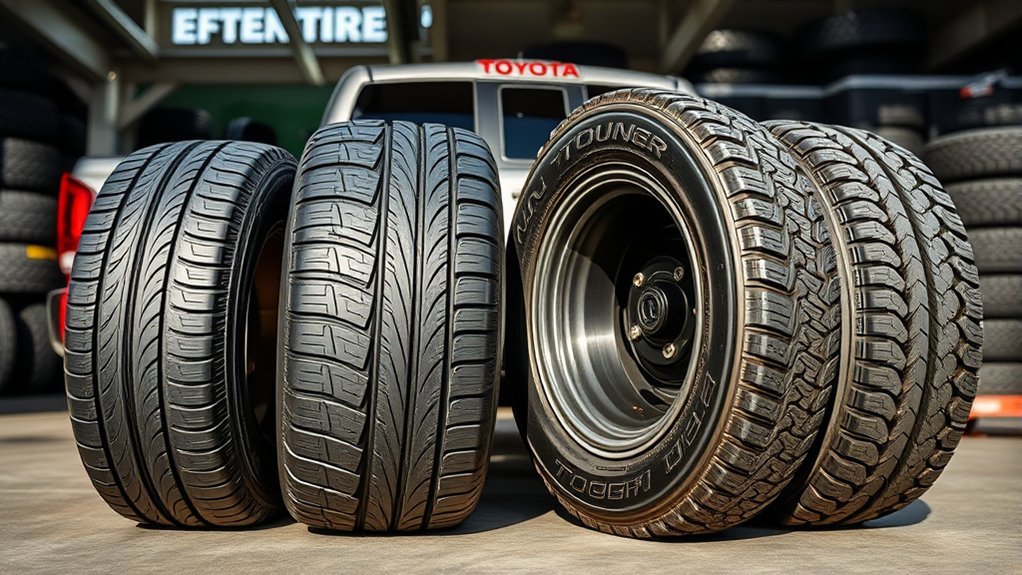
The best seller is one that can verify your exact Tacoma fitment and support the tires after installation. Suitable options may include a Toyota dealer, an established tire specialist, a manufacturer-authorized dealer, or a reputable online retailer with a qualified local installer.
Look for a seller that will:
- Confirm the model year, trim, drivetrain, wheel, and placard specifications.
- Verify size, load index, speed rating, construction, and wheel compatibility.
- Explain whether a proposed alternative size is manufacturer-approved or an aftermarket fitment.
- Inspect for rubbing risks when installing a non-stock size.
- Use current mounting and balancing equipment.
- Service or register TPMS sensors correctly.
- Provide the complete written warranty and rotation requirements.
- Give an itemized installed price rather than advertising only the tire price.
- Offer follow-up balancing, rotation, and warranty support.
If you are shopping near Millenia Mall or anywhere else, choose the seller for its fitment skill and after-sale service rather than location alone. A convenient shop is not a good value if it installs an unsuitable size or cannot support a warranty claim.
[Products Worth Considering]

The 22800 wheel stud installer makes replacing wheel studs quick and secure, saving time and effort during tire service. It uses a ratchet or impact wrench to pull new studs firmly into place, helping when existing studs are too long. Compatible with most automotive wheels and light-duty truck wheel studs, it’s designed for easy, tool-assisted installation.

Measure tire tread depth quickly and accurately with this LUMITECO dial gauge that reads in 1/32" increments up to 14/32". The color-coded green/yellow/red zones make it easy to judge tire wear and know when replacement is needed. A rugged, compact design with a protective pouch helps keep the gauge ready for use on cars, trucks, motorcycles, and more.

Monitor tire tread wear with a smart, color-coded depth gauge that shows clear condition ranges at a glance. The bar is range marked for fast, easy readings, helping you maintain safer traction and performance. Each gauge is portable with a pocket clip, and the set includes 20 units for daily use and sharing.
Pre-Purchase Tacoma Tire Checklist
- Confirm the driver-door placard size and cold pressure.
- Check the exact model year, trim, drivetrain, wheel, cab, and package.
- Match or exceed the required load capacity.
- Confirm the required speed rating.
- Decide whether standard metric, P-metric, or LT-metric construction fits your use.
- Check whether the exact size carries M+S, 3PMSF, or another winter marking.
- Compare actual tire weight, not only tread appearance.
- Review treadwear warranty terms for the exact size.
- Confirm rotation-documentation requirements.
- Check wheel width, offset, and load rating.
- Verify full-lock and suspension-compression clearance for non-stock sizes.
- Confirm spare-tire compatibility.
- Plan for TPMS service or initialization.
- Compare the complete installed price.
Frequently Asked Questions
Can all-season tires handle light off-road conditions?
Yes. A suitable all-season or highway-terrain tire can normally handle maintained gravel roads, campsites, dry dirt roads, and other light-duty surfaces. It will not provide the same loose-soil, mud, rock, or shoulder traction as a capable all-terrain tire.
How do warranties differ between all-season and all-terrain tires?
There is no fixed category rule. Warranties differ by brand, product, tire size, and construction. Some current all-terrain tires have mileage warranties that overlap highway-oriented tires. Read the terms for the exact size and keep purchase, pressure, alignment, and rotation records.
What is the typical lifespan of all-terrain tires?
There is no reliable universal mileage. Tire model, construction, inflation, load, alignment, rotation, road surface, climate, towing, and off-road use all affect wear. Use the exact product warranty as a comparison tool, not as a guaranteed lifespan.
Are all-season tires suitable for winter driving?
Standard all-season tires can handle moderate conditions and light snow, but they are not the best choice for frequent deep snow or ice. Look for the 3PMSF symbol or use a dedicated winter tire when severe winter traction is a priority.
How often should I rotate my Tacoma tires?
Follow the maintenance schedule for your exact model year and the tire manufacturer’s warranty requirements. A common general range is 5,000 to 8,000 miles, but rotate sooner if the manual requires it or irregular wear appears.
Do all-terrain tires reduce Tacoma fuel economy?
They can, particularly when the replacement is heavier, larger, underinflated, or designed with higher rolling resistance. The change is not a fixed percentage and may be small or noticeable depending on the exact tire and driving conditions.
Should I install LT tires on my Tacoma?
Only when the construction suits the truck’s required load capacity and your use. LT tires may benefit heavy-duty or rough-service applications, but they can add weight and stiffness. Do not choose a higher load range without checking the correct load-and-inflation requirements.
Can I mix all-season and all-terrain tires on a Tacoma?
Mixing categories, models, sizes, tread depths, or constructions can create different grip and handling characteristics between axles. The safest approach is a matched set that meets Toyota’s specifications. Consult the exact owner’s manual and a qualified tire professional before any temporary or mixed replacement.
Conclusion
For a Tacoma driven mainly on pavement, a correctly specified all-season or highway-terrain tire normally provides the best balance of road comfort, wet-weather usefulness, predictable wear, and everyday efficiency. A properly fitted all-terrain tire is the stronger choice when loose or rough surfaces are a regular part of the truck’s work or recreation.
The category name is only the beginning. Use the driver-door placard and exact owner’s manual to verify size and pressure, then compare load capacity, speed rating, construction, winter certification, wheel compatibility, warranty, and installed cost. That process is more reliable than choosing the most aggressive tread or copying another Tacoma owner’s setup.
Sources
- National Highway Traffic Safety Administration: TireWise — tire categories, sizing, pressure, tread, rotation, TPMS, and replacement safety
- Toyota 2026 Tacoma Manuals and Warranties — current model-specific owner information
- Toyota 2024 Tacoma Maintenance Data — examples of factory tire sizes, load indexes, wheels, and pressures varying by configuration
- Toyota Tacoma Initialization Guidance — situations requiring tire-pressure warning system initialization
- Michelin Defender LTX M/S2 — current product and size-dependent treadwear warranty information
- Nitto Terra Grappler G3 — all-terrain features, 3PMSF status, and size-dependent warranty information