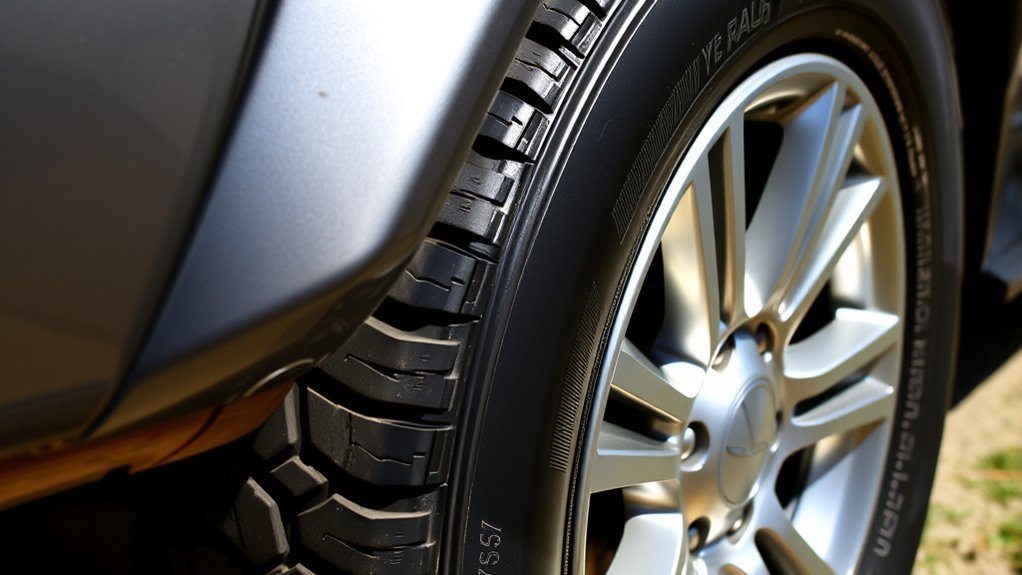
Choosing wheels and tyres for an eighth-generation Toyota Hilux is not as simple as matching one popular size. The correct setup depends on the model year, market, cab style, grade, 4×2 or 4×4 configuration, wheel design, axle loads, and any suspension or brake changes. Start with the tyre placard and owner’s manual for your exact vehicle, then confirm every replacement wheel and tyre specification before installation.
Quick Answer
Use the size, load rating, speed rating, and cold pressure listed for your exact Hilux on its tyre placard or in its owner’s manual. Common N80 sizes include 215/65R16C, 225/70R17C, 265/65R17, and 265/60R18, but wheel fitment and pressure vary by market, grade, and drivetrain.
Key Takeaways
- Identify the exact model, market, grade, drivetrain, and factory tyre size before ordering anything.
- Do not treat one bolt pattern, centre bore, offset range, or pressure as universal across all Hilux variants.
- Replacement tyres should meet or exceed the original load and speed requirements and suit the vehicle’s actual use.
- Larger tyres require clearance, speedometer, braking, suspension, spare-wheel, and legal checks.
- Use the vehicle placard for cold pressure, not the maximum pressure moulded into the tyre sidewall.
Warning: This guide covers the eighth-generation Hilux, commonly called the N80. Toyota now sells an all-new Hilux in some markets, and its wheel, tyre, brake, and drivetrain specifications may differ. Confirm your VIN and build generation before buying parts.
How to Choose the Right Wheels for Your Toyota Hilux
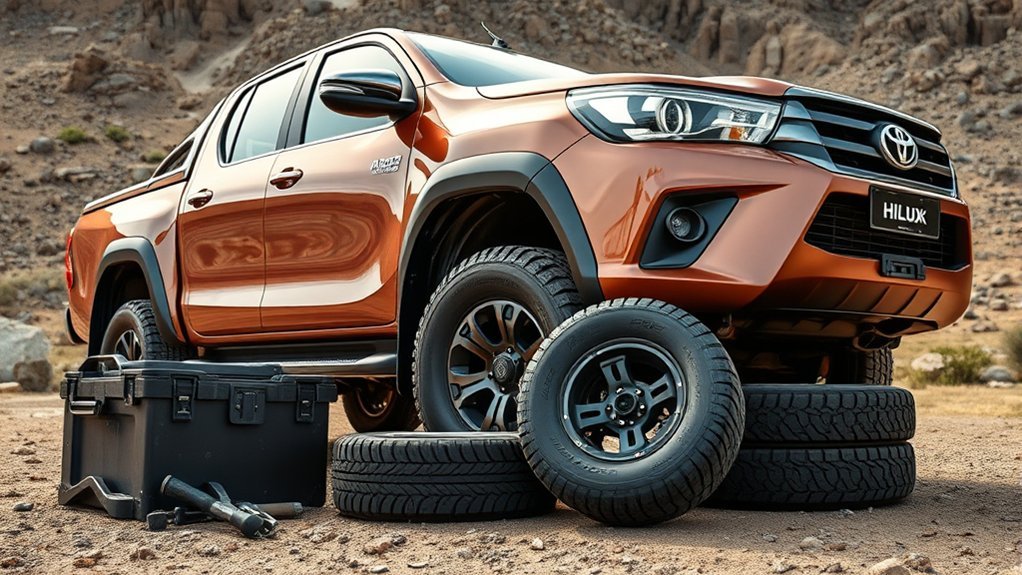
Begin with your Hilux identification details. Record the model year, VIN, country of sale, cab type, grade, drivetrain, factory wheel size, and tyre placard information. The eighth-generation range includes low-rider 4×2, Hi-Rider 4×2, and 4×4 variants, and they do not all share the same tyres, brakes, or wheel clearances.
Before approving a wheel, confirm all of the following:
- Stud pattern and stud count: The wheel must match the hub exactly. Do not select a pattern from drivetrain alone.
- Centre bore: The bore must fit the hub correctly. Approved hub-centric rings may adapt an oversized wheel bore, but they cannot correct the wrong stud pattern.
- Wheel width and diameter: Both must suit the tyre and clear the brake caliper, suspension, steering, and bodywork.
- Offset: The offset controls how far the wheel sits inward or outward. A change can reduce suspension clearance, increase fender protrusion, alter scrub radius, and increase bearing or steering loads.
- Load rating: The wheel and tyre must safely support the Hilux’s axle loads, payload, towing use, and accessories.
- Nut seat and hardware: The nut seat profile, thread, shank, washer, and engagement must match the wheel and hub.
- Brake and steering clearance: Test at full steering lock and through suspension travel, not only while the vehicle is parked on level ground.
Pro Tip: Ask the wheel supplier to confirm fitment against your VIN and provide the wheel’s load rating, width, diameter, offset, centre bore, nut-seat type, and brake-clearance approval in writing.
[Products Worth Considering]

These M14x1.5 closed-end chrome lug nuts are a one-piece replacement designed for secure fitment on compatible GM, Ford, and select Chrysler/Dodge models. Featuring a 60-degree conical seat and anti-rust chrome plating, they help resist corrosion and maintain a bright look for everyday driving. Built for long-term durability, they include OEM-style part references and are backed by 12 months of support.

Upgrade your wheels with MIKKUPPA closed-end lug nuts designed for reliable fit and corrosion resistance. The one-piece, cold-forged and heat-treated steel construction helps resist rust and stripping, while the integrated finish delivers a durable black appearance. Built to OEM standards with a conical 60-degree seat, these nuts provide a secure solution for compatible Ford, Honda, Jeep, and Chevrolet models.

Upgrade your wheels with MIKKUPPA M12x1.5 mag seat lug nuts built for secure, corrosion-resistant performance. These closed-end chrome lug nuts are a direct replacement for select Toyota models, including Camry, Corolla, RAV4, Sienna, Avalon, Highlander, Matrix, Venza, and Prius. Triple-chromium plating and cold-forged, heat-treated steel help deliver strength for daily driving and replacement needs.
Optimal Tyre Sizes for Your Hilux
The best starting point is the factory size shown on the vehicle placard. Toyota’s published Australian specifications for the 2020 eighth-generation HiLux show how much the original equipment varies across one market alone.
| Example N80 configuration | Published wheel and tyre |
|---|---|
| 4×2 WorkMate low-rider | 16-inch steel wheel with 215/65R16C tyre |
| Hi-Rider and selected 4×4 single-cab WorkMate or SR | 17-inch steel wheel with 225/70R17C tyre |
| Selected 4×4 extra-cab and double-cab WorkMate or SR | 17-inch steel wheel with 265/65R17 tyre |
| SR option package | 17-inch alloy wheel with 265/65R17 tyre |
| SR5 | 18-inch alloy wheel with 265/60R18 tyre |
These are examples, not a universal fitment chart. Other countries, years, grades, commercial versions, and special editions may use different specifications. Check the Toyota Australia eighth-generation HiLux specifications only as a reference, then rely on your own placard and owner’s manual.
[Products Worth Considering]

The 22800 wheel stud installer makes replacing wheel studs quick and secure, saving time and effort during tire service. It uses a ratchet or impact wrench to pull new studs firmly into place, helping when existing studs are too long. Compatible with most automotive wheels and light-duty truck wheel studs, it’s designed for easy, tool-assisted installation.

This car D-wheel lock nut key provides an anti-theft solution for D-shaped wheel lock bolts, helping keep your wheels secure. It features a flower-shaped internal pattern that resists micro-adjustment theft while allowing removal and mounting of compatible locking nuts. Made for reliable performance under high torque, it’s easy to use with standard socket wrench turning for quick tire maintenance and emergency repairs.

Upgrade your 2024-2026 Tesla Model 3 Highland with REEVAA all-weather mud flaps designed for seamless fit along the original body lines. The set of four delivers strong splash protection against mud, gravel, and road debris while using OEM-grade durable materials. Installation is non-destructive with original hole positions and snap-in clips, and the aerodynamic design helps minimize impact on efficiency.
How to Read a Hilux Tyre Size
In a size such as 265/65R17, 265 is the nominal section width in millimetres, 65 is the sidewall height as a percentage of that width, R identifies radial construction, and 17 is the wheel diameter in inches. The service description that follows the size contains the load index and speed symbol. Do not replace a tyre with a lower required capacity without written approval from a qualified tyre professional or the vehicle manufacturer.
Choosing the Right Tyre Type
- Highway terrain: Best for mostly sealed roads, lower noise, predictable wet-road behaviour, and efficient daily driving.
- All terrain: A balanced choice for mixed sealed roads, gravel, worksites, and moderate trails.
- Mud terrain: Built for difficult off-road use, but usually noisier and less refined on wet or paved roads.
- Commercial or light-truck construction: May be required for specific Hilux variants and loads. Do not replace a C-marked or LT tyre with a passenger tyre based on size alone.
Correct Hilux Tyre Pressure
Use the cold pressure on the tyre placard or in the owner’s manual for your exact configuration. The number moulded into the tyre sidewall is a maximum rating, not the vehicle’s normal recommended pressure. The NHTSA tyre-safety guide recommends checking all tyres, including the spare, at least monthly when cold.
An official Toyota UK guide lists 35 psi for a Hilux with 225/70R17 tyres and 29 psi for listed 265/65R17 and 265/60R18 configurations. Those figures show why a blanket 28 to 32 psi rule is unreliable. Your market, load condition, tyre construction, and placard may specify something different. See the Toyota UK tyre pressure and size guide and follow your vehicle-specific information.
Note: If you change from an original passenger-metric or commercial tyre to an LT construction, do not copy the old pressure automatically. Ask a qualified tyre specialist or Toyota dealer to calculate a safe cold pressure for the tyre’s load table and the Hilux’s axle loads.
Common Mistakes When Choosing Tyres for Your Toyota Hilux
- Buying by diameter alone: A 17-inch wheel can still have the wrong width, offset, centre bore, load rating, or brake clearance.
- Assuming every 2WD or 4WD is identical: Low-rider, Hi-Rider, cab, grade, and regional differences matter.
- Ignoring load index and construction: The replacement tyre must support the vehicle, payload, accessories, and towing demands.
- Using sidewall maximum pressure: Use the vehicle placard’s cold pressure instead.
- Changing offset for appearance only: Moving the wheel outward or inward can create rubbing, steering, bearing, and legal problems.
- Failing to check all four tyres on a 4WD: Large circumference differences can affect driveline operation and handling.
- Skipping a loaded clearance test: A tyre that clears while parked may rub at full lock, under braking, or when the suspension compresses.
- Forgetting the spare: A larger tyre may not fit the original spare location, and an undersized spare may create a major rolling-circumference mismatch.
Essential Maintenance Tips for Your Hilux Wheels and Tyres
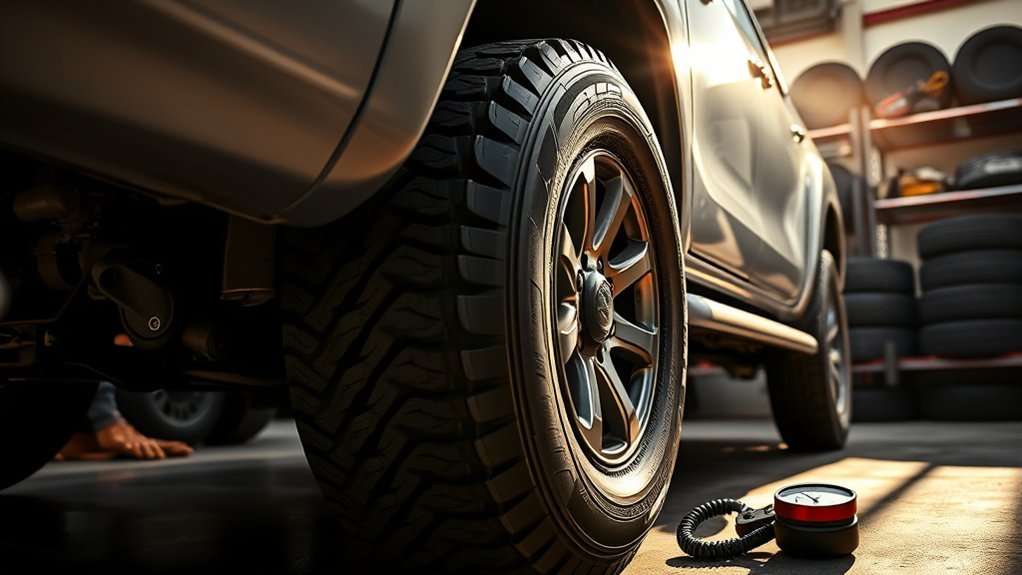
Check cold tyre pressure and visible condition at least once a month and before towing, carrying a heavy load, or starting a long trip. Inspect the tread and sidewalls for cuts, cracking, bulges, punctures, exposed cords, embedded objects, and uneven wear. Check the spare at the same time.
Rotate the tyres according to the owner’s manual and tyre manufacturer. Bridgestone gives a broad general interval of 5,000 to 8,000 miles or six months, while noting that pickups, 4WD vehicles, towing, heavy loads, and off-road use may require shorter intervals. Follow the pattern permitted for your tyre type, especially if the tyres are directional, staggered, or different front to rear. See Bridgestone’s tyre rotation guidance.
After off-road driving, remove packed mud and stones, inspect both sides of each wheel, and look for bead damage, sidewall cuts, bent rims, missing weights, loose hardware, and steering vibration. Have alignment and balance checked when wear becomes uneven, the steering pulls, or vibration appears.
Whenever a wheel has been removed, use the correct tightening sequence and the vehicle or wheel manufacturer’s specified torque. Recheck aftermarket wheel hardware when its manufacturer requires it. Do not use a generic torque figure because wheel material, nut design, and vehicle specification can differ.
For seasonal storage, clean and dry the tyres, keep them away from direct sunlight, ozone sources, fuel, oil, and standing water, and follow the tyre maker’s storage instructions. Mark each tyre’s position if you plan to rotate them when refitting.
Regional Variations in Wheel Fitment and Specs
Toyota sells the Hilux in many markets with different grades, payload requirements, emissions packages, brakes, suspensions, and wheel options. A size published for Australia, the UK, South Africa, Thailand, or the Middle East may not match a vehicle imported from another region.
Wheel Fitment Differences
Do not rely on a regional forum post or a wheel advertised only as “Hilux compatible.” Confirm the exact model code and build details. Special editions can also depart from the core range. For example, Toyota’s engineered Hilux AT35 uses 35-inch tyres with changes to the body, frame, bodywork, suspension, and ride height rather than treating the tyre as a simple bolt-on upgrade. See Toyota UK’s Hilux AT35 overview.
Region-Specific Tyre Options
Tyre construction, speed symbols, load indexes, seasonal markings, and legal requirements can vary by country. Match the local registration and inspection rules, and check whether changes affect tyre coverage, insurance, payload certification, speedometer compliance, or warranty. When the vehicle has been imported, use the VIN and original build information rather than assuming the local-market brochure applies.
Understanding Toyota Hilux Wheel Specifications
Wheel Bolt Patterns
The wheel’s stud count and pitch-circle diameter must match the hub exactly. Drive type alone is not enough to identify the correct pattern across every N80 configuration. Verify it through the VIN, the original wheel specification, a Toyota dealer, or direct measurement by a competent wheel shop. Never use wobble nuts, forced fitment, or redrilling as a shortcut for a mismatched pattern.
Centre Bore Measurements
The centre bore must clear and correctly locate on the hub. A wheel with a smaller bore will not seat. A properly specified hub-centric ring may be used with some approved aftermarket wheels that have a larger bore, but the ring does not increase load capacity or correct the wrong stud pattern, offset, or nut seat.
Offset and Backspacing Factors
Offset is the distance between the wheel’s mounting face and its centreline. More positive offset generally pulls the wheel inward, while a lower or negative offset pushes it outward. Either direction can create problems if taken too far. Check inner clearance to the upper control arm, tie rod, brake hose, caliper, and chassis, plus outer clearance to the fender, liner, mud flap, and body mount.
Backspacing is another way to describe the mounting face’s position relative to the wheel’s inner edge. It must be considered together with wheel width and offset. Do not use a universal backspacing range for the Hilux, because the correct value depends on the exact wheel width, brake package, suspension, tyre size, and body configuration.
Larger Tyres and Plus-Sizing
A larger tyre can improve ground clearance and off-road traction, but it also adds rotating mass and may change acceleration, braking, steering effort, fuel use, gearing, speedometer and odometer readings, electronic stability control behaviour, and driveline stress. The measured size can also vary between tyre models that share the same sidewall label.
| Nominal size | Calculated diameter | Change from 265/65R17 |
|---|---|---|
| 265/65R17 | About 776 mm or 30.6 inches | Baseline |
| 265/70R17 | About 803 mm or 31.6 inches | About 3.4% larger |
| 285/70R17 | About 831 mm or 32.7 inches | About 7.0% larger |
These are mathematical nominal dimensions, not guaranteed mounted measurements. A 3.4% circumference increase means the vehicle would theoretically travel about 103.4 km/h when the speedometer calculation based on the original tyre indicates 100 km/h, before accounting for the vehicle’s built-in speedometer tolerance. Recalibration and local compliance checks may be necessary.
[Products Worth Considering]

This universal wheel alignment tool helps you accurately restore tire tilt angles after tire or suspension repairs using an adjustable camber gauge. It features a powerful magnetic base that firmly attaches to brake rotors for stationary, slip-free readings, improving consistency during measurement. Built from durable PC plastic, it resists wear and corrosion and is compact enough for car, truck, RV, and motorcycle alignment tasks.

Secure a full-size spare on your trailer with this powder-coated steel spare tire mount bracket. It fits most 4-, 5-, and 6-lug wheel bolt patterns and mounts to trailer tongues up to 4 in wide and 5 in tall. Built for reliable carry with a max 150 lb load rating and includes zinc-plated hardware for straightforward installation.

Steelman white tire marking crayons provide high-contrast, semi-permanent marks for repairing and inspecting tires and equipment. They write on wet or dry, smooth or coarse surfaces including rubber, metal, glass, and wood, making them ideal for puncture location and damage outlining. The lead- and zinc-free crayons resist weather and fading yet wipe away when you no longer need the marks.
Will 265/70R17 Fit a Hilux?
It fits some N80 setups, but it is not a guaranteed bolt-on size for every Hilux. Compared with 265/65R17, it is about 26.5 mm larger in overall diameter and raises the axle by about 13 mm. Wheel width and offset, alignment, suspension height, body mounts, mud flaps, tyre model, and vehicle load determine whether it rubs. Test full lock in both directions and clearance through suspension compression.
Can You Fit 33-Inch Tyres on a Hilux?
Some modified N80 Hilux builds use tyres marketed as 33-inch, but the required work varies. A lift alone does not guarantee clearance. The setup may need carefully selected wheels, alignment changes, liner or mud-flap work, body-mount clearance, suspension changes, speedometer correction, spare-wheel planning, and legal engineering approval. Have the complete package assessed before buying parts.
Warning: Never cut, grind, space, or modify structural, steering, brake, or suspension parts without competent engineering advice. A tyre that contacts the body or suspension can be damaged suddenly during steering or suspension movement.
Frequently Asked Questions
What size tyres can I put on my Hilux?
Use the size on your tyre placard or an approved equivalent that preserves load capacity, brake and body clearance, acceptable circumference, and local compliance. Common eighth-generation examples include 215/65R16C, 225/70R17C, 265/65R17, and 265/60R18, but they do not apply to every model.
Can you fit 33-inch tyres on a Hilux?
Yes, some modified N80 Hilux setups use approximately 33-inch tyres, but fitment is not universal. Wheel width and offset, suspension, alignment, body clearance, tyre model, and legal requirements all matter. A lift kit by itself does not prove that the tyre is safe or rub-free.
Will 265/70R17 fit a Hilux?
It can fit some N80 configurations, but you must check clearance. It is about 3.4% larger in diameter than 265/65R17, so it may affect rubbing, speedometer accuracy, gearing, and legality. Confirm the exact tyre’s measured dimensions and test clearance under steering and suspension movement.
Can you fit 16-inch rims on an N80 Hilux?
Some N80 variants were supplied with 16-inch wheels, but that does not mean every 16-inch wheel clears every N80 brake package. Confirm stud pattern, centre bore, width, offset, load rating, nut seat, and caliper clearance for your exact VIN before installation.
What tyre pressure should a Toyota Hilux use?
Use the cold pressure listed on the vehicle’s tyre placard or in its owner’s manual. Pressure varies by tyre size, market, load, and construction. Do not use the maximum sidewall pressure as the normal setting, and do not assume one pressure range covers every Hilux.
Conclusion
The safest Hilux wheel and tyre setup starts with the exact vehicle, not a universal internet chart. Match the placard size and pressure, preserve the required load and speed capability, and confirm wheel pattern, centre bore, width, offset, hardware, and brake clearance. If you choose a larger tyre, check the whole system under steering, load, and suspension movement before driving.
Sources
- Toyota Australia: Eighth-generation HiLux specifications – supports example factory wheel and tyre sizes by configuration.
- Toyota UK: Tyre pressure and size guide – supports listed Hilux pressure examples and vehicle-specific verification.
- Toyota UK: All-New Hilux model page – supports the warning that current all-new models use a different specification set.
- NHTSA TireWise – supports placard use, cold-pressure checks, tread inspection, and monthly maintenance.
- Bridgestone: Tyre rotation guidance – supports rotation intervals and shorter service for pickups, loads, and off-road use.
- Toyota UK: Hilux AT35 Arctic Truck – illustrates that very large-tyre fitment can require integrated body, frame, suspension, and ride-height engineering.