
Rain can quickly reduce the grip, visibility, and stopping margin of your Toyota Camry. Safe wet-weather driving starts before you move: check cold tire pressure, inspect tread and damage, confirm that the wipers and lights work, and slow down when water begins collecting on the road.
Quick Answer
For safer Camry driving in rain, inflate each tire to the cold pressure shown on the driver’s-door label, inspect tread across the full width, replace tires at 2/32 inch at the latest, and consider replacement near 4/32 inch if you frequently drive in heavy rain. Slow down, leave extra space, avoid cruise control, and never enter floodwater.
Key Takeaways
- Use the pressure on your Camry’s tire-and-loading label, not the maximum pressure molded into the tire sidewall.
- A tire must be replaced by 2/32 inch of tread, but wet-road performance can decline well before that point.
- Reduce speed, increase following distance, avoid cruise control, and make every steering, braking, and throttle input smooth.
- Keep traction and stability control enabled during normal rainy driving, but do not treat them as substitutes for good tires.
- Turn around at a flooded road. Water depth, current, and road damage cannot be judged safely from the driver’s seat.
At a Glance
| Time Required | About 10 to 15 minutes for a basic pre-rain inspection |
| Difficulty | Easy |
| Tools Needed | Accurate tire-pressure gauge, tread-depth gauge or U.S. quarter, clean cloth, and washer fluid |
| Cost | No service cost for a home check; the cost of a pressure or tread gauge varies |
Preparing Your Toyota Camry for Rainy Conditions

Begin with the four tires because every braking, steering, and stability system depends on their contact with the road. Check pressure when the tires are cold, ideally before driving or after the car has been parked long enough for the tires to cool.
Use the pressure printed on the tire-and-loading information label inside the driver’s door area. The number molded into the tire sidewall is a tire limit, not the recommended operating pressure for your Camry. The National Highway Traffic Safety Administration also recommends using the vehicle label or owner’s manual for the correct size and pressure.
Inspect each tread groove at several points across the tire. Look for uneven wear, embedded objects, cuts, exposed cords, sidewall bulges, cracking, or a tire-pressure warning that returns after inflation. Any bulge, exposed cord, rapid air loss, or serious cut requires professional inspection before you continue driving.
Next, test the low-beam headlights, taillights, brake lights, and turn signals. Replace wiper blades that skip, chatter, smear, or leave broad streaks. Clean the inside and outside of the windshield, fill the washer reservoir, and confirm that the front and rear defogging systems work.
Pro Tip: Keep a pencil-style or digital pressure gauge in the glove box. Check all four tires at least monthly and before a long trip, but always compare the readings with the Camry’s own door-label specification.
[Products Worth Considering]

Monitor tire tread wear with a smart, color-coded depth gauge that shows clear condition ranges at a glance. The bar is range marked for fast, easy readings, helping you maintain safer traction and performance. Each gauge is portable with a pocket clip, and the set includes 20 units for daily use and sharing.

Measure tyre tread depth precisely with a digital gauge that reads in both MM and inches, helping you monitor safe driving conditions. The large LCD screen is easy to operate, and the compact tool fits for cars, trucks, and motorcycles. It provides high accuracy with a 0-25.4mm range and includes a 1-year warranty for added peace of mind.

The SAFELIFE dial tire tread depth gauge measures tread depth in 1/32 inch increments with clear, easy-to-read 2-inch dial face. Color zones using a traffic light system help you quickly judge whether tread is low, marginal, or ample for safer driving. Built with a durable zinc cast body and a metal detect probe for precise, comfortable use across cars, motorcycles, trucks, and buses.
How to Understand and Prevent Hydroplaning
Hydroplaning occurs when a tire cannot move water away quickly enough and begins riding on a film of water instead of maintaining full contact with the pavement. Speed, water depth, tread depth, tire pressure, road surface, and tire design all affect the risk.
You cannot rely on one universal “hydroplaning speed.” Even a good tire can lose grip when speed is too high for the amount of water on the road. Your safest response is to slow down before standing water, avoid abrupt inputs, and leave enough room to make gentle corrections.
- Reduce speed early: Lift off the accelerator gradually before reaching pooled water, deep ruts, or a heavy downpour.
- Keep both hands ready: Hold the wheel steadily and avoid sharp steering changes.
- Increase following distance: Give yourself more space because wet grip and visibility can change without warning.
- Turn off cruise control: Keep direct control of the accelerator so you can reduce speed immediately if traction changes.
- Avoid standing water: Change lanes only when it is safe, and never drive into a flooded roadway.
What to Do If Your Camry Hydroplanes
If steering suddenly feels light or the car stops responding normally, remain calm. Ease off the accelerator, look and steer gently where you want the vehicle to go, and avoid forceful braking or sudden steering corrections.
Wait for the tires to regain contact before making stronger inputs. If the vehicle has started to rotate, make small steering corrections toward your intended path rather than jerking the wheel. Once traction returns, reduce speed and pull over safely if the tires, alignment, or road conditions need attention.
Warning: Never assume shallow-looking floodwater is safe. The National Weather Service advises drivers to turn around because water can hide a washed-out road, and moving water can carry a vehicle away.
What Tire Features Are Crucial for Rainy Conditions?
Choose tires in the exact size, load rating, and speed rating approved for your Camry model and wheel package. Fitment can vary by model year and trim, so confirm the driver’s-door label and owner’s manual before buying.
[Products Worth Considering]

Measure tire tread depth quickly and accurately with this LUMITECO dial gauge that reads in 1/32" increments up to 14/32". The color-coded green/yellow/red zones make it easy to judge tire wear and know when replacement is needed. A rugged, compact design with a protective pouch helps keep the gauge ready for use on cars, trucks, motorcycles, and more.

Upgrade your Toyota tire setup with these corrosion-resistant, leak-proof valve stem caps designed to help protect the valve core from water, snow, and road grime. The caps feature a snug rubber seal and durable copper alloy construction to resist rust and oxidation while maintaining stable tire pressure. Ideal for replacing worn original caps and keeping your wheels looking clean and stylish.

Milton S-921 pencil tire pressure gauge helps you maintain optimal tire pressure for passenger cars with accurate readings in PSI and kPa. It features a built-in deflator valve for convenient pressure adjustments, plus a single chuck head and nylon indicator bar for easy use on the go. Built from durable plated brass and designed for reliable performance, it’s a practical road trip and cold-weather maintenance tool.
Tread Pattern and Water Evacuation
Wide circumferential grooves, lateral channels, and well-designed sipes can help move water away from the contact patch. However, appearance alone does not prove that one tire will stop or handle better than another. Compare reputable wet-braking and wet-handling test results for the exact tire model and size.
Tread Depth for Wet Weather
The minimum replacement threshold for a passenger tire is 2/32 inch. At that depth, the treadwear bars become level with the surrounding tread, and the tire must be replaced.
For frequent heavy-rain driving, 4/32 inch is a sensible point to begin replacement planning. In a controlled AAA wet-road test, passenger-car tires worn to 4/32 inch had substantially longer stops and reduced handling compared with new tires. That result does not mean every tire loses the same amount of performance, but it shows why the minimum threshold should not be treated as an ideal wet-weather target.
AAA’s controlled test found that passenger-car tires worn to 4/32 inch required an average of 87 additional feet to stop from 60 mph on wet pavement compared with new tires.
Understanding UTQG Traction Grades
The UTQG traction grade, shown as AA, A, B, or C, measures straight-line wet braking performance under a specific government test. A higher grade can help with comparison, but it does not rate cornering, hydroplaning resistance, ride quality, snow traction, or performance after years of wear.
Do not choose a tire from the UTQG grade alone. Review independent tests, warranty terms, climate needs, noise, tread life, and the tire maker’s intended use. A quality all-season tire is often the practical choice for a daily-driven Camry, while a summer tire may provide stronger warm-weather wet and dry performance but is unsuitable in freezing temperatures.
Essential Tire Maintenance Tips for Rainy Weather
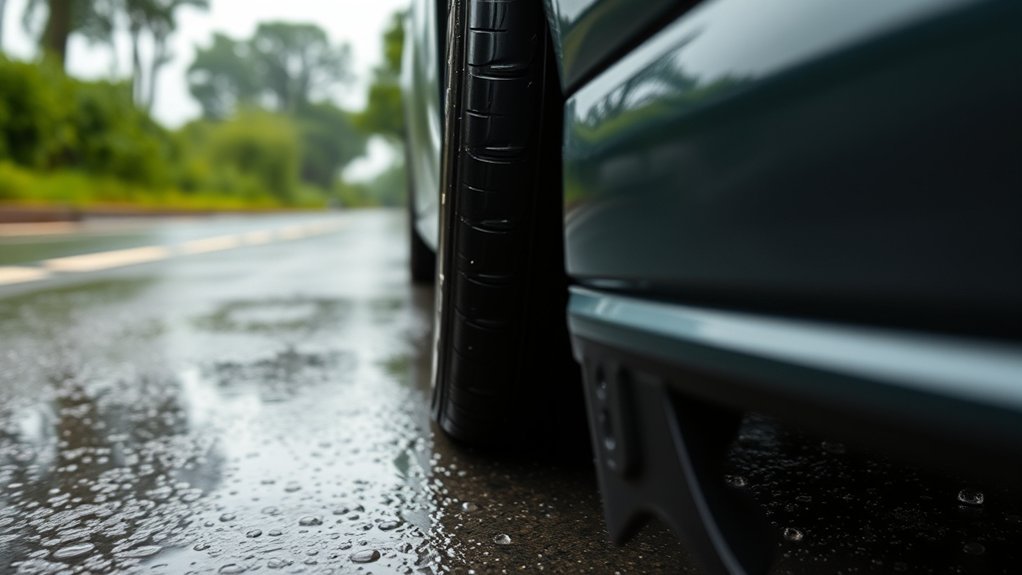
Wet-weather tire safety depends more on consistent maintenance than on a last-minute check during a storm. Use the following routine to catch pressure loss, worn tread, and alignment problems before they reduce grip.
[Products Worth Considering]

The Big Rig Defense Tire Thumper is a truck tire pressure checker that lets you quickly check multiple tires by giving them a firm whack. Listen for a reassuring thump and feel the stick bounce when a tire is fully inflated, helping you get back on the road safely. It features a comfortable, glove-friendly handle and a secure wrist strap for confident use on busy routes.

The Milton S-693 straight foot dual head air chuck is designed for accurate tire pressure checks and quick, secure valve-core engagement with lock-on threads on both ends. With a 1/4" FNPT connection and a maximum 150 PSI rating, it’s built for use on inner duals and common vehicle tires, including trucks and RVs.

Accurately measure tire tread depth with a calibrated gauge marked from 0 to 1 inch in 1/32 inch increments. The color-coded bar helps you quickly identify tread condition ranges, supporting safe driving for trucks, motorcycles, automobiles, and passenger vehicles.
Tire Inflation Checks
- Check all four tires when cold at least once a month and before long drives.
- Compare every reading with the cold pressure on the Camry’s tire-and-loading label.
- Add or release air as needed, then reinstall each valve cap.
- Do not reduce pressure from a warm tire simply because the reading is higher after driving.
- Have a tire inspected if it repeatedly loses pressure or the warning light returns.
Temperature changes can alter tire pressure, so a warning may appear after a cold night even when no puncture is visible. Recheck with a reliable gauge rather than relying only on appearance or the dashboard warning.
Tread Depth Importance
Measure tread in the inner, center, and outer grooves because one edge can wear faster than the rest. A tread-depth gauge gives the clearest reading. You can also insert a U.S. quarter with Washington’s head down; if the top of the head remains fully visible, the tread is near 4/32 inch and wet-weather replacement planning should begin.
The penny test checks the 2/32-inch replacement limit. Insert a penny with Lincoln’s head down. If the top of the head is visible, the tire is at or below the minimum and should be replaced.
Note: Tread depth is only one part of tire condition. Replace or professionally inspect a tire with a bulge, exposed cord, serious cracking, impact damage, or an unrepairable puncture even when the tread appears deep.
Tire Rotation Recommendations
Rotate tires according to the schedule and pattern in the maintenance guide for your exact Camry year, drivetrain, and tire setup. A fixed interval does not fit every Camry, especially when front and rear tire sizes differ or when directional tires are installed.
Ask the technician to record tread depth at all four corners. A clear record makes it easier to spot rapid inner-edge wear, front-to-rear imbalance, or a tire that is not wearing normally.
Alignment, Balance, and Suspension
Have the alignment and suspension checked if the Camry pulls, the steering wheel sits off-center, one edge wears faster, or the tread develops cupping. Balance should be checked when vibration appears at road speed or after a wheel or tire is repaired.
Correcting the cause early protects the usable tread and helps all four tires respond more evenly in rain. Rotation alone cannot repair wear caused by incorrect alignment, a damaged component, or chronic underinflation.
Driving Safely in Rain: Techniques and Best Practices
Good tires increase your margin, but your driving choices determine how much of that margin remains. Slow down before visibility or grip becomes poor, and avoid trying to maintain dry-road speeds in a downpour.
Essential Visibility Tips
- Use low-beam headlights: They help you see and make the Camry easier for other drivers to notice.
- Keep glass clear: Use the defogger or air conditioning to control interior condensation.
- Replace weak wipers: Blades should clear the windshield without broad streaks or missed areas.
- Avoid high beams in heavy rain: Reflected light can increase glare and reduce useful visibility.
- Pull over safely when needed: If you cannot clearly see lane markings or nearby traffic, leave the travel lane and stop at a safe location.
Speed, Spacing, and Smooth Control
Reduce speed and increase following distance based on rainfall, traffic, tire condition, and visibility. Do not use one fixed percentage or distance for every storm because conditions can change from one section of road to the next.
Brake earlier and more gradually than you would on a dry road. Complete most of your braking before a turn, steer smoothly through it, and accelerate gently after the car is straight. Avoid abrupt lane changes and do not follow large vehicles so closely that their spray blocks your view.
Traction Control and Stability Control
Leave the Camry’s traction control and vehicle stability control enabled during normal rainy driving. Toyota describes these systems as aids that help with acceleration, steering, and braking in slippery conditions, but they cannot create grip that worn or damaged tires do not have.
Do not switch the systems off simply because it is raining. Only change these settings when the owner’s manual for your exact Camry instructs you to do so for a specific recovery situation.
Driving Through Puddles and Floodwater
Avoid deep puddles when you can do so without a sudden maneuver. Water can pull at one side of the car, hide potholes, damage wheels, or reach components that were not designed for immersion.
After passing through an unavoidable shallow puddle at low speed, lightly test the brakes when it is safe. If braking feels uneven, weak, or delayed, slow down, increase space, and stop safely for inspection.
Never drive onto a flooded road or around a barricade. The National Weather Service warns that the depth and condition of the road cannot be judged by looking, and moving water can float or sweep away a vehicle.
When to Get Professional Help for Your Tires
Arrange prompt tire or vehicle inspection when you notice any of the following:
- Pressure loss that keeps returning: A puncture, valve leak, wheel damage, or bead leak may be present.
- Bulges, exposed cords, deep cuts, or impact damage: These can indicate structural damage and should not be ignored.
- Uneven or rapid tread wear: Alignment, inflation, balance, or suspension problems may be responsible.
- Vibration, pulling, or an off-center steering wheel: A tire, wheel, alignment, or suspension fault needs diagnosis.
- Repeated hydroplaning at reasonable speeds: The tires may have insufficient tread or poor wet performance for the conditions.
- Spongy, noisy, or unresponsive brakes: Treat this as a brake-system concern and have the vehicle assessed immediately.
Do not continue driving on a tire that is visibly deformed, rapidly losing air, or showing cord material. Move to a safe location and use roadside assistance or the vehicle’s approved spare-tire procedure.
Frequently Asked Questions
What’s the Most Common Problem With a Toyota Camry?
No single problem applies to every Camry generation. Oil-consumption, transmission, brake, electrical, and suspension concerns vary by model year and powertrain. Check your exact year for recalls and service information. For rainy-weather safety, focus on current tire condition, brake response, wipers, lights, and warning indicators rather than assuming one model-wide fault.
How Many Inches of Rain Is Safe to Drive Through?
No visible depth of floodwater should be treated as safe. Water can be deeper than it appears, flow faster than expected, or hide a washed-out road. Turn around rather than entering a flooded roadway. A normal shallow puddle is different, but you should still slow down, avoid abrupt steering, and test the brakes gently afterward when safe.
Should I Use Traction Control When It Rains?
Yes. Leave traction control and vehicle stability control on during normal rainy driving. They can reduce wheelspin and help the car follow your intended path, but they cannot overcome excessive speed, deep water, worn tread, or incorrect tire pressure.
Is 2/32 Inch of Tread Enough for Heavy Rain?
Two thirty-seconds of an inch is the replacement limit, not an ideal wet-weather target. If you regularly drive in heavy rain, begin evaluating replacement around 4/32 inch because water evacuation and wet stopping can decline as tread wears.
Should I Use Cruise Control in the Rain?
Avoid cruise control on wet or slippery roads. Keeping direct control of the accelerator lets you ease off immediately when water, traffic, or traction changes. Follow the restrictions in your Camry owner’s manual for conventional or radar cruise control.
What Tire Pressure Should I Use for a Toyota Camry in Rain?
Use the same manufacturer-specified cold pressure shown on the tire-and-loading label inside the driver’s door area. Do not add extra pressure for rain and do not use the maximum sidewall number as the vehicle setting. Check the exact label because pressure can vary by model year, trim, tire size, and load.
Conclusion
Your Toyota Camry is safest in rain when tire condition and driving technique work together. Keep cold pressure at the door-label specification, monitor tread across every groove, address damage or uneven wear promptly, and begin planning for wet-weather replacement before the tires reach the 2/32-inch limit.
On the road, slow down, leave more space, keep traction and stability control enabled, and avoid cruise control, sudden inputs, standing water, and flooded roads. If visibility, braking, or steering becomes uncertain, reduce speed and stop at a safe location rather than pushing through the storm.
Sources
- NHTSA TireWise: Tires – tire pressure labels, treadwear indicators, replacement at 2/32 inch, and UTQG traction grades
- AAA: Tread Lightly, Worn Tires Put Drivers at Risk – controlled wet-road testing at 4/32 inch and rainy-driving precautions
- AAA Wet Weather Driving Tips – monthly cold-pressure checks, visibility, cruise-control guidance, spacing, and skid response
- National Weather Service: Turn Around, Don’t Drown – floodwater and flooded-road safety
- Toyota Camry Safety Hub – Toyota stability, traction, braking, and slippery-condition support systems