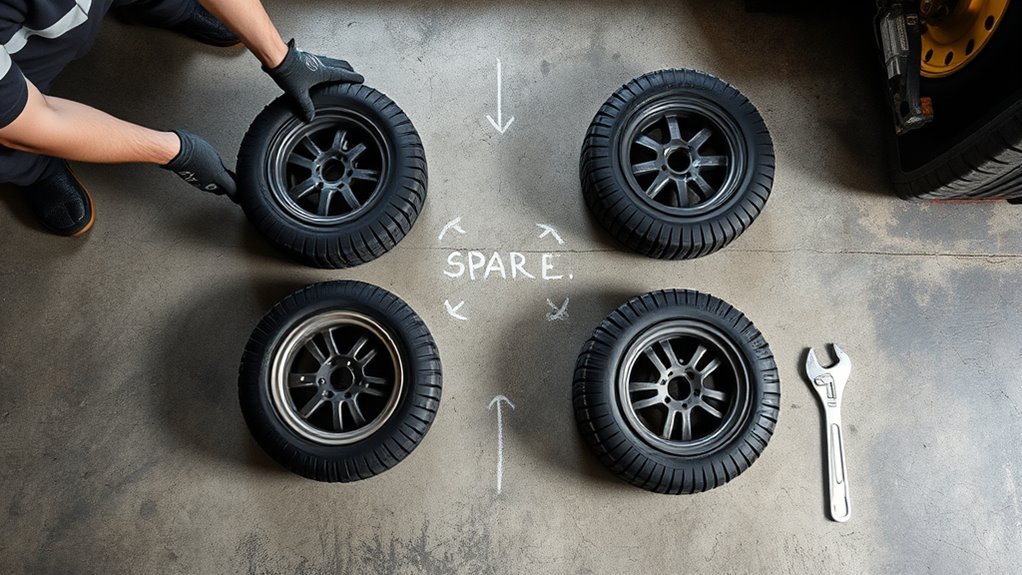
If your vehicle carries a full-size matching spare, rotating five tires can help spread tread wear and keep the spare useful before it ages out. The choice is not automatic, though. You need the right spare, the right wheel setup, and a rotation pattern your owner’s manual allows.
Quick Answer
Rotate your spare tire only if it is a full-size matching tire approved for regular road use. It works best when all five tires are the same size, type, load rating, speed rating, wheel fitment, and similar tread depth. Never rotate a compact donut spare, an old damaged spare, or a mismatched spare.
Key Takeaways
- A 5-tire rotation only works with a full-size spare that matches the four road tires.
- AWD, 4WD, SUV, truck, and off-road setups often benefit most from keeping tire diameter similar.
- Compact temporary spares are emergency-use tires and should never enter a normal rotation.
- Check pressure, tread depth, age, damage, wheel fitment, and TPMS compatibility before using the spare.
- A 5-tire plan may save money only when the service cost, tire age, alignment, and tread wear all work in your favor.
At a Glance
| Time Required | About 20 to 45 minutes at a shop; longer for DIY work if the spare is underbody-mounted or rear-mounted |
| Difficulty | Easy for a tire shop; moderate for DIY because you must lift the vehicle safely and track five positions |
| Tools Needed | Owner’s manual, tire pressure gauge, tread-depth gauge, torque wrench, jack stands, wheel chocks, and correct lug tools |
| Cost | Often included with some tire packages; otherwise pricing varies by shop, vehicle, TPMS needs, and spare access |
Should You Rotate Your Spare Tire?

You should rotate your spare tire only when it is a full-size spare that matches the tires already on the vehicle. That means the same size, similar tread design, correct load rating, correct speed rating, compatible wheel, and safe condition.
This approach spreads mileage across five tires instead of four. When done correctly, it can help reduce uneven wear, keep the spare closer in tread depth to the road tires, and make the spare more useful during a flat-tire emergency.
The benefit matters most if you drive an AWD or 4WD vehicle. These vehicles can be more sensitive to tire diameter differences, especially when one tire has much more or much less tread than the others. A matching full-size spare helps avoid a sudden mismatch when you need to replace a flat on the road.
Warning: Do not include a compact temporary spare, donut spare, old spare, cracked spare, or different-size spare in a normal tire rotation. Use temporary spares only as your owner’s manual and the spare tire sidewall allow.
How a 5-Tire Rotation Works
A 5-tire rotation means one road tire becomes the spare at each service, while the spare moves onto the vehicle. Over time, all five tires share road mileage instead of leaving one tire unused for years.
The right pattern depends on your drivetrain and tire design. For many non-directional tire sets, shops use a five-tire pattern based on a forward-cross or rearward-cross rotation. The spare normally enters one rear position, and one road tire moves back to the spare location.
Directional tires can only roll in one direction unless they are dismounted and remounted, so they usually move front-to-rear on the same side. Staggered setups with different front and rear tire sizes may not be rotatable at all. Always follow your owner’s manual first because vehicle makers can set special rules for AWD systems, TPMS sensors, and wheel positions.
Note: The best time to start a 5-tire rotation is when all five tires are new or similarly worn. Adding a new spare to four worn tires can create the same mismatch you are trying to avoid.
[Products Worth Considering]

This TPMS sensor training and relearn reset tool is customized for Ford, Lincoln, and Mercury vehicles to help activate tire pressure programming after sensor replacement or tire rotation. It can activate individual tire pressure sensors with one-button operation, helping prevent TPMS warning light illumination. It is not a sensor programming tool and cannot program replacement sensors—use it to trigger/activate sensors only.

The VEHLIVE SU-50448 II TPMS relearn tool provides a fast activation reset to restore accurate tire pressure monitoring after sensor replacement or tire rotation. It supports 315 MHz and 433 MHz GM series sensors and helps clear dashboard pressure warnings. With simple two-button operation and horn-confirmed relearning order, you can reprogram sensors conveniently at home.
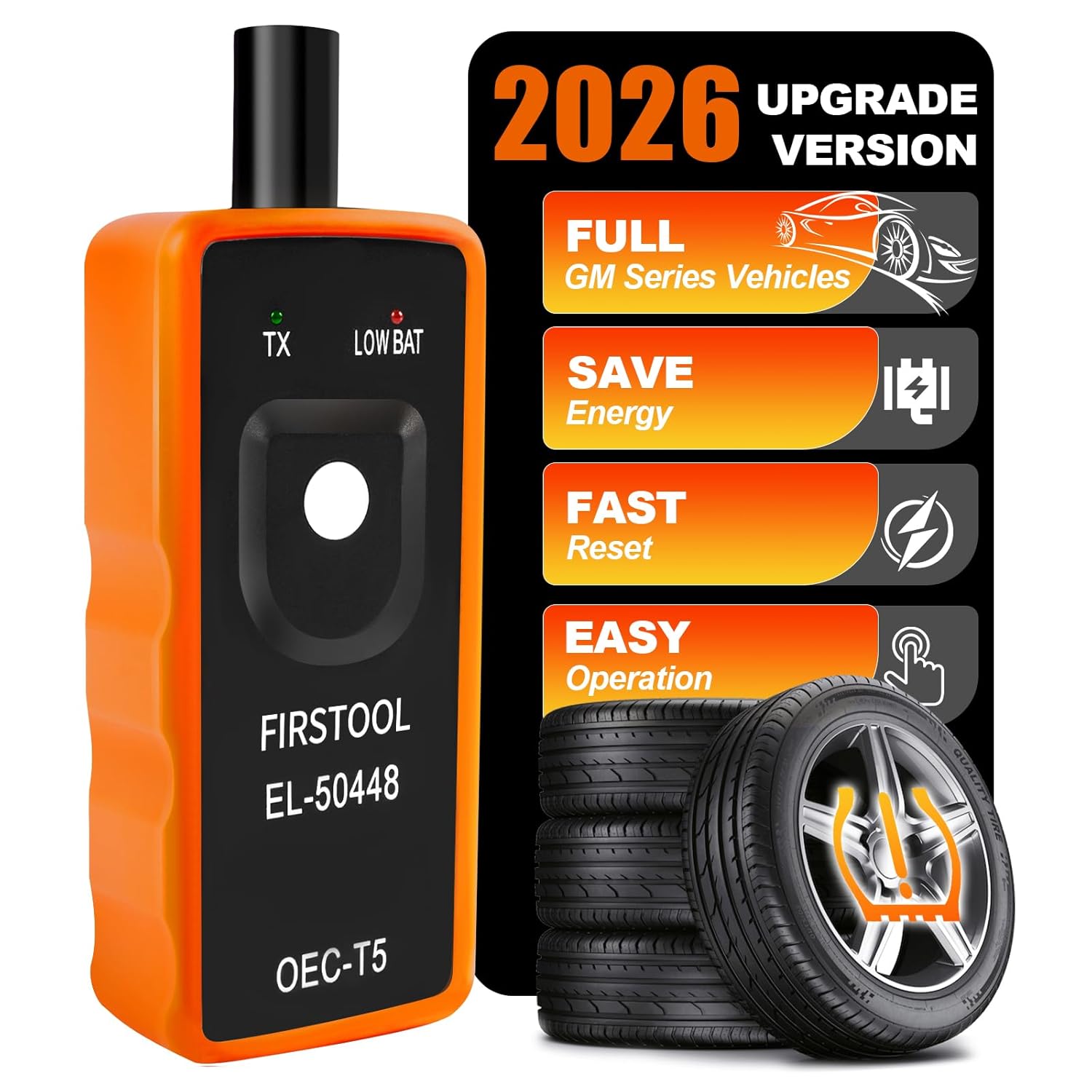
This TPMS relearn tool helps you quickly activate, match, and reset GM tire pressure sensors to keep the vehicle monitoring system working properly. It clears tire pressure alarms and dashboard warning lights after sensor replacement or tire rotation, and supports learning for common 315/433 MHz TPMS sensors. Designed for simple one-button operation, it can help you avoid unnecessary trips to repair shops.
When a 5-Tire Rotation Makes Sense
A 5-tire rotation makes sense when the spare is a real fifth tire, not just an emergency backup. You are a good candidate if your SUV, truck, Jeep, or off-road vehicle came with a full-size spare that matches the tire set.
You may also benefit if you travel far from tire shops, drive on rough roads, tow, camp, or use trails where a flat tire can leave you waiting for help. In those cases, a healthy, road-ready spare gives you more than convenience. It gives you a safer backup.
Five-tire rotation may also help when you buy higher-cost tires and plan to keep the vehicle long enough to use the full set. The savings are not guaranteed. They depend on tire price, rotation cost, tire age, alignment, inflation, and whether the spare stays close enough in wear to remain useful.
When You Should Not Rotate the Spare
Skip the 5-tire rotation if your spare does not match the four road tires. A compact spare, temporary spare, or smaller emergency wheel should stay out of the regular rotation pattern.
You should also skip it if your vehicle has staggered tire sizes, directional tires that cannot move to every position, different front and rear wheel sizes, or a spare mounted on a different wheel that does not match the road wheels. Some vehicles also need TPMS sensor relearning after rotations, so ask your shop before the service.
Do not rotate a spare that is too old, dry-rotted, damaged, underinflated, or worn far differently from the other tires. NHTSA explains that tire aging can affect tires over time, and some vehicle and tire manufacturers recommend replacement after six to 10 years regardless of treadwear.
A full-size spare should not become a cheap replacement for a set of worn tires. NHTSA notes that spare tires age because they are seldom replaced, and a full-size spare should not be used as a replacement for worn tires except in an emergency such as a flat.
Note: A full-size spare can still be unsafe if it is old, cracked, incorrectly inflated, recalled, or no longer close to the rest of the tire set in tread depth and condition.
Which Saves More Money: 4-Tire or 5-Tire Rotation?
A 5-tire rotation can save money in the right setup, but it does not always cost less. The basic idea is simple: five tires sharing the work may last longer as a group than four tires carrying all the mileage while the spare sits unused.
The real savings depend on your tire price, rotation cost, driving mileage, alignment, inflation habits, and whether the spare stays close enough in wear to remain useful. A shop may charge more because it must remove, inspect, inflate, and reinstall the spare. That extra cost can be worth it on AWD, 4WD, SUV, and light-truck setups with a matching full-size spare.
For a standard two-wheel-drive commuter car with a compact spare, the 5-tire approach usually does not apply. You are better off rotating the four road tires on schedule, checking the spare monthly, and replacing the spare when age or damage makes it unsafe.
NHTSA reported 511 motor vehicle traffic fatalities in tire-related crashes in 2024, so spare tire decisions should start with safety rather than savings.
What Are the Real Downsides of 5-Tire Rotation?
The main downside is complexity. A 5-tire pattern takes more tracking than a normal 4-tire rotation because one tire leaves the road and becomes the spare at each service.
- Higher setup cost: You need five matching tires, not four. That can raise the first replacement cost.
- More service time: Rear-mounted and underbody spares can take extra time to remove and reinstall.
- More chances for mistakes: The wrong pattern can create uneven wear instead of fixing it.
- TPMS issues: Some vehicles may need sensor relearning after tire positions change.
- Replacement complications: If one tire gets damaged beyond repair, matching the remaining tread depth can be harder.
These drawbacks do not make five-tire rotation a bad idea. They simply mean you should use it only when the spare truly belongs in the set.
When Does 5-Tire Rotation Actually Make Sense?
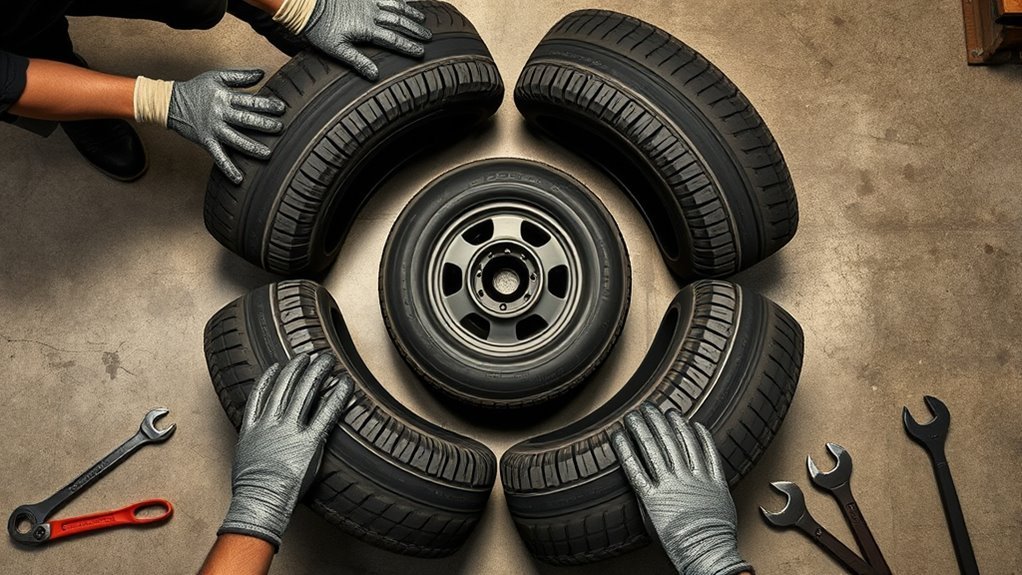
Five-tire rotation makes the most sense when your vehicle manufacturer allows it and your spare is identical or very close to the four road tires. Always start with the owner’s manual because some vehicles have special rotation rules.
It can be especially useful for AWD and 4WD vehicles, off-road vehicles, and trucks that carry a full-size spare outside the cabin. In those cases, the spare may already be exposed to weather and age, so keeping it inspected and rotated can make better use of the tire before it gets too old.
You should also consider it if your spare is mounted on the same wheel style and has a TPMS sensor that can work in normal service. If the spare wheel is plain steel, lacks a sensor, or does not match the road wheels, ask a tire professional before including it.
What to Check Before Rotating Your Spare
Before you ask for a 5-tire rotation, inspect the spare the same way you inspect the tires already on the vehicle. NHTSA recommends checking tire pressure at least once a month, including the spare, when tires are cold.
- Size: The spare should match the tire size listed on your tire placard or owner’s manual.
- Type: The spare should match the road tires closely in category, tread design, and intended use.
- Load and speed rating: The spare must meet the vehicle’s requirements.
- Tread depth: Replace unsafe tires when tread reaches 2/32 inch. For wet or winter driving, do not wait until the legal minimum if traction feels poor.
- Age: Check the DOT Tire Identification Number. The last four digits show the week and year the tire was made, and the full TIN may appear on only one side.
- Condition: Look for cracks, bulges, cuts, punctures, uneven wear, and sidewall damage.
- Pressure: Inflate the spare to the pressure listed for your vehicle, not the maximum pressure molded on the tire sidewall.
- Recall status: Use the DOT Tire Identification Number to check whether the tire is affected by a safety recall.
- TPMS compatibility: Confirm whether the spare has a sensor and whether your vehicle needs relearning after rotation.
Pro Tip: Write the tire positions on a small note in your glove box after each rotation. It helps you and your shop keep the five-tire pattern consistent next time.
How Often Should You Rotate Tires With a Spare?
Use the interval in your owner’s manual first. If your manual allows rotation but does not give a special five-tire interval, many vehicles follow the same mileage range used for normal tire rotation.
NHTSA says that, if recommended by the vehicle manufacturer, tires should be rotated every 5,000 to 8,000 miles or sooner if uneven wear appears. You can also pair rotation with oil changes if that schedule fits your vehicle.
Shorten the interval if you tow, carry heavy loads, drive gravel roads, run all-terrain tires, or notice one axle wearing faster than the other. Fix alignment, suspension, or inflation problems before relying on rotation to even out wear.
How to Choose Based on Your Vehicle and Driving Habits
Your tire maintenance strategy should match how you drive. Start with your drivetrain, then look at the spare, the tire setup, and the conditions you face most often.
- Check your drivetrain: AWD and 4WD vehicles often benefit most from similar tread depth across all tire positions.
- Confirm the spare type: Use five-tire rotation only with a full-size matching spare.
- Review the manual: Follow the vehicle maker’s rotation pattern, especially with directional tires, staggered wheels, or TPMS sensors.
- Inspect wear patterns: Uneven tread can point to inflation, alignment, suspension, or rotation issues.
- Think about your driving: Long trips, rough roads, towing, and off-road driving make a road-ready spare more valuable.
When you visit a shop, ask for a five-tire rotation by name. Also ask the technician to check the spare’s pressure, tread depth, age, condition, recall status, and TPMS compatibility before installing it on the vehicle.
[Products Worth Considering]

Replace worn or missing TPMS sensors with a pre-programmed 4-pack designed for compatible GM vehicles. These 315MHz sensors provide real-time tire pressure monitoring and alert you if pressure is too high, too low, or if a rapid air leak occurs. Most installations are ready with minimal relearn effort after mounting, helping improve safety and driving confidence.

Masoll Gen 2 external TPMS sensors are a DIY replacement set of 4 for select GM vehicles made after 2006, helping you shut off the TPMS warning light quickly. Simply screw the sensors onto the tire valves and sync to your car ECU using the included EL-50448 relearn tool. Dual-frequency 315/433 MHz design provides OEM-level performance with accurate readings and replaceable batteries for about two years.

This tire inflator with pressure gauge delivers long-lasting performance with a durable rubber-protected gauge and sturdy build. The longer hose and 360 swivel air chuck help you seal the valve securely and keep your hands free while measuring, inflating, or deflating. It’s battery-free for reliable use and provides ±2 PSI accuracy in the mid-range for most typical tires, with universal compatibility for 1/4 NPT compressor outputs.
Shop Checklist for a 5-Tire Rotation
Before the spare touches the road, ask the shop to confirm these items. This quick check can prevent a mismatched tire from creating noise, warning lights, poor handling, or drivetrain strain.
- All five tires match the approved size and load rating for the vehicle.
- The spare is not older than the service-life guidance from your vehicle or tire maker.
- The spare has safe tread depth and no cracking, bulging, punctures, or sidewall damage.
- The wheel fits the hub, brake clearance, lug hardware, and offset requirements.
- The TPMS sensor works or the vehicle can relearn the new wheel positions.
- The shop torques lug nuts to the vehicle maker’s specification.
- The removed road tire is secured properly in the spare location.
[Products Worth Considering]

These M14x1.5 closed-end chrome lug nuts are a one-piece replacement designed for secure fitment on compatible GM, Ford, and select Chrysler/Dodge models. Featuring a 60-degree conical seat and anti-rust chrome plating, they help resist corrosion and maintain a bright look for everyday driving. Built for long-term durability, they include OEM-style part references and are backed by 12 months of support.

Autel MX TPMS sensors combine 315MHz and 433MHz in a single easy-to-install press-in design for faster tire service. They support wireless programming with strong signal performance, and the sensors are clone-able for streamlined replacement. Built for reliability and tested to SAE standards, each sensor includes a series number for quality control.

Vigorder rubber cement glue delivers superior adhesion and cures quickly within about 30 seconds for seamless rubber bonding. Once cured, it helps provide a strong, durable, waterproof seal that holds up to vehicle weight, pressure, and heat. Suitable for cars, motorcycles, trucks, bicycles, and off-road tires, it’s designed for emergency patch and maintenance repairs.
Frequently Asked Questions
How much should I pay for a tire rotation?
Tire rotation pricing varies by shop, region, vehicle, and whether you bought a service plan with your tires. Some tire shops include rotation with a tire purchase, while others charge a service fee. A five-tire rotation may cost more because the shop must remove, inspect, inflate, and reinstall the spare.
What is the 50/50 rule for spare tires?
The 50/50 rule usually refers to compact temporary spares that limit speed to about 50 mph and distance to short emergency use. Do not treat it as a universal rule. Your owner’s manual and the markings on the spare tire sidewall give the actual speed, distance, pressure, and placement limits for your vehicle.
How often should I rotate tires with a spare?
Follow your owner’s manual first. If your vehicle allows five-tire rotation, a common interval is every 5,000 to 8,000 miles when recommended by the manufacturer, or sooner if uneven wear appears. Check pressure, tread depth, damage, age, and TPMS status at the same time.
Can I rotate a donut spare with my regular tires?
No. A donut spare is smaller and designed for temporary emergency use. Keep it inflated, inspect it, and replace it when it ages or shows damage, but do not include it in normal tire rotation.
Should I rotate the spare on an AWD vehicle?
You should consider it if the spare is full-size, matching, safe, similarly worn, and approved by your owner’s manual. AWD vehicles can be sensitive to tire diameter differences, so a matching full-size spare is more useful than a worn road tire paired with a much newer spare during an emergency.
Can a full-size spare be too different to rotate?
Yes. A full-size spare can still be wrong for rotation if it has a different size, different load rating, different speed rating, different tread pattern, old rubber, uneven wear, wheel mismatch, or no compatible TPMS sensor. Full-size does not automatically mean interchangeable.
Do I need a TPMS relearn after rotating the spare?
Maybe. Some vehicles relearn tire positions automatically, while others need a scan tool, manual relearn process, or shop service. If the spare has no TPMS sensor, installing it as a road wheel may trigger a warning light.
Conclusion
A 5-tire rotation is worth considering when your vehicle has a full-size matching spare and your owner’s manual allows it. It can help spread wear, keep the spare road-ready, and reduce mismatch problems during a flat-tire emergency.
Skip it if your spare is compact, mismatched, damaged, too old, recalled, or not approved for regular road use. In that case, rotate the four road tires on schedule and treat the spare as emergency equipment that still needs monthly pressure checks and regular inspection.
Sources
- NHTSA TireWise — tire pressure checks, tread depth, rotation intervals, tire aging, spare tire awareness, TPMS basics, and tire-related crash context
- NHTSA Recalls — vehicle, tire, and equipment recall lookup resources
- NHTSA Tire Buyers’ FAQ — tire size, DOT Tire Identification Number, tire rating, and tire label guidance
- NHTSA Congratulations on Your New Tire Purchase — tire manufacture date, monthly pressure checks, owner’s manual rotation interval, and tire recall alerts