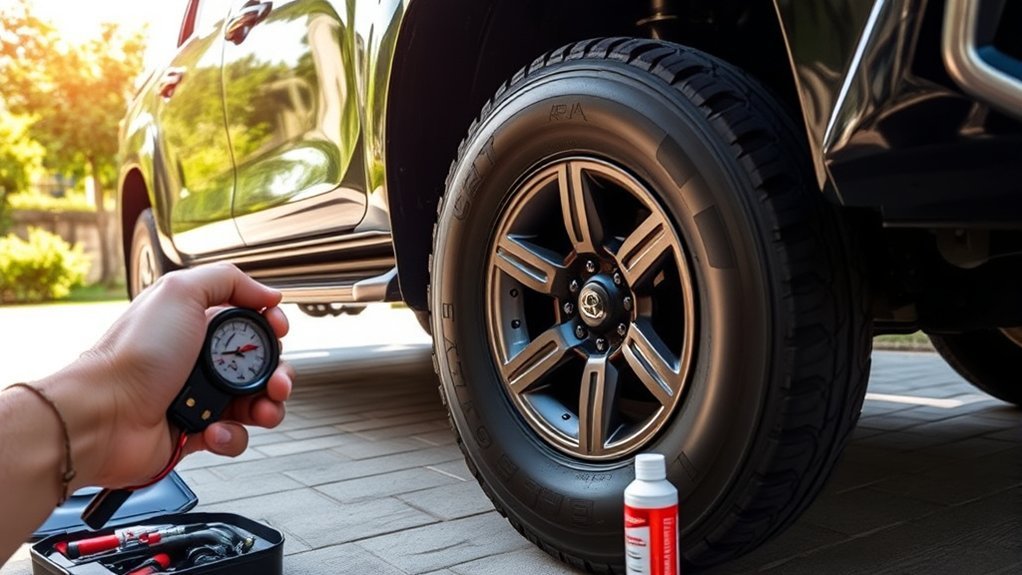
Your Toyota Hilux depends on its tires for braking, steering, towing stability, off-road grip, and everyday comfort. Good tire care is not just about making the tires last longer. It helps prevent uneven wear, poor fuel economy, vibration, loss of traction, and blowouts. Start with cold tire pressure, tread depth, visible damage, rotation, alignment, and the right tire type for how you actually use your truck.
Quick Answer
To care for Toyota Hilux tires, check cold tire pressure monthly, inspect tread and sidewalls, rotate tires on the schedule in your owner’s manual, keep alignment and balance in check, and choose tires with the right size, load rating, and tread pattern for highway, towing, winter, or off-road use.
Key Takeaways
- Use the tire pressure on your Hilux door placard or owner’s manual, not the maximum pressure printed on the tire sidewall.
- Check tire pressure and tread at least once a month, including the spare if your Hilux carries one.
- Rotate tires according to Toyota’s schedule and the correct pattern for your tire type, drivetrain, and spare setup.
- Replace tires with unsafe tread depth, bulges, cracks, exposed cords, or repeated air loss.
- For towing, payload, gravel, mud, or winter driving, choose tires with the right load rating and tread design.
At a Glance
| Time Required | 10 to 15 minutes for a monthly check; longer if rotating tires |
| Difficulty | Easy for pressure and tread checks; moderate for DIY rotation |
| Tools Needed | Accurate tire pressure gauge, tread-depth gauge or penny, flashlight, gloves, air compressor, and for rotation: jack, jack stands, wheel chocks, and torque wrench |
| Cost | Free if you already own the tools; about $10 to $30 for a quality pressure gauge; professional rotation, balancing, or alignment varies by shop |
The National Highway Traffic Safety Administration reports that poor tire maintenance can lead to flats, blowouts, or tread separation, and it recorded 511 tire-related crash fatalities in 2024.
Check Cold Tire Pressure Monthly

To keep your Toyota Hilux safe and predictable, check tire pressure at least once a month when the tires are cold. “Cold” means the truck has been parked for at least three hours or has only been driven a short distance at low speed. Heat from driving raises pressure, so a hot reading can make an underinflated tire look better than it really is.
Use the pressure shown on your Hilux tire information placard or in your Toyota owner’s manual. Do not use the maximum pressure printed on the tire sidewall as your normal driving pressure. The sidewall number is a tire limit, not the pressure Toyota chose for your truck’s weight, handling, and load rating.
Warning: Never guess your Hilux tire pressure. Pressure can vary by model year, tire size, axle load, cab style, payload, and towing setup. If your truck is loaded or towing, follow Toyota’s load-specific pressure guidance for your exact model.
Check all four tires and the spare if your Hilux carries one. A spare that looks fine can still be low, cracked, or too old to trust. Keep a reliable pressure gauge in the glove box or tool kit so you can check pressure before long drives, towing trips, off-road routes, or major temperature changes.
How to Check Hilux Tire Pressure
- Park the truck on level ground and let the tires cool.
- Find the recommended cold pressure on the door placard or in the owner’s manual.
- Remove the valve cap and press the gauge squarely onto the valve stem.
- Add air if the reading is low, or release air slowly if it is too high.
- Recheck the pressure after each adjustment.
- Replace valve caps to help keep dirt and moisture out of the valve stem.
Note: A Tire Pressure Monitoring System can warn you when a tire is significantly low, but it is not a replacement for a monthly pressure check with a gauge.
Rotate Tires for Even Wear
Tire rotation moves each tire to a different position so the tread wears more evenly. On a Hilux, this matters because front tires handle steering forces, braking loads, and alignment angles, while rear tires may carry extra weight from cargo, tools, trailers, or off-road gear.
Recommended Rotation Schedule
Follow the tire rotation interval and pattern in your Toyota owner’s manual first. As a general tire-care range, the NHTSA says tires may be rotated every 5,000 to 8,000 miles if the vehicle manufacturer recommends it, or sooner if uneven wear appears.
- Check your manual for the correct pattern for 2WD, 4WD, and spare-tire rotation.
- Do not cross-rotate directional tires unless they are remounted correctly.
- If the front and rear tires are different sizes, rotation may be limited or not recommended.
- Rotate sooner if you tow often, drive gravel roads, or see uneven tread wear.
Benefits of Regular Rotation
Regular tire rotation helps reduce irregular wear, keeps traction more balanced from front to rear, and can extend tire life. It can also help you spot early problems because each tire is removed and inspected more often.
For a working Hilux, rotation is especially helpful when your driving includes heavy loads, job-site access roads, gravel, mud, or frequent braking with cargo in the bed. These conditions can wear tires faster than light highway use.
Signs of Uneven Wear
Uneven tire wear can point to pressure, alignment, balancing, suspension, or rotation issues. Look for these warning signs:
- Bald spots or tread that is much shallower on one tire
- Wear on both outer shoulders, often linked to underinflation or hard cornering
- Wear down the center, often linked to overinflation
- One-sided edge wear, often linked to alignment issues
- Feathering, cupping, scalloping, or vibration while driving
Pro Tip: When you rotate the tires, mark each tire’s old position with chalk before removal. That makes it easier to track wear patterns and catch a recurring problem before it ruins a full set.
Inspect Tread Depth for Optimal Traction
Tread gives your Hilux grip on wet roads, loose gravel, mud, and snow. Shallow tread increases stopping distance and raises the risk of hydroplaning. Check tread depth at least once a month when you check pressure.
Use the Penny Test
The penny test is a quick screening method. Place a penny into the tread groove with Lincoln’s head upside down and facing you. If you can see the top of Lincoln’s head, the tread is at or below 2/32 inch, and the tire should be replaced.
A tread-depth gauge is more accurate than a penny and costs very little. Check several grooves across each tire, not just one spot. If one part of the tire is much lower than the rest, the problem may be alignment, inflation, balancing, or worn suspension parts.
Check Treadwear Bars
Most tires have built-in treadwear indicators. These are raised bars inside the tread grooves. When the tread surface becomes level with those bars, the tire is worn out and should be replaced.
Check for Uneven Wear
Uneven tread wear can appear even when the tire still has enough depth in the center. Inspect the inner edge, outer edge, center ribs, and shoulder blocks. On all-terrain and mud-terrain tires, pay close attention to chunking, torn lugs, stone drilling, and cracks between tread blocks.
Why Wheel Alignment Matters for Hilux Tires
Proper wheel alignment helps your tires meet the road at the correct angle. When alignment is off, your Hilux may pull to one side, the steering wheel may sit crooked, or the tires may wear quickly on one edge. A hard pothole, curb hit, trail impact, or heavy off-road use can knock alignment out of specification.
Have alignment checked by a qualified technician if you notice:
- The truck pulls left or right on a straight, level road
- The steering wheel is off-center
- The tires show one-sided edge wear
- The truck feels nervous, wanders, or feels unstable after an impact
- You install new tires, suspension parts, or a lift kit
Tire balancing is different from alignment. Balancing helps the wheel and tire spin smoothly without shake or vibration. If your Hilux vibrates through the steering wheel or seat at certain speeds, ask the shop to check tire balance, wheel damage, and suspension condition.
Detect Tire Damage Early
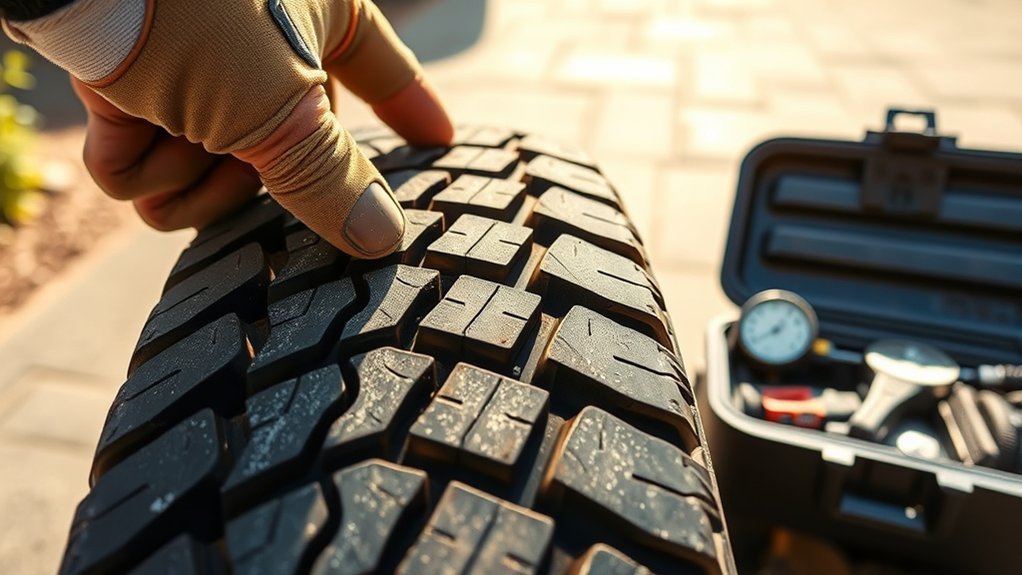
Inspecting tire damage early can prevent a roadside failure. Walk around your Hilux once a month and before long trips. Use a flashlight to check the tread, sidewalls, valve stems, and inner tire edges.
Do not ignore these signs:
- Bulges, bubbles, or blisters on the sidewall
- Deep cuts, cracks, exposed cords, or missing chunks of tread
- Nails, screws, or sharp objects in the tread
- Repeated pressure loss in the same tire
- Vibration, thumping, or pulling that starts suddenly
- Damage after hitting a curb, pothole, rock, or trail obstacle
Warning: Do not keep driving on a tire with a sidewall bulge, exposed cords, or severe cracking. Install the spare if safe to do so, then have the tire inspected or replaced.
Choose the Right Tires for Driving Conditions
Choosing the right tires for your Toyota Hilux depends on where you drive, how much weight you carry, and whether you tow. The right size and load rating matter as much as the tread pattern.
- Highway terrain tires: Best for mostly paved roads, quiet driving, and everyday commuting.
- All-terrain tires: A good match for mixed pavement, gravel, job sites, camping tracks, and moderate off-road use.
- Mud-terrain tires: Useful for deep mud and rough trails, but usually louder and less comfortable on pavement.
- Winter tires: Best for cold weather, snow, slush, and ice. All-season tires are not the same as true winter tires.
- Light-truck or reinforced tires: Often better for towing, payload, rough roads, and work use when the correct load rating is required.
Before buying tires, confirm the size, load index, and speed rating in your Hilux owner’s manual, tire placard, or with a qualified tire dealer. If you tow or carry heavy loads, ask for a tire that matches the loaded use of your truck, not just the empty curb weight.
[Products Worth Considering]

Get precise tire readings with the ETENWOLF T300 Plus digital gauge, calibrated to ANSI B40.7 Grade 2A for reliable accuracy. It measures across a wide 3–200 PSI range and includes thermal compensation for dependable performance from extreme cold to heat. The bright LED display, LED illumination, and replaceable AAA batteries make it easy to check pressures quickly, even in low light.

Monitor tire tread wear with a smart, color-coded depth gauge that shows clear condition ranges at a glance. The bar is range marked for fast, easy readings, helping you maintain safer traction and performance. Each gauge is portable with a pocket clip, and the set includes 20 units for daily use and sharing.

Measure tire tread depth quickly and accurately with this LUMITECO dial gauge that reads in 1/32" increments up to 14/32". The color-coded green/yellow/red zones make it easy to judge tire wear and know when replacement is needed. A rugged, compact design with a protective pouch helps keep the gauge ready for use on cars, trucks, motorcycles, and more.
Adjust Tire Care for Towing, Payload, and Off-Road Driving
A Hilux used for towing, tools, overlanding gear, or rough roads needs closer tire attention than one used only for light commuting. Extra weight raises tire temperature and load stress. Gravel, rocks, and ruts can cut tread blocks or damage sidewalls.
Use this checklist before heavy use:
- Check cold pressure before loading the truck or attaching a trailer.
- Use Toyota’s pressure guidance for loaded driving if your manual provides separate load settings.
- Inspect sidewalls and tread after trail driving or construction-site use.
- Look for stones lodged deep in the tread and remove them carefully.
- Do not exceed the tire load rating or the vehicle’s payload and towing limits.
- Recheck pressure after a big temperature swing or before highway driving after off-road use.
Note: Some off-road drivers air down tires for traction on sand, rocks, or trails. If you do this, air them back up to the correct road pressure before highway driving.
[Products Worth Considering]

Milton S-921 pencil tire pressure gauge helps you maintain optimal tire pressure for passenger cars with accurate readings in PSI and kPa. It features a built-in deflator valve for convenient pressure adjustments, plus a single chuck head and nylon indicator bar for easy use on the go. Built from durable plated brass and designed for reliable performance, it’s a practical road trip and cold-weather maintenance tool.

Keep your tires properly inflated with this analog VONDIOR tire pressure gauge, designed for fast, easy readings without batteries. The swiveling, two-axis hose and large glow dial help you measure at any tire angle with instant visibility. Built with a protective rubber shield, it supports durable, low-maintenance use for cars and trucks.

These aluminum alloy tire valve stem caps with an O-ring seal help protect valve stems from corrosion while adding a clean, stylish look to your vehicle. The universal fit works across cars, trucks, motorcycles, bicycles, and more, making them an easy upgrade for everyday driving and off-road use. Installation is quick, and the included four-pack keeps all your tires dressed and protected.
Know When to Replace Hilux Tires
Replace a Hilux tire when it reaches 2/32 inch tread depth, shows treadwear bars, has serious damage, or cannot hold pressure. You should also consider replacement earlier if the tire has poor wet traction, severe uneven wear, repeated punctures, or damage from overloading or underinflation.
Tire age matters too. Rubber changes over time from heat, sunlight, storage, and use. Check the DOT date code on the sidewall when inspecting older tires or a spare. If you are unsure how old a tire is or whether it is safe, have it inspected by a qualified tire professional.
[Products Worth Considering]

The Milton S-693 straight foot dual head air chuck is designed for accurate tire pressure checks and quick, secure valve-core engagement with lock-on threads on both ends. With a 1/4" FNPT connection and a maximum 150 PSI rating, it’s built for use on inner duals and common vehicle tires, including trucks and RVs.

Accurately measure tire tread depth with a calibrated gauge marked from 0 to 1 inch in 1/32 inch increments. The color-coded bar helps you quickly identify tread condition ranges, supporting safe driving for trucks, motorcycles, automobiles, and passenger vehicles.

This heavy duty dual head tire pressure gauge helps you quickly check Schrader valve tires with clear ABS bar markings for both PSI and Bar readings. The straight and 30° reverse chuck designs make it easier to reach inner and outer wheels, while the zinc alloy/brass construction supports reliable use in tough conditions. No battery is required, making it a dependable tool for cars, trucks, RVs, and more.
Schedule Professional Tire Maintenance Regularly
Professional tire maintenance helps catch problems you may miss at home. A shop can rotate tires, balance wheels, check alignment, inspect punctures, measure tread depth, and look for suspension or steering issues that cause uneven wear.
Schedule service:
- At the rotation interval in your Toyota owner’s manual
- When installing new tires
- After a hard impact with a curb, pothole, rock, or road debris
- Before long towing trips or heavy work use
- When the truck pulls, vibrates, wanders, or wears tires unevenly
If you rotate tires yourself, use wheel chocks, jack stands, a safe lifting point, and a torque wrench. Never work under a vehicle supported only by a jack. Tighten wheel nuts to the torque specification in your owner’s manual and recheck them after driving if your manual or tire shop recommends it.
Frequently Asked Questions
What tire-care weakness should Toyota Hilux owners watch for?
The biggest tire-care weakness is treating the Hilux like an ordinary commuter vehicle when it is often used for towing, payload, gravel, off-road routes, and work sites. Those conditions can speed up wear and damage. Check pressure, tread, sidewalls, and load rating more often if your truck works hard.
How often should I check Toyota Hilux tire pressure?
Check tire pressure at least once a month when the tires are cold. Also check before long trips, towing, hauling, off-road driving, or major temperature changes. Use the pressure on the door placard or in the owner’s manual.
What tire pressure should a Toyota Hilux use?
Use the pressure listed for your exact Hilux on the tire placard or in the owner’s manual. Do not rely on a generic PSI number or the maximum pressure printed on the tire sidewall. Loaded driving and towing may require different guidance.
How often should Hilux tires be rotated?
Follow the rotation schedule in your Toyota owner’s manual. A common general range is every 5,000 to 8,000 miles if the manufacturer recommends rotation, but your tire type, drivetrain, spare setup, and driving conditions can change the correct pattern or interval.
Can I drive if one Hilux tire has a sidewall bulge?
No. A sidewall bulge can mean internal tire damage. If it is safe, stop driving, install the spare, and have the damaged tire inspected or replaced. Do not tow, drive at highway speed, or go off-road on a tire with a bulge.
Are all-terrain tires best for every Toyota Hilux?
Not always. All-terrain tires are useful for mixed pavement, gravel, and light off-road use, but highway tires may be quieter and more efficient for daily road driving. Winter tires are better for snow and ice, while mud-terrain tires suit deeper mud and rough trails.
Conclusion
Good Toyota Hilux tire care comes down to a simple routine: check cold pressure, inspect tread and sidewalls, rotate tires on schedule, fix alignment or balancing symptoms early, and choose tires that match your load and driving conditions. A few minutes each month can help your Hilux stop, steer, tow, and handle better while reducing the chance of premature tire failure.
Sources
- NHTSA TireWise — tire pressure, tread depth, penny test, tire rotation, alignment, TPMS, and tire-related crash safety data.
- Toyota Owner’s Manuals — model-specific owner manual reference for tire pressure, tire size, rotation guidance, and wheel nut torque.
- Michelin Tire Maintenance — tire rotation, alignment, balancing, visual inspection, and routine tire-care support.