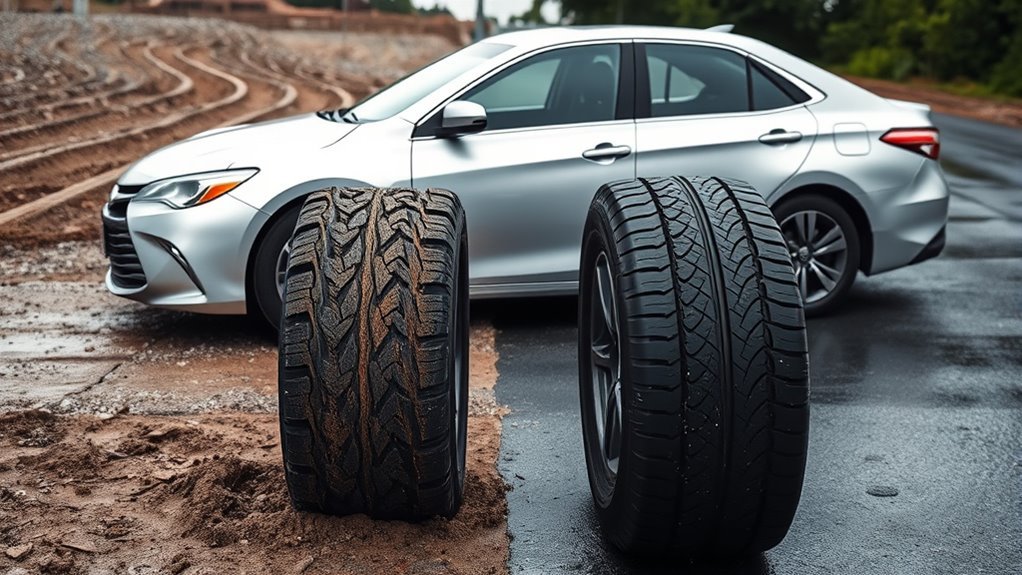
For most Toyota Camry drivers, all-season tires are the better choice because they match how the Camry is usually driven: commuting, highway travel, errands, and year-round paved-road use. They offer a quieter ride, dependable wet-road traction, better fuel efficiency, and easier fitment than most all-terrain tires. All-terrain tires only make sense if your Camry regularly sees gravel roads, rough rural routes, construction sites, or mountain access roads. Even then, you need to confirm the exact tire size, load index, speed rating, and clearance before buying.
Quick Answer
Choose all-season tires for a Toyota Camry if you drive mostly on pavement. Choose all-terrain tires only if you often drive on rough gravel, dirt, or mountain roads and can find a compatible passenger-car size. For snow and ice, dedicated winter tires are usually safer than either option.
Key Takeaways
- All-season tires are the best default choice for Camry owners who drive mainly on city streets, highways, and maintained roads.
- All-terrain tires can help on repeated gravel, dirt, or rough-road use, but they may add noise, weight, rolling resistance, and fitment challenges.
- Always confirm the tire size, load rating, speed rating, and inflation pressure on the driver’s door label or in the Toyota owner’s manual.
- Replace tires when tread reaches 2/32 inch, when damage appears, or when wet-weather traction noticeably drops.
Are All-Season or All-Terrain Tires Better for a Camry?
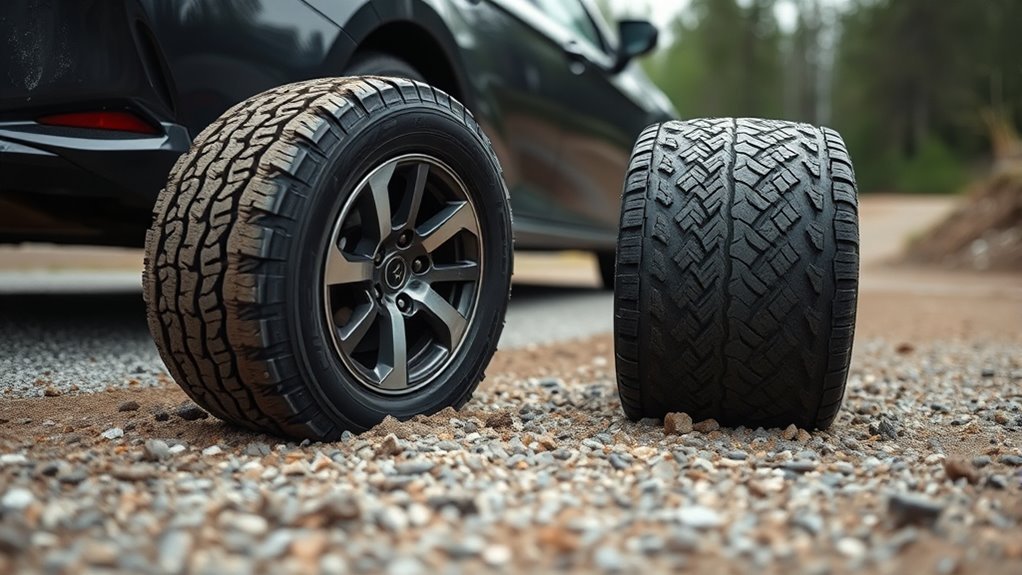
For a Toyota Camry, all-season tires are usually the better choice because they are designed for everyday road use. They give you a balanced mix of comfort, quietness, wet-road grip, tread life, and fuel efficiency. That fits the Camry’s role as a midsize sedan built for commuting and long-distance pavement driving.
According to NHTSA TireWise, all-season tires can handle a variety of road conditions, while all-terrain tires are mainly used on four-wheel-drive vehicles and provide a compromise between on-road driving and off-road capability. That distinction matters because a Camry is not an SUV or truck. It has limited ground clearance, street-focused suspension, and tire sizes that are usually aimed at touring or performance use.
All-terrain tires can still make sense in a narrow set of cases. If you frequently drive on gravel, dirt, rough rural roads, or uneven mountain access routes, a compatible all-terrain tire may add tread toughness and loose-surface grip. The tradeoff is that you may notice more road noise, firmer ride quality, slower steering response, and lower fuel economy compared with a good all-season tire.
Warning: Do not install an all-terrain tire just because it fits the wheel diameter. It must also match the correct overall size, load index, speed rating, clearance, and inflation requirements for your Camry.
[Products Worth Considering]

These aluminum alloy tire valve stem caps with an O-ring seal help protect valve stems from corrosion while adding a clean, stylish look to your vehicle. The universal fit works across cars, trucks, motorcycles, bicycles, and more, making them an easy upgrade for everyday driving and off-road use. Installation is quick, and the included four-pack keeps all your tires dressed and protected.

These universal tire valve stem caps help protect valve cores from dust, debris, and moisture while helping maintain stable tire pressure. The corrosion-resistant metal construction and sealed design provide reliable protection in road grime, mud, and winter conditions. Twist-on installation makes them quick to fit on cars, SUVs, trucks, and motorcycles.

This tire inflator with pressure gauge delivers long-lasting performance with a durable rubber-protected gauge and sturdy build. The longer hose and 360 swivel air chuck help you seal the valve securely and keep your hands free while measuring, inflating, or deflating. It’s battery-free for reliable use and provides ±2 PSI accuracy in the mid-range for most typical tires, with universal compatibility for 1/4 NPT compressor outputs.
All-Season vs All-Terrain Tires for a Camry
The easiest way to choose is to match the tire to where you drive most often. A Camry that spends 90% of its life on pavement should stay on all-season, grand touring, performance all-season, or all-weather tires. A Camry that regularly travels on rough unpaved roads may justify a tougher tire, but only after fitment is verified.
| Factor | All-season tires | All-terrain tires |
|---|---|---|
| Best use | Daily pavement, commuting, highway travel | Frequent gravel, dirt, rough rural roads |
| Ride comfort | Usually smoother and quieter | Can feel firmer and louder |
| Fuel economy | Usually better due to lower rolling resistance | May reduce efficiency due to weight and tread design |
| Wet-road control | Strong on pavement when tread is healthy | Varies by model; not always better on pavement |
| Fitment | Easy to find in Camry sizes | Limited passenger-car options; clearance must be checked |
[Products Worth Considering]

Keep your tires properly inflated with this analog VONDIOR tire pressure gauge, designed for fast, easy readings without batteries. The swiveling, two-axis hose and large glow dial help you measure at any tire angle with instant visibility. Built with a protective rubber shield, it supports durable, low-maintenance use for cars and trucks.

Upgrade your Toyota’s wheels with durable aluminum alloy valve stem caps that help protect valve cores from corrosion and direct exposure to road grime, clay, water, and snow. Rubber rings improve sealing to help prevent air leakage and maintain stable tire pressure for safer driving. These caps are easy to install or remove without tools and add a unique, stylish look to your car.

ETENWOLF’s tire pressure gauge helps you quickly and accurately check tire PSI across cars, trucks, motorcycles, bikes, and more. It’s manually calibrated to ANSI B40.1 Grade A for reliable readings, includes a large glow dial for easy nighttime viewing, and features a 360-degree swivel chuck for use at any valve angle. The gauge also works consistently in extreme hot or cold weather.
Why All-Season Tires Work Best on a Camry
All-season tires fit the Toyota Camry’s mission because they are built for balanced handling, comfort, and efficiency on paved roads. You get predictable grip in rain, steady cornering, and low cabin noise, which helps the Camry stay easy to live with every day.
They also support fuel economy better than heavier, more aggressive tire designs. FuelEconomy.gov notes that proper tire inflation can improve gas mileage by 0.6% on average and up to 3% in some cases. A tire with lower rolling resistance and correct pressure helps your Camry keep the efficient feel it was designed to deliver.
Pro Tip: Check tire pressure when the tires are cold, meaning the car has been parked for at least three hours. Use the pressure on the driver’s door label, not the maximum pressure printed on the tire sidewall.
All-season tires are also easier to shop for in Camry-friendly sizes. You can choose from touring, grand touring, performance all-season, and all-weather options depending on your budget and climate. For most drivers, that gives a better result than forcing an aggressive all-terrain tire onto a sedan.
When a Camry Could Benefit From All-Terrain Tires
A Camry could benefit from all-terrain tires only when your actual driving conditions call for them. Think repeated gravel roads, dirt access roads, rough rural pavement, job sites, campground roads, or mountain routes with loose surfaces. Even then, you should treat all-terrain tires as a practical compromise, not an upgrade for every Camry.
Rough Road Conditions
If your Camry regularly encounters gravel roads, dirt paths, pothole-heavy rural routes, or broken pavement, a tougher tire can help resist cuts and impact damage. All-terrain tread blocks and deeper grooves can improve bite on loose surfaces. However, those same features can make the tire louder and less refined on the highway.
If the rough roads are occasional and well maintained, a durable touring all-season or all-weather tire is usually enough. If the roads are rutted, rocky, or muddy, consider whether a sedan is the right vehicle for that route before relying on tires alone.
Mountain Driving Needs
Mountain driving can involve steep grades, loose gravel, wet switchbacks, and quick weather changes. A compatible all-terrain tire may improve confidence on unpaved climbs and descents. Still, it will not give a Camry SUV-like ground clearance, skid-plate protection, or off-road suspension travel.
If your mountain driving is mostly paved, choose all-season, all-weather, or winter tires based on temperature and snow exposure. If the route includes regular gravel or dirt, focus on a tire with strong sidewall construction, good wet braking ratings, and the correct Camry fitment.
Light Off-Road Use
For light off-road use, such as campground roads, boat launches, farm lanes, or occasional dirt tracks, all-terrain tires can add loose-surface traction and durability. They will not turn a Camry into a trail vehicle. The goal is simply to reduce slipping and tire damage on mild unpaved surfaces.
Before choosing this route, check for rubbing at full steering lock, suspension clearance, brake clearance, and tire load rating. If the tire shop cannot confirm the fitment, do not guess.
Best Camry Tires by Driving Conditions

The best tire for your Camry depends on the road surface, climate, and how often you face poor conditions. For most owners, all-season tires remain the safest default. Use the table below to narrow the choice.
| Driving condition | Best tire choice | Why it works |
|---|---|---|
| City commuting | All-season touring | Quiet ride, steady wet grip, easy fitment |
| Highway travel | Grand touring all-season | Stable handling, comfort, long-distance refinement |
| Frequent rain | All-season with strong wet traction rating | Better braking and hydroplaning resistance when tread is healthy |
| Snow and ice | Winter tire | Better cold-weather grip and braking than all-season tires |
| Occasional maintained gravel | Durable all-season or all-weather | Enough for light use without major pavement tradeoffs |
| Regular rough gravel or dirt | Compatible all-terrain, if available | More tread bite and impact resistance on loose surfaces |
NHTSA reported 511 traffic fatalities in tire-related crashes in 2024, which is why correct tire type, pressure, tread depth, and fitment matter for everyday driving safety.
[Products Worth Considering]

Measure tyre tread depth precisely with a digital gauge that reads in both MM and inches, helping you monitor safe driving conditions. The large LCD screen is easy to operate, and the compact tool fits for cars, trucks, and motorcycles. It provides high accuracy with a 0-25.4mm range and includes a 1-year warranty for added peace of mind.

The TYAMATE TM8 solar-powered wireless TPMS delivers real-time tire pressure and temperature monitoring with six alarm modes for safer driving. A vibrant color LCD display shows readings clearly while windshield mounting keeps it hands-free and easy to read. With a wide 0–87 PSI range, strong 433.92 MHz signal transmission, and quick sensor pairing, it’s ideal for RV, sedan, SUV, MPV, and truck use.

The SAFELIFE dial tire tread depth gauge measures tread depth in 1/32 inch increments with clear, easy-to-read 2-inch dial face. Color zones using a traffic light system help you quickly judge whether tread is low, marginal, or ample for safer driving. Built with a durable zinc cast body and a metal detect probe for precise, comfortable use across cars, motorcycles, trucks, and buses.
Camry Tire Sizes and Fitment
Your Camry’s correct tire size depends on model year, trim, wheel package, and sometimes drivetrain. You may see sizes such as 215/60R16, 215/55R17, 225/45R18, 235/45R18, or 235/40R19 across different Camry years and trims, but do not buy based on a generic list alone.
The source of truth is the Tire and Loading Information Label on the driver’s door edge or door jamb, plus the owner’s manual. Toyota owners can access official manuals through the Toyota Manuals and Warranties page.
Common Camry Tire Sizes
Common Toyota Camry tire sizes vary by generation and trim. Smaller wheels usually give a softer ride and lower replacement cost. Larger wheels can sharpen steering response, but they may ride firmer and cost more to replace.
- 16-inch sizes: often used on comfort-focused base or efficiency trims.
- 17-inch sizes: common for balanced ride comfort and handling.
- 18-inch sizes: often found on sportier trims with sharper steering feel.
- 19-inch sizes: usually sport-oriented and more sensitive to potholes.
When comparing tires, match the full tire code, not just the wheel diameter. A tire that fits a 17-inch wheel can still be the wrong width, sidewall height, load rating, or speed rating.
Checking Exact Fitment
Before you buy tires for a Toyota Camry, confirm the exact fitment in three places: the driver’s door label, the owner’s manual, and the tire sidewall currently on the car. If those do not match, ask a qualified tire shop to verify the correct specification for your VIN and wheel package.
| Check point | What to confirm |
|---|---|
| Driver’s door label | Original tire size and cold inflation pressure |
| Owner’s manual | Approved tire size, rotation guidance, spare tire notes |
| Tire sidewall | Size, load index, speed rating, DOT date code |
| Tire shop fitment check | Clearance, rubbing risk, brake clearance, TPMS compatibility |
Size Impact on Performance
Tire size affects handling, fuel economy, ride comfort, and road noise. A wider tire can add grip, but it may also add rolling resistance and cost. A shorter sidewall can sharpen steering, but it usually makes potholes feel harsher. A taller sidewall can improve comfort, but it may reduce steering precision.
Changing tire size without expert guidance can also affect speedometer accuracy, ABS behavior, traction control, and suspension clearance. For a daily-driven Camry, staying with the factory-approved size is usually the safest and most cost-effective choice.
Winter Driving: All-Season vs Winter Tires
All-season tires are not the same as winter tires. They can handle mild cold, wet roads, and light winter conditions, but they are not ideal for deep snow, packed snow, or ice. NHTSA notes that winter tires are more effective than all-season tires in deep snow.
If you live where winter storms are common, use dedicated winter tires in the correct Camry size. If your winters are mild and roads are plowed quickly, quality all-season or all-weather tires may be enough. All-terrain tires are not automatically better in winter unless that specific model carries the right winter rating and performs well in independent wet, snow, and ice testing.
Note: If you drive in severe winter conditions, look for tires with the Three-Peak Mountain Snowflake symbol and confirm they are available in the correct Camry size.
When to Replace Camry Tires
You should replace Camry tires when tread depth reaches 2/32 inch, when damage appears, or when the tires no longer grip safely in rain, snow, or emergency braking. Mileage alone is not enough because tire life depends on the tire model, alignment, inflation pressure, rotation schedule, road quality, driving style, and climate.
Use the penny test as a quick check. Place a penny into the tread with Lincoln’s head upside down and facing you. If you can see the top of Lincoln’s head, the tire is at or below the replacement point. Also inspect for uneven wear, cracks, bulges, exposed cords, vibration, pulling, or repeated air loss.
Rotate tires according to the owner’s manual. If Toyota recommends rotation for your setup, NHTSA says many vehicles use a 5,000 to 8,000 mile interval, or sooner if uneven wear appears. Some tire setups may have restrictions, especially if front and rear sizes differ.
Camry Tire Maintenance Checklist
Good tire maintenance can make a bigger difference than switching to a more aggressive tire. A properly maintained all-season tire is usually safer than a neglected all-terrain tire.
- Check pressure monthly: Use a quality gauge and check tires when cold.
- Use the door label pressure: Do not inflate based on the maximum sidewall pressure.
- Inspect tread depth: Replace at 2/32 inch, and consider earlier replacement if wet traction drops.
- Rotate on schedule: Follow the owner’s manual and tire warranty requirements.
- Watch for uneven wear: Cupping, feathering, and shoulder wear can point to alignment, suspension, or inflation problems.
- Check tire age: Read the DOT date code, especially if the car is driven lightly or stored often.
- Recheck after impacts: Potholes, curbs, and road debris can damage sidewalls or knock alignment out.
Frequently Asked Questions
Is there a downside to all-terrain tires on a Toyota Camry?
Yes. All-terrain tires can add road noise, weight, rolling resistance, and ride firmness. They may also be harder to find in the correct Camry size. Unless you regularly drive on rough gravel, dirt, or rural access roads, all-season tires usually give a better balance of comfort, control, and fuel economy.
Can you put all-terrain tires on a Camry?
You can only use all-terrain tires if they are available in a compatible size and meet the correct load index, speed rating, overall diameter, and clearance needs. Many all-terrain tires are made for trucks and SUVs, so a tire shop should verify fitment before installation.
Are all-season tires good enough for Camry winter driving?
They can be enough for mild winters, cold rain, and light snow on maintained roads. If you regularly drive in deep snow, packed snow, ice, or steep winter conditions, dedicated winter tires are the safer choice.
What tire size should I buy for my Toyota Camry?
Buy the size listed on the Tire and Loading Information Label on the driver’s door edge or door jamb. You can also confirm it in the Toyota owner’s manual. Do not rely only on a generic Camry tire-size list because sizes vary by year, trim, and wheel package.
How often should Camry tires be rotated?
Follow the owner’s manual and tire warranty. If rotation is recommended for your setup, many vehicles use a 5,000 to 8,000 mile interval, or sooner if uneven wear appears. Some setups may have restrictions if tire sizes differ front to rear.
Conclusion
For most Camry drivers, all-season tires are the right choice because they deliver the best mix of quietness, wet-road traction, comfort, fuel efficiency, and easy fitment. All-terrain tires only make sense if your Camry regularly travels on rough gravel, dirt, or rural roads and you can confirm a safe, compatible fit. For snow and ice, look beyond both categories and consider dedicated winter tires. Check the door-jamb label, owner’s manual, tread depth, pressure, and wear pattern before you buy, and replace tires before safety and performance drop.
Sources
- NHTSA TireWise — tire type guidance, tire size label, tread depth, tire pressure, rotation, and tire safety statistics.
- FuelEconomy.gov: Keeping Your Vehicle in Shape — proper tire inflation and fuel economy impact.
- Toyota Manuals and Warranties — official Toyota owner manual access for model-year-specific tire information.