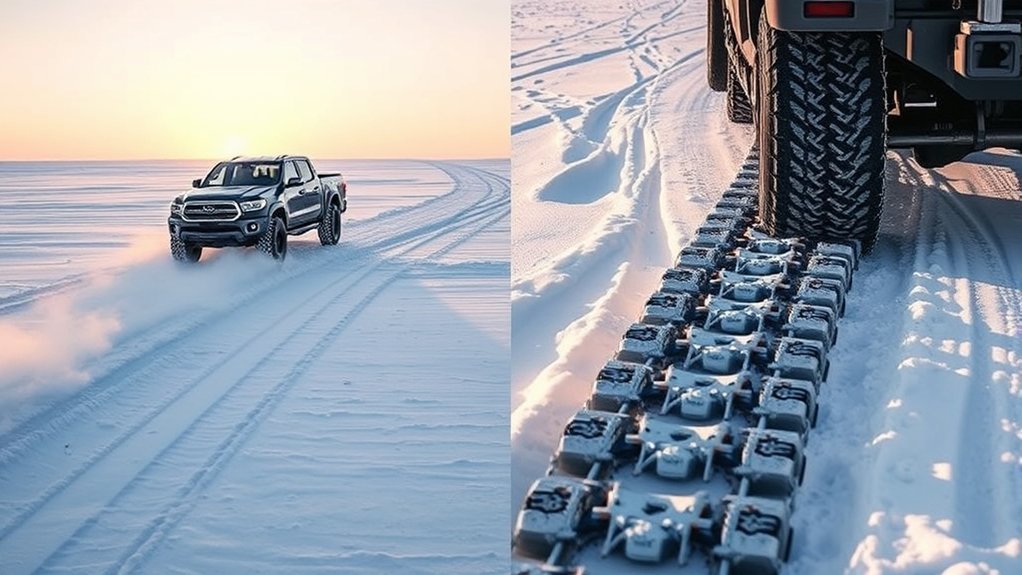
Choosing between studded tires and tire chains for a Toyota Tundra depends on where you drive, how often you face ice, and whether you need to pass through chain-control areas. Studded tires are better for repeated driving on hard ice and packed snow. Chains are better for short, severe stretches of deep snow, steep grades, or roads where signs require traction devices.
Quick Answer
For most Tundra owners, use quality winter tires for regular cold-weather driving and carry chains when traveling through mountain passes or chain-control areas. Choose studded winter tires only if your local roads stay icy for long periods and your state allows them. Always check your Toyota owner’s manual, tire size, and local rules before buying chains or studs.
Key Takeaways
- Studded tires are best for frequent ice and packed snow, but they can be noisy and may be legal only during certain dates.
- Tire chains give strong bite in deep snow and on steep winter grades, but they are slow to install and should not be driven fast or used on bare pavement.
- Four-wheel drive helps you move, not stop. A 4WD Tundra still needs proper tires, slower speeds, and more following distance on ice.
- Fitment matters. Check your Tundra’s tire size, trim, wheel clearance, and owner’s manual before buying chains or traction devices.
- Local law controls the final answer. Chain requirements and studded-tire dates vary by state, province, road, and weather condition.
Comparing Studded Tires and Chains for Your Tundra
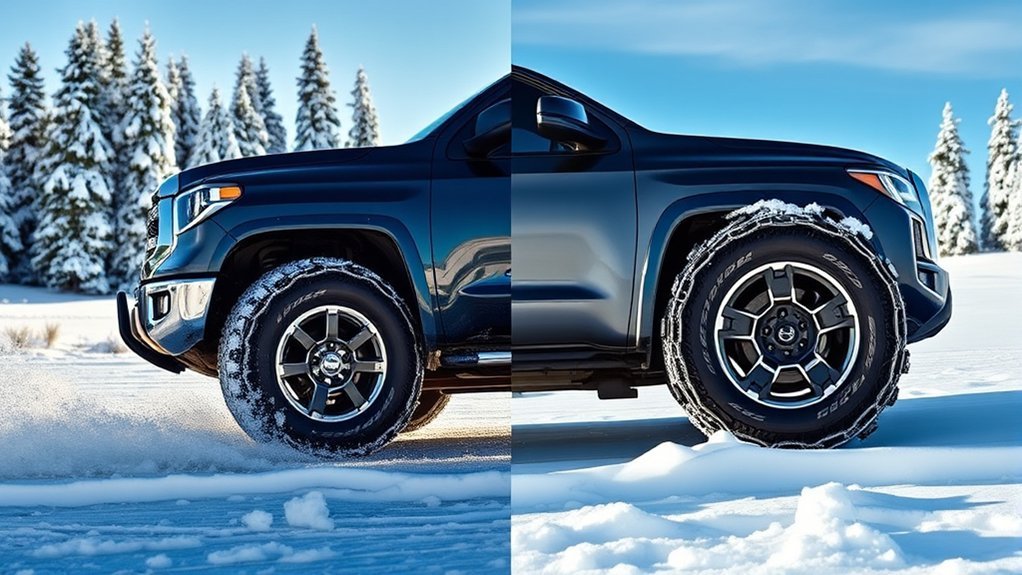
Studded tires and chains solve different winter traction problems. Studded tires are mounted for the season and are ready every time you drive. Chains are installed only when conditions are bad enough to need them, such as deep snow, icy mountain grades, or posted chain-control roads.
| Best use | Studded Tires | Tire Chains |
| Ice | Strong grip on hard ice and packed snow when legal and properly installed on all four tires. | Very strong bite, but mainly for short stretches where conditions require them. |
| Deep snow | Helpful, but not always enough in deep, loose snow. | Usually the stronger choice for deep snow, steep grades, and temporary severe conditions. |
| Convenience | Easy once installed for the season. | Must be installed, tightened, driven slowly, and removed when no longer needed. |
| Legal limits | Often restricted by date or location. | Often required by posted signs during severe winter conditions. |
[Products Worth Considering]

Milton S-921 pencil tire pressure gauge helps you maintain optimal tire pressure for passenger cars with accurate readings in PSI and kPa. It features a built-in deflator valve for convenient pressure adjustments, plus a single chuck head and nylon indicator bar for easy use on the go. Built from durable plated brass and designed for reliable performance, it’s a practical road trip and cold-weather maintenance tool.

These universal tire valve stem caps help protect valve cores from dust, debris, and moisture while helping maintain stable tire pressure. The corrosion-resistant metal construction and sealed design provide reliable protection in road grime, mud, and winter conditions. Twist-on installation makes them quick to fit on cars, SUVs, trucks, and motorcycles.

Steelman white tire marking crayons provide high-contrast, semi-permanent marks for repairing and inspecting tires and equipment. They write on wet or dry, smooth or coarse surfaces including rubber, metal, glass, and wood, making them ideal for puncture location and damage outlining. The lead- and zinc-free crayons resist weather and fading yet wipe away when you no longer need the marks.
Check Your Tundra Before Buying Either Option
Before you buy studs, chains, cables, or snow socks, check your exact Tundra setup. A chain that fits one Tundra may not fit another because wheel size, tire size, trim, suspension, and aftermarket changes can affect clearance.
Start with your Toyota owner’s manual and the tire information label on the driver-side door jamb. Confirm:
- Your tire size and load rating.
- Whether Toyota allows chains or only certain low-clearance traction devices for your wheel-and-tire package.
- Which axle should use chains for your drivetrain and road condition.
- The maximum speed allowed by the chain maker and the posted chain-control area.
- Whether aftermarket wheels, larger tires, lift kits, or spacers have changed chain clearance.
Warning: Do not assume a chain set fits just because it matches the tire size printed on the box. Test-fit the chains at home first. A loose or oversized chain can hit brake lines, suspension parts, fenders, or wheel wells.
Benefits of Studded Tires for Winter Driving
Studded winter tires make the most sense if your Tundra regularly sees frozen roads, packed snow, and glare ice. They are especially useful for rural roads, steep icy driveways, and cold regions where pavement stays frozen for long periods.
[Products Worth Considering]

Measure tire tread depth quickly and accurately with this LUMITECO dial gauge that reads in 1/32" increments up to 14/32". The color-coded green/yellow/red zones make it easy to judge tire wear and know when replacement is needed. A rugged, compact design with a protective pouch helps keep the gauge ready for use on cars, trucks, motorcycles, and more.

Monitor tire tread wear with a smart, color-coded depth gauge that shows clear condition ranges at a glance. The bar is range marked for fast, easy readings, helping you maintain safer traction and performance. Each gauge is portable with a pocket clip, and the set includes 20 units for daily use and sharing.

Black Magic Tire Wet delivers a deep wet-look shine that makes tires appear dark, rich, and freshly detailed. Its long-lasting formula helps resist rain, dust, and road grime for weeks of glossy protection, not days. Apply by spraying onto clean, dry tires—no buffing or wiping required—with a low-sling design to reduce splatter on paint and wheels.
Enhanced Traction on Ice
Studded tires use small metal studs that bite into hard ice. That can improve starting, turning, and braking traction compared with regular all-season tires in icy conditions. The benefit is strongest on ice and hard-packed snow, not on dry highways.
For best handling, studded winter tires should be installed as a matched set of four. Mixing studded tires with non-studded tires can create uneven grip, which may make the truck harder to control during braking or cornering.
Improved Handling in Snow
Studded tires can feel smoother than chains because they stay on the truck all season and do not slap against the tire. They also avoid the roadside installation work that chains require. For daily winter driving, that convenience matters.
| Studded tire strength | Ready every time you drive in icy winter conditions. |
| Main drawback | Noisy on pavement, restricted in many places, and not ideal for warm or dry roads. |
| Best driver | Someone who drives through frequent ice all winter and lives where studs are legal. |
When to Use Tire Chains in Severe Conditions
Tire chains are the better tool when the problem is short, severe, and temporary. Use them when signs require chains, when a mountain pass is under chain control, or when deep snow and steep grades overwhelm regular tires.
Chains dig into snow and ice, but they come with limits. You must stop in a safe pull-off area, install them correctly, drive slowly, listen for rubbing or slapping, and remove them when you return to bare pavement. In California chain-control areas, Caltrans says the speed limit when chains are required is usually 25 or 30 mph.
Pro Tip: Practice installing your chains in your driveway before the first storm. Gloves, a small mat, a flashlight, and a plastic storage bin can make roadside installation much easier.
How Chain Controls Work
Chain rules depend on the road and the state. California uses R1, R2, and R3 chain requirement levels, but other states may use different terms. Always follow posted signs and instructions from highway officials.
- R1: Chains are required on many vehicles, but some passenger vehicles and light-duty trucks with snow tires may be exempt while still carrying chains.
- R2: Chains or traction devices are required on most vehicles, but 4WD or AWD vehicles with snow-tread tires on all four wheels may be exempt while still carrying traction devices.
- R3: Chains or traction devices are required on all vehicles with no exceptions. Roads often close before this level is used.
These levels are useful examples, not national rules. If you drive your Tundra across state lines, check each state transportation department before you travel.
Driving Performance: Studded Tires vs. Chains
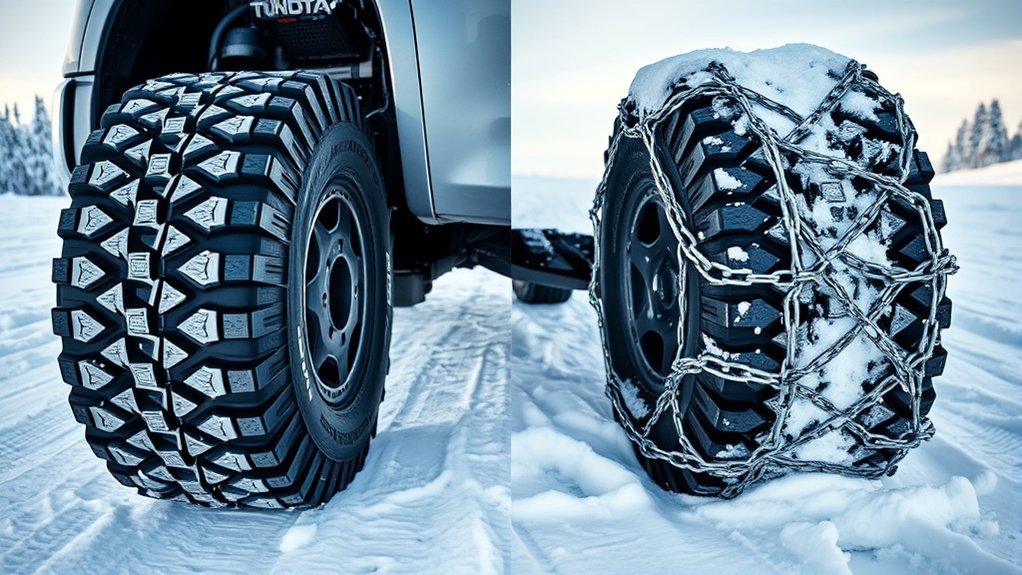
Studded tires feel more natural at normal winter speeds because they are part of the tire. Chains feel more aggressive and can create vibration, noise, and steering feedback. That is normal, but heavy banging, rubbing, or pulling means you should stop safely and inspect the fit.
Winter traction helps, but it does not cancel physics. Slow down, leave more following distance, and remember that a heavy pickup needs extra room to stop on snow and ice.
Note: Four-wheel drive helps your Tundra start moving and climb slippery grades, but it does not give you four-wheel braking magic. Tire grip, speed, weight, and following distance still control how safely you stop.
Essential Considerations for Choosing Studded Tires vs. Chains
Use these questions to make the right choice for your Tundra:
- Do you drive on ice every week? Studded tires may be worth it if they are legal in your area.
- Do you only visit snow a few times each winter? Carrying approved chains or traction devices may be more practical.
- Do you cross mountain passes? Carry chains even if you have 4WD, because signs may require them.
- Do your roads switch between snow and dry pavement? Studless winter tires may be a better daily choice than studs.
- Does your Tundra have oversized tires or aftermarket wheels? Confirm chain clearance before the trip.
- Are you towing? Follow the chain-control rules for both the truck and trailer. Some areas require chains on a trailer axle when brakes are present.
[Products Worth Considering]

The Kurgo Seasonal Tire Tote helps protect your car interior, clothes, and garage from tire grime, brake dust, and residue during seasonal tire changes. Its universal design fits most passenger tires between 22" and 31" in diameter, making storage and transport simpler with less mess. Built for rugged, repeated use, it’s machine washable for easy care and comes with a lifetime warranty.

Protect tire valves from water, dust, and sand to help prevent leaks and support safe driving. These universal stem caps install quickly by hand and feature durable aluminum alloy construction with an inner sealing ring for better air retention. Compatible with cars, SUVs, trucks, motorcycles, and bicycles for everyday convenience.

ETENWOLF T300 is a calibrated digital tire pressure gauge for accurate readings from 3 to 200 PSI across light and heavy-duty vehicles. It includes thermal compensation for reliable performance in extreme cold or heat, with an auto shut-off to extend battery life and an LED for easier reading. The sturdy design supports rugged everyday use, making it ideal for pickups, RVs, and industrial applications.
Cost, Convenience, and Storage
Chains usually cost less upfront than a full set of studded winter tires, but they take more work during a storm. Studded tires cost more because you need a seasonal tire set, mounting, balancing, and storage if you switch between winter and non-winter tires.
Chains also need care. After use, rinse off road salt, dry them, inspect for broken links or worn cables, and store them in a dry container. Studded tires need normal tire care: correct pressure, rotation, tread checks, and seasonal removal when local law requires it. NHTSA recommends checking tire pressure when tires are cold and inspecting tires at least monthly.
Legal Requirements for Studded Tires and Chains
Studded-tire laws vary widely. Some places allow them only during winter dates. Some restrict them because of pavement wear. Others ban them or allow them only in certain regions. Washington law, for example, says metal studs are unlawful from April 1 to November 1, with limited exceptions and possible extensions from the transportation department.
Chains are also controlled by local law and posted road signs. A road can require chains even if your Tundra has 4WD. A state may also require you to carry traction devices in chain-control areas even when you are not required to install them yet.
Local Regulations Overview
Before winter travel, check:
- Your state transportation department’s chain and traction-device rules.
- Studded-tire legal dates in your state or province.
- Mountain pass forecasts and live road cameras.
- Whether snow socks or alternative traction devices are accepted where you drive.
- Whether towing changes the number or placement of required chains.
Seasonal Restrictions Explained
Studded tires are not “install and forget forever” equipment. If they are legal where you live, they are usually meant for the winter season only. Remove them when the season ends or when local rules require it. Driving on studs outside the legal window can lead to fines and unnecessary tire wear.
| Equipment | Legal reminder |
| Studded tires | Often limited to winter dates. Check your state or province before installing them. |
| Tire chains | May be required by posted signs during severe winter conditions. Use only when conditions justify them. |
| Snow socks or alternative devices | May not count as legal chain substitutes everywhere. Confirm before relying on them. |
Making the Right Choice: Studded Tires or Chains?
Choose studded tires if you live where roads stay icy for weeks, you drive in winter conditions often, and studs are legal during your driving season. They are convenient for daily use, but they are not the best fit for mild climates or mostly dry highways.
Choose chains if you need emergency traction for mountain trips, deep snow, chain-control roads, or steep icy climbs. They are cheaper than a full tire set and useful to carry, but they are not comfortable for normal driving and should be removed when conditions improve.
For many Tundra owners, the safest setup is a good set of winter-rated tires plus correctly sized chains in the truck. That gives you daily winter grip and the backup equipment needed when a pass, park road, or storm route requires chains.
Frequently Asked Questions
What are the best tires to put on a Toyota Tundra for winter?
The best winter tire for a Toyota Tundra is one that matches your exact tire size, load rating, driving conditions, and owner’s manual guidance. For regular snow and ice, look for dedicated winter tires or severe-snow-rated all-terrain tires that fit your truck. Do not choose by brand alone. Confirm the size, load index, speed rating, and whether you need studs, studless winter tires, or all-terrain winter capability.
What are the downsides of studded snow tires?
Studded snow tires can be noisy, may feel rough on dry pavement, and are restricted or banned in some areas. They also need seasonal removal when local law requires it. They work best on ice and hard-packed snow, so they may not be worth the cost if your roads are usually wet, slushy, or dry.
Do I need chains if my Tundra has 4WD?
You may still need to carry or install chains. Four-wheel drive helps with traction when accelerating, but chain-control signs can still require traction devices. Some areas allow properly equipped 4WD vehicles to continue without installing chains under certain conditions, but they may still require you to carry chains.
Can I use studded tires and chains together?
In some severe conditions, chains may still be required even if you have studded tires. Use chains only if they fit your Tundra, are allowed by the owner’s manual, and are required by road conditions or signs. Never add chains just for extra grip on bare pavement.
Are cables better than chains for a Tundra?
Cables can be easier to store and may fit vehicles with tighter clearance, but heavy-duty chains may offer more bite in deep snow. The right answer depends on your tire size, clearance, local chain rules, and Toyota’s guidance for your exact Tundra.
How fast can I drive with chains on?
Follow the lower limit from the chain maker, the vehicle manual, and posted road signs. In many chain-control areas, speeds are much lower than normal highway speeds. If the chains start slapping, rubbing, or vibrating hard, pull over safely and check the fit.
Conclusion
For a Toyota Tundra, studded tires are the better choice for regular driving on icy roads where studs are legal. Tire chains are the better backup for deep snow, steep winter grades, mountain passes, and roads where chain-control signs require traction devices. The most practical winter setup for many drivers is winter-rated tires on the truck and correctly sized chains carried in the cab or bed.
Before you buy either option, check your Tundra’s manual, tire size, chain clearance, and local laws. Then drive like the road is still slippery, because it is. Good traction equipment helps, but slower speed and extra space are what keep a winter trip under control.
Sources
- Toyota Owners Manuals and Warranties — official source for model-specific Tundra manual and fitment guidance.
- NHTSA Winter Weather Driving Tips — winter driving, tire pressure, vehicle preparation, and emergency guidance.
- NHTSA Tire Safety Ratings and Awareness — tire categories, tire safety, and maintenance basics.
- Caltrans Chain Controls and Chain Installation — R1, R2, R3 chain-control levels and chain-use safety guidance.
- Washington RCW 46.37.420 — example of state studded-tire restrictions and seasonal legality.