
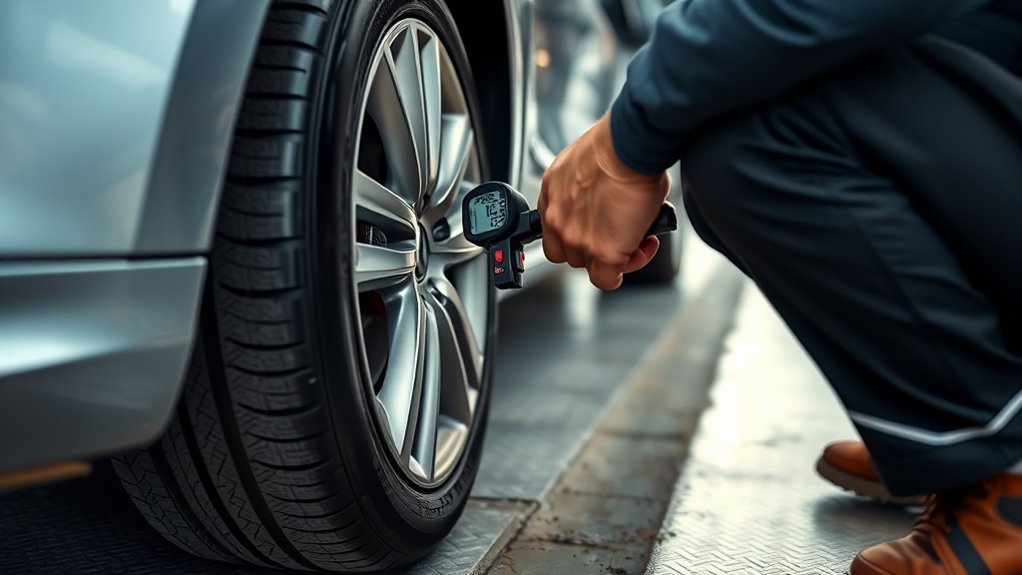
Getting this right helps the tire carry its intended load and supports predictable handling, braking, tread wear, and fuel economy.
Quick Answer
Find the recommended cold PSI on the vehicle’s Tire and Loading Information label or in the owner’s manual. With the tires cold, remove each valve cap, press a tire-pressure gauge firmly onto the valve stem, compare the reading with the correct front or rear PSI, adjust the air, recheck, and replace the cap.
At a Glance
| Time Required | A few minutes for all four tires |
| Difficulty | Basic vehicle maintenance |
| Tools Needed | Tire-pressure gauge; air source if adjustment is needed |
Find Your Car’s Tire Pressure Label
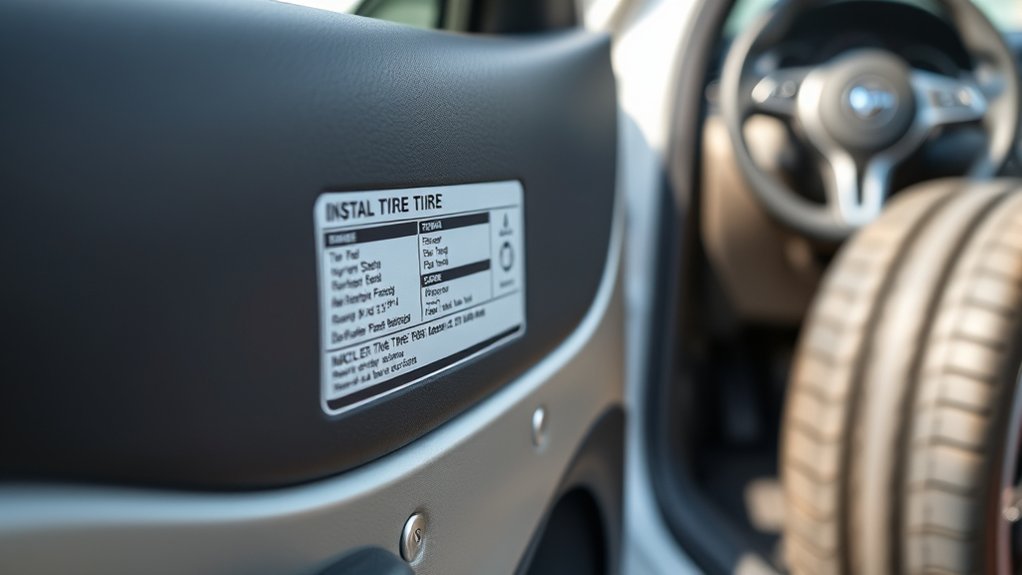
Start with the vehicle’s Tire and Loading Information label. For current U.S. light vehicles covered by the federal labeling rule, the placard is normally on the driver-side B-pillar or another specified surface next to the driver’s seating position. The federal tire placard requirements also require the manufacturer’s recommended cold pressure for the front, rear, and spare tire when applicable.
Older vehicles and vehicles sold in other markets can place this information elsewhere. If you do not see it at the driver’s door area, use the owner’s manual. The placard is the best baseline because it matches the vehicle’s original tire size, axle loads, and manufacturer specifications.
Check Your Recommended Tire Pressure
The correct tire pressure is the recommended cold inflation pressure for your vehicle. Do not substitute a generic PSI from another car, and do not use the tire sidewall’s maximum pressure as your everyday target.
Find The Door Placard
Open the driver’s door and read the Tire and Loading Information label. Record the cold PSI for the front and rear tires separately, because the two axles may use different pressures.
- Locate the front-tire cold PSI.
- Locate the rear-tire cold PSI.
- Check whether the label lists a separate spare-tire pressure.
The NHTSA TireWise guidance says to use the vehicle manufacturer’s pressure and check all tires, including the spare, at least monthly when cold.
Read The Tire Label
The label may show tire size, cold inflation pressure, seating capacity, and maximum combined occupant-and-cargo weight. The important pressure number is the cold PSI assigned to each tire position.
| Location | What you read | Why it matters |
|---|---|---|
| Vehicle placard | Recommended cold PSI | Your normal pressure target |
| Owner’s manual | Vehicle-specific exceptions | May cover loading, towing, or special use |
| Tire sidewall | Maximum inflation/load information | A tire limit, not the vehicle’s target |
Use Owner’s Manual
Use the owner’s manual when the placard is missing, unreadable, or when you need instructions for a special operating condition. It can also clarify the correct pressure for a spare tire, heavy loading, towing, or a manufacturer-approved alternate tire setup.
Note: If your vehicle has non-original tire sizes, wheels, or load requirements, do not guess the pressure. Use vehicle- and tire-manufacturer guidance or ask a qualified tire professional to confirm the correct inflation pressure.
Read the Door Placard First
The placard should control your normal pressure setting because the tire sidewall answers a different question. Sidewall markings show the tire’s maximum cold inflation or load information; they do not tell you the pressure your specific vehicle should use in everyday driving.
| Placard field | Meaning |
|---|---|
| Front PSI | Cold-pressure target for the front axle |
| Rear PSI | Cold-pressure target for the rear axle |
| Tire size | Original or approved vehicle fitment |
If the front and rear values differ, keep them different. If the placard or manual lists an alternate pressure for a particular load or operating condition, use that value only under the stated condition.
Use a Tire Gauge Correctly
A stick, dial, or digital tire-pressure gauge can work if it is in good condition and gives a stable reading. Press it straight onto the valve stem so the seal is tight; a continuing hiss means air is escaping and the reading may be wrong.
- Park and let the tires get cold. Check before driving or after the vehicle has been parked for at least three hours.
- Confirm the target PSI. Write down the front and rear values before moving around the vehicle.
- Remove the valve cap. Put it somewhere clean so it does not get lost.
- Press the gauge straight onto the valve stem. Apply firm, even pressure until the hissing stops, then read the gauge.
- Compare the reading with the placard. Use the correct value for that tire position.
- Add or release air as needed. Add air in short bursts when low. If high, briefly press the valve pin, then measure again.
- Recheck and replace the cap. Confirm the final reading, then repeat for every tire and the spare if equipped.
If the reading seems unusual, remove the gauge and take a second reading. A tire can look normal while being significantly underinflated, so appearance alone is not a reliable pressure check.
[Products Worth Considering]

The TYAMATE TM8 solar-powered wireless TPMS delivers real-time tire pressure and temperature monitoring with six alarm modes for safer driving. A vibrant color LCD display shows readings clearly while windshield mounting keeps it hands-free and easy to read. With a wide 0–87 PSI range, strong 433.92 MHz signal transmission, and quick sensor pairing, it’s ideal for RV, sedan, SUV, MPV, and truck use.

The Tymate TM12 RV TPMS delivers real-time tire pressure and temperature monitoring with a stable 433Hz display for safer long-distance driving. It supports simultaneous monitoring across vehicle and trailer zones, includes six alarm modes for pressure, temperature, leakage, battery, and signal loss, and features easy DIY installation with auto calibration. Power is supplied via USB-C charging or solar recharging, with a wide 0–144 PSI range and up to 50 ft signal coverage for RVs and towable trailers.

Milton S-921 pencil tire pressure gauge helps you maintain optimal tire pressure for passenger cars with accurate readings in PSI and kPa. It features a built-in deflator valve for convenient pressure adjustments, plus a single chuck head and nylon indicator bar for easy use on the go. Built from durable plated brass and designed for reliable performance, it’s a practical road trip and cold-weather maintenance tool.
Measure Tire Pressure When Cold
“Cold” does not mean cold weather. It means the tire has not been heated significantly by driving. NHTSA defines a cold check for this purpose as a vehicle that has not been driven for at least three hours.
Driving heats the tire and raises its internal pressure. If you bleed a warm tire down to the placard’s cold PSI, the tire can end up underinflated after it cools.
Warning: Do not release air from a warm tire simply because its reading is above the cold placard value. If you must add air while the tire is warm, make a temporary correction and recheck all pressures when the tires are fully cold.
Direct sun can also warm one side of the vehicle more than the other. For the most consistent readings, check all tires under similar conditions.
Set Front and Rear Tires Separately
Front and rear tires can have different recommended pressures because the axles may carry different loads and the vehicle is tuned for a specific handling balance. Always match each tire to the placard value for its axle instead of forcing all four tires to the same PSI.
Front Versus Rear
If the placard gives two different numbers, use the front number for both front tires and the rear number for both rear tires. This is normal on many vehicles and does not mean one axle is incorrectly inflated.
- Measure all tires with the same gauge.
- Adjust the front pair to the front specification.
- Adjust the rear pair to the rear specification.
Load-Based Adjustments
Heavy passengers, cargo, or trailer tongue weight can increase tire loading, but you should not invent a higher pressure on your own. Before a heavy-load or towing trip, check the tires cold and use an alternate loaded or towing pressure only if the placard or owner’s manual specifies one.
The U.S. Tire Manufacturers Association recommends checking pressure before long trips, heavy loads, or towing and following the vehicle manufacturer’s recommended pressure.
Sticker Pressure Specs
Treat the sticker values as separate targets, not an average. After adjustment, measure each tire again so you know the final reading is correct.
Also check the spare. Compact temporary spares often use a different pressure from the road tires, so follow the value printed on the vehicle placard, spare-tire label, or owner’s manual rather than copying the road-tire PSI.
Adjust PSI for Seasonal Changes
Seasonal weather changes the pressure inside the tire, but it does not automatically change the vehicle manufacturer’s target. In cold weather, add air as needed to return the cold tire to the placard value; in warmer weather, recheck cold before deciding that pressure is too high.
Use the same cold-pressure target year-round unless your vehicle manufacturer specifies a different condition.
As a practical rule, tire pressure commonly changes by about 1–2 PSI for each 10°F change in ambient temperature. Bridgestone also notes an approximate 1 PSI change for every 10°F, which is why the first cold mornings of a season often reveal low pressure.
Do not “compensate” by permanently overinflating in winter or bleeding a hot tire in summer. Measure cold and restore the manufacturer’s specified pressure.
[Products Worth Considering]

Keep your tires properly inflated with this analog VONDIOR tire pressure gauge, designed for fast, easy readings without batteries. The swiveling, two-axis hose and large glow dial help you measure at any tire angle with instant visibility. Built with a protective rubber shield, it supports durable, low-maintenance use for cars and trucks.
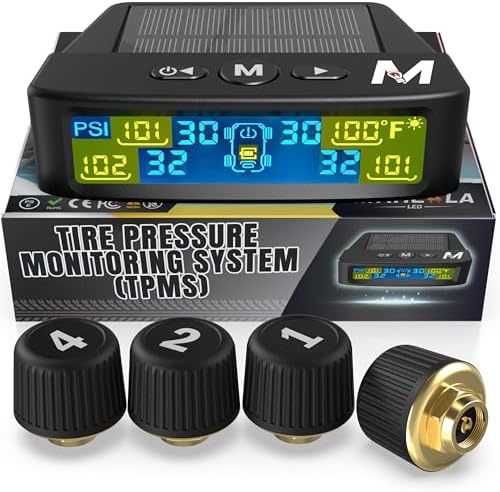
Marcala’s TPMS set of four sensors helps you monitor tire pressure and temperature in real time while driving, with updates every second. The bright color LCD uses auto-dimming for easy viewing, powered by dual solar and USB charging, and offers six alarm modes. Built for trailers, RVs, campers, trucks, and towing setups, the sensors support monitoring 1-4 wheels up to 98 PSI with IP67 waterproof protection.

This TPMS relearn tool helps you quickly activate, match, and reset GM tire pressure sensors to keep the vehicle monitoring system working properly. It clears tire pressure alarms and dashboard warning lights after sensor replacement or tire rotation, and supports learning for common 315/433 MHz TPMS sensors. Designed for simple one-button operation, it can help you avoid unnecessary trips to repair shops.
How Often Should You Check Tire Pressure?
Check tire pressure at least once a month and before a long trip. Also check after a major temperature change, when the TPMS light appears, or before carrying a heavy load or towing.
- Check all road tires and the spare, if equipped.
- Use a gauge even if your dashboard shows tire pressure.
- Look for cuts, bulges, punctures, or unusual tread wear while you are at the tire.
- Have a tire inspected if it repeatedly loses pressure after being correctly inflated.
Repeated air loss can come from a puncture, leaking valve, wheel damage, or another tire problem. A tire that will not hold its specified pressure needs diagnosis rather than repeated topping off.
What Should You Do When the TPMS Light Comes On?
A Tire Pressure Monitoring System (TPMS) warning means you should check the tires with a gauge as soon as it is safe. The light is a warning system, not a replacement for routine pressure checks.
Under U.S. requirements, TPMS is designed to warn when one or more tires become significantly underinflated. That means a tire can be below its ideal pressure before the warning appears. Inflate the affected tire to the vehicle’s cold specification, then follow the owner’s manual if the light does not clear or if it flashes to indicate a system fault.
If a tire is visibly flat, damaged, rapidly losing air, or unsafe to drive on, do not keep driving just to reach an air pump. Use the vehicle’s approved roadside procedure or get professional assistance.
Key Takeaways
- The vehicle placard or owner’s manual sets the cold PSI; the tire sidewall maximum is not your everyday target.
- Check pressure before driving or after the vehicle has sat for at least three hours.
- Front, rear, and spare tires may require different pressures, so read each specification separately.
- Temperature changes pressure, but you still return a cold tire to the manufacturer’s specified target.
- A TPMS warning is useful, but monthly gauge checks can catch pressure loss sooner.
[Products Worth Considering]

The Milton S-693 straight foot dual head air chuck is designed for accurate tire pressure checks and quick, secure valve-core engagement with lock-on threads on both ends. With a 1/4" FNPT connection and a maximum 150 PSI rating, it’s built for use on inner duals and common vehicle tires, including trucks and RVs.

Get precise tire readings with the ETENWOLF T300 Plus digital gauge, calibrated to ANSI B40.7 Grade 2A for reliable accuracy. It measures across a wide 3–200 PSI range and includes thermal compensation for dependable performance from extreme cold to heat. The bright LED display, LED illumination, and replaceable AAA batteries make it easy to check pressures quickly, even in low light.
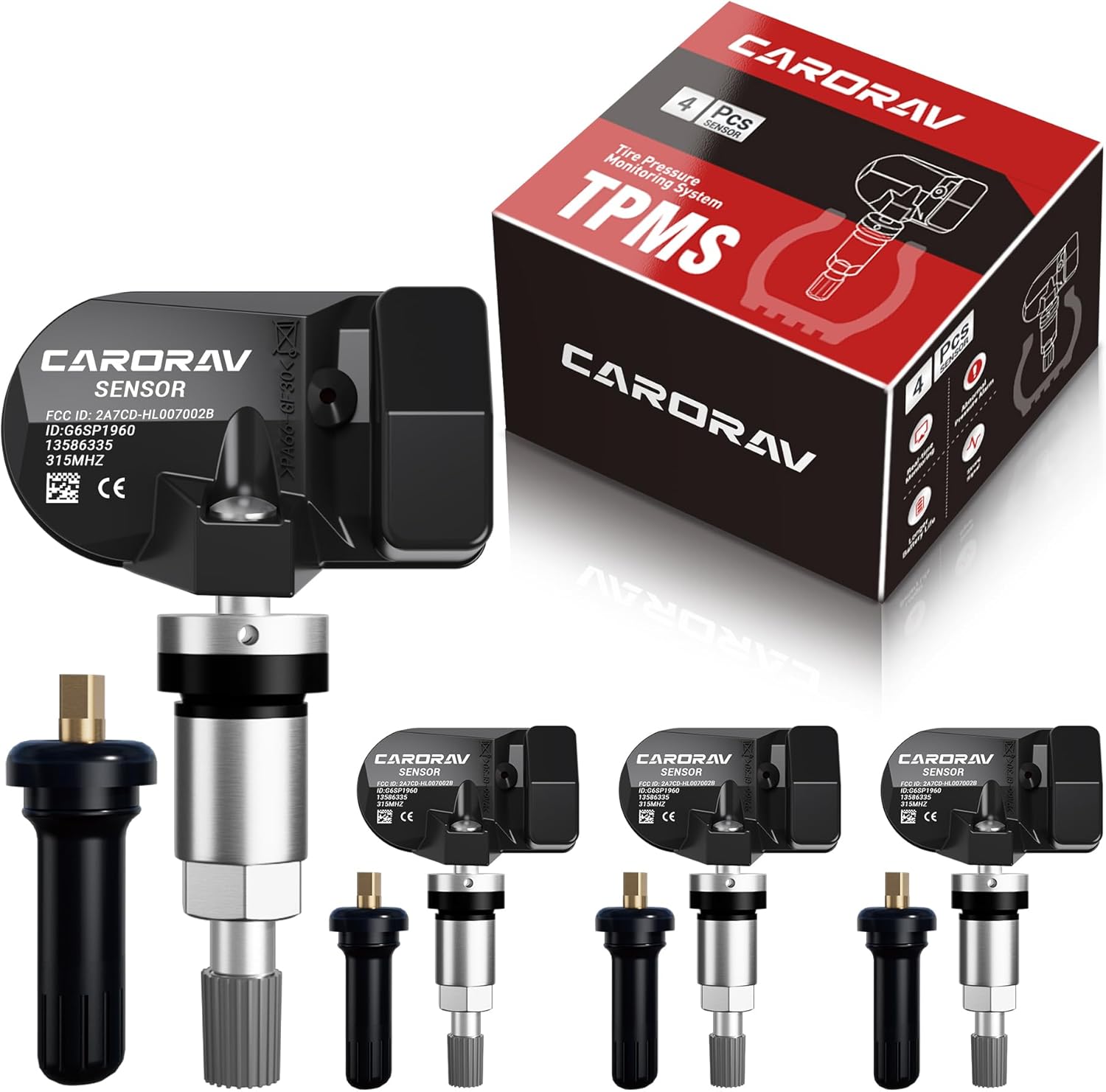
Replace worn or missing TPMS sensors with CARORAV pre-programmed GM-compatible sensors for a smoother installation experience. These 315MHz replacement sensors help monitor tire pressure in real time with long battery life, and they are designed to withstand harsh temperatures. Manual or OBDII relearn may be required to reset the system for proper recognition.
Frequently Asked Questions
Can I Use the Tire Pressure Listed on the Tire Sidewall?
No. The sidewall pressure is a tire limit, not the vehicle manufacturer’s normal operating target. Use the recommended cold PSI on the Tire and Loading Information label or in the owner’s manual, and make sure the specified pressure does not exceed the tire’s marked limit.
What Happens if My Tires Are Slightly Overinflated?
Overinflation can make the ride harsher and can increase a tire’s vulnerability to impact damage. It may also contribute to uneven tread wear. If a cold tire is above the vehicle specification, release air gradually and recheck until it matches the placard value.
Should I Trust My Car’s Dashboard Tire Pressure Warning Light?
Use the TPMS light as a warning, not as your only pressure check. A tire can be below its ideal pressure before the system warns you. Check monthly with a gauge, and inspect the tires promptly when the light comes on.
Do Spare Tires Need Different Tire Pressure?
Often, yes. A temporary spare may have a different specified pressure from the four road tires. Use the pressure listed for the spare on the vehicle placard, spare label, or owner’s manual, and include it in your monthly pressure check.
Can Tire Pressure Affect Fuel Economy and Handling?
Yes. Underinflation increases tire flex and rolling resistance and can make steering feel less precise, while incorrect pressure can change ride, grip, and tread wear. Keeping the tires at the vehicle manufacturer’s specified pressure supports the balance the vehicle was designed to use.
Can I Check Tire Pressure After Driving?
You can check it, but a warm reading should not be treated as the cold target. If a warm tire appears low, make a temporary correction rather than bleeding it down to the placard value, then recheck and set the pressure accurately after the tires have been parked for at least three hours.
Conclusion
Use the vehicle placard, check every tire cold with a reliable gauge, and set each position to its specified PSI. Recheck monthly, before long trips, and after major temperature changes so you can catch slow pressure loss early and keep the tires working as the vehicle manufacturer intended.
Sources
- National Highway Traffic Safety Administration — TireWise: Cold-pressure checks, monthly inspection, placard guidance, spare-tire checks, and TPMS limitations.
- 49 CFR § 571.110 via Legal Information Institute: U.S. Tire and Loading Information placard requirements and location rules.
- U.S. Tire Manufacturers Association — Tire Care Essentials: Cold checks, temperature effects, loading and towing checks, and TPMS guidance.
- Bridgestone Americas — Tire Inflation: Monthly checks and approximate pressure change with ambient temperature.

