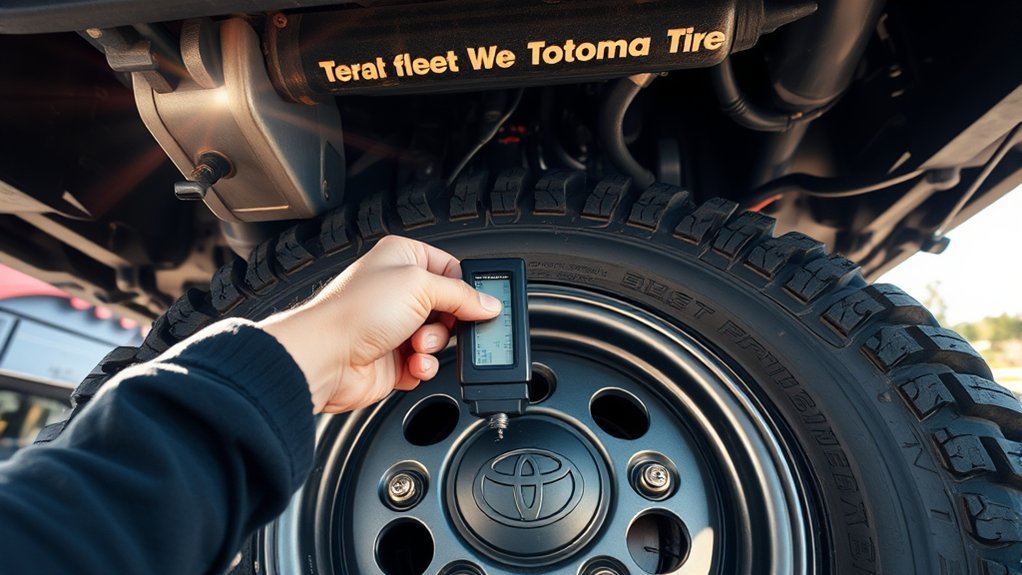
To check your Toyota Tacoma spare tire pressure, lower the under-bed spare far enough to reach the valve stem, use an accurate tire pressure gauge, and compare the reading with the pressure listed for your spare. For many temporary spares, the correct pressure is printed on the spare sidewall, often 60 psi, but a full-size spare should follow the pressure listed on your Tacoma’s tire placard or in the Toyota owner’s manual. Check it monthly when the tire is cold so the spare is ready before you need it.
Quick Answer
Lower the Tacoma spare with the factory jack handle, remove the valve cap, press a tire pressure gauge firmly onto the valve stem, and adjust the pressure to the number shown on the spare tire sidewall, door-jamb tire label, or owner’s manual. Check it cold at least once a month.
Key Takeaways
- Do not guess the spare tire PSI. Use the spare sidewall, Tacoma door-jamb tire label, or owner’s manual.
- Check the spare when it is cold, meaning the truck has been parked for at least three hours.
- A TPMS light is not a replacement for manual spare tire checks.
- While the spare is lowered, inspect the tire, valve stem, DOT date code, and hoist cable.
At a Glance
| Time Required | 10 to 20 minutes |
| Difficulty | Easy, if the spare hoist is not stuck |
| Tools Needed | Tire pressure gauge, factory jack handle/tools, air compressor, flashlight, gloves, valve cap |
| Cost | Usually free if you own a gauge and compressor; about $10 to $30 for a basic gauge |
Understanding the Importance of Spare Tire Pressure
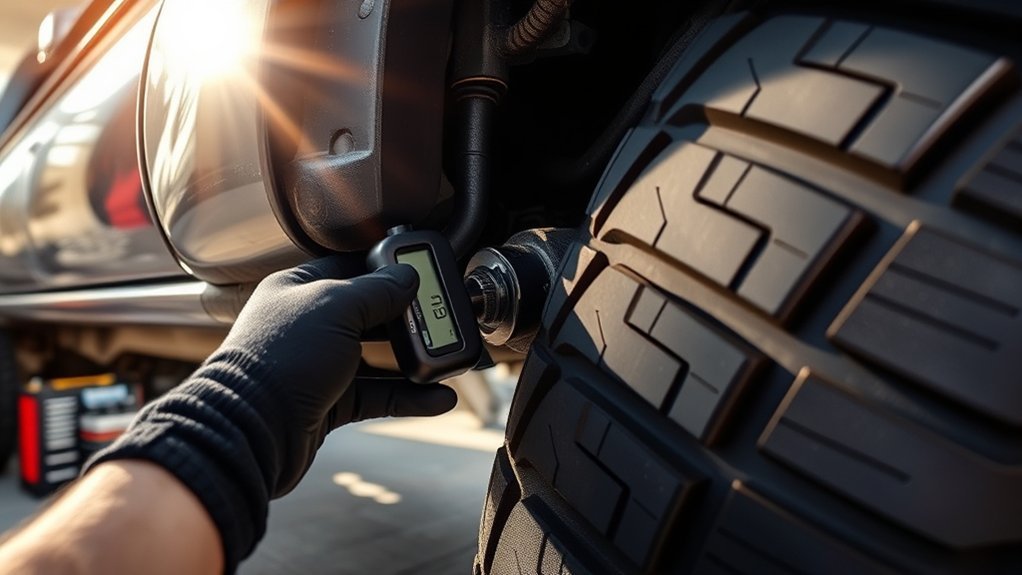
A properly inflated spare tire is not just a convenience. It can decide whether a flat tire becomes a short delay or a long roadside problem. Your Tacoma’s spare sits under the truck, where it is easy to forget, and it can lose air slowly over time even when you never use it.
The National Highway Traffic Safety Administration recommends checking all tires, including the spare, at least once a month when they are cold. This matters because low pressure can create extra heat, reduce handling, shorten tire life, and make the spare unsafe when you need it.
The most important rule is simple: use the correct pressure for your exact spare. If your Tacoma has a temporary spare, the tire sidewall may list a higher pressure such as 60 psi. If your Tacoma has a full-size spare, use the cold pressure listed on the tire and loading information label on the driver’s doorjamb or in your owner’s manual.
How to Find the Correct Toyota Tacoma Spare Tire PSI
Do not rely on a generic PSI number from an online chart. Tacoma model years, trims, wheel sizes, and spare types vary. The right pressure is the one Toyota or the tire label gives for your vehicle.
| Where to Check | What It Tells You | Best Use |
|---|---|---|
| Spare tire sidewall | Maximum or specified pressure for that spare | Best for temporary or compact spares marked “temporary use only” |
| Driver’s door-jamb tire label | Toyota’s recommended cold pressure for original tire sizes | Best for full-size spares matching the road tires |
| Owner’s manual | Model-specific tire, spare, jack, and TPMS instructions | Best when tire size, trim, or spare type is unclear |
Note: The pressure printed on the tire sidewall is not always the same as the recommended operating pressure for the truck’s road tires. For normal tires, use the Tacoma tire placard or manual. For a temporary spare, follow the pressure marking and Toyota’s instructions for that spare.
Tools for Checking Spare Tire Pressure
To check your Tacoma spare tire pressure accurately, gather the tools before you lower the spare. A visual check is not enough because a tire can look normal while it is underinflated.
- Tire pressure gauge: Digital, dial, or pencil-style gauges work if they are accurate and rated high enough for your spare.
- Factory jack handle and tool kit: These operate the spare tire lowering mechanism on most Tacoma models.
- Portable air compressor: A 12-volt or cordless compressor makes it easier to add air at home.
- Flashlight and gloves: Useful because the spare, cable, and valve area can be dirty under the truck.
- Soapy water: Helps reveal slow leaks at the valve stem or bead by forming bubbles.
- Valve caps: Replace a missing cap to help keep dirt and moisture out of the valve.
Pro Tip: Keep a compact gauge and valve caps in the glove box. If your Tacoma’s spare is under the bed, checking it is much easier when the gauge is already in the truck.
[Products Worth Considering]
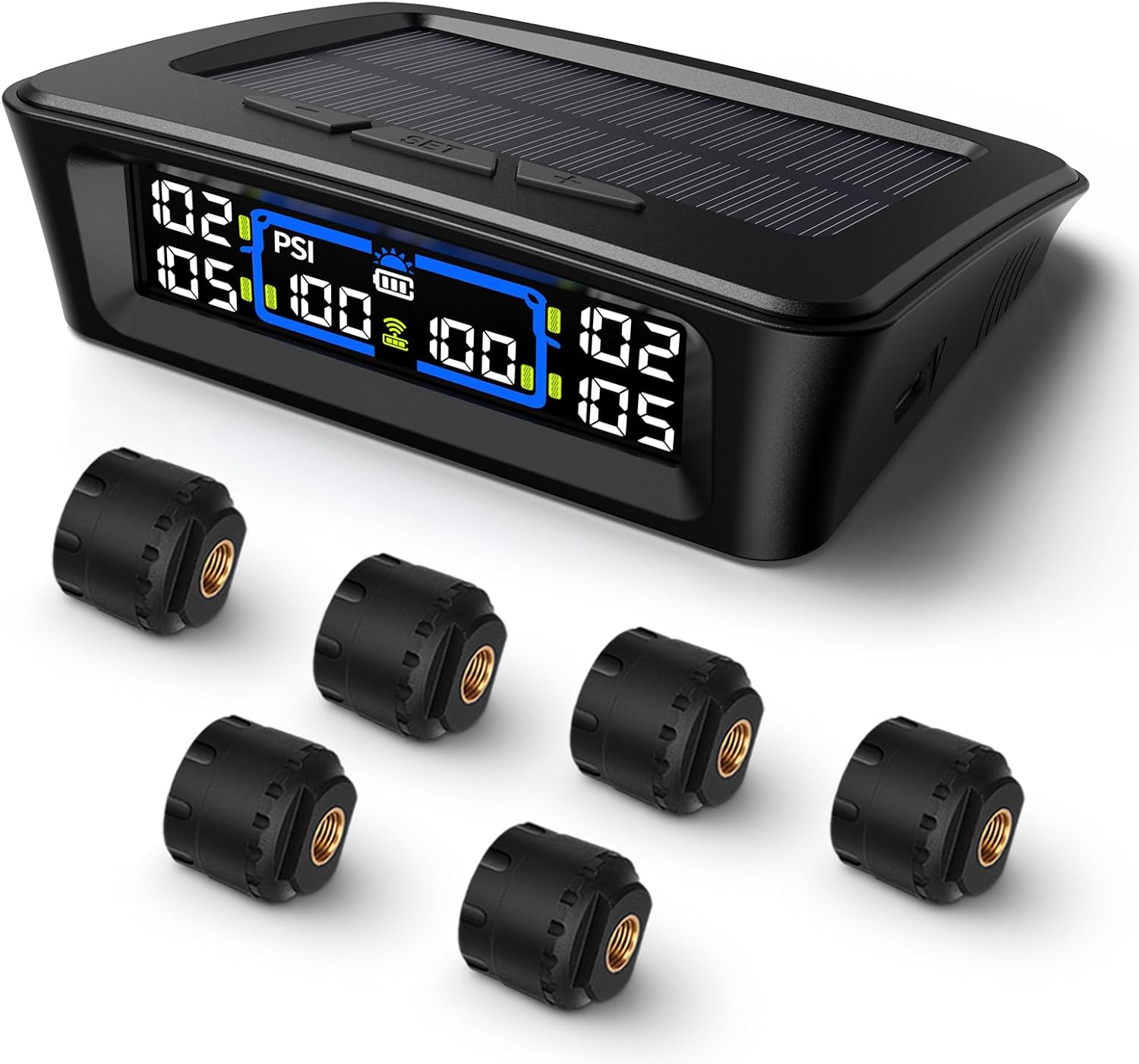
The Tymate TM12 RV TPMS delivers real-time tire pressure and temperature monitoring with a stable 433Hz display for safer long-distance driving. It supports simultaneous monitoring across vehicle and trailer zones, includes six alarm modes for pressure, temperature, leakage, battery, and signal loss, and features easy DIY installation with auto calibration. Power is supplied via USB-C charging or solar recharging, with a wide 0–144 PSI range and up to 50 ft signal coverage for RVs and towable trailers.

The Dr.Roc spare tire tool kit helps you release, lower, or raise your spare tire with reliable extension tools and a lug nut wrench. It is made from rustproof automotive-grade steel and includes an organized carry case for convenient storage. Designed for compatibility with select GM models from the late 1990s through 2019, it uses upgraded extension components to install and remove spare tires with less hassle.

This spare tire tool kit is designed for the 2004 to 2018 Ford F-150 to help you loosen and tighten wheel lug nuts and manage the spare tire and provided jack functions from underneath the vehicle. It includes the lug nut wrench and extension pieces plus a convenient storage carrying case for organized transport. The jack itself is not included.
Step-by-Step Guide to Lowering Your Spare Tire
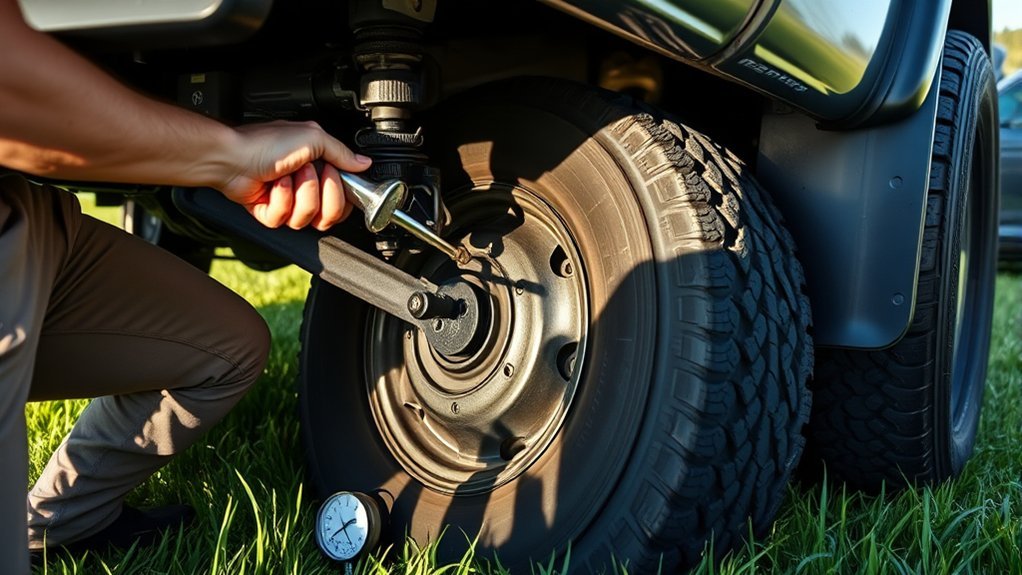
Most Toyota Tacoma spare tires are stored under the rear of the truck. You usually need the factory tool kit to lower the spare far enough to reach the valve stem and check the pressure.
Warning: Park on level ground, set the parking brake, and keep your hands, feet, and body clear of the spare as it lowers. Never crawl under a vehicle supported only by a jack.
[Products Worth Considering]

ETENWOLF’s tire pressure gauge helps you quickly and accurately check tire PSI across cars, trucks, motorcycles, bikes, and more. It’s manually calibrated to ANSI B40.1 Grade A for reliable readings, includes a large glow dial for easy nighttime viewing, and features a 360-degree swivel chuck for use at any valve angle. The gauge also works consistently in extreme hot or cold weather.

These aluminum alloy tire valve stem caps with an O-ring seal help protect valve stems from corrosion while adding a clean, stylish look to your vehicle. The universal fit works across cars, trucks, motorcycles, bicycles, and more, making them an easy upgrade for everyday driving and off-road use. Installation is quick, and the included four-pack keeps all your tires dressed and protected.

The TYAMATE TM8 solar-powered wireless TPMS delivers real-time tire pressure and temperature monitoring with six alarm modes for safer driving. A vibrant color LCD display shows readings clearly while windshield mounting keeps it hands-free and easy to read. With a wide 0–87 PSI range, strong 433.92 MHz signal transmission, and quick sensor pairing, it’s ideal for RV, sedan, SUV, MPV, and truck use.
Tools Needed For Lowering
Use the jack handle sections and related tool pieces supplied with your Tacoma. Depending on the model year and cab style, the tool kit may be stored behind or under a seat, in a storage compartment, or in another location shown in the owner’s manual. If the factory tool kit is missing, replace it before you need the spare during a roadside emergency.
Step-by-Step Lowering Process
- Park safely. Choose flat, firm ground. Shift to Park or gear, set the parking brake, and turn on hazard lights if you are near traffic.
- Clear the rear area. Move cargo, trailer gear, mud, or debris that blocks access to the spare tire crank point.
- Assemble the jack handle. Fit the tool sections together as described in your Tacoma owner’s manual.
- Insert the handle into the spare hoist access point. On many Tacomas, this is accessed from the rear bumper area.
- Turn the handle slowly. Lower the spare until it rests on the ground or until the valve stem is easy to reach.
- Do not force the hoist. If the cable or mechanism binds, stop and inspect it. Forcing a rusty or stuck hoist can damage the cable or retainer.
- Check the pressure. Once the valve is accessible, remove the cap and use your gauge.
- Raise the spare securely. After checking and adjusting pressure, raise the tire until it is tight against the carrier and does not swing.
How to Measure Tire Pressure Accurately
Accurate tire pressure readings depend on timing and technique. Tire pressure rises as tires warm from driving, so the best time to check the spare is when the truck has been parked for at least three hours.
- Remove the valve cap and place it somewhere clean.
- Press the tire pressure gauge straight onto the valve stem.
- Hold it firmly until the reading stabilizes.
- Compare the reading with the spare sidewall, tire placard, or owner’s manual.
- If pressure is low, add air in short bursts and recheck.
- If pressure is high, release air slowly and recheck.
- Reinstall the valve cap tightly by hand.
If air hisses while you press the gauge, the gauge is not seated squarely. Remove it and try again. A crooked gauge reading can make the tire look lower than it really is.
[Products Worth Considering]

Secure a full-size spare on your trailer with this powder-coated steel spare tire mount bracket. It fits most 4-, 5-, and 6-lug wheel bolt patterns and mounts to trailer tongues up to 4 in wide and 5 in tall. Built for reliable carry with a max 150 lb load rating and includes zinc-plated hardware for straightforward installation.

Upgrade your Toyota tire setup with these corrosion-resistant, leak-proof valve stem caps designed to help protect the valve core from water, snow, and road grime. The caps feature a snug rubber seal and durable copper alloy construction to resist rust and oxidation while maintaining stable tire pressure. Ideal for replacing worn original caps and keeping your wheels looking clean and stylish.
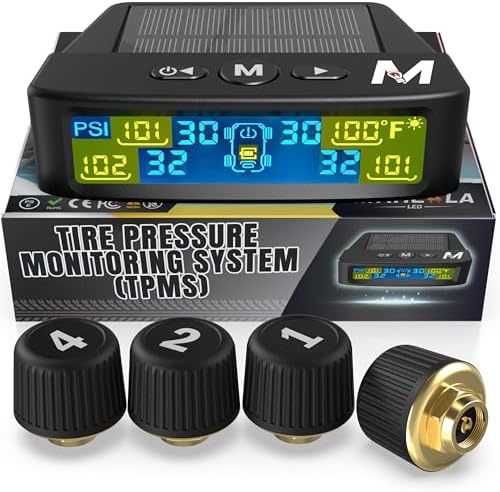
Marcala’s TPMS set of four sensors helps you monitor tire pressure and temperature in real time while driving, with updates every second. The bright color LCD uses auto-dimming for easy viewing, powered by dual solar and USB charging, and offers six alarm modes. Built for trailers, RVs, campers, trucks, and towing setups, the sensors support monitoring 1-4 wheels up to 98 PSI with IP67 waterproof protection.
When to Inflate or Deflate Your Spare Tire?
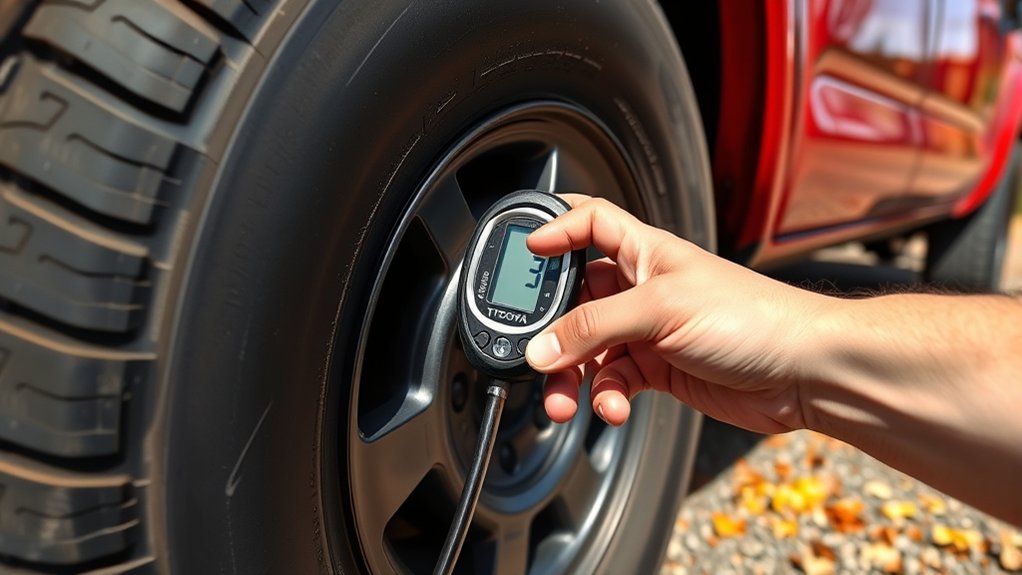
Inflate or deflate your spare whenever the cold reading does not match the pressure specified for that spare. A small pressure change can happen with temperature swings, seasonal weather changes, and long storage.
- Inflate it if the reading is below the specified pressure.
- Deflate it if the reading is above the specified pressure and the tire is cold.
- Recheck it cold if you added air after driving or after the spare sat in direct sun.
- Inspect it again if it loses pressure between monthly checks.
If you are checking pressure on the roadside after driving, treat the reading as temporary. Add enough air to avoid obvious underinflation, then check again later when the tire is cold.
Common Tire Pressure Problems and Solutions
Spare tire pressure problems are often simple, but they can leave you stranded if you ignore them. Use this table to identify the cause and next step.
| Problem | Likely Cause | What to Do |
|---|---|---|
| Spare is low every month | Slow valve, bead, or puncture leak | Use soapy water to check for bubbles and have the tire inspected. |
| Valve stem leaks | Loose core, damaged stem, or dirt | Replace the valve cap and have the valve serviced if bubbles appear. |
| Spare will not lower | Rust, jammed hoist, damaged cable, or missing tool | Do not force it. Clean the area and schedule service if the hoist stays stuck. |
| TPMS light stays on | Low road tire, spare sensor issue, reset needed, or TPMS malfunction | Check all road tires and the spare manually, then follow the owner’s manual reset procedure if required. |
| Sidewall cracks or bulges | Age, impact damage, or dry rot | Do not rely on the spare. Replace it before an emergency. |
The Role of TPMS in Monitoring Spare Tire Pressure
The Tire Pressure Monitoring System, or TPMS, warns you when one or more monitored tires are significantly underinflated. Federal TPMS rules require the system to warn drivers about significant underinflation, but the system is not a substitute for checking pressure manually.
TPMS Functionality Overview
A direct TPMS uses pressure sensors mounted in the wheels. An indirect system estimates pressure changes through wheel-speed data and other signals. Tacoma systems vary by model year and trim, so always confirm how your system works in the owner’s manual.
Under federal rules, the low tire pressure warning must illuminate when pressure is significantly below the manufacturer’s recommended cold inflation pressure. The same rules also require a malfunction warning when the TPMS cannot operate correctly.
Importance of Spare Tire Monitoring
Some Tacoma configurations may monitor the spare, while others may not. Even when the spare has a sensor, you should still check it manually once a month. A spare can sit under the truck for years, lose pressure slowly, or age without triggering a warning you notice.
Note: If the TPMS light flashes for about a minute and then stays on, treat it as a possible TPMS malfunction and check your owner’s manual or have the system inspected.
Common TPMS Issues
- Low pressure: One or more tires may be below the warning threshold.
- Spare not monitored: The spare may need manual checks even if the road tires are monitored.
- Dead sensor battery: A sensor can stop transmitting after years of use.
- Aftermarket wheels: Some replacement wheels or sensors may not communicate correctly.
- Reset or relearn needed: Some systems need a reset after pressure changes or wheel service.
How to Maintain Your Spare Tire for Emergencies
Pressure is only one part of spare tire maintenance. While the spare is lowered, inspect the tire and the under-bed carrier so you know the spare will work when you need it.
- Check pressure monthly: Use a gauge when the tire is cold.
- Look for cracks, cuts, or bulges: Replace the tire if the sidewall is damaged.
- Check the DOT date code: The last four digits show the week and year the tire was made.
- Inspect tread: Do not use a bald or damaged spare as a regular replacement tire.
- Check the valve stem: Replace cracked stems and missing caps.
- Inspect the hoist cable: Look for rust, kinks, or loose hardware.
- Confirm tools are present: Make sure the jack handle, jack, and lug wrench are in the truck.
NHTSA warns that spare tires can age because they are rarely replaced. If the spare is old, cracked, or unable to hold pressure, replace it before you count on it during a flat.
Community Insights on Efficient Tire Pressure Checks
Tacoma owners often share one practical lesson: make the spare tire check part of your normal monthly tire routine. It is easy to check the four road tires and forget the spare under the bed, but the spare is the one tire you may need when you are already dealing with stress, traffic, bad weather, or darkness.
Essential Checking Tools
- A gauge that reads high enough: Choose one that can read the pressure listed for your spare.
- A compact compressor: Helpful if your spare is low while it is still under the truck.
- Flashlight: Makes the valve stem and hoist easier to see.
- Gloves or a towel: The under-bed spare can collect dirt, road salt, and mud.
Common Checking Techniques
The most efficient method is to lower the spare enough to reach the valve, check pressure with a gauge, adjust it with a compressor, and raise it back tightly. If you do not want to fully remove the spare, lower it only as far as needed to access the valve stem safely.
After adding air, wait a few seconds and check again. If the reading drops quickly, apply soapy water to the valve stem and bead area. Bubbles point to a leak that needs service.
Community Preferred Practices
- Check the spare whenever you check the four road tires.
- Lower the spare at home before a road trip to make sure the hoist works.
- Keep the factory tools in their storage location so they do not get lost.
- Replace missing valve caps right away.
- Do not wait for a TPMS warning before checking the spare manually.
Frequently Asked Questions About Spare Tire Maintenance
How often should I check my Toyota Tacoma spare tire pressure?
Check it at least once a month when the tire is cold. Also check it before long trips, towing, off-road travel, or any trip where a flat tire would be harder to handle.
Should my Tacoma spare tire be 60 psi?
Only use 60 psi if your spare tire sidewall, tire label, or owner’s manual specifies 60 psi. Many temporary spares use higher pressure, but a full-size spare should follow the Tacoma placard or manual for that tire size.
Can I check the spare tire without lowering it?
Sometimes, but it depends on valve position and access. Lowering the spare is usually the most reliable way to reach the valve stem, inspect the tire, and confirm the hoist works.
What should I inspect while the spare is down?
Check pressure, tread, sidewall cracks, bulges, punctures, valve condition, DOT age code, and the spare hoist cable. A spare that is flat, cracked, or stuck under the truck is not emergency-ready.
Frequently Asked Questions
How do you look at tire pressure on a Toyota Tacoma?
Use a tire pressure gauge on the valve stem. For the road tires, compare the reading with the driver’s door-jamb tire label. For the spare, check the spare sidewall and owner’s manual, especially if it is a temporary spare.
Does a spare tire show tire pressure?
Not always. Some vehicles may monitor the spare through TPMS, but many spares are not shown in the pressure display. The safest habit is to check the spare manually with a gauge.
What if the Tacoma TPMS light stays on after I inflate the tires?
Check all four road tires and the spare manually. If pressures are correct and the light stays on, follow the owner’s manual reset or initialization procedure. If the light flashes and then stays on, have the TPMS inspected.
Can I drive normally on a temporary spare?
No. If the spare is marked “temporary use only,” use it only long enough to repair or replace the damaged tire. Follow the speed, distance, and load limits printed on the spare and listed in your owner’s manual.
Conclusion
Keeping your Toyota Tacoma spare tire properly inflated is one of the easiest ways to avoid a bad roadside surprise. Lower the spare, check it with a gauge, use the correct PSI from the spare sidewall, tire placard, or owner’s manual, and inspect the tire while it is down. Do this monthly when the tire is cold, and your spare will be far more likely to work when you need it.
Sources
- Toyota Manuals and Warranties — official source for model-specific Tacoma owner’s manual instructions.
- Toyota Warning Lights — Toyota guidance to consult the owner’s manual for vehicle-specific warning lights and indicators.
- NHTSA TireWise — monthly tire pressure checks, cold pressure guidance, spare checks, tire aging, and TPMS limitations.
- 49 CFR 571.138, Tire Pressure Monitoring Systems — federal TPMS warning threshold, malfunction behavior, and required owner manual language.