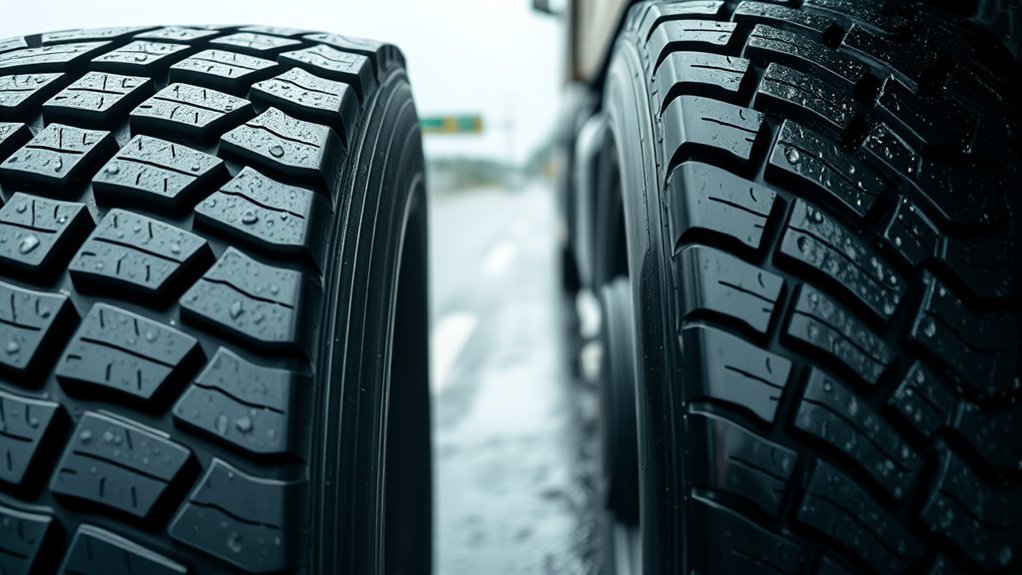
Tire width affects how your truck grips the road, how it feels when turning or braking, and how much energy it takes to keep rolling. Wider tires can help in mud, sand, snow, towing, and off-road use, but they can also add weight, increase rolling resistance, and hurt fuel economy if the size, tread, pressure, and alignment are not matched to the truck.
Quick Answer
Wider truck tires usually improve grip and stability by putting more tread on the ground, but they do not automatically improve performance. If the wider tire is heavier, more aggressive, underinflated, or outside the manufacturer-approved size range, it can reduce MPG, change handling, and create fitment or safety issues.
Key Takeaways
- Wider tires can improve traction, especially off-road or under heavy loads, but tread design and rubber compound matter just as much as width.
- Fuel economy usually drops when a tire adds rolling resistance, weight, aggressive tread, or aerodynamic drag.
- A narrower or low-rolling-resistance tire may improve MPG for highway and city driving.
- Before changing width, check wheel width, load rating, clearance, overall diameter, speedometer accuracy, and the tire size recommended by your truck manufacturer.
Understanding Tire Width and Its Impact on Performance
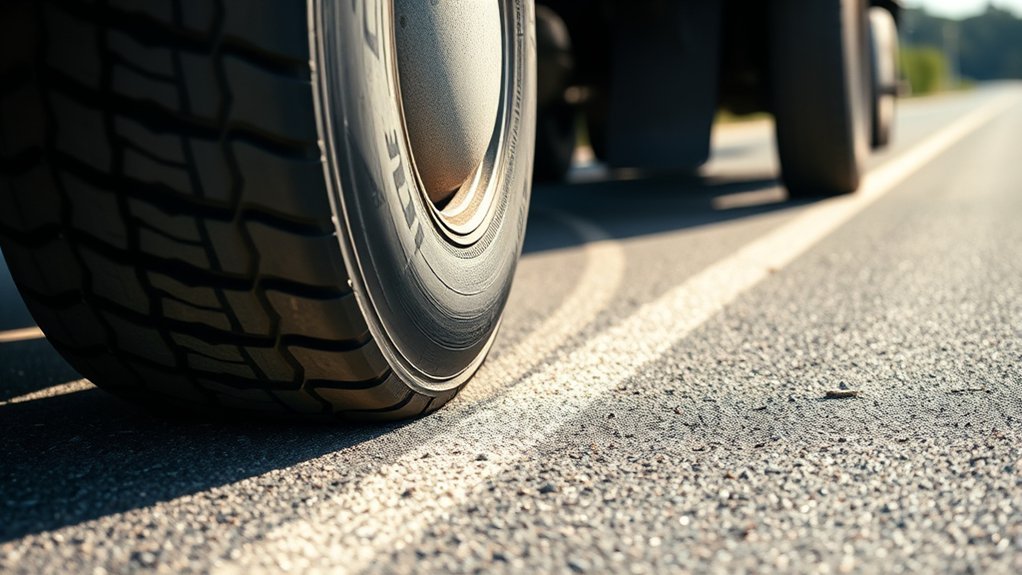
Tire width is the first three-digit number in many tire sizes. For example, in a size such as P265/70R17, the “265” means the tire’s nominal section width is 265 millimeters. That width influences the tire’s footprint, sidewall shape, weight, and how it fits on the wheel.
A wider tire can give your truck a larger contact area and a more planted feel, especially when cornering, braking, towing, or driving on loose surfaces. However, tire width does not work by itself. The tire’s tread pattern, rubber compound, inflation pressure, load rating, construction, and overall diameter can change the result.
Warning: Do not choose a wider tire only because it fits the wheel well. Use a size approved by your truck manufacturer or verified by a qualified tire professional. The tire must clear the suspension and fenders, match the correct wheel width, and meet or exceed the required load index and speed rating.
The Relationship Between Tire Width and Traction
Tire width can improve traction because more tread may be available to interact with the road, trail, mud, sand, or snow. This is why many off-road and towing setups use wider tires: the extra footprint can help spread the load and improve stability.
That said, a wider tire is not always the best traction choice. In deep snow, for example, a narrower tire can sometimes cut down through loose snow better than a wide tire that floats on top. On wet roads, tread depth and water-channeling design are critical because worn or poorly matched tires can hydroplane more easily.
- Dry pavement: Wider performance-oriented tires may improve cornering grip if the compound and tread are suited to the road.
- Wet pavement: Tread depth, siping, and water evacuation matter more than width alone.
- Mud and sand: Wider tires can help flotation, especially when paired with the right tread and pressure for off-road use.
- Snow and ice: Winter-rated tires usually matter more than extra width.
- Towing and hauling: The correct load rating and inflation pressure are more important than simply going wider.
How Tire Width Affects Rolling Resistance
Rolling resistance is the energy a tire loses as it flexes and rolls under load. A tire with more rolling resistance requires more energy from the engine, which can reduce fuel economy. Official fuel-economy guidance also connects proper tire pressure with MPG because underinflated tires flex more and waste more energy.
Width can affect rolling resistance, but it is only one piece of the puzzle. A wider tire may add rubber mass, tread width, and aerodynamic drag. It may also use a more aggressive tread pattern. Those changes can increase energy loss. However, a modern low-rolling-resistance tire in a slightly wider size may still outperform a narrower tire with a heavy, aggressive tread.
The real MPG question is not “wide or narrow?” It is “how much rolling resistance, weight, tread aggressiveness, and diameter am I adding?”
How Tire Width Impacts Your Fuel Economy
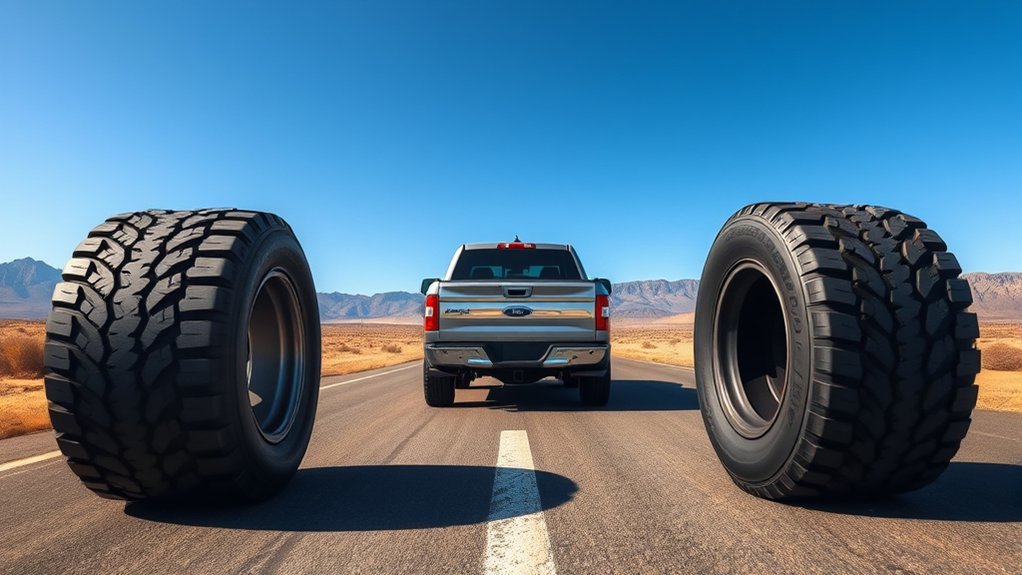
Changing tire width can affect fuel economy in several ways. The most common MPG loss happens when the new tire is wider, heavier, taller, and more aggressive than the original tire. That combination can require more energy to accelerate, keep rolling, and maintain highway speed.
Tire Width and Rolling Resistance
Wider tires often have more tread rubber and a larger footprint. More rubber flexing against the road can increase rolling resistance, especially if the tire is underinflated or built with an aggressive all-terrain or mud-terrain tread.
For the best balance, compare tires by more than size. Look for the tire’s intended use, weight, tread pattern, warranty, load index, and whether it is marketed as a fuel-efficient or low-rolling-resistance design.
Impact on Aerodynamics
A wider tire can stick farther into the airflow around the wheel opening. At highway speeds, that can add drag. The effect depends on your truck’s body shape, wheel offset, tire sidewall profile, lift height, and whether the tire protrudes past the fender.
| Change | Likely MPG Effect | Why It Matters |
|---|---|---|
| Slightly wider highway tire, same diameter | Small change, sometimes barely noticeable | Width changes less than tread design, pressure, and tire weight. |
| Wider all-terrain tire | Possible MPG drop | Extra tread depth, stronger casing, and added mass increase energy demand. |
| Wider mud-terrain tire | More likely MPG drop | Large tread blocks, weight, and noise usually increase rolling resistance. |
| Wider and taller tire | Can noticeably reduce MPG | Added diameter can change effective gearing, acceleration, speedometer reading, and engine load. |
Trade-Offs in Traction
The traction benefit of a wider tire is most useful when your driving conditions actually need it. If your truck spends most of its time on paved roads, a moderate-width highway or all-terrain tire may deliver better MPG, quieter ride quality, and longer tread life than the widest tire that fits.
If your truck spends a lot of time off-road, on job sites, or towing heavy loads, the extra footprint and stability may be worth the fuel-economy trade-off. The right choice depends on how the truck is used.
Selecting Tire Width Based on Driving Conditions
Start with the tire size listed on your truck’s Tire and Loading Information Label or owner’s manual. From there, choose the tire width that fits your actual use.
- Daily highway driving: Stay close to the factory size and choose a road-focused tread for better MPG and lower noise.
- City driving: Avoid unnecessary tire weight. Stop-and-go driving makes heavy tires more noticeable.
- Towing and hauling: Prioritize load index, tire pressure, heat resistance, and stability over width alone.
- Off-road trails: Wider all-terrain tires may help with grip and flotation, but confirm clearance at full steering lock and suspension compression.
- Mud: Choose tread pattern first. Width helps only when the tread can clean itself and maintain bite.
- Snow and ice: Use winter-rated tires when conditions require them; extra width is not a substitute for winter traction.
Pro Tip: When comparing two tire sizes, check the actual tire weight and revolutions per mile, not just the width number. A small increase in width with the same diameter may feel minor, while a wider and taller tire can change gearing and MPG much more.
[Products Worth Considering]

Measure tire tread depth quickly and accurately with this LUMITECO dial gauge that reads in 1/32" increments up to 14/32". The color-coded green/yellow/red zones make it easy to judge tire wear and know when replacement is needed. A rugged, compact design with a protective pouch helps keep the gauge ready for use on cars, trucks, motorcycles, and more.

Keep your tires properly inflated with this analog VONDIOR tire pressure gauge, designed for fast, easy readings without batteries. The swiveling, two-axis hose and large glow dial help you measure at any tire angle with instant visibility. Built with a protective rubber shield, it supports durable, low-maintenance use for cars and trucks.

Monitor tire tread wear with a smart, color-coded depth gauge that shows clear condition ranges at a glance. The bar is range marked for fast, easy readings, helping you maintain safer traction and performance. Each gauge is portable with a pocket clip, and the set includes 20 units for daily use and sharing.
What to Check Before Going Wider
Before changing tire width, confirm these fitment and safety points:
- Approved size: Check your owner’s manual, tire placard, or a trusted tire fitment guide.
- Load index: The replacement tire should meet or exceed the required load capacity for your truck.
- Wheel width: The tire must be approved for the width of your wheel.
- Clearance: Check fenders, suspension, brake lines, mud flaps, and control arms at full steering lock.
- Overall diameter: Taller tires can affect speedometer accuracy, transmission shift behavior, and effective gearing.
- Offset and poke: Tires that stick out past the fender can increase spray, drag, and legal issues in some areas.
- Pressure: Use the correct cold inflation pressure for the vehicle and tire setup, not the maximum pressure printed on the sidewall.
- Alignment: After changing tire size, verify alignment to reduce uneven wear and rolling resistance.
[Products Worth Considering]

The SAFELIFE dial tire tread depth gauge measures tread depth in 1/32 inch increments with clear, easy-to-read 2-inch dial face. Color zones using a traffic light system help you quickly judge whether tread is low, marginal, or ample for safer driving. Built with a durable zinc cast body and a metal detect probe for precise, comfortable use across cars, motorcycles, trucks, and buses.

Accurately measure tire tread depth with a calibrated gauge marked from 0 to 1 inch in 1/32 inch increments. The color-coded bar helps you quickly identify tread condition ranges, supporting safe driving for trucks, motorcycles, automobiles, and passenger vehicles.

The TYAMATE TM8 solar-powered wireless TPMS delivers real-time tire pressure and temperature monitoring with six alarm modes for safer driving. A vibrant color LCD display shows readings clearly while windshield mounting keeps it hands-free and easy to read. With a wide 0–87 PSI range, strong 433.92 MHz signal transmission, and quick sensor pairing, it’s ideal for RV, sedan, SUV, MPV, and truck use.
Debunking Myths About Tire Width and Fuel Economy
Myth: Wider Tires Always Destroy MPG
Wider tires can reduce mileage, but the effect is not automatic. A wider tire that is only slightly larger and built for highway efficiency may have a small impact. A much wider, heavier, taller mud-terrain tire can have a much larger impact.
The better rule is this: MPG usually drops when the new tire adds rolling resistance, rotating mass, aggressive tread, or aerodynamic drag.
Myth: Narrow Tires Are Always More Efficient
Narrower tires can help fuel economy because they often weigh less and expose less rubber to the road. But a narrow tire with poor construction, soft compound, underinflation, or an aggressive tread can still waste fuel.
For fuel economy, look for the best match of size, load rating, tread design, pressure, and low rolling resistance.
Myth: More Traction Always Means More Fuel Cost
There is often a trade-off between traction and fuel economy, but modern tire design can reduce that compromise. Some tires are engineered to maintain wet traction while lowering rolling resistance. This is why comparing tire category and specifications matters more than judging width alone.
Optimize Your Tire Performance With These Maintenance Tips
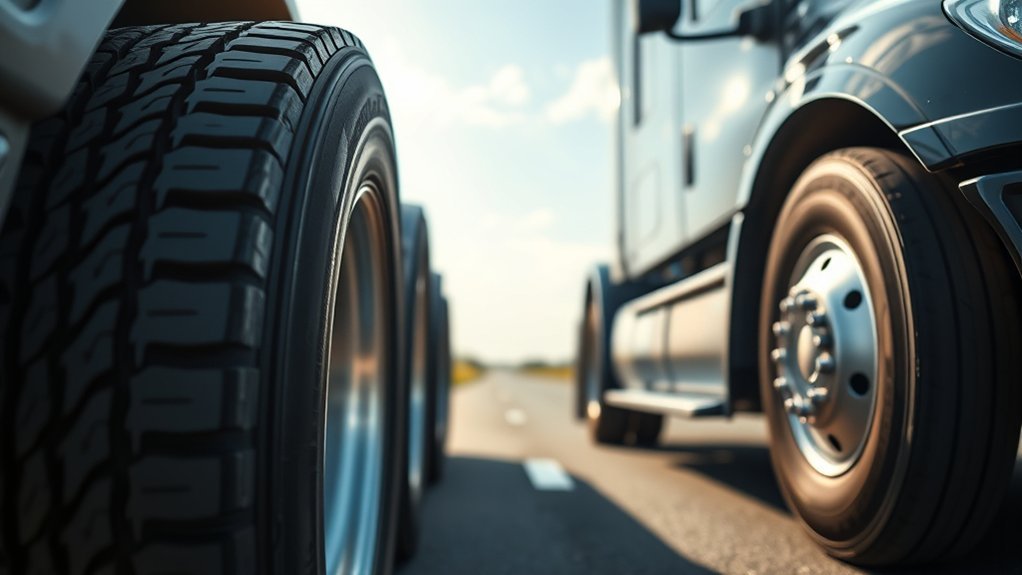
Even the right tire width will perform poorly if the tires are neglected. Tire pressure, tread depth, rotation, balance, and alignment all affect traction, fuel economy, and tire life.
- Check tire pressure monthly: Measure pressure when tires are cold, ideally before driving or after the truck has been parked for at least three hours.
- Use the placard pressure: The correct pressure is listed on the Tire and Loading Information Label or in the owner’s manual. Do not use the tire sidewall maximum as your normal target pressure.
- Watch tread depth: Replace tires when tread is worn to 2/32 inch, or sooner if wet, snow, or towing performance has become unsafe.
- Rotate when recommended: If your vehicle manufacturer recommends rotation, many trucks use a 5,000- to 8,000-mile interval, or sooner if uneven wear appears.
- Balance and align: Poor alignment increases tire wear and can add rolling resistance.
- Do not ignore TPMS: A tire-pressure warning means at least one tire is significantly underinflated and should be checked as soon as possible.
Note: If you changed tire size, your factory placard pressure may not be perfect for the new setup. Ask a qualified tire professional to confirm the correct cold inflation pressure for the replacement size, load, and use.
[Products Worth Considering]
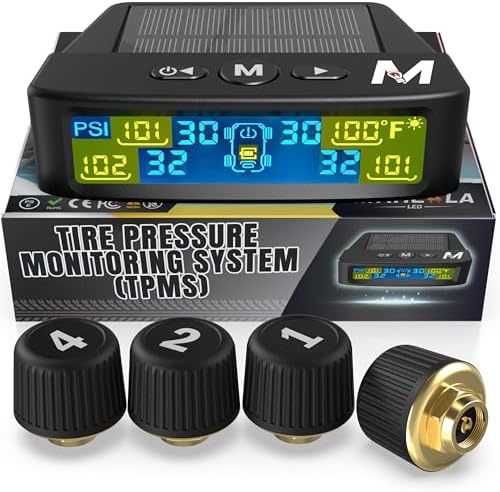
Marcala’s TPMS set of four sensors helps you monitor tire pressure and temperature in real time while driving, with updates every second. The bright color LCD uses auto-dimming for easy viewing, powered by dual solar and USB charging, and offers six alarm modes. Built for trailers, RVs, campers, trucks, and towing setups, the sensors support monitoring 1-4 wheels up to 98 PSI with IP67 waterproof protection.
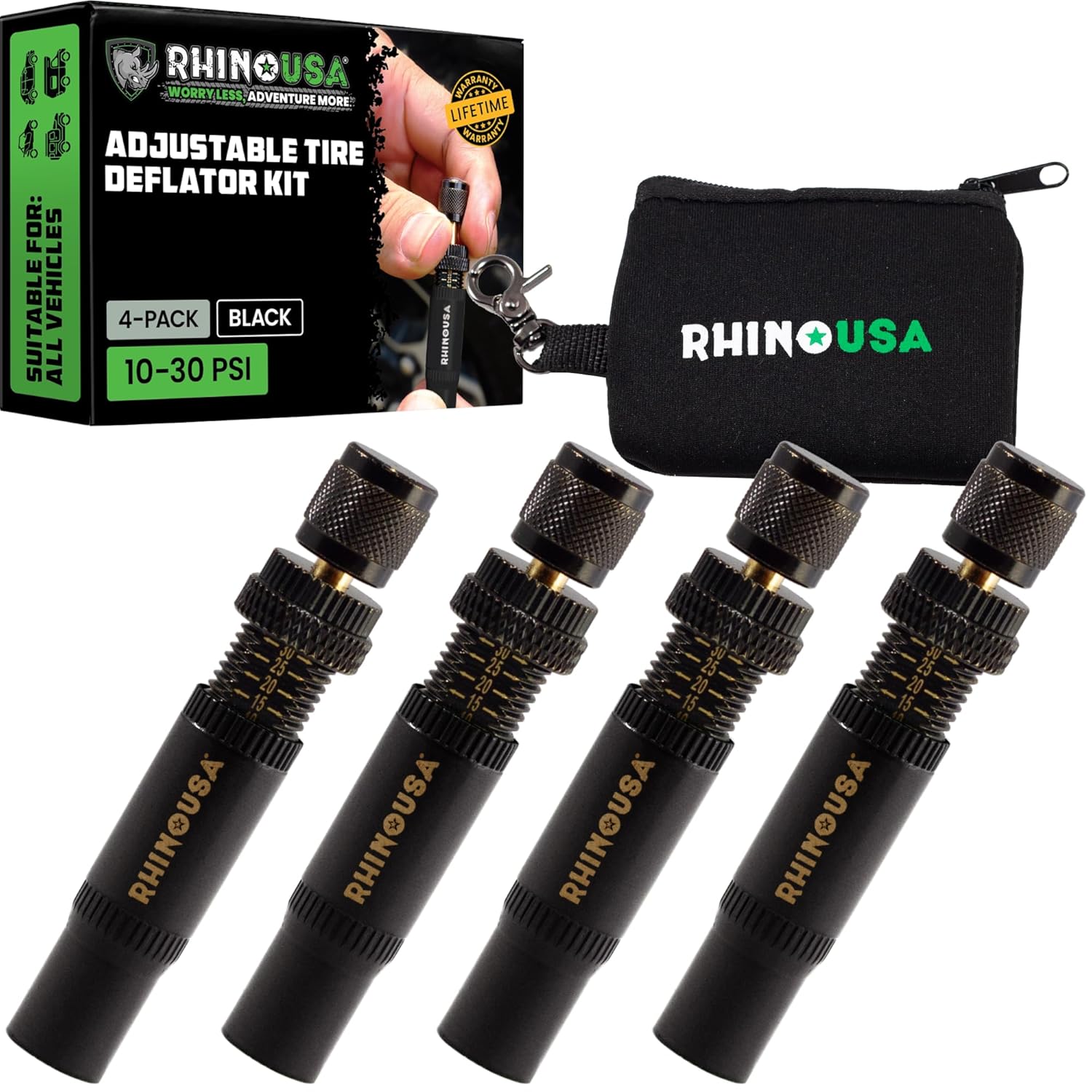
Use the Rhino USA adjustable tire deflators to air down all four tires at once by screwing one deflator onto each valve stem, letting you step away while the tires reach your preset pressure. Each deflator independently adjusts across a 10–30 PSI range with laser-etched indicators for quick setup and verification, making it ideal for beach, sand, and rocky off-road trails.

The Tymate TM12 RV TPMS delivers real-time tire pressure and temperature monitoring with a stable 433Hz display for safer long-distance driving. It supports simultaneous monitoring across vehicle and trailer zones, includes six alarm modes for pressure, temperature, leakage, battery, and signal loss, and features easy DIY installation with auto calibration. Power is supplied via USB-C charging or solar recharging, with a wide 0–144 PSI range and up to 50 ft signal coverage for RVs and towable trailers.
Balancing Traction and Fuel Economy: Making Informed Choices
The best tire width is the one that fits your truck, supports the load, matches your driving conditions, and gives you the traction you need without unnecessary fuel cost.
If you mostly drive on pavement, stay close to the factory size and choose a lighter highway or mild all-terrain tire. If you tow, haul, or drive off-road, a wider tire may be worthwhile, but only if the load rating, clearance, wheel width, and pressure are correct.
Think of tire width as one part of a system. Tire compound, tread, weight, diameter, inflation pressure, alignment, and driving habits all work together to determine how your truck feels and how much fuel it uses.
Frequently Asked Questions
Do 22-inch rims affect gas mileage?
Yes, 22-inch rims can reduce gas mileage if they are heavier than the factory wheels or require wider, heavier, lower-profile tires. The effect depends on total wheel-and-tire weight, tire rolling resistance, overall diameter, tread design, and driving speed.
Do wider truck tires always use more fuel?
No. Wider tires often use more fuel when they add weight, tread width, aggressive tread, or rolling resistance, but width alone does not determine MPG. A low-rolling-resistance tire in a moderate size may be more efficient than a narrower tire with a heavy all-terrain or mud-terrain tread.
Are narrower tires better for fuel economy?
Often, yes, especially for highway and city driving, because narrower tires may weigh less and create less rolling resistance. But tread design, tire compound, inflation pressure, and overall tire weight can matter as much as width.
Can wider tires improve towing stability?
They can help stability in some setups, but towing safety depends more on load index, tire pressure, sidewall strength, trailer weight distribution, and suspension condition. Never choose a tire with a lower load rating than your truck requires.
Will changing tire width affect my speedometer?
Changing width alone may not affect the speedometer much, but changing overall tire diameter can. If the replacement tire is taller or shorter than the factory size, your speedometer, odometer, shift points, and effective gearing may change.
Conclusion
Tire width can make a real difference in your truck’s traction, handling, and fuel economy, but it should never be judged by width alone. Wider tires can improve grip and stability when the terrain or load calls for it, while narrower or low-rolling-resistance tires may be better for daily fuel economy.
For the best result, choose a tire that matches your truck’s approved size range, load needs, wheel width, terrain, and driving style. Then protect that performance with proper cold tire pressure, regular tread checks, rotation when recommended, balancing, and alignment.
Sources
- NHTSA TireWise — tire safety, tire size, pressure, tread, rotation, alignment, and fuel-efficiency guidance.
- FuelEconomy.gov: Keeping Your Vehicle in Shape — official tire-pressure and fuel-economy guidance.
- NHTSA: The Pneumatic Tire — technical explanation of tire sizing, contact patch, rolling resistance, load, pressure, speed, and tire design factors.
- Federal Register: Tire Fuel Efficiency Consumer Information Program — NHTSA rulemaking on rolling resistance, fuel efficiency, traction, and treadwear.