
Rolling resistance is the energy your RAV4 loses as its tires flex, heat up, and return to shape while rolling. Lowering that loss can improve fuel economy, but the best tire choice is not simply the “lowest rolling resistance” tire you can find. You still need the right size, load rating, wet braking, tread life, inflation pressure, and tire matching for your gas, hybrid, AWD, or Prime model.
Quick Answer
Low-rolling-resistance tires can improve a RAV4’s fuel economy modestly, usually around 1–2% when the tire reduces rolling resistance meaningfully. Proper tire pressure, alignment, rotation, and matched tread depth often matter just as much in daily driving because they help the tire roll efficiently and safely.
Key Takeaways
- A 10% reduction in tire rolling resistance is commonly estimated to improve vehicle fuel economy by about 1–2%, according to NHTSA tire guidance.
- Do not trade away wet braking or stability just to chase fuel savings. Look for a balanced touring or all-season tire with proven wet traction.
- Use the cold PSI on the RAV4 door-jamb placard, not the maximum PSI printed on the tire sidewall.
- Toyota’s RAV4 maintenance chart lists tire rotation at every 5,000-mile interval, with damage and uneven-wear checks during rotation.
- For AWD and hybrid RAV4s, keep tires closely matched in size, type, load rating, and tread depth to protect handling and vehicle systems.
At a Glance
| Time Required | 5 minutes for pressure checks; 30–60 minutes for a rotation or alignment inspection at a shop |
| Difficulty | Easy for tire pressure checks; professional help recommended for alignment and tire mounting |
| Tools Needed | Accurate tire-pressure gauge, air source, tread-depth gauge or penny, maintenance log |
| Cost | Pressure checks are free; alignment and tire prices vary by tire size, shop, and region |
Rolling Resistance: What RAV4 Owners Need to Know

Rolling resistance is the force that works against a tire as it rolls. Every time the tire contacts the road, the tread, sidewall, belts, and rubber compound flex. Some of that energy becomes heat instead of forward motion, so the engine or hybrid system must use more energy to keep the vehicle moving.
For a compact SUV like the Toyota RAV4, rolling resistance is not the only drag on fuel economy. Aerodynamic drag, vehicle weight, traffic, speed, road grade, temperature, and driving style all matter. Still, tires are one of the few efficiency factors you can improve without changing the vehicle itself.
NHTSA estimates that a 10% reduction in tire rolling resistance can improve vehicle fuel economy by about 1–2%, which is why tire choice and tire maintenance are worth paying attention to.
The practical goal is simple: choose a tire that wastes less energy while still stopping, steering, and draining water well. For most RAV4 owners, that means a high-quality touring, all-season, or SUV tire with documented fuel-efficiency features and strong wet-traction performance.
How Rolling Resistance Affects RAV4 Fuel Economy: Gas vs. Hybrid
Lower rolling resistance reduces the energy needed to maintain speed. On a gas RAV4, that can mean slightly lower fuel use on steady highway drives and mixed commutes. On a RAV4 Hybrid or RAV4 Prime, it can also help preserve electric range and reduce energy losses, especially in stop-and-go driving where the vehicle frequently blends engine, battery, and regenerative braking behavior.
The improvement is usually modest, not dramatic. If a RAV4 gets 35 mpg and a tire change improves efficiency by 1–2%, the new result might be roughly 35.4–35.7 mpg under similar conditions. That is still useful over many miles, but it should not be sold as a miracle upgrade.
Note: Real-world MPG changes are hard to isolate because weather, speed, tire size, tire pressure, road surface, fuel blend, and driving style can hide or exaggerate the effect of a tire swap.
Tire Features That Change Rolling Resistance
Rolling resistance is mostly shaped by tire construction. When comparing tires for a RAV4, focus on the features below instead of relying only on marketing language.
Rubber Compound
Low-rolling-resistance tires often use advanced silica-rich compounds that reduce energy loss while still maintaining wet grip. A harder compound can roll efficiently, but it may hurt braking or ride quality if it is not engineered well. The best tires balance efficiency with traction, not efficiency alone.
Tread Pattern
A tire with fewer large tread blocks, optimized siping, and stable tread elements can reduce tread squirm. That helps the tire roll more efficiently. However, deep grooves and water channels are still important for rain. Do not choose a low-rolling-resistance tire that performs poorly in wet braking or hydroplaning tests.
Sidewall and Casing
Stiffer or lighter internal construction can reduce flex losses. The tradeoff is that a very stiff tire may ride more firmly or transmit more road noise. For a family SUV like the RAV4, comfort and wet-weather control should remain part of the decision.
Weight and Size
Heavier tires and larger wheel packages can require more energy to accelerate. If you move from the factory wheel-and-tire size to a larger aftermarket setup, you may give back some of the efficiency you hoped to gain. Always match Toyota’s approved tire size, load index, and speed rating unless a qualified tire professional confirms the change is safe.
Real MPG: Expected Gains From Low-Rolling-Resistance Tires

Expect low-rolling-resistance tires to produce small but measurable gains when everything else stays equal. NHTSA’s tire guidance states that a 10% reduction in tire rolling resistance is estimated to improve fuel economy by about 1–2%. The National Academies also describes a similar 1–2% consumer fuel-expenditure reduction from a 10% rolling-resistance cut.
That means the payoff depends on how many miles you drive, fuel prices, and whether the tire costs more than a comparable non-LRR tire. A high-mileage commuter can recover more of the premium than someone who drives only a few thousand miles per year.
| Scenario | What to Expect | What Can Reduce the Gain |
|---|---|---|
| Mostly highway driving | Most consistent chance of seeing a small MPG gain | High speeds, roof racks, strong headwinds, oversized tires |
| City commuting | Possible improvement, especially on hybrid models | Hard acceleration, frequent braking, low tire pressure |
| Cold weather | Pressure maintenance becomes more important | Low ambient temperature, winter fuel, underinflation |
| Worn or mismatched tires | Efficiency and handling can become inconsistent | Uneven tread depth, poor alignment, mixed tire models |
One Tire or Two? Replacement Rules for AWD and Hybrid RAV4s
Replacing just one tire on a RAV4 can be safe in limited situations, but only when the new tire closely matches the others. Size, load index, speed rating, construction type, brand/model, and tread depth all affect rolling circumference and vehicle behavior.
[Products Worth Considering]

Upgrade your Toyota’s wheels with durable aluminum alloy valve stem caps that help protect valve cores from corrosion and direct exposure to road grime, clay, water, and snow. Rubber rings improve sealing to help prevent air leakage and maintain stable tire pressure for safer driving. These caps are easy to install or remove without tools and add a unique, stylish look to your car.

Keep your tires properly inflated with this analog VONDIOR tire pressure gauge, designed for fast, easy readings without batteries. The swiveling, two-axis hose and large glow dial help you measure at any tire angle with instant visibility. Built with a protective rubber shield, it supports durable, low-maintenance use for cars and trucks.

These universal tire valve stem caps help protect valve cores from dust, debris, and moisture while helping maintain stable tire pressure. The corrosion-resistant metal construction and sealed design provide reliable protection in road grime, mud, and winter conditions. Twist-on installation makes them quick to fit on cars, SUVs, trucks, and motorcycles.
Single Tire Replacement
You may be able to replace one tire if the other three are nearly new and the replacement is the same model, size, load rating, speed rating, and tread pattern. If the remaining tires are significantly worn, replacing only one can create a mismatch in rolling circumference and traction.
Some tire shops can shave a new tire to match the tread depth of the others, but this is not available everywhere and may not make economic sense. If the tread-depth difference is meaningful, replacing a pair or all four tires is often the cleaner choice.
Matching Tread Depth
AWD and hybrid systems rely on consistent wheel-speed readings and predictable tire behavior. Even though the RAV4 Hybrid uses an electric rear drive system rather than a traditional mechanical driveshaft to the rear axle, mismatched tires can still affect traction control, stability control, ABS behavior, and handling.
Warning: Do not mix different tire sizes, load ratings, or tire types on a RAV4. For AWD and hybrid models, ask the tire shop to measure tread depth on all four tires before approving a single-tire replacement.
Where to Install Two New Tires
If you replace only two tires, the newer or deeper-tread tires should generally go on the rear axle. Industry safety guidance from the U.S. Tire Manufacturers Association explains that better rear traction helps reduce the risk of oversteer and loss of stability on wet roads.
Choosing Low-RR Tires That Still Stop and Handle Well
A good low-rolling-resistance tire should not feel like a compromise in normal driving. Before buying, compare the tire’s wet braking reputation, hydroplaning resistance, treadwear warranty, noise, comfort, and available sizes for your exact RAV4 trim.
- Start with the door-jamb placard. Use the listed tire size and cold inflation pressure as your baseline.
- Check load index and speed rating. Replacement tires should meet or exceed the original equipment requirements.
- Look for fuel-efficiency language backed by engineering details. Manufacturer pages that mention low rolling resistance, optimized tread, or efficiency-focused compounds are more useful than vague “eco” labels.
- Verify wet traction. Choose tires with strong wet braking and hydroplaning feedback from reputable testing or large owner datasets.
- Match the set. For best handling, use the same model and similar tread depth across all four positions.
Examples of efficiency-focused tires to compare include the Michelin Primacy All Season, which Michelin describes as low rolling resistance, and the Bridgestone Ecopia H/L 422 Plus, which Bridgestone positions as a fuel-efficient SUV/CUV touring tire. These are not the only good options, and availability depends on your RAV4’s wheel size.
[Products Worth Considering]

These aluminum alloy tire valve stem caps with an O-ring seal help protect valve stems from corrosion while adding a clean, stylish look to your vehicle. The universal fit works across cars, trucks, motorcycles, bicycles, and more, making them an easy upgrade for everyday driving and off-road use. Installation is quick, and the included four-pack keeps all your tires dressed and protected.

Measure tire tread depth quickly and accurately with this LUMITECO dial gauge that reads in 1/32" increments up to 14/32". The color-coded green/yellow/red zones make it easy to judge tire wear and know when replacement is needed. A rugged, compact design with a protective pouch helps keep the gauge ready for use on cars, trucks, motorcycles, and more.

The SAFELIFE dial tire tread depth gauge measures tread depth in 1/32 inch increments with clear, easy-to-read 2-inch dial face. Color zones using a traffic light system help you quickly judge whether tread is low, marginal, or ample for safer driving. Built with a durable zinc cast body and a metal detect probe for precise, comfortable use across cars, motorcycles, trucks, and buses.
Maintenance Checklist to Cut Rolling Resistance Today: Pressure, Alignment, Rotation
The cheapest way to reduce wasted tire energy is maintenance. A premium low-rolling-resistance tire will not deliver its full benefit if it is underinflated, misaligned, overloaded, or worn unevenly.
| Task | Target | Why It Matters |
|---|---|---|
| Check tire pressure | Cold PSI on the driver-door placard | FuelEconomy.gov says proper inflation can improve gas mileage by 0.6% on average and up to 3% in some cases. |
| Rotate tires | Follow Toyota’s maintenance schedule and owner’s manual pattern | Toyota’s 2025 RAV4 maintenance chart lists rotation at every 5,000-mile interval. |
| Inspect tread depth | Even wear across the tire and across the axle | Uneven wear can raise noise, reduce wet grip, and signal alignment or suspension issues. |
| Check alignment | Within Toyota/shop specifications | Poor alignment increases scrub, heat, uneven wear, and rolling resistance. |
| Inspect for damage | No bulges, cuts, exposed cords, puncture damage, or sidewall cracking | Damaged tires are a safety issue, not just an efficiency issue. |
Pro Tip: Check pressure in the morning before driving. Tire pressure rises as the tire heats up, so a hot reading can make an underinflated tire look closer to correct than it really is.
OEM vs. Aftermarket: Recommended Low-RR Tire Options for RAV4
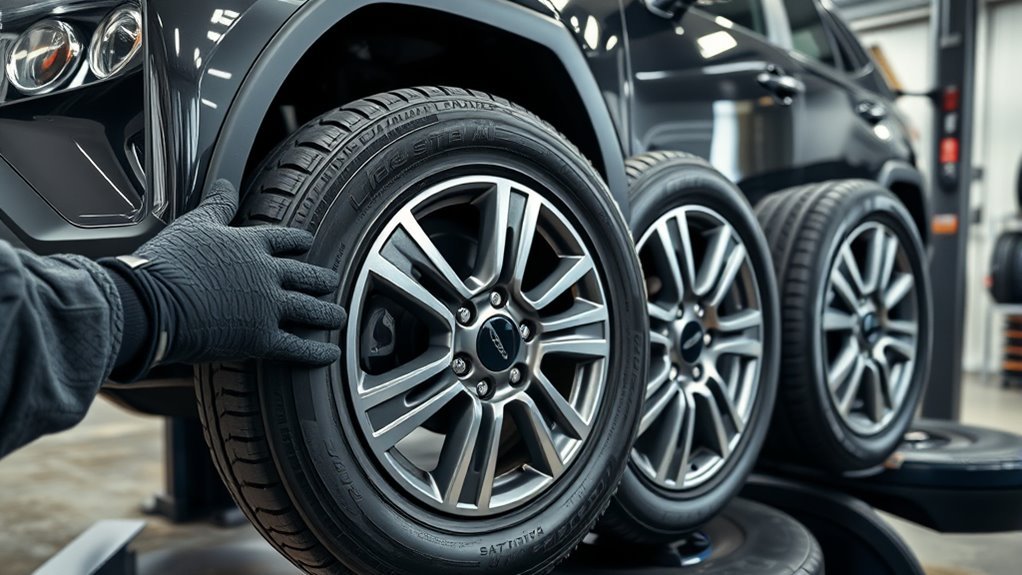
Original-equipment tires are chosen to balance cost, ride quality, noise, fuel economy, availability, and Toyota’s performance targets. They are not automatically the best replacement tire for every driver. Your ideal replacement depends on whether you prioritize MPG, wet braking, winter performance, tread life, quietness, or price.
[Products Worth Considering]

Monitor tire tread wear with a smart, color-coded depth gauge that shows clear condition ranges at a glance. The bar is range marked for fast, easy readings, helping you maintain safer traction and performance. Each gauge is portable with a pocket clip, and the set includes 20 units for daily use and sharing.

The Big Rig Defense Tire Thumper is a truck tire pressure checker that lets you quickly check multiple tires by giving them a firm whack. Listen for a reassuring thump and feel the stick bounce when a tire is fully inflated, helping you get back on the road safely. It features a comfortable, glove-friendly handle and a secure wrist strap for confident use on busy routes.

The Airmoto portable tire inflator quickly and accurately fills car, truck, SUV, motorcycle, and bicycle tires up to 120 PSI with auto shut-off when your target pressure is reached. Its large LCD, multi-unit pressure display, and digital gauge make it easy to dial in settings and verify readings, while the built-in LED flashlight helps in low light. The included polyurethane hard carrying case and storage mesh pocket keep the inflator and accessories protected and organized.
OEM Tire Trade-Offs
OEM tires can be a safe, simple choice because they match the vehicle’s original engineering intent. The downside is that some factory tires emphasize cost, low noise, or efficiency more than long tread life or wet-weather confidence. Before buying the same tire again, compare current owner feedback, warranty mileage, and wet-traction performance.
Best Low-RR Picks to Compare
Instead of treating one tire as the universal “best,” use these categories:
- Efficiency-focused commuting: Look at touring all-season tires with low-rolling-resistance technology, such as Michelin Primacy All Season or Bridgestone Ecopia H/L 422 Plus in compatible sizes.
- Balanced wet-weather daily driving: Prioritize wet braking and hydroplaning performance even if the tire is not the absolute lowest rolling-resistance option.
- Winter or mountain climates: A dedicated winter tire or all-weather tire may be safer than a pure efficiency tire. Winter traction should outrank small fuel savings.
- Heavy loads or frequent road trips: Choose a tire with the correct load index, strong treadwear reputation, and stable highway manners.
Matching Tires to Your Use
For a RAV4 Hybrid commuter, an efficiency-focused all-season tire can make sense. For a RAV4 Adventure or TRD Off-Road that sees rough roads, durability and all-terrain traction may matter more. For rainy regions, wet braking should be near the top of the list. For snowy regions, winter capability matters more than a 1–2% MPG gain.
When comparing tires, ask the shop for three numbers: installed price, treadwear warranty, and expected wet-weather performance. Then confirm the size, load index, speed rating, and whether the tire is suitable for your exact RAV4 model.
Cost vs. Savings: Is Switching to Low-RR Tires Worth It?
Low-rolling-resistance tires are most likely to pay off when you drive a lot, keep the tires properly inflated, and choose a model that does not wear out too quickly. The math is simple:
- Estimate your annual fuel cost.
- Multiply that cost by 0.01 and 0.02 to estimate a realistic 1–2% savings range.
- Compare that annual savings with the price premium of the LRR tire.
- Include tread life. A tire that saves fuel but wears out early may not be cheaper overall.
For example, if you spend $1,800 per year on gas, a 1–2% improvement saves about $18–$36 per year. If the low-rolling-resistance set costs $120 more than a comparable tire, the fuel savings alone may take several years to recover the premium. If the tire also lasts longer or rides better, the value case improves.
Common Mistakes That Cancel Out Low-Rolling-Resistance Gains
- Running low pressure: Underinflation increases flex, heat, wear, and fuel use.
- Using the tire sidewall PSI: The sidewall number is the tire’s maximum pressure, not the RAV4’s recommended cold pressure.
- Skipping rotations: Uneven wear changes handling and shortens tire life.
- Ignoring alignment: A misaligned tire scrubs against the road instead of rolling cleanly.
- Mixing tire models: Different tread patterns and compounds can create uneven traction, especially in rain.
- Upsizing wheels without checking weight: Larger or heavier packages can reduce the efficiency benefit.
- Choosing efficiency over safety: Wet braking, load capacity, and stability matter more than a small MPG gain.
Frequently Asked Questions
What is the rolling resistance of my RAV4 tires?
Most drivers will not find a rolling-resistance coefficient printed on the tire sidewall. In the U.S., the sidewall usually shows size, load index, speed rating, DOT code, and UTQG treadwear/traction/temperature grades. To compare rolling resistance, check the tire manufacturer’s product page, independent tests, or ask the tire retailer for efficiency-focused options in your RAV4’s size.
How often does a RAV4 need tire rotation?
Toyota’s 2025 RAV4 maintenance chart lists “Rotate Tires” at every 5,000-mile interval. Always follow the maintenance guide and owner’s manual for your exact model year, drivetrain, and tire type. During rotation, inspect for damage, uneven wear, and tread-depth differences.
Do low-rolling-resistance tires reduce traction?
They can if the tire is poorly balanced for wet grip, but modern LRR tires do not have to be unsafe or slippery. The key is choosing a tire with proven wet braking, hydroplaning resistance, and the correct RAV4 fitment. Do not choose a tire based only on fuel economy claims.
Are low-rolling-resistance tires worth it for a RAV4 Hybrid?
They can be worth it, especially for high-mileage drivers, but the gain is usually small. Hybrids may benefit because reducing tire losses helps preserve energy, yet tire pressure, alignment, rotation, and driving style still have a major effect on real-world MPG.
Can I replace just one tire on an AWD RAV4?
Only if the replacement closely matches the other tires in size, model, load rating, speed rating, and tread depth. If the other tires are noticeably worn, replacing a pair or all four is safer. Ask the shop to measure all four tread depths before deciding.
What tire pressure gives the best fuel economy on a RAV4?
Use the recommended cold tire pressure on the driver-side door-jamb placard or in the owner’s manual for your exact RAV4. Do not inflate to the maximum PSI printed on the tire sidewall. Proper inflation improves safety, tire life, and fuel economy.
Conclusion
You can reduce rolling resistance on a RAV4, but the smartest approach is balanced. Start with correct cold tire pressure, regular rotation, even tread depth, and proper alignment. When it is time for replacement tires, compare low-rolling-resistance options that also deliver strong wet braking, suitable load ratings, quiet ride quality, and good tread life.
For most RAV4 owners, the expected MPG gain from low-rolling-resistance tires is modest—often around 1–2% when the tire meaningfully reduces rolling resistance. That can still be worthwhile over many miles, especially on hybrid models and daily commuters, as long as you do not sacrifice safety, traction, or tire matching to get it.
Sources
- NHTSA TireWise: Tire Safety Ratings and Awareness — rolling resistance, fuel economy, tire design, and tire safety guidance.
- FuelEconomy.gov: Gas Mileage Tips — tire inflation effects on fuel economy and proper pressure guidance.
- Toyota 2025 RAV4 Warranty & Maintenance Guide — RAV4 maintenance chart and tire-rotation schedule.
- National Academies: Tires and Passenger Vehicle Fuel Economy — consumer fuel-savings estimates from rolling-resistance reductions.
- U.S. Tire Manufacturers Association: Replacing Tires — tire replacement and rear-axle placement guidance for two new tires.
- Michelin Primacy All Season and Bridgestone Ecopia H/L 422 Plus — examples of manufacturer-described efficiency-focused replacement tires.