
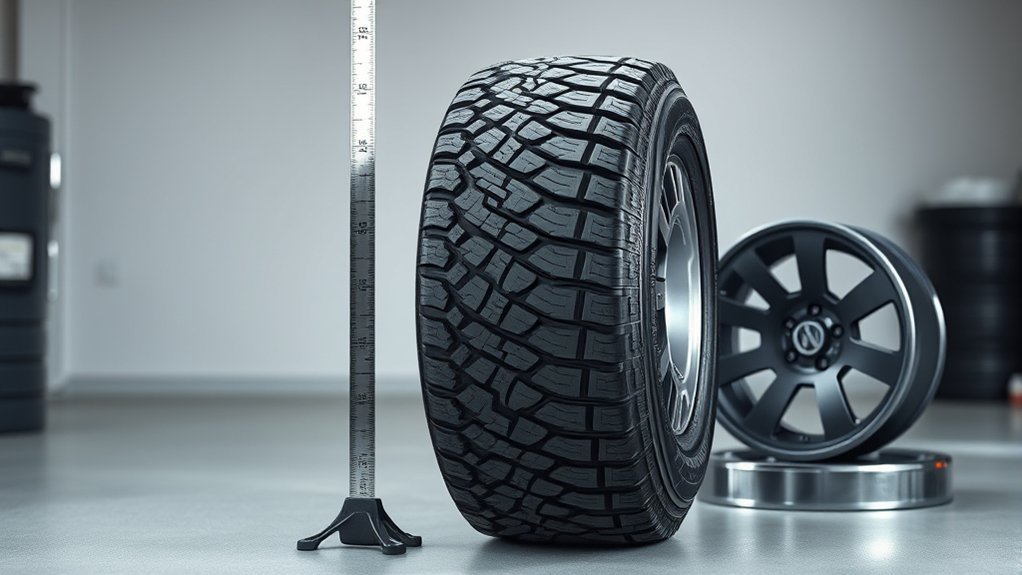
A 285/75R17 tire is about 33.83 inches tall, about 11.22 inches wide, and has an 8.42-inch sidewall by nominal tire-size math. Many drivers round it to a 34-inch tire, but the exact mounted size can vary by brand, tread design, wheel width, air pressure, and vehicle load. Use the numbers below as a planning guide, then confirm the exact tire model’s published specs before you buy.
Quick Answer
A 285/75R17 tire measures about 33.83 inches tall, 11.22 inches wide, and 8.42 inches from rim to tread by standard tire-size math. It fits a 17-inch wheel and is commonly rounded to a 34-inch tire, but actual mounted dimensions vary by tire model.
Key Takeaways
- A 285/75R17 tire is about 33.83 inches tall by nominal formula.
- The 285 mm section width equals about 11.22 inches.
- The sidewall is about 8.42 inches because 75% of 285 mm equals 213.75 mm.
- The tire fits a 17-inch wheel, but the approved rim-width range depends on the exact tire model.
- Do not choose pressure, load rating, or speed rating by size alone. Use the vehicle placard, owner’s manual, and tire manufacturer specs.
At a Glance
| Overall Diameter | About 33.83 inches |
| Section Width | About 11.22 inches |
| Sidewall Height | About 8.42 inches |
| Wheel Diameter | 17 inches |
| Circumference | About 106.3 inches |
| Revolutions Per Mile | About 596 revolutions per mile by nominal calculation |
How Tall Is a 285/75R17 Tire?
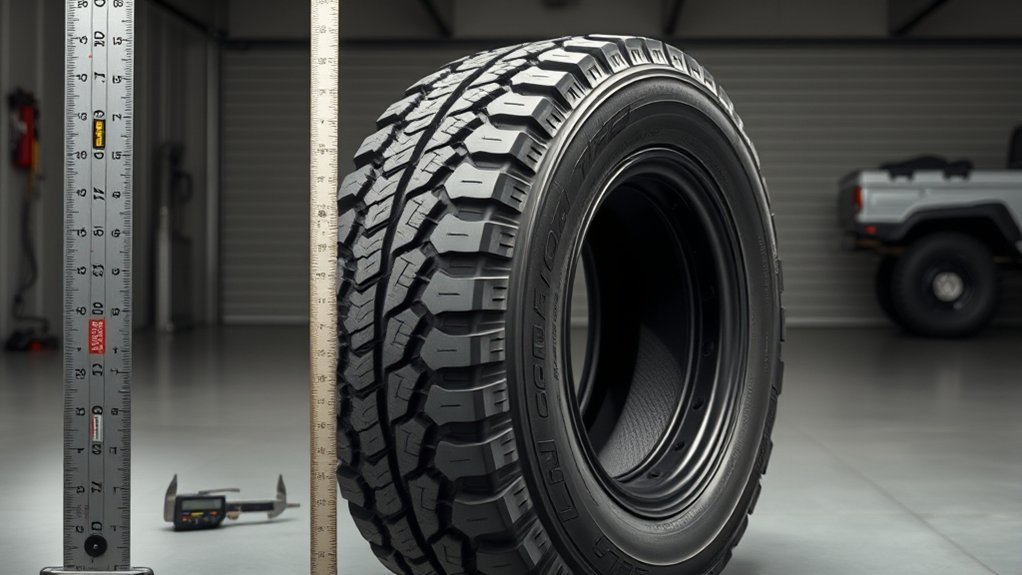
A 285/75R17 tire is about 33.83 inches tall by the standard tire-size formula. You may also see it rounded to 33.8 inches, 33.9 inches, or simply called a 34-inch tire in casual fitment discussions.
The math works like this: the tire is 285 mm wide, and the sidewall is 75% of that width. That gives one sidewall height of 213.75 mm, or about 8.42 inches. Since the tire has one sidewall above the wheel and one below it, you double the sidewall height and add the 17-inch wheel diameter. Tire Rack explains this same nominal tire-diameter formula for converting metric tire sizes.
Nominal formula: 8.42 inches + 8.42 inches + 17 inches = about 33.83 inches overall.
That number is a calculated size, not a guarantee of the exact mounted measurement. Tire model, tread depth, casing design, wheel width, air pressure, and vehicle load can all change the real-world height slightly. For close-clearance builds, compare the tire maker’s published spec sheet before you buy.
Note: Tire-size math gives you a strong estimate, but manufacturer specs matter more when fender, suspension, garage-door, or spare-carrier clearance is tight.
285/75R17 Tire Width, Sidewall, and Rim Size
The 285/75R17 tire size breaks into four useful parts. The 285 is the section width in millimeters. The 75 is the aspect ratio, which means the sidewall height equals 75% of the section width. The R means radial construction. The 17 means the tire mounts on a 17-inch wheel. Tire Rack’s sidewall guide uses the same section-width, aspect-ratio, construction, and wheel-diameter definitions.
| Size Code | Meaning | Approximate Value |
|---|---|---|
| 285 | Section width | 285 mm, or about 11.22 inches |
| 75 | Aspect ratio | Sidewall is 75% of width |
| R | Construction | Radial |
| 17 | Wheel diameter | 17-inch rim |
The tall sidewall can help absorb bumps on trucks, SUVs, and off-road builds. It can also change steering feel, braking response, gearing, fuel economy, and speedometer readings if you are moving from a smaller original tire.
How to Convert 285/75R17 to Inches
To convert 285/75R17 to inches, convert the width first, calculate the sidewall, then add the two sidewalls to the wheel diameter. Keep the precise number for fitment work, and round only when you are comparing general tire categories.
Size Breakdown
| Measurement | Formula | Result |
|---|---|---|
| Width | 285 ÷ 25.4 | 11.22 inches |
| Sidewall | 11.22 × 0.75 | 8.42 inches |
| Overall diameter | 8.42 + 8.42 + 17 | 33.83 inches |
| Circumference | 33.83 × 3.1416 | 106.3 inches |
| Revolutions per mile | 63,360 ÷ 106.3 | About 596 revs/mile |
Inch Conversion Steps
- Divide 285 mm by 25.4 to convert width to inches.
- Multiply the width by 0.75 to find one sidewall height.
- Double the sidewall height because the tire has two sidewalls across its diameter.
- Add the 17-inch wheel diameter.
- Multiply diameter by 3.1416 if you need circumference.
- Divide 63,360 inches by circumference if you need approximate revolutions per mile.
This gives you a clean comparison point when you look at other tire sizes. It also helps you estimate speedometer change if you move from your original tire size to 285/75R17.
Key Dimensions Explained
The section width is not always the same as tread width. It measures the inflated tire from sidewall to sidewall on a specified measuring rim. The sidewall height is the tire’s cushion between the wheel and the tread. The overall diameter is the full unloaded tire height from top to bottom by nominal formula.
Actual mounted height often runs slightly different from the calculated number. Aggressive all-terrain or mud-terrain tread, heavy load, wheel width, and inflation pressure can all change how the tire sits under your vehicle.
Nominal vs. Actual 285/75R17 Size
The calculated 33.83-inch diameter is useful, but it is not the same as a tire maker’s measured specification. Tire manufacturers publish measured overall diameter, section width, tread width, approved rim-width range, load rating, and maximum pressure for each tire model.
This matters because two tires with the same 285/75R17 size code may not measure exactly the same once mounted. One model may have a squared-off shoulder and deep tread blocks. Another may have a rounder shoulder or slightly different casing shape. Those small changes can decide whether the tire rubs at full steering lock.
Pro Tip: For tight builds, compare the exact tire model’s published overall diameter and section width, then test fit one tire before mounting a full set.
Will 285/75R17 Fit Your Vehicle?
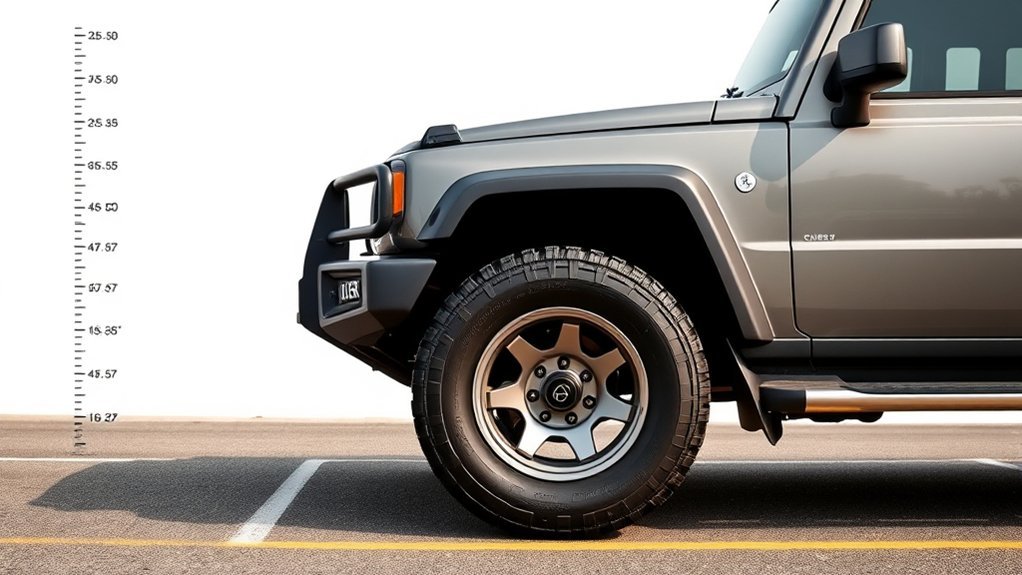
A 285/75R17 tire may fit many trucks and SUVs, but you should not assume it fits your vehicle without checking clearance. The tire is about 33.83 inches tall and 11.22 inches wide by formula, so it needs more room than many factory tire sizes.
Warning: Do not install a larger tire based only on online size math. Check the vehicle placard, owner’s manual, tire manufacturer specs, wheel offset, brake clearance, suspension travel, and fender clearance before driving.
Start with the tire size listed on your vehicle’s Tire and Loading Information Label or in the owner’s manual. Then compare the new tire’s diameter, width, load index, speed rating, and inflation requirements against your vehicle’s needs. The Tire Industry Association recommends following the vehicle placard or owner’s manual when selecting replacement tires, and it advises consulting a tire professional for custom tire and wheel changes.
[Products Worth Considering]

AstroAI’s digital tire pressure gauge inflates and measures with high accuracy, reading within 1% and supporting four pressure units from 3 to 250 PSI. The heavy-duty brass air chuck locks securely on valve stems, while the 19.7-inch stainless braided hose and 360° rotatable dial improve comfort and control for faster single-hand operation. Battery-saver behavior and an integrated flashlight add convenience and safety for everyday roadside and garage use.

Measure tire tread depth quickly and accurately with this LUMITECO dial gauge that reads in 1/32" increments up to 14/32". The color-coded green/yellow/red zones make it easy to judge tire wear and know when replacement is needed. A rugged, compact design with a protective pouch helps keep the gauge ready for use on cars, trucks, motorcycles, and more.

Keep your tires properly inflated with this analog VONDIOR tire pressure gauge, designed for fast, easy readings without batteries. The swiveling, two-axis hose and large glow dial help you measure at any tire angle with instant visibility. Built with a protective rubber shield, it supports durable, low-maintenance use for cars and trucks.
285/75R17 Fitment Checklist
- Wheel diameter: The tire must mount on a 17-inch wheel.
- Rim width: Use only the rim-width range approved by the tire manufacturer for that exact model.
- Wheel offset and backspacing: Wider tires can contact control arms, sway bars, frame rails, or fender liners.
- Suspension travel: Check clearance at full steering lock and during compression, not just while parked.
- Brake clearance: Confirm the wheel and tire setup clears the brake calipers and hardware.
- Spare location: A 33.83-inch tire may not fit every factory spare-tire well or underbody carrier.
- Speedometer and gearing: A larger tire can make the speedometer read low and can affect acceleration.
- Load index: Match or exceed the vehicle’s required load capacity.
- Speed rating: Match or exceed the vehicle manufacturer’s required rating unless the manufacturer allows an exception for a specific use.
- TPMS and ABS behavior: Large tire changes can affect warning systems and driver-assistance behavior on some vehicles.
Best Replacement Sizes for 285/75R17 Tires
The best replacement size depends on whether you want to stay close to the original diameter, gain width, reduce width, or move slightly taller. Compare overall diameter first because it affects speedometer accuracy, gearing, ABS behavior, and clearance.
| Size | Approx. Diameter | Variance vs. 285/75R17 | Best For |
|---|---|---|---|
| 33×10.50R17 | 33.0 in | -2.46% | A narrower 33-inch-style setup |
| 255/80R17 | 33.1 in | -2.27% | A tall, narrow metric option |
| 295/70R17 | 33.3 in | -1.69% | A slightly wider metric option |
| 33×12.50R17 | 33.0 in | -2.46% | A wider flotation-style 33-inch tire |
| 34×12.50R17 | 34.0 in | +0.50% | A near-height match with more width |
These are comparison sizes, not automatic replacements. A tire can be close in height but still fail fitment because of section width, tread width, wheel offset, rim width, or load rating.
[Products Worth Considering]

This 12-inch LUMITECO dual head tire pressure gauge features an integrated straight-on chuck and a 30° reverse chuck to reach hard-to-access dual wheel valves. Its 10–150 PSI / 1–10 BAR range with a clear, two-sided scale helps you quickly check tire pressure for safer, smoother driving. Heavy-duty construction and a simple no-battery design make it a reliable tool for trucks, cars, RVs, and motorcycles.

This tire inflator extension hose helps your air chuck quickly connect and disconnect from the tire nozzle with minimal leakage, supporting more accurate tire pressure. It uses a high-pressure resistant inflatable tube and durable brass chuck adapter for long-lasting performance. The quick-connect 90-degree thumb press chuck converts to a locking style and is easy to operate for car, motorcycle, and bicycle inflations.

AstroAI’s calibrated digital tire pressure gauge delivers precise readings across a 0–150 PSI range, with high clarity from a backlit LCD. Built for everyday road use, it features one-button operation, an anti-slip ergonomic grip, and support for multiple pressure units plus auto shutoff. Powered by AAA batteries, it’s an all-weather essential for checking tire health and TPMS warnings.
Speedometer Change With 285/75R17 Tires
A tire-size change can make your speedometer read higher or lower than your actual road speed. Use this simple formula:
Actual speed = indicated speed × new tire diameter ÷ original tire diameter.
As a quick example, if your speedometer was calibrated for a 285/75R17 and you switched to a 33.0-inch tire, your actual speed would be about 58.5 mph when the speedometer shows 60 mph. If you switch from 285/75R17 to a 34.0-inch tire, your actual speed would be about 60.3 mph when the speedometer shows 60 mph.
The same percentage change can affect gearing feel. A taller tire usually lowers effective gearing, which can reduce acceleration and make downshifts more common while towing or climbing hills.
285/75R17 Tire Speed Ratings and Load Limits
A tire’s size does not tell you everything about its strength or speed capability. You also need the service description, which combines the load index and speed rating. Tire Rack explains that a service description such as 91S identifies the tire’s load index and speed rating.
[Products Worth Considering]

The ETENWOLF T600 digital tire pressure gauge delivers precise, manually calibrated readings to ANSI B40.7 Grade 2A standards with ±0.5% PSI accuracy. Its 360° rotating nozzle and display hold make it easy to check pressures from any angle, while a bleed button helps dial tires to the perfect level. With a 0–250 PSI range and support for PSI, BAR, and KPA, it’s a convenient tool for maintaining tire performance across many vehicles and seasons.

This heavy-duty tire pressure gauge combines measurement, inflation, and deflation in one compact tool for quick roadside and garage use. Its dual-head chuck helps reach inner and outer dual-wheel positions, while the clear indicator bar makes readings easy to see. Built for durability, it supports a wide pressure range and works across cars, trucks, RVs, SUVs, and motorcycles.

This tire inflator with pressure gauge delivers long-lasting performance with a durable rubber-protected gauge and sturdy build. The longer hose and 360 swivel air chuck help you seal the valve securely and keep your hands free while measuring, inflating, or deflating. It’s battery-free for reliable use and provides ±2 PSI accuracy in the mid-range for most typical tires, with universal compatibility for 1/4 NPT compressor outputs.
Speed Rating Basics
The speed rating is the letter after the load index on many tire sidewalls. It tells you the maximum speed category the tire can sustain under controlled test conditions when properly loaded and inflated. Common 285/75R17 light-truck tires often use ratings such as Q, R, S, or T, but you must read the exact tire sidewall. Tire Rack’s speed-rating chart lists Q as 99 mph, R as 106 mph, S as 112 mph, and T as 118 mph.
| Rating | Max Speed | Common Use |
|---|---|---|
| Q | 99 mph | Some off-road, winter, and LT tires |
| R | 106 mph | Heavy-duty light-truck tires |
| S | 112 mph | Truck, SUV, van, and family-vehicle tires |
| T | 118 mph | Some highway-terrain tires |
Never choose a lower speed rating than your vehicle requires unless the vehicle manufacturer allows it for a specific use, such as certain winter tire applications. When in doubt, match or exceed the original speed rating and follow the vehicle manufacturer’s guidance.
Load Limit Guide
The load index tells you how much weight one tire can carry at its rated conditions. For example, a 121/118 light-truck tire uses two load ratings because single-wheel and dual-wheel applications are rated differently. Tire Rack’s load index chart lists 121 as 3,197 lb and 118 as 2,910 lb.
- Read the full service description on the tire sidewall.
- Match or exceed your vehicle’s required load index.
- Use the correct pressure from the placard, owner’s manual, or load-inflation guidance for the tire and vehicle.
- Do not exceed the tire’s load limit, wheel rating, or maximum pressure limit.
- Replace tires with cuts, bulges, exposed cords, or severe uneven wear.
Load Range vs. Load Index
Many 285/75R17 tires are sold as LT tires, and you may see terms such as Load Range C, D, or E. Load range is not the same as load index. Load range describes the tire’s strength category and pressure capability, while load index is the number that maps to a specific weight capacity.
Do not choose a tire only because it has a familiar load range letter. Read the full service description and confirm that the tire’s load capacity matches your vehicle, payload, towing setup, and wheel rating.
How to Set 285/75R17 Tire Pressure
Set 285/75R17 tire pressure by starting with your vehicle’s Tire and Loading Information Label or owner’s manual. NHTSA TireWise states that the correct cold tire pressure is the vehicle manufacturer’s recommended pressure, not the maximum pressure printed on the tire sidewall.
Check pressure when the tires are cold, meaning the vehicle has been parked for at least three hours or has only been driven a short distance at low speed. Use a quality tire pressure gauge and check all tires, including the spare if your vehicle uses one.
- If pressure is low: Add air until the tire reaches the recommended cold pressure.
- If pressure is high: Release air slowly and recheck with the gauge.
- If tire size changed: Confirm pressure with a qualified tire shop, tire manufacturer guidance, or load-inflation data.
- If you tow or haul: Check axle weights and pressure requirements before long trips.
- If wear looks uneven: Recheck pressure, alignment, rotation schedule, and suspension condition.
Warning: Do not copy another driver’s PSI just because they run the same 285/75R17 size. Vehicle weight, axle load, wheel rating, tire construction, and use case can all change the correct pressure.
Frequently Asked Questions
What is 285/75R17 in inches?
A 285/75R17 tire is about 33.83 inches tall and 11.22 inches wide by nominal calculation. The sidewall is about 8.42 inches, and the circumference is about 106.3 inches.
Is a 285 tire a 33 or 35?
A 285/75R17 is closer to a 34-inch tire than a 33 or 35. By formula, it measures about 33.83 inches tall. A true 35-inch tire is noticeably taller and usually needs more clearance.
Is 285/75R17 a 34-inch tire?
Yes, you can reasonably call a 285/75R17 a 34-inch tire in casual tire sizing because the calculated diameter is about 33.83 inches. It is not exactly 34.0 inches by formula, and the exact mounted height can vary by tire model and load.
Is 285/75R17 the same as 34×11.50R17?
It is close in height, but it is not automatically the same. A 285/75R17 is about 33.83 inches tall and 11.22 inches wide by formula. A 34×11.50R17 is usually marketed by nominal flotation sizing, so you still need to compare the tire maker’s exact diameter, width, load rating, and approved rim width.
Is a 285/70R17 taller than a 265/70R17?
Yes. A 285/70R17 is about 32.7 inches tall by formula, while a 265/70R17 is about 31.6 inches tall. That gives the 285/70R17 roughly 1.1 inches more overall diameter, plus extra width. Check clearance before making the swap.
How tall and wide is a 285/75 tire?
A 285/75 tire on a 17-inch wheel is about 33.83 inches tall and 11.22 inches wide by nominal calculation. The sidewall is about 8.42 inches. If the rim diameter changes, the overall tire height changes too.
Will a 285/75R17 affect my speedometer?
Yes, it can affect your speedometer if your vehicle was calibrated for a smaller or larger original tire. A taller tire usually makes the speedometer read lower than your actual speed. Compare the new diameter with your original tire diameter to estimate the change.
What PSI should I run in 285/75R17 tires?
Use your vehicle’s recommended cold tire pressure first if the tire size matches the vehicle placard. If you changed to 285/75R17 from another size, confirm pressure with a qualified tire professional, tire manufacturer guidance, or load-inflation data. Do not use the tire sidewall maximum as your normal driving pressure.
Do you need a lift for 285/75R17 tires?
Maybe. Some trucks and SUVs can clear this size with the right wheel offset and minor trimming, while others need a lift or different wheels. Check clearance at full steering lock and full suspension compression before driving.
Conclusion
A 285/75R17 tire is about 33.83 inches tall, about 11.22 inches wide, and has an 8.42-inch sidewall by nominal calculation. That makes it close enough to call a 34-inch tire in everyday fitment talk, but it is not a 35-inch tire.
Use those numbers as your starting point, then verify the exact tire model’s published dimensions, approved rim width, load index, speed rating, and pressure requirements. If your fitment is close, measure the vehicle and consult a qualified tire professional before installing a full set.
Sources
- Tire Rack: How Do I Calculate Tire Dimensions? — supports the width, sidewall, wheel-diameter, and overall-diameter calculation method.
- Tire Rack: How Do I Read My Tire Size On My Sidewall? — supports tire size code, radial construction, wheel diameter, and service description wording.
- Tire Rack: How Do I Check a Tire’s Speed Rating? — supports Q, R, S, and T speed-rating values.
- Tire Rack: What Is Load Index? — supports load-index definitions and 121/118 load values.
- Tire Industry Association: Tire Replacement — supports placard-based replacement guidance and professional consultation for custom tire changes.
- NHTSA TireWise — supports tire pressure, tire size, tire maintenance, and cold-pressure safety guidance.
