
AAA’s standard flat-tire roadside service generally focuses on getting you moving safely rather than repairing the puncture at the roadside. If you have a usable spare, the roadside technician can usually install it. If a safe tire change is not possible, AAA can arrange towing under your membership benefits. Exact services, towing mileage, and limits can vary by regional AAA club.
Quick Answer
AAA generally does not perform a permanent puncture repair as part of standard roadside flat-tire service. If your vehicle has a safe, usable spare, the technician can install it. If there is no usable spare or the tire cannot be changed safely, AAA can arrange a tow according to your local club and membership benefits.
Key Takeaways
Key Takeaways
- AAA’s standard roadside flat-tire service normally involves installing a usable spare rather than permanently repairing a puncture.
- If you do not have a usable spare or a roadside tire change is unsafe, towing may be provided under your membership benefits.
- AAA towing mileage and some roadside-service rules vary by regional club, so check your own membership terms.
- A proper puncture repair requires the tire to be removed and inspected; industry guidance does not consider an outside plug alone a proper permanent repair.
- Tread-area punctures up to 1/4 inch (6 mm) may be repairable when they meet all other safety requirements, while shoulder and sidewall injuries generally are not candidates for a standard puncture repair.
Does AAA Patch Tires?

AAA’s standard roadside flat-tire benefit is a tire-change service, not a permanent puncture-repair service. Current AAA roadside-assistance information says that when a vehicle has a spare tire ready to use, the roadside provider can replace the flat with the spare. If a usable spare is not available, towing may be arranged.
That distinction matters because a proper tire repair requires more than inserting a plug from the outside. The U.S. Tire Manufacturers Association recommends removing the tire from the wheel, inspecting it internally, filling the puncture injury with a suitable rubber stem or plug, and sealing the inner liner with a patch.
You can request AAA roadside assistance 24/7. Depending on your regional club, you may be able to request service through an AAA app, online, or by calling the roadside-assistance number shown on your membership card or digital membership information.
Note: AAA is made up of regional clubs. Flat-tire procedures are broadly similar, but towing mileage, waiting periods, service-call limits, phone numbers, and other benefit details can vary. Your current membership terms control your coverage.
What AAA Does for a Flat Tire
When you request roadside help for a flat tire, the technician typically evaluates whether the vehicle can be safely serviced where it is and whether you have a serviceable spare.
If the spare is available, properly inflated enough for use, compatible with the vehicle, and safe to install, the technician can normally replace the flat tire with that spare. Some regional AAA services may also provide limited assistance for a low tire, but you should not assume that roadside service includes a permanent puncture repair.
If there is no usable spare, the wheel cannot be removed safely, the vehicle is in an unsafe location, or another condition prevents the change, towing may be the appropriate next step.
Spare Installation Service
AAA roadside assistance is available throughout the United States and Canada for eligible members and vehicles. A flat-tire call normally involves installing the vehicle’s spare when that can be done safely.
Before a trip, check that the spare is actually present, accessible, and inflated to the pressure specified by the vehicle or spare-tire manufacturer. This is especially important with compact temporary spares, which may require much higher inflation pressure than the vehicle’s normal road tires.
Pro Tip: Check your spare at the same time you check your regular tires. A flat or inaccessible spare can turn a straightforward roadside tire change into a towing call.
After a temporary spare is installed, follow the speed, distance, inflation-pressure, and other restrictions printed on the spare tire and listed in your owner’s manual. A temporary spare is meant to get you to a place where the damaged full-size tire can be inspected, repaired, or replaced.
AAA may ask you to verify your membership and identity when service arrives. Keeping your physical or digital membership card and photo identification available can make the process easier.
Towing When Needed
If the flat tire cannot be changed safely or no serviceable spare is available, AAA can arrange towing subject to your membership and regional club rules.
You may be able to select a tire shop, general repair facility, AAA Approved Auto Repair facility, or another eligible destination within your towing benefit. The destination options and mileage included depend on your club’s current membership terms.
Do not assume that one towing-mileage figure applies to every AAA member nationwide. Different official AAA clubs publish different Classic towing allowances, while Plus and Premier benefits can also have specific conditions and annual limits.
Before choosing a distant repair shop, check your current benefit in the AAA app, membership guide, website, or with the roadside representative so you know whether additional mileage charges could apply.
How AAA Tire Change Service Works
The process usually starts when you submit a roadside-assistance request through your regional AAA app, website, or roadside-service phone number. You provide your location, vehicle information, and the type of problem you are experiencing.
Digital requests can often be entered quickly, but that should not be confused with the technician’s travel time. AAA provides an estimated arrival time after a provider is assigned, and the actual wait can vary with location, traffic, weather, demand, time of day, and service-provider availability.
Many AAA apps and text-message systems let you follow status updates and, where available, track the assigned service vehicle in real time.
When the technician reaches you, the technician can assess the roadside situation and the spare. If the spare is usable and a tire change can be completed safely, it can be installed. If not, towing or another appropriate roadside solution may be arranged under your coverage.
Warning: If your vehicle is disabled in a dangerous traffic location, prioritize personal safety over inspecting or changing the tire yourself. Turn on the hazard lights, move as far from moving traffic as safely possible if the vehicle can be moved, and call 911 when the situation presents an immediate danger. Follow the dispatcher’s instructions about where to wait.
When Does AAA Tow Your Car Instead?
AAA may arrange a tow when a safe roadside tire change is not practical. Common examples include having no spare tire, having a damaged or unusable spare, being unable to remove the wheel safely, or being stopped where roadside work would create an unacceptable risk.
A tow may also make sense when the problem is more than a simple flat. A damaged wheel, multiple damaged tires, suspension damage, or another mechanical issue can prevent the vehicle from being driven safely even after a spare would otherwise be available.
The towing distance included with membership is not identical across all AAA clubs. Some current regional plans provide relatively short Classic towing, while Plus commonly includes substantially longer towing and Premier may include one longer-distance tow plus shorter remaining eligible tows. Always check the terms associated with your own AAA club rather than relying on a nationwide mileage assumption.
If towing beyond your included mileage is necessary, additional charges may apply.
Products Worth Considering

This screw-in tire plug kit provides a fast, no-tire-removal fix for tubeless flat tires by aligning and screwing the plugs into the puncture. Built for a reliable, airtight seal, the thick rubber plugs create a durable repair that helps prevent slow leaks. The kit includes two plug sizes for handling different puncture widths and comes in a compact case for quick roadside use.

The Gurduenon scissor car jack tire changing kit is designed for quick flat-tire replacement with a lifting capacity of 2.5 tons and a scissor-lift range sized for many vehicles. The complete emergency set includes a ratchet wrench, lug wrench, gloves, a pencil tire pressure gauge, and a storage bag for convenient trunk or garage use. Universal compatibility makes it suitable for cars, SUVs, and other vehicles roadside assistance needs.

This roadside assistance kit helps drivers and passengers in urgent situations after an accident or breakdown, providing practical support while waiting for help. It includes a lightweight, compact tire inflator for fast inflation of standard vehicle tires, plus reinforced jumper cable protection for safer handling. Ideal for winter weather, road trips, camping, and travel, with everything stowed neatly in a trunk bag.
What to Expect When AAA Arrives
After your roadside request is accepted and a provider is assigned, AAA normally supplies an estimated arrival time. Where service tracking is available, you may also receive updates through an app, website, or text-message link.
The “less than four minutes” figure published by some AAA clubs refers to how quickly a member can submit a digital roadside request—not how quickly a service truck will arrive.
When the technician reaches the vehicle, be ready to verify your membership and, when requested, show photo identification. The technician will assess the roadside conditions, your flat tire, and the available spare before deciding whether a safe tire change can be completed.
If the spare is suitable, the technician can install it. If the spare is missing, damaged, underinflated beyond practical use, incompatible, or otherwise unsafe, towing may be arranged instead.
After a temporary spare is fitted, do not treat the problem as permanently solved. Follow the spare’s restrictions and have the original tire inspected promptly.
How Your AAA Plan Affects Towing
Your AAA membership level and regional club determine how much towing is included when your vehicle cannot be safely driven.
It is tempting to summarize AAA towing as one nationwide Classic/Plus/Premier mileage chart, but current official AAA terms show that this can be misleading. For example, different AAA regions publish different Classic mileage allowances. Plus frequently provides towing of up to 100 miles per eligible call, while Premier plans commonly include one tow of up to 200 miles with shorter limits on remaining eligible tows. The exact rules, however, depend on the club that issued your membership.
You can review current terms through your AAA club’s membership page or membership guide. One example is the AAA Membership Terms and Conditions, which explains towing allowances and other roadside-service rules for that club.
Many AAA clubs provide up to four roadside-assistance service calls per member during a membership year, with additional calls subject to charges or different terms. Because exceptions can exist, confirm your own annual allowance before relying on a specific number.
Knowing your towing benefit before a breakdown also makes it easier to choose a repair destination without unexpectedly exceeding your included mileage.
When a Flat Tire Can’t Be Repaired
Whether a tire can be repaired is determined by the location and size of the injury, the condition of the tire, any previous repairs, and whether the tire suffered hidden damage while driven underinflated or flat.
According to USTMA guidance for passenger and light-truck tires, a standard puncture repair is generally limited to an injury no larger than 1/4 inch (6 mm) that is confined to the repairable tread area. The tire must be removed from the wheel so its interior can be inspected.
| Condition | Typical Action |
|---|---|
| Puncture within the repairable tread area, 1/4 inch (6 mm) or smaller | May be repairable after professional internal inspection |
| Sidewall or shoulder injury | Not suitable for a standard puncture repair; replacement is generally required |
| Puncture larger than 1/4 inch (6 mm) | Outside standard USTMA puncture-repair limits |
| Repair would overlap an existing repair | Not suitable for another standard repair |
| Internal damage from driving while flat or severely underinflated | Replacement may be required after inspection |
A qualified tire professional should make the final repair decision after removing and inspecting the tire. Tire manufacturers may also impose additional restrictions for particular tire designs or applications.
Products Worth Considering

Use this tire repair rubber screw kit for fast, self-service flat fixes on the road. Choose the matching short or long nail size and twist it into the puncture without removing the tire from the rim. Compact storage keeps the emergency set organized for cars, motorcycles, electric bikes, and bicycles, helping you seal tubeless leaks quickly and reliably.
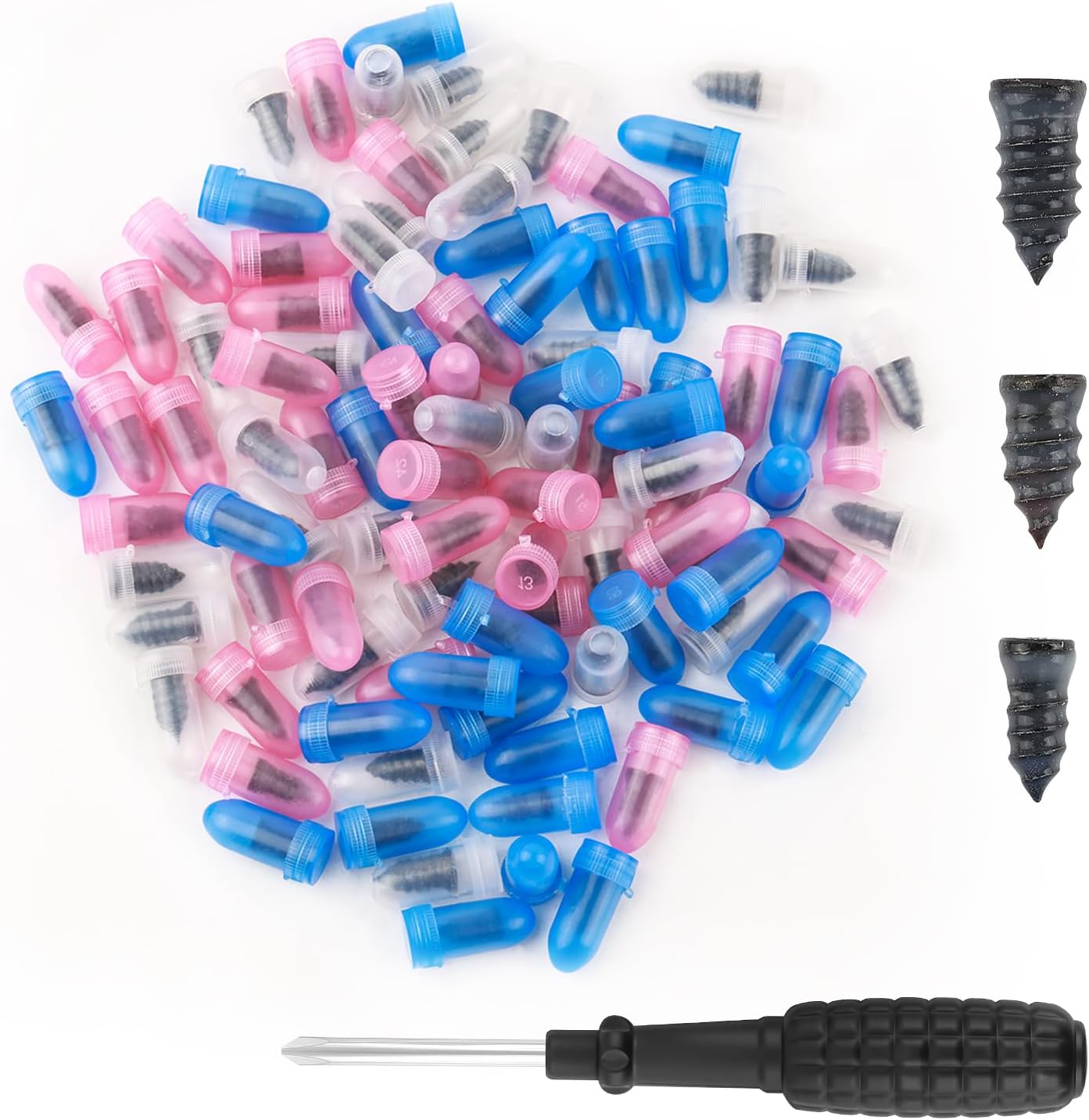
This 100-piece tire repair screw plug kit provides a fast, self-service solution for punctures on the road. Choose the correct plug size, insert it into the break, and screw it in to help seal the puncture and temporarily restore tire pressure. Thickened threads and rubber-wrapped plugs improve bite and sealing while remaining compact and easy to carry.
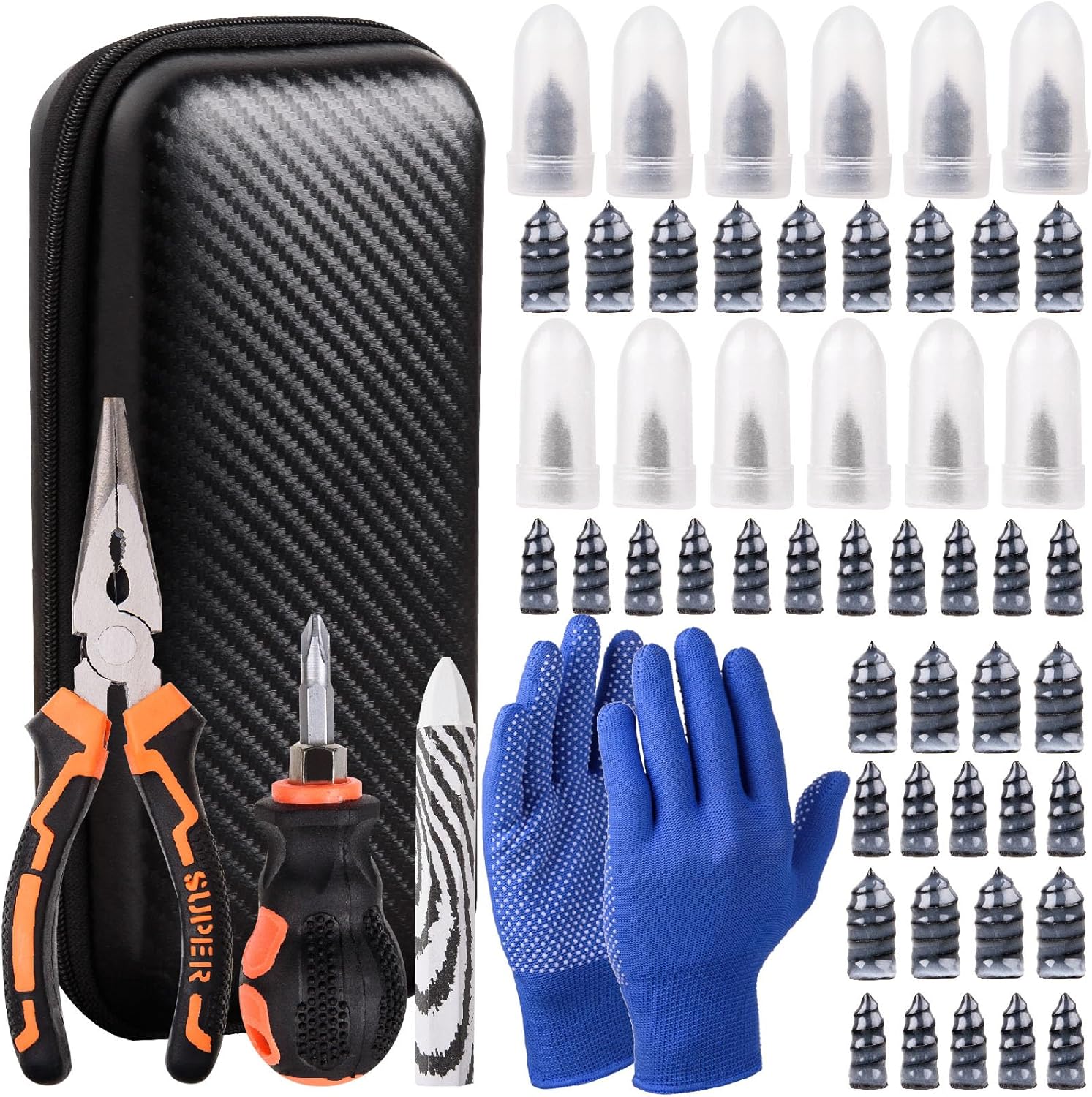
This tire sidewall puncture repair kit fixes flats fast without removing the tire, helping you get back on the road in minutes. It includes self-tapping repair nails, essential tools, gloves, and a portable storage bag for convenient roadside use. Designed for tubeless tires, it helps create a tight, leak-resistant seal for cars, motorcycles, trucks, SUVs, and ATVs.
Sidewall Damage
Sidewall punctures are not candidates for the standard passenger-tire puncture repair described by USTMA. The same concern applies when an injury extends into the shoulder or belt-edge area.
The sidewall flexes continuously while the tire is operating, and damage there can compromise structural components that a normal tread puncture repair is not designed to restore.
If your tire has a cut, puncture, bulge, exposed cord, or other significant sidewall damage, do not assume that a small-looking injury is safe. Have the tire professionally inspected and replaced when the damage makes repair unsuitable.
Large Punctures
For passenger and light-truck tires, USTMA limits its standard puncture-repair procedure to injuries no larger than 1/4 inch (6 mm) and within the repairable tread area.
The article’s previous 45-degree puncture rule is not an industry-standard cutoff. What matters is whether the injury remains within the permitted tread area or extends or angles into the shoulder or belt-edge area.
Even when a puncture initially appears small enough to repair, a technician still needs to remove the tire and inspect the inside. Driving on a tire after substantial pressure loss can damage the casing in ways that are not visible from outside.
Replace Old Tires
A flat on an already worn or damaged tire may lead to replacement instead of repair. Low tread depth, cracking, bulges, exposed cords, previous improper repairs, internal run-flat damage, or other structural problems can disqualify an otherwise small puncture.
USTMA also says repairs should not overlap previous repairs and that a tire with an existing improper repair should not simply receive another puncture repair.
Do not judge repairability only by the nail or screw visible in the tread. A tire-service professional should inspect the entire tire, including the inner liner, before approving continued use.
Where to Get Tire Repair After AAA
After AAA installs your spare or tows the vehicle, take the damaged tire to a qualified tire or repair facility for inspection. The shop can determine whether the puncture meets recognized repair criteria or whether the tire needs replacement.
A proper repair should not consist of inserting an outside plug and immediately putting the tire back into service. USTMA recommends removing the tire from the wheel, inspecting it for internal damage, filling the puncture channel with a suitable rubber stem or plug, and applying a patch to seal the inner liner.
You may choose a local tire shop, dealership, independent repair facility, or an AAA Approved Auto Repair facility. AAA Approved facilities may offer member benefits such as repair discounts or warranties, but the exact discount, cap, eligibility, and terms can vary.
Before authorizing the work, ask whether the shop follows industry puncture-repair procedures, whether your particular tire is repairable, what the complete repair will cost, and whether any tire-manufacturer restrictions apply.
Products Worth Considering

This tire repair kit provides fast emergency puncture repair without removing the tire from the rim, helping you get back on the road quickly. Its screw plug system is designed for punctures in both tread and sidewall and includes a complete patch plug tool set with essential accessories. A portable storage bag makes it easy to carry for cars, trucks, SUVs, motorcycles, and heavy-duty applications.

Mosconly tire repair glue and nail kit delivers an elastic, waterproof bond for quick sidewall puncture repairs. The adhesive cures securely to help prevent peeling, flaking, and tearing, while the included nails support a strong, seamless repair. Designed for easy roadside use, it works on car, motorcycle, bike, and other tire types, with full curing within 24 hours.

Yieokei Tesla jack pads are molded rubber lifting pucks designed for 2016-2026 Model 3/Y/S/X, including Juniper, to fit securely in the jack hole. They cushion the underframe and help position the jack precisely at the factory jack points to reduce risk of battery, paint, or chassis damage. The set also includes a tire repair tool kit for emergency roadside fixes and comes with a portable storage case to keep everything organized.
Frequently Asked Questions
Will AAA Patch a Tire for Free?
AAA’s standard roadside flat-tire benefit normally covers roadside assistance such as installing a usable spare or arranging towing under your plan; it does not normally provide a permanent puncture repair at the roadside. A tire shop may charge separately to inspect and repair the damaged tire.
What Does AAA Do if You Have a Flat Tire and No Spare?
If you have no usable spare and the vehicle cannot be driven safely, AAA can generally arrange towing under your membership benefits. The included towing distance and any extra-mileage charges depend on your regional AAA club and membership level.
How Much Do They Usually Charge to Patch a Tire?
There is no reliable nationwide fixed price for puncture repair. The cost varies by shop, location, tire type, and the work required. Ask the shop for the total price before approving the repair, and make sure the tire will be removed and inspected rather than repaired with an outside plug alone.
What Does AAA Cover for Tire Issues?
AAA roadside coverage generally includes help with a flat tire by installing a safe, usable spare and arranging towing when a roadside change cannot be completed. Exact services, service-call allowances, towing mileage, and charges depend on your regional club and membership terms.
Sources
- AAA Roadside Assistance — flat-tire, spare-installation, towing, and roadside-service information.
- AAA Membership Terms and Conditions — example of club-specific towing and roadside-benefit rules.
- U.S. Tire Manufacturers Association — Tire Repair Basics — professional puncture-repair limits and procedures.
- AAA Roadside Emergency Safety Guidance — safe waiting and roadside-emergency practices.
- AAA Approved Auto Repair — repair-facility locator and applicable member benefits.
Conclusion
AAA’s standard roadside flat-tire service generally helps by installing a safe, usable spare or arranging a tow when a tire change cannot be completed. A permanent puncture repair is normally a job for a qualified tire shop, where the tire can be removed and inspected internally.
If the injury is confined to the repairable tread area and no larger than 1/4 inch (6 mm), it may qualify for a proper professional repair. Sidewall, shoulder, oversized, overlapping, or internally damaged injuries generally require a different solution, often tire replacement. Because AAA towing mileage and other benefits vary by regional club, check your current membership terms before choosing a repair destination.