Disclosure: As an Amazon Associate, we earn from qualifying purchases. If you click a link on this page and make a purchase, we may receive a small commission at no extra cost to you.
Checking tire pressure should be quick, but awkward valve stems and separate inflating tools can turn a basic job into repeated connecting, filling, and rechecking. The AstroAI T3 Tire Pressure Gauge combines a mechanical gauge, inflator control, and deflation function in one battery-free tool. Its 10-120 PSI range, dual-head chuck, and 1/4-inch NPT compressor connection make it especially useful for trucks, RVs, SUVs, motorcycles, and vehicles with hard-to-reach valves. It is a practical workshop tool, although buyers who want a backlit digital display or need pressures above 120 PSI should consider another model.
Quick Verdict
Rating: 8/10, recommended with caveats
Best For: Drivers and home-garage users who already own an air compressor and need easier access to standard automotive valve stems.
Bottom Line: The T3 offers useful three-in-one control and a durable, battery-free design at a sensible value level. Its mechanical indicator is less convenient in low light, and the 120 PSI ceiling will not suit every high-pressure application.
| Specification | Detail |
|---|---|
| Brand | AstroAI |
| Model | T3 |
| Product type | Three-in-one mechanical tire pressure gauge, inflator, and deflator |
| Pressure range | 10-120 PSI |
| Accuracy claim | ANSI B40.1 rated; verify against a trusted reference gauge when precision is critical |
| Chuck design | Dual head with straight and 30-degree reverse ends |
| Air connection | 1/4-inch NPT compressor connection |
| Materials | Stainless steel and brass components |
| Power | Battery-free mechanical operation |
| Vehicle compatibility | Cars, trucks, RVs, SUVs, and motorcycles with compatible valve stems |
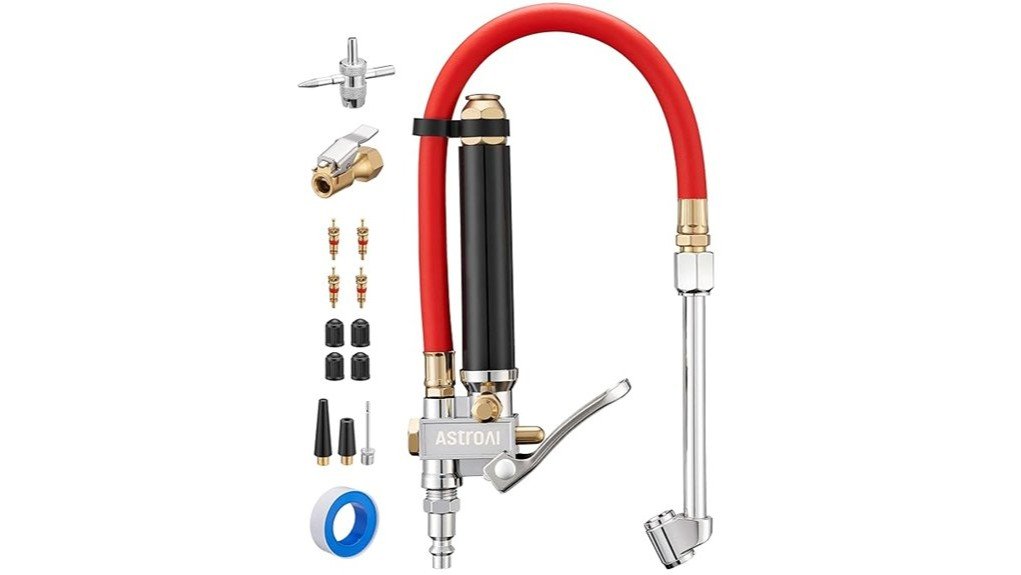
| Listed accessories | Valve cores, stem caps, valve-core tool, brass chuck, sealing tape, cone nozzles, and ball needle; confirm the current seller bundle |
| Best use | Routine garage inflation, dual-wheel access, and pressure adjustment with an air compressor |
Key Takeaways
- The AstroAI T3 checks pressure, adds air, and releases excess air without batteries.
- Its 10-120 PSI range covers most passenger vehicles and many light-truck, RV, and motorcycle applications.
- The straight and 30-degree reverse chuck ends improve access around tight valve angles and dual wheels.
- Stainless steel and brass parts give the tool a more workshop-ready feel than a basic plastic gauge.
- You need a compatible air compressor and fitting to use the inflation function.
What Is the AstroAI T3 Gauge?
The AstroAI T3 is a mechanical air chuck with an integrated pressure gauge and inflation control. Instead of using one tool to add air and another to check pressure, you can connect the T3 to a compatible compressor, seat the chuck on the valve stem, and make small adjustments from one setup.
Its main selling point is access. The dual-head chuck includes a straight end and a 30-degree reverse end, which can help when a wheel, brake component, or outer dual wheel blocks a direct approach. The indicator bar provides a simple PSI reading without a battery, screen, or electronic menu.
This design suits home garages, work trucks, and roadside equipment kits where simple mechanical operation is more important than a backlit display or decimal-level digital readout.
Who Should Buy It?
Best For
- You already have a portable or shop air compressor with a compatible 1/4-inch NPT setup.
- You service trucks, RVs, SUVs, motorcycles, or dual-wheel vehicles with difficult valve angles.
- You prefer a battery-free mechanical tool that can measure, inflate, and deflate.
Skip If
- You need a bright digital screen, multiple pressure units, or decimal readings.
- Your application regularly exceeds the gauge’s 120 PSI maximum range.
- You do not own an air compressor and want a self-powered tire inflator.
Before You Buy: This is an inflator gauge, not a compressor. Confirm that your compressor hose, coupler, and valve stems match the T3’s connection and chuck before ordering.
[Products Worth Considering]

This tire inflator with pressure gauge delivers long-lasting performance with a durable rubber-protected gauge and sturdy build. The longer hose and 360 swivel air chuck help you seal the valve securely and keep your hands free while measuring, inflating, or deflating. It’s battery-free for reliable use and provides ±2 PSI accuracy in the mid-range for most typical tires, with universal compatibility for 1/4 NPT compressor outputs.

AstroAI’s tire pressure gauge with inflator helps you check and adjust car tire pressure accurately for safer, smoother driving. It offers 3-in-1 operation to inflate, deflate, or measure pressure, with an easy-to-read 2.5-inch glow dial and a heavy-duty air chuck for convenient use. Universal compatibility supports Schrader-valve tires and quick-connect 1/4" NPT air compressors for quick maintenance.

AstroAI’s digital tire pressure gauge inflates and measures with high accuracy, reading within 1% and supporting four pressure units from 3 to 250 PSI. The heavy-duty brass air chuck locks securely on valve stems, while the 19.7-inch stainless braided hose and 360° rotatable dial improve comfort and control for faster single-hand operation. Battery-saver behavior and an integrated flashlight add convenience and safety for everyday roadside and garage use.
AstroAI T3 Key Features
Dual-Head Access
The straight chuck works well on exposed valve stems, while the reverse end is intended for valves that face inward or sit behind another wheel. That makes the T3 more practical than a short single-head chuck for dual rear wheels and crowded wheel designs.
The chuck still needs to seat squarely. A poor seal can release air and make the reading appear unstable, so access alone does not replace careful placement.
Mechanical Gauge and Accuracy
The T3 covers 10-120 PSI and carries an ANSI B40.1 accuracy claim. That range is broad enough for common passenger-car pressures and many higher-pressure truck or RV tires, but it is not intended for systems above 120 PSI.
A mechanical indicator is easy to understand and does not depend on batteries. The tradeoff is that it lacks a backlight and may be harder to read from an angle. Before relying on a new gauge, compare several readings with a trusted reference gauge and check for repeatability.
Inflation and Deflation Control
With a compatible compressor attached, you can add air in short bursts and use the release control to remove excess pressure. This reduces the cycle of disconnecting the air hose, attaching a separate gauge, and reconnecting the hose for another adjustment.
The benefit is control, not automatic inflation. You still need to watch the reading, stop at the vehicle manufacturer’s recommended cold pressure, and avoid exceeding the gauge or tire limits.
Stainless Steel and Brass Construction
Stainless steel and brass components give the T3 a more durable build than an inexpensive all-plastic gauge. These materials are suitable for regular garage use, but fittings, seals, and threads can still wear or leak if the tool is dropped, overtightened, or stored wet.
How to Use the AstroAI T3 Correctly
- Find the correct cold pressure. Use the vehicle’s driver-door placard or owner’s manual, not the maximum number molded on the tire sidewall.
- Check the setup. Confirm that the compressor, coupler, T3 connection, hose, and chuck are secure and free from visible damage.
- Seat the chuck firmly. Choose the straight or reverse head that gives the cleanest approach to the valve stem.
- Read the gauge head-on. Avoid judging the indicator from a steep angle.
- Add air in short bursts. Pause between bursts so the reading can settle.
- Release excess air gradually. Recheck after each small adjustment.
- Repeat the reading. A second consistent reading helps confirm that the chuck sealed correctly.
Pro Tip: Check tires before driving or after they have been parked for several hours. Warm tires can show higher pressure, which makes small adjustments less reliable.
How It Performs in Real Use
For Weekly or Monthly Tire Checks
For routine maintenance, the T3’s biggest advantage is keeping the measuring and filling steps together. You can move from tire to tire with fewer tool changes, which is useful when checking a vehicle, trailer, and spare in one session.
For Trucks and Dual Wheels
The reverse chuck is the feature that matters most on dual-wheel setups. It can reach an inward-facing valve that a short straight chuck may miss. The 120 PSI ceiling provides useful range, although you should confirm that every tire you service stays within the tool’s stated limit.
For Motorcycles and Tight Wheels
Motorcycle brake rotors, spokes, and compact wheel openings can restrict access. The two chuck angles give you more positioning options, but the long metal body may still be less convenient than a flexible hose gauge on especially cramped designs.
For Long-Term Garage Use
Battery-free operation removes one common failure point and makes the T3 easy to leave in a toolbox. Long-term consistency depends on keeping the chuck clean, protecting the indicator from impacts, and checking threaded joints and seals when you notice air leakage.
Compatibility and Safety
The T3 is designed around a 1/4-inch NPT compressor connection and standard automotive tire service. A quick-connect coupler may be included or may need to match your existing compressor setup, so review the current listing and compare fittings before use.
Always use the cold inflation pressure specified by the vehicle manufacturer. Stop using the tool if the indicator sticks, the chuck cannot seal, the hose or fittings leak heavily, or the gauge gives inconsistent readings. Never exceed the gauge’s 120 PSI range, and wear eye protection when working around pressurized air fittings.
The listed accessory bundle may include valve cores, caps, a valve-core tool, a brass chuck, sealing tape, cone nozzles, and a ball needle. Seller bundles can change, so treat those extras as a listing detail to confirm rather than the main reason to buy.
Best Uses for the AstroAI T3
| Use Case | Main Benefit | Important Limit |
|---|---|---|
| Passenger vehicles | Fast pressure checks and controlled adjustment | Mechanical display is not backlit |
| Trucks and RVs | Dual-head access and 120 PSI range | Not suitable above 120 PSI |
| Motorcycles | Two chuck angles for crowded valve areas | Fit depends on wheel and valve position |
| Home garage | One tool for checking, filling, and bleeding air | Requires a compatible compressor |
Pros and Cons
Pros
- Combines pressure checking, inflation, and deflation in one tool.
- Dual-head chuck helps with inward-facing and awkward valve stems.
- 10-120 PSI range supports many cars, trucks, RVs, SUVs, and motorcycles.
- Battery-free operation is simple and dependable for toolbox storage.
- Stainless steel and brass components suit regular garage use.
Cons
- No digital screen, backlight, or multi-unit display.
- Requires a compatible compressor and fitting for inflation.
- The 120 PSI maximum and fixed chuck design will not fit every use case.
Is It Worth the Price?
The AstroAI T3 offers strong value for the price when you already own an air compressor and regularly maintain several tires. Its value comes from reducing tool changes, improving valve access, and avoiding batteries rather than from advanced display features.
It is a smart buy for everyday garage use, work vehicles, and RV owners who value a rugged mechanical design. It is not the best fit if you need a self-contained compressor, digital precision, pressure units other than PSI, or a range above 120 PSI.
[Products Worth Considering]

This all-in-one air compressor accessory kit combines a digital tire pressure gauge with an inflator and blow gun in a single easy-to-use unit. The heavy duty, corrosion-resistant construction helps you quickly set and read tire PSI up to 200, and the vent valve releases excess air without removing the chuck. It connects to any 1/4 inch NPT air compressor output and includes multiple nozzles, adaptors, and stem caps for versatile inflating and blowing tasks.

This heavy-duty tire pressure gauge combines measurement, inflation, and deflation in one compact tool for quick roadside and garage use. Its dual-head chuck helps reach inner and outer dual-wheel positions, while the clear indicator bar makes readings easy to see. Built for durability, it supports a wide pressure range and works across cars, trucks, RVs, SUVs, and motorcycles.

Inflate Presta and Schrader bike and car tires with one compressor attachment, including tubeless setups. The digital gauge lets you monitor 2–200 PSI readings in 0.1 PSI increments with ±2 PSI accuracy, while the adjustable lever and built-in bleed button help you dial in precise pressure. Quick-connect coupler, hose, and a complete Presta service kit with spare cores and caps make it ready for fast maintenance.
How It Compares to Alternatives
AstroAI’s 100 PSI mechanical inflator gauge is worth comparing if you prefer a large glow dial and do not need the T3’s 120 PSI range or long dual-head chuck. The AstroAI ATG250 digital inflator gauge offers a higher 250 PSI range and a digital display, but it requires batteries and adds electronic controls.
The T3 makes the most sense when dual-wheel access, battery-free operation, and a simple indicator bar matter more than a bright screen or very high pressure capacity.
[Products Worth Considering]

ETENWOLF’s calibrated tire pressure gauge delivers accurate readings for cars, trucks, motorcycles, bikes, SUVs, RVs, and ATVs across a 0–75 PSI range. The large glow dial improves visibility in low light, while the 360° swivel chuck makes it easy to check valve pressure from any angle. It’s designed to stay accurate even in extreme hot or cold weather.

This all-in-one digital tire pressure gauge with inflator helps you quickly and accurately set tire pressure for safer, smoother rides. It features an LED backlit display with measurements in PSI, KPA, Bar, and Kg/cm², along with a straight locking chuck, hose, and bleed valve for easy adjustments. Calibrated accuracy within 1% and automatic shutoff after inactivity help reduce guesswork and conserve battery life.

Keep your tires properly inflated with this analog VONDIOR tire pressure gauge, designed for fast, easy readings without batteries. The swiveling, two-axis hose and large glow dial help you measure at any tire angle with instant visibility. Built with a protective rubber shield, it supports durable, low-maintenance use for cars and trucks.
Frequently Asked Questions
Does the AstroAI T3 require batteries?
No. The T3 uses a mechanical indicator, so it does not need batteries, charging, or an electronic display. You still need an air compressor to use the inflation function.
Can it be used with a portable air compressor?
Yes, provided the compressor hose and coupler are compatible with the T3’s 1/4-inch NPT connection. Check the fitting type before buying because portable compressor outlets are not all configured the same way.
What thread size does the inflator connection use?
The product is listed for a 1/4-inch NPT air compressor connection. You may need a matching quick-connect coupler based on your compressor setup.
Is the T3 suitable for dual rear wheels?
The straight and 30-degree reverse chuck ends are designed to improve access to outward-facing and inward-facing valve stems. Actual fit still depends on wheel spacing, valve length, and valve orientation.
How accurate is the AstroAI T3?
AstroAI lists an ANSI B40.1 accuracy claim for the T3. For dependable maintenance, compare the new gauge with a trusted reference and look for consistent repeated readings rather than relying on one measurement.
Can the gauge be recalibrated if readings drift?
A user recalibration procedure is not clearly documented for this mechanical model. If readings become inconsistent after checking the chuck seal and fittings, contact the manufacturer or replace the gauge rather than guessing at tire pressure.
What accessories are included?
The listed bundle may include valve cores, valve stem caps, a valve-core tool, a brass chuck, sealing tape, cone nozzles, and a ball needle. Confirm the current Amazon package contents because seller bundles can change.
Who should choose a different gauge?
Choose another model if you need a backlit digital display, decimal readings, several pressure units, or capacity above 120 PSI. A flexible-hose model may also fit better on wheels with very restricted valve access.
The Bottom Line
The AstroAI T3 is a practical choice for drivers, RV owners, and garage users who want a battery-free inflator gauge with better access to awkward valve stems. Its strongest features are the dual-head chuck, three-in-one operation, and 10-120 PSI range, while its main limits are the mechanical display, compressor requirement, and 120 PSI ceiling. Choose it for simple, repeatable tire maintenance, but skip it if you need digital convenience or a self-powered inflator.
Ready to Buy?
Check the latest price, fitting details, and package contents before you decide.