
Wheel Spacers vs Lower Offset Wheels: Pros and Cons
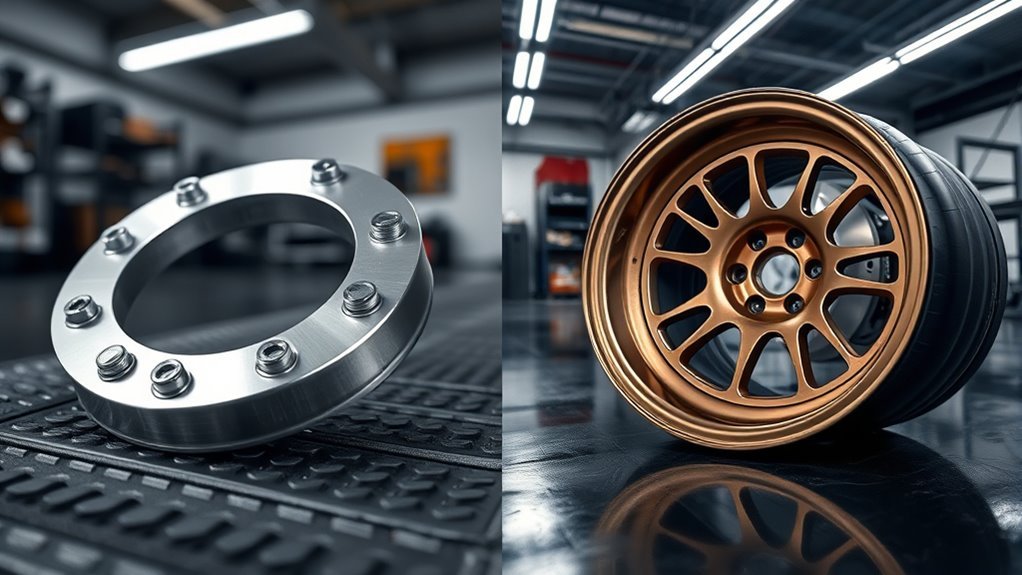
Lower offset wheels preserve your suspension geometry and factory scrub radius, eliminating the adapter interfaces and leverage forces that spacers introduce. You’ll avoid the 40% increase in bearing wear, ball joint fatigue, and control arm stress that hub-centric spacers create through extended moment arms. While spacers offer lower initial cost and immediate stance gains, they demand meticulous torque maintenance and amplify load path complications. Offset rims integrate durability into a single component, delivering superior predictability for track precision and off-road articulation. Your specific application and tolerance for maintenance protocols will determine the best solution—and the deeper comparison reveals critical nuances in installation risks and long-term economics you won’t want to overlook.
Wheel Spacers vs. Offset Rims: Which One Fits Your Build?

How do you determine whether wheel spacers or negative offset rims suit your build? You start by evaluating your priorities: cost-effectiveness versus long-term integration.
Wheel spacers deliver immediate spacer aesthetics, letting you dial in fitment incrementally without committing to new wheels. You’re paying less upfront, but you’re introducing additional stress points into your suspension geometry. Most failures stem from improper torque specs or hub-centric fitment—errors you control through meticulous installation.
Wheel spacers offer instant stance upgrades on a budget, but demand precision—your torque wrench and hub-centric discipline separate safe fitment from catastrophic failure.
Negative offset rims offer superior rim durability through seamless integration. You’re eliminating adapter interfaces, reducing bearing loads, and preserving handling dynamics for daily driving. The forged or cast construction distributes forces natively across hub assemblies rather than concentrating them at spacer flanges.
For your liberation on the trail, spacers provide adjustability to accommodate varying tire widths. For street-driven builds prioritizing reliability, lower offset rims minimize maintenance cycles. Your choice hinges on temporary experimentation versus permanent optimization.
Are Wheel Spacers Actually Safe for Daily Driving?
Why do enthusiasts keep running spacers despite the controversy? You want that aggressive stance without replacing your entire wheel setup, and quality hub-centric spacers deliver exactly that—when you respect the engineering.
Your safety concerns center on load path alteration. You widen the scrub radius, increasing bearing stress and suspension component fatigue. You risk fender contact during compression if your spacing exceeds clearances. You invite vibration and potential wheel failure with poorly manufactured units.
Master these installation tips to liberate your build responsibly:
- Verify hub-centric fitment eliminates radial runout
- Torque to manufacturer spec using a calibrated wrench
- Inspect thread engagement depth on extended studs
- Monitor bearing preload through regular maintenance intervals
- Select aircraft-grade aluminum with proper anodization
You trade integrated strength for adaptability. Negative offset rims distribute loads through the barrel; spacers introduce a shear plane. For daily driving, you mitigate risk through obsessive maintenance and premium components. Your freedom demands precision.
How Spacers and Offset Rims Change Your Suspension Differently
You alter your suspension’s force distribution mechanics fundamentally differently depending on whether you choose spacers or negative offset rims. Spacers introduce an additional mounting interface that creates stress concentration points and modifies your bearing load lines, while lower offset wheels integrate that geometry change into the wheel structure itself. These geometry alteration effects manifest in your scrub radius, effective spring rate, and component wear patterns—differences you’ll notice in handling response and long-term durability.
Force Distribution Mechanics
The fundamental distinction between wheel spacers and negative offset rims lies in how each solution manages load paths through your suspension architecture. Wheel spacers introduce an additional mounting point, fragmenting force management and altering stress distribution across your components. You’re fundamentally creating a cantilevered load that amplifies bending moments on control arms and hub assemblies.
Negative offset rims integrate spacing into the wheel structure itself, preserving designed suspension geometry and maintaining cleaner load paths. This integrated approach allows your OEM bushings and bearings to handle forces as engineered.
- Spacers create dual shear planes, complicating stress distribution
- Offset rims consolidate loads within the wheel barrel
- Extended scrub radius from spacers generates kingpin moment asymmetry
- Integrated designs maintain consistent steering response
- Spacer stacks multiply failure points requiring vigilance
Geometry Alteration Effects
Although both solutions widen your track, wheel spacers and negative offset rims diverge sharply in how they manipulate your suspension’s kinematic envelope. You increase scrub radius with spacers, degrading handling predictability and risking fender contact during aggressive cornering. Lower offset rims preserve your original scrub radius, delivering consistent feedback through the steering wheel.
| Parameter | Wheel Spacers | Lower Offset Rims |
|---|---|---|
| Scrub Radius | Increases | Maintains original |
| Moment Arm | Extended, unfavorable | Enhanced around kingpin |
| Force Path | Interrupted at spacer interface | Continuous through wheel structure |
| Spring Rate Effect | Alters effective rates | Preserves designed kinematics |
| Bearing Load | Misaligned, reduced lifespan | Direct, ideal alignment |
You face compounding geometric penalties with spacers—each millimeter of track width costs you in suspension fidelity. Offset rims integrate spacing into the wheel casting, liberating your chassis to function as engineers intended.
Off-Road and Track: Where Spacers or Offset Rims Perform Best
You’re chasing apexes on track day or crawling over boulders—either way, your wheel setup determines whether your suspension geometry stays true or your components take a beating. Negative offset rims give you the integrated track handling precision and off-road durability you need without introducing failure points, while spacers offer terrain adaptability through quick stance adjustments at the cost of added weight and maintenance demands. Choose based on whether you prioritize permanent performance gains or temporary flexibility.
Track Day Precision
When you’re pushing your vehicle to its limits on a closed circuit, every millimeter of suspension geometry matters—lower offset rims deliver the precision you need by preserving factory scrub radius and minimizing unsprung weight, whereas spacers introduce compliance and potential failure points that compromise lap times.
- Track dynamics remain uncompromised with lower offset rims
- Precision handling stays true to factory calibration
- Reduced unsprung mass sharpens transient response
- Eliminated spacer flex maintains consistent cornering loads
- Factory scrub radius preserves predictable steering feedback
You’ll feel the difference through high-speed sweepers where wheel position integrity dictates confidence. Spacers create measurable deflection under lateral load, translating to vague turn-in and mid-corner corrections. Lower offset rims integrate hub, rim, and tire as one rigid assembly—no intermediary failure modes, no geometry drift. For repeatable lap times and chassis predictability, this isn’t preference; it’s engineering necessity.
Off-Road Durability
Track precision demands exacting standards, but off-road durability presents an entirely different engineering challenge—one where component survivability under cyclic loading and environmental exposure takes precedence.
| Factor | Wheel Spacers | Negative Offset Rims |
|---|---|---|
| Structural Integrity | Additional mounting points introduce failure modes | Integrated design minimizes stress risers |
| Bearing Load Distribution | Spacer longevity compromised by lever arm extension | Rim stability maintained through optimized scrub radius |
| Mass Penalty | Added unsprung weight degrades compliance | Reduced rotating inertia enhances articulation response |
You’re choosing between adaptability and permanence. Spacers offer rapid track width adjustment but amplify suspension strain through cantilevered loading. Negative offset rims preserve factory geometry while eliminating joint fatigue. For rugged terrain, integrated solutions reduce catastrophic failure probability. Your liberation demands hardware that survives the abuse you intend to deliver.
Terrain Adaptability
- Spacers enable on-the-fly width adjustments for varying terrain
- Negative offset rims provide fixed, optimized geometry for predictable surfaces
- Track driving favors offset rims’ preserved suspension kinematics
- Off-road expeditions benefit from spacer-induced stance flexibility
- Integrated rim designs eliminate spacer-induced failure modes during extreme articulation
Your liberation demands hardware that responds to environment, not constrains it.
The Hidden Costs: Spacers vs. Offset Rims Over Time
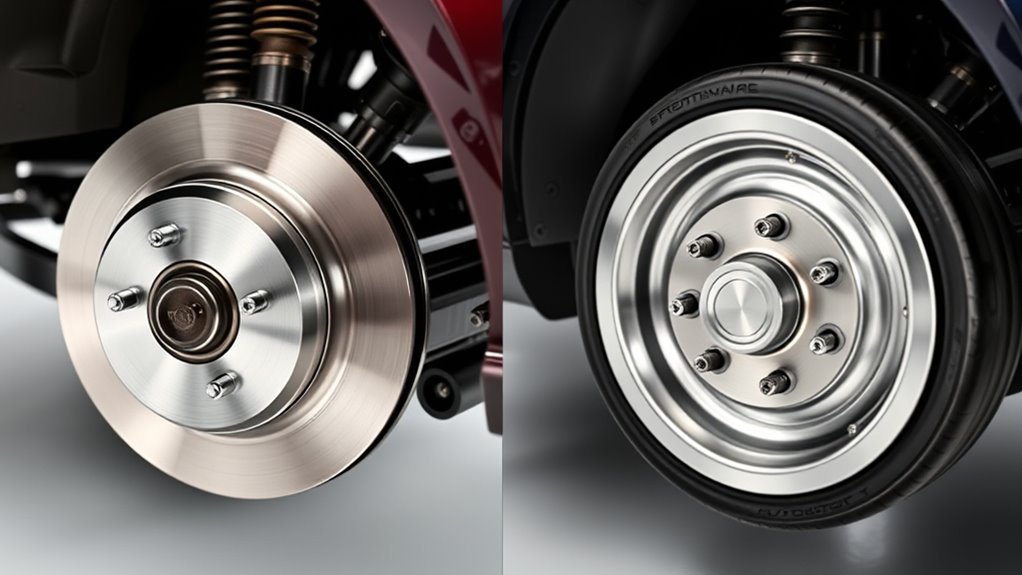
Although wheel spacers often win the initial cost comparison, you’re likely underestimating the cumulative financial impact they’ll exert across your vehicle’s service life. Your cost analysis must account for accelerated wear on hub bearings, ball joints, and control arms—components that endure amplified leverage forces when you introduce spacing elements between the hub and wheel mounting surface.
Your maintenance expectations shift dramatically with each option. Spacers demand vigilant torque verification, corrosion monitoring, and periodic replacement cycles. You’re managing additional failure points: bolt fatigue, thread engagement degradation, and potential galling on aluminum interfaces.
Conversely, lower offset rims integrate your stance modification into a singular, engineered component. You’re eliminating intermediary stress concentrations while achieving identical track width expansion. The forged or cast wheel structure distributes loads through OEM-intended load paths.
You’re trading immediate budget relief against systemic longevity. Spacers liberate your wallet today; proper offset wheels liberate your schedule—and your suspension—from chronic intervention.
Installation Reality Check: What Can Go Wrong
Whether you’re pressing a hub-centric ring into place or torquing down extended studs, you’re introducing critical failure modes that demand absolute precision. Installation pitfalls multiply when you deviate from factory torque sequences or neglect surface prep. You compromise bearing longevity through uneven load distribution the moment your spacer sits cocked on the hub. Your suspension geometry shifts under misalignment, transforming neutral handling into unpredictable understeer or snap oversteer. Low-grade alloys create stress risers that accelerate fatigue in control arms and knuckles.
Critical Failure Vectors:
- Torque spec deviation inducing fastener loosening
- Hub-centric ring mismatch causing radial runout
- Surface contamination destroying clamp load integrity
- Extended stud thread engagement miscalculation
- Neglected spacer maintenance protocols
You liberate performance only through disciplined execution. Post-installation inspection intervals aren’t optional—they’re your insurance against catastrophic separation. Verify fastener preload after thermal cycles; your safety margin depends on it.
Match Your Setup to Your Driving Style
Since your driving demands ultimately dictate component selection, you’ll need to weigh offset wheels against spacers through the lens of your actual use case rather than aesthetics alone. Your driving preferences directly determine which configuration optimizes your vehicle’s handling dynamics.
For daily commuting, offset rims preserve factory suspension geometry and maintain predictable steering response without introducing additional failure points. You’ll retain OEM reliability without compromising ride quality.
Off-road enthusiasts benefit from spacers’ modularity—you’re adapting track width rapidly for terrain-specific requirements while achieving aggressive stance modifications. However, recognize that you’re adding unsprung mass and stress concentration zones.
Track applications demand lower offset wheels. You’re achieving optimized scrub radius and reduced moment arm on suspension components, directly translating to mitigated understeer and enhanced transient response. Spacers compromise here—you’re introducing stack-up tolerances that degrade precision.
Align your technical solution to operational reality. You’re not selecting components; you’re engineering handling dynamics for your specific operational envelope.
Frequently Asked Questions
What Offset Is Equivalent to a 2 Inch Spacer?
A 2-inch spacer equals approximately -50.8 mm offset change. You effectively reduce your wheel offset by 50.8 mm, transforming a +35 mm wheel into -15 mm. Spacer benefits include retained wheel alignment and suspension geometry.
What Are the Disadvantages of Offset Rims?
Like Icarus chasing the sun, you risk hub bearing overload, compromised wheel stability, accelerated tire wear, unpredictable handling characteristics, and clearance issues—trading aesthetic appeal for installation complexity that chains your build to permanent geometry alterations.
Conclusion
You’re choosing between widening your track through spacers or offset rims, and both paths demand precision. Spacers offer bolt-on adaptability; offset rims deliver integrated strength. You prioritize clearance; you sacrifice hub loading. You optimize geometry; you compromise bearing life. Match your modification to your application—daily drivers demand durability, track builds crave adjustability, off-road rigs need resilience. Your wheels anchor every input; build accordingly.

Related Articles
All-Terrain vs Mud-Terrain Tires: Which Suits Your Driving
Get insights on choosing between all-terrain and mud-terrain tires for your driving needs; discover which option truly fits your lifestyle.
Read More
Load Range C vs E for a 4Runner: Does Weight Matter
Heavier Load E tires add 32 pounds of unsprung mass—but is that trade-off worth it for your 4Runner?
Read More
Do 5th Gen 4Runner Wheels Fit the 6th Gen
Not all 5th Gen 4Runner wheels fit the 6th Gen, but the reasons behind this may surprise you. Discover the crucial details inside.
Read More