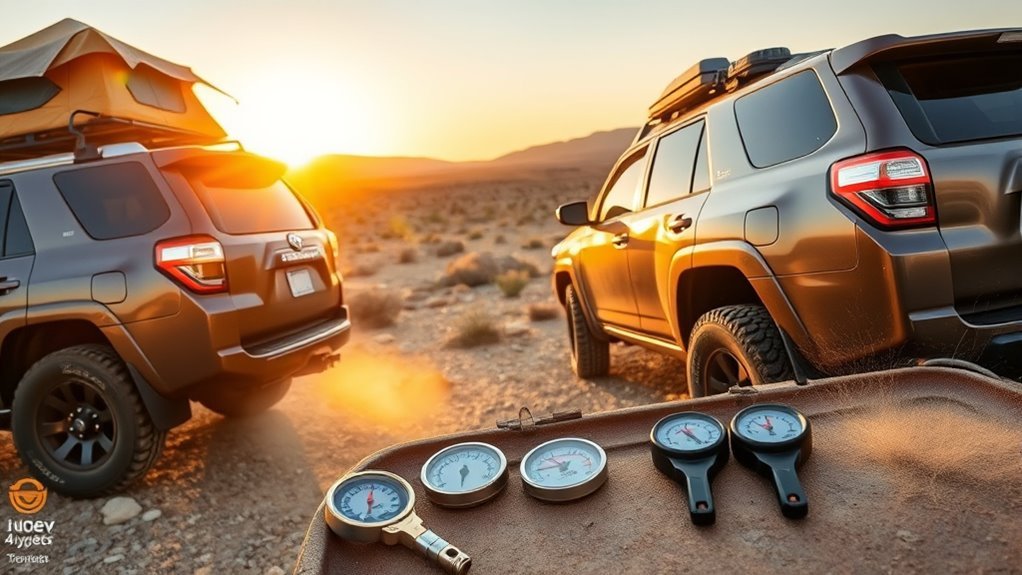
Choosing between Load C and Load E tires for your Toyota 4Runner comes down to how you actually use the vehicle. Load C tires usually make more sense for daily driving, lighter trail use, snow, and comfort. Load E tires make more sense when you tow often, carry heavy gear, run armor, or spend time on sharp rocky trails. The safest choice starts with your 4Runner’s tire placard, load requirements, wheel size, and real payload.
Quick Answer
For most 4Runner owners, Load C tires are the better everyday choice because they are usually lighter, more compliant, and easier to live with on pavement and moderate trails. Choose Load E tires if your 4Runner regularly tows, carries heavy overland gear, runs steel armor, or sees sharp rock terrain.
Key Takeaways
- Load C usually gives your 4Runner a smoother ride, better steering feel, and less rotating weight than a comparable Load E tire.
- Load E adds load capacity and tougher-duty construction, but it can feel harsher when the tire is not carrying enough weight.
- A higher load range does not increase your 4Runner’s GVWR, GAWR, tow rating, or legal payload.
- Use the tire placard and owner’s manual as your starting point for pressure, not the maximum PSI molded on the tire sidewall.
- Sidewall strength depends on the exact tire model, not only the load range letter.
Warning: Never use tire load range as a shortcut for payload. Your 4Runner’s safe carrying capacity is still limited by the vehicle’s door-jamb label, GVWR, axle ratings, wheels, suspension, and hitch rating. A stronger tire does not make the vehicle legally or mechanically rated to carry more weight.
Load C or Load E? How to Choose for Your 4Runner

Start with your use case. If your 4Runner is a daily driver with weekend trails, camping gear, and occasional dirt roads, a Load C all-terrain tire often gives you the best balance. It usually weighs less, rides softer, and lets the suspension work more freely over broken pavement and washboard trails.
Choose Load E tires when your 4Runner regularly carries heavy loads. That can include a drawer system, fridge, water, rooftop tent, steel bumpers, sliders, skid plates, recovery gear, passengers, and trailer tongue weight. Load E can also help when you spend a lot of time in sharp desert rock or remote terrain where sidewall damage matters more than ride comfort.
The key is to match the tire to your real load, not your imagined worst-case trip. Overbuilding the tire can make your 4Runner feel heavy and stiff. Underbuilding it can reduce safety margins when the vehicle is loaded.
[Products Worth Considering]

The SAFELIFE dial tire tread depth gauge measures tread depth in 1/32 inch increments with clear, easy-to-read 2-inch dial face. Color zones using a traffic light system help you quickly judge whether tread is low, marginal, or ample for safer driving. Built with a durable zinc cast body and a metal detect probe for precise, comfortable use across cars, motorcycles, trucks, and buses.
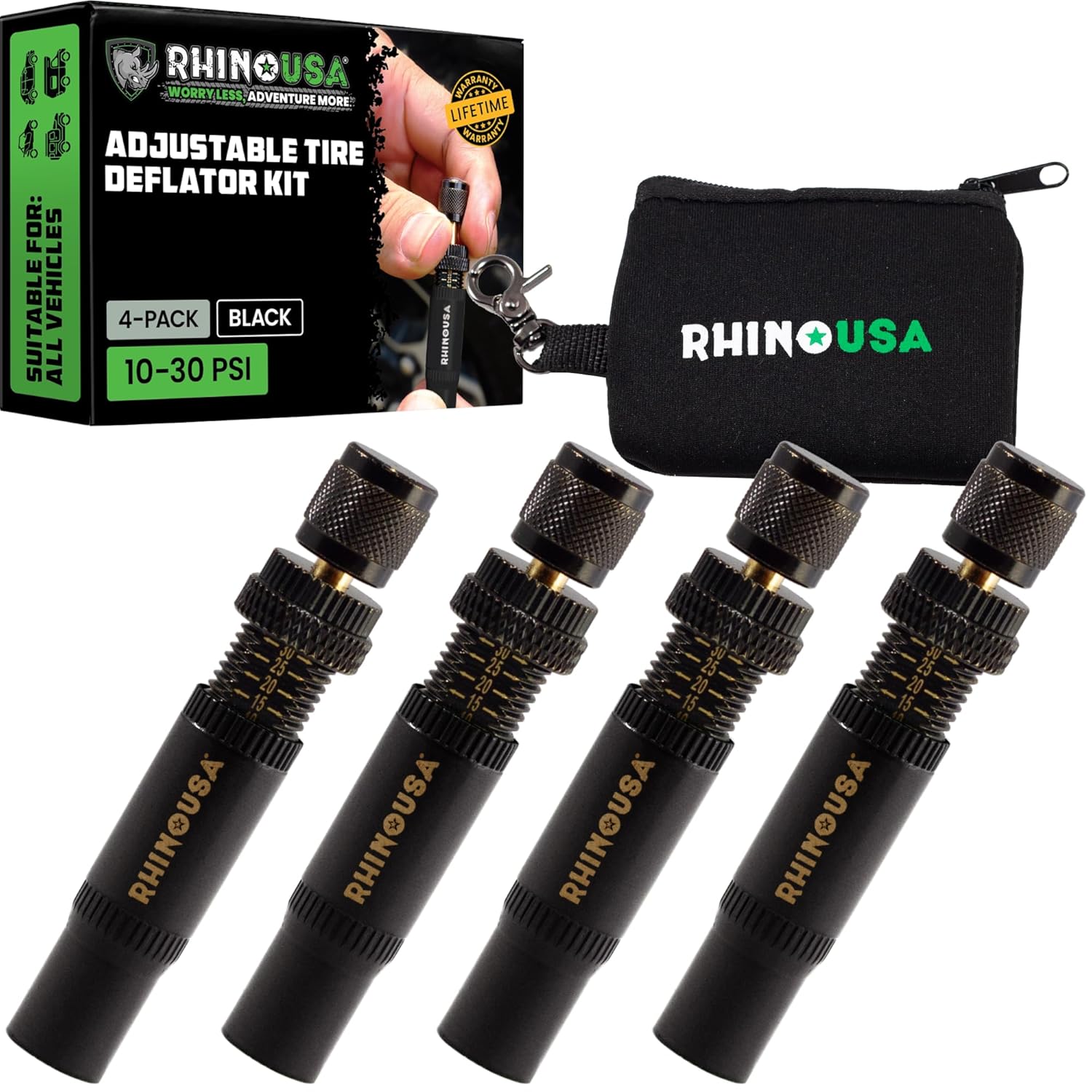
Use the Rhino USA adjustable tire deflators to air down all four tires at once by screwing one deflator onto each valve stem, letting you step away while the tires reach your preset pressure. Each deflator independently adjusts across a 10–30 PSI range with laser-etched indicators for quick setup and verification, making it ideal for beach, sand, and rocky off-road trails.
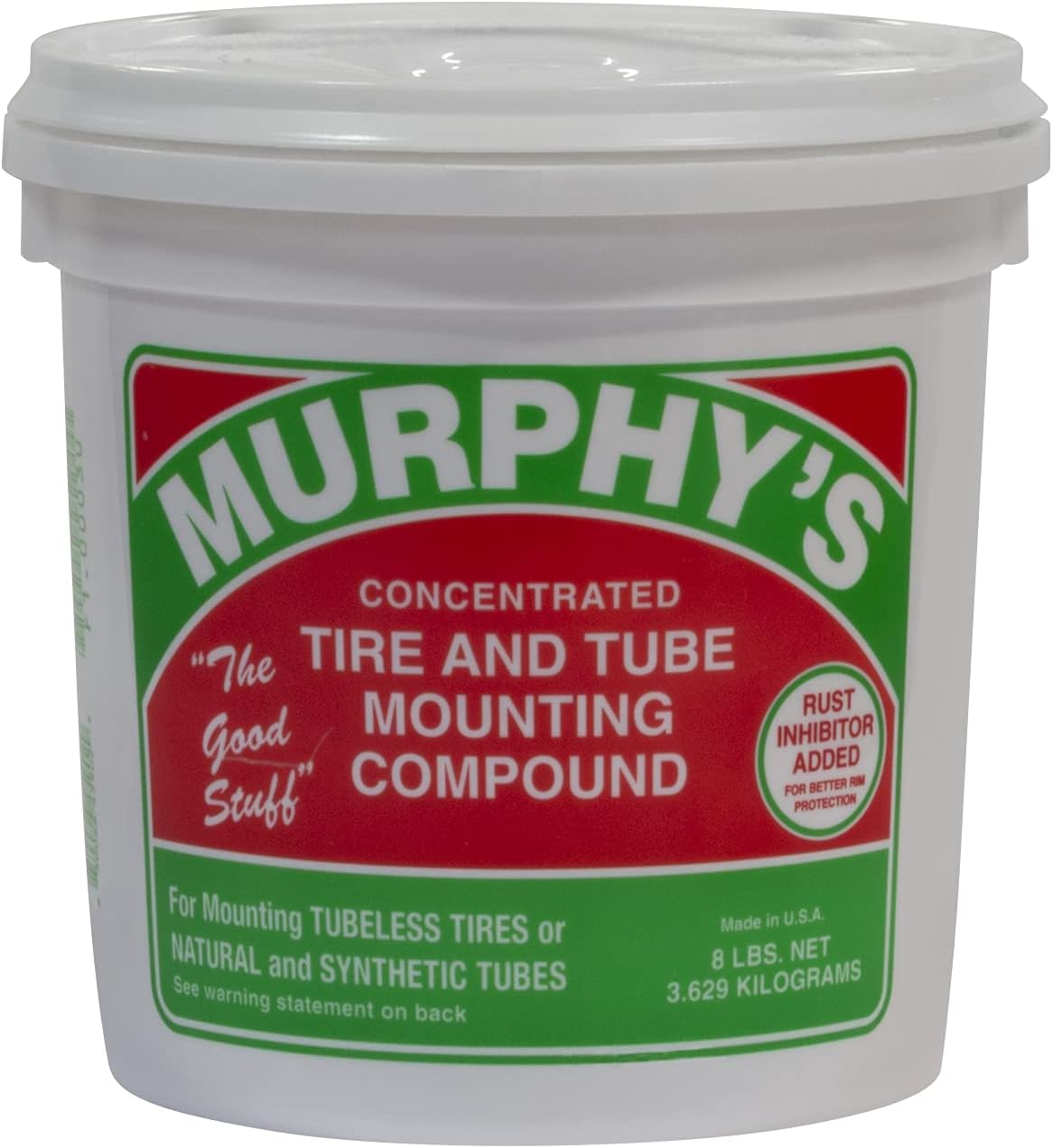
A concentrated tire and tube mounting compound designed to help simplify mounting rubber tires and tubes on passenger, semi truck, construction, and OTR applications. Its ultra-thick formula packs beads effectively and includes rust inhibitors to help protect against corrosion during use.
Load Range vs Load Index: What the Letters Actually Mean
Load range is a strength category for light-truck tires. It replaced older literal ply-count descriptions, so a “10-ply-rated” tire does not always contain ten physical plies. For many LT tires, Load Range C is commonly 6-ply rated with a 50 psi maximum load pressure, while Load Range E is commonly 10-ply rated with an 80 psi maximum load pressure.
Load index is the number that tells you how much weight one tire can carry when properly inflated. Two Load E tires can have different load indexes, weights, and maximum loads. That is why you should compare the exact tire size and service description, not just the letter C or E.
Note: If you change tire size, wheel size, load range, or pressure target, ask a qualified tire shop to verify load capacity, wheel rating, clearance, and TPMS behavior before you drive long distances.
Load C vs Load E Tires for a 4Runner: Quick Comparison
| Category | Load C | Load E |
| Best use | Daily driving, moderate trails, snow, lighter camping loads | Heavy towing, full overland builds, armor, sharp-rock terrain |
| Ride quality | Usually softer and more compliant | Usually firmer, especially on an unloaded 4Runner |
| Weight | Often lighter in the same tire family and size | Often heavier due to stronger-duty construction |
| Pressure range | Lower maximum load pressure on many LT sizes | Higher maximum load pressure on many LT sizes |
| Main trade-off | Less heavy-load margin than E | More harshness and rotating weight than C |
[Products Worth Considering]
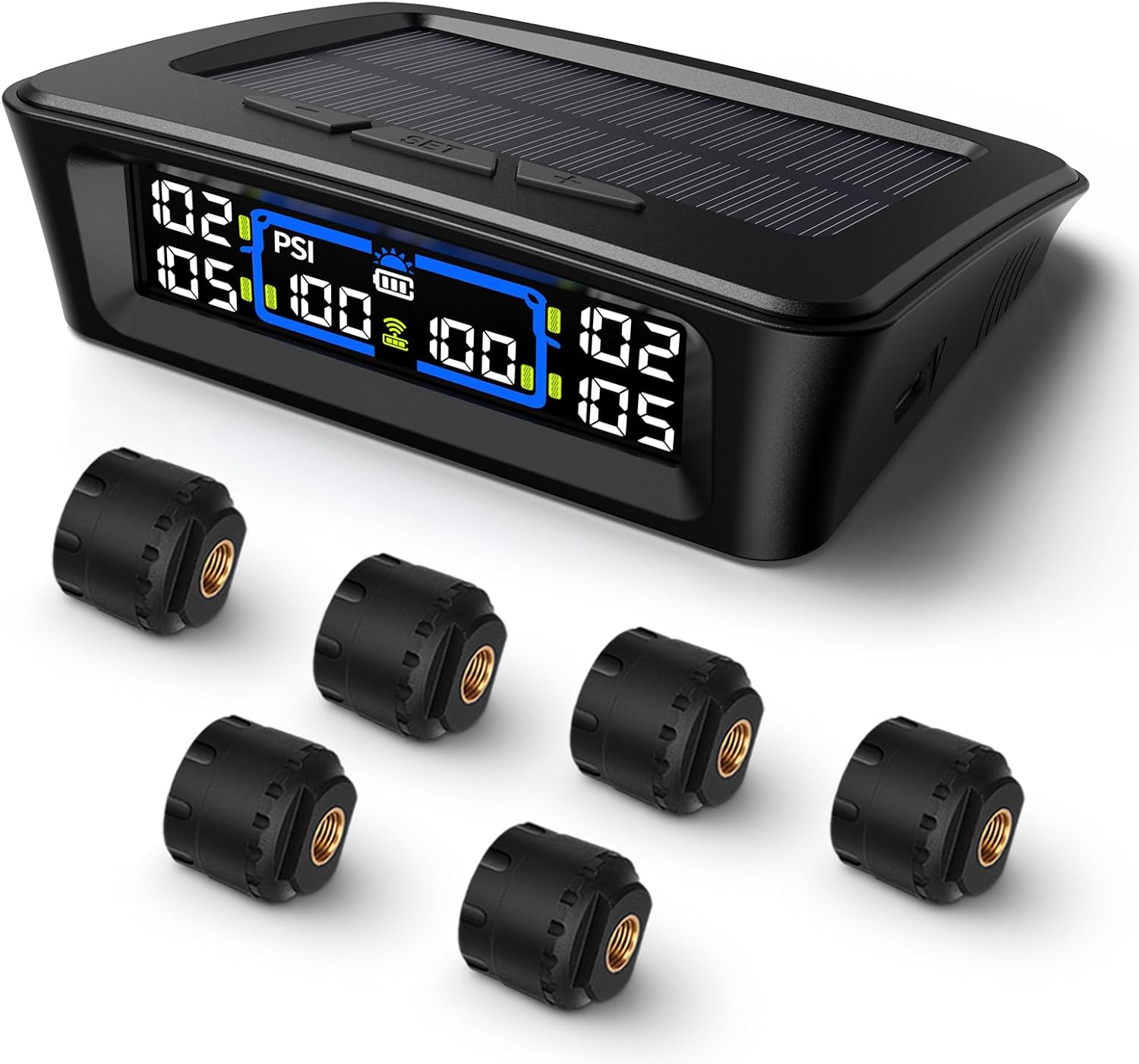
The Tymate TM12 RV TPMS delivers real-time tire pressure and temperature monitoring with a stable 433Hz display for safer long-distance driving. It supports simultaneous monitoring across vehicle and trailer zones, includes six alarm modes for pressure, temperature, leakage, battery, and signal loss, and features easy DIY installation with auto calibration. Power is supplied via USB-C charging or solar recharging, with a wide 0–144 PSI range and up to 50 ft signal coverage for RVs and towable trailers.

Monitor tire tread wear with a smart, color-coded depth gauge that shows clear condition ranges at a glance. The bar is range marked for fast, easy readings, helping you maintain safer traction and performance. Each gauge is portable with a pocket clip, and the set includes 20 units for daily use and sharing.

Measure tire tread depth quickly and accurately with this LUMITECO dial gauge that reads in 1/32" increments up to 14/32". The color-coded green/yellow/red zones make it easy to judge tire wear and know when replacement is needed. A rugged, compact design with a protective pouch helps keep the gauge ready for use on cars, trucks, motorcycles, and more.
The Real-World Performance Gap: Acceleration, Braking, and Ride Quality
Tire weight matters because your tires are both unsprung mass and rotating mass. Unsprung mass is weight the suspension has to control directly. Rotating mass is weight the engine has to spin up and the brakes have to slow down.
In the same size and tire family, a Load E tire often weighs more than a Load C version. That extra weight can make your 4Runner feel slower off the line, less eager to change direction, and firmer over small bumps. The difference is not always dramatic, but it is noticeable when you move from a lighter tire to a heavier LT tire.
Braking can also feel different. Heavier tires add more rotating mass, so the brake system has more work to do during repeated stops. This does not mean Load E tires are unsafe. It means you should only accept the weight and stiffness when you actually need the added load capacity or durability.
A heavier-duty tire is not automatically a better tire. The best tire is the one that safely matches your 4Runner’s load, terrain, and daily driving needs.
Sidewall Strength: Do You Need the Extra Protection?
Sidewall strength is one of the biggest reasons 4Runner owners look at Load E tires. If you crawl through jagged rock, desert ledges, or remote trails where one sliced sidewall can end the trip, the added toughness can be worth the firmer ride.
Still, load range alone does not tell the whole story. A well-built Load C all-terrain tire can have strong sidewall features, while a different Load E tire may focus more on load capacity than trail damage resistance. For example, BFGoodrich describes the All-Terrain T/A KO2 as using CoreGard Technology with split- and bruise-resistant sidewall rubber. That is a tire-model feature, not a universal feature of every Load C or Load E tire.
[Products Worth Considering]

This ALL-TOP auto-stop tire deflator valve kit lets you air down off-road tires quickly without watching pressure, automatically stopping when your preset PSI is reached. Each valve is individually calibrated for reliable performance with an acceptable +/- 2 PSI tolerance. The adjustable deflator range covers 10 to 30 PSI and includes four valves plus valve caps and a zipper pouch for easy setup on trucks, SUVs, RVs, UTVs, and powersports.

The Trivd Frol 1/2" air impact wrench delivers high performance torque up to 1500 ft-lbs with a twin hammer impact mechanism for strong, balanced blows. It features an ergonomic grip, compact lightweight design, and quick-stop control with 3 forward speeds up to 8000 RPM plus a reverse speed. Built for demanding automotive repair and tire shop work, the rear exhaust helps keep debris away from the surface.

The TYAMATE TM8 solar-powered wireless TPMS delivers real-time tire pressure and temperature monitoring with six alarm modes for safer driving. A vibrant color LCD display shows readings clearly while windshield mounting keeps it hands-free and easy to read. With a wide 0–87 PSI range, strong 433.92 MHz signal transmission, and quick sensor pairing, it’s ideal for RV, sedan, SUV, MPV, and truck use.
Ply Rating, Not Literal Ply Count
Older tire language makes this topic confusing. Load Range C is often called “6-ply rated,” and Load Range E is often called “10-ply rated.” That does not mean every Load E tire has ten physical sidewall layers. Modern tire construction uses different materials, belts, sidewall compounds, and casing designs.
Use the load range as a capacity clue, then compare the exact tire’s sidewall design, weight, tread depth, warranty, load index, and real fitment data.
Rock Puncture Resistance
For mild trails, gravel roads, forest roads, beach driving, and occasional rocky climbs, Load C often gives enough durability with better comfort. When aired down correctly for trail use, a lighter tire can flex well and maintain traction over uneven ground.
For frequent rock crawling, sharp volcanic rock, desert ledges, or remote overlanding, Load E can give you a wider safety margin. The stronger-duty casing and higher load capacity can help when your 4Runner is heavy and far from help.
Pro Tip: If your 4Runner is mostly stock, Load C is usually easier to justify. If you have steel bumpers, sliders, skid plates, a drawer system, rooftop tent, water, tools, and recovery gear, weigh the vehicle loaded for a trip before choosing tires.
When Load E Tires Actually Make Sense
Load E tires make sense when your tire is part of a heavier system. That system may include towing, added accessories, high cargo weight, remote travel, or repeated impacts from sharp terrain.
| Scenario | Why Load E Can Help |
| Frequent towing | Adds tire load margin when the vehicle is carrying tongue weight and cargo |
| Heavy overland build | Better matches higher real-world vehicle weight from armor, gear, and supplies |
| Sharp rock trails | Stronger-duty construction can improve resistance to sidewall abuse |
| Remote trips | Extra durability may matter more than ride comfort when help is far away |
| Work use | Useful when the 4Runner regularly carries tools, equipment, or heavy cargo |
Toyota lists the current 4Runner with a maximum towing capacity of up to 6,000 pounds, depending on configuration. That does not mean every 4Runner should run Load E tires. It means you should consider Load E when your actual trailer, cargo, passengers, accessories, and tongue weight push the vehicle closer to its rated limits.
The Tire Pressure Sweet Spot for Load C vs. Load E
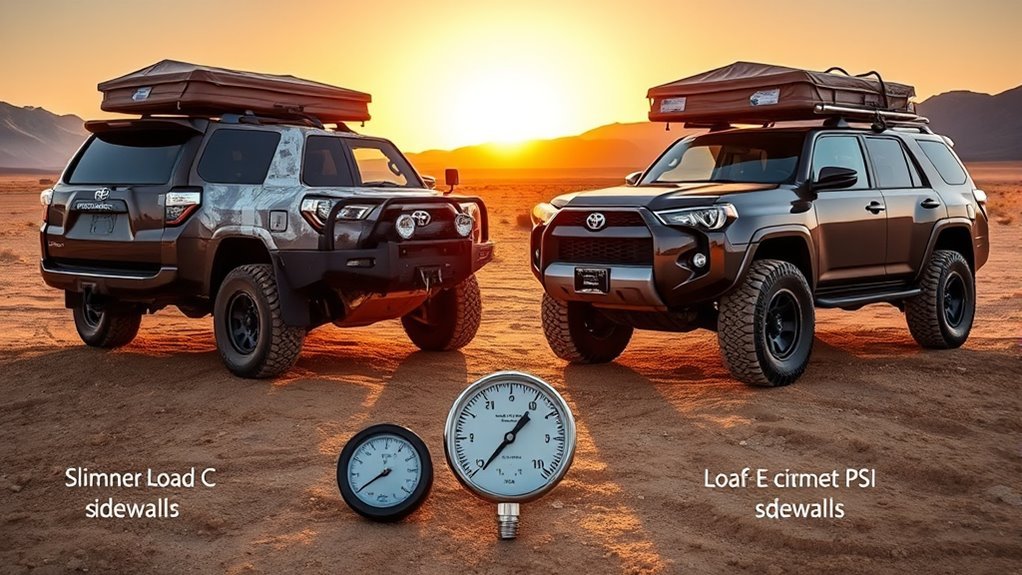
Tire pressure is where many Load C vs Load E debates go wrong. The number on the tire sidewall is a maximum load pressure, not a universal daily-driving recommendation. The safest starting point is the cold tire pressure listed on your 4Runner’s tire and loading information label or owner’s manual. NHTSA also recommends checking pressure cold and using the vehicle manufacturer’s listed pressure rather than the number molded on the tire sidewall.
After you install a different tire size or load range, your ideal pressure may need adjustment. A qualified tire shop can use load inflation tables to match the tire to your actual axle weights. This matters more if your 4Runner has heavy accessories or carries different loads from trip to trip.
For trail use, many drivers air down to improve comfort and traction. Do that carefully. Airing down too far can damage the tire, debead the tire, or overheat the casing if you drive too fast. Air back up before highway driving.
Daily Driving, Snow, and Wet Road Use
If your 4Runner spends most of its time on pavement, Load C is usually the easier tire to live with. The lighter casing often helps steering response, ride comfort, and braking feel. It can also help the suspension keep the tire planted over broken pavement.
In snow and wet conditions, tread design, rubber compound, tire age, and inflation pressure often matter more than load range alone. A heavy-duty Load E tire with the wrong compound can perform worse than a properly rated Load C tire with better siping and a winter-ready design.
Look for the exact tire’s traction ratings, winter markings, tread pattern, and owner feedback in your tire size. Do not assume Load E automatically means more grip.
Why Load C Tires Are Harder to Find and What to Do
Some 4Runner owners struggle to find Load C tires in the exact size they want. Availability depends on wheel diameter, tire size, brand, and regional inventory. In some popular LT sizes, tire makers offer more Load E options because trucks, fleets, and heavier SUVs create steady demand for higher load ratings.
Market Availability Challenges
If you run 16-inch wheels, you may see fewer modern all-terrain choices than owners running 17-inch wheels. Many newer 4Runner builds also move toward 17-inch sizing because it opens more options in popular all-terrain patterns.
Before you settle for Load E only because it is available today, compare several brands, check different retailers, and ask tire shops about incoming inventory. Sometimes the right Load C tire is available in a slightly different size that still fits your wheel, suspension, and clearance needs.
Alternative Size Solutions
A 17-inch wheel can expand your options, but do not change wheels only for load range without checking fitment. Confirm brake clearance, offset, rubbing risk, spare tire fit, speedometer effect, and load rating for the wheel itself.
You can also compare tire families that offer multiple load ranges in the same size. For example, some all-terrain lines offer both C and E versions in common 4Runner-friendly sizes. Compare the exact listed weight, load index, maximum pressure, tread depth, and warranty before choosing.
How to Make the Final Choice
Use this simple decision path:
- Choose Load C if your 4Runner is mostly a daily driver, lightly modified, and used for camping, forest roads, snow, sand, and moderate trails.
- Choose Load E if you tow often, carry heavy cargo, run a full overland setup, or drive sharp rocky terrain where casing strength matters.
- Check your door-jamb label before buying. Your tires must meet or exceed the required load rating for your vehicle.
- Compare exact tire specs, not just the load letter. Weight, tread design, compound, sidewall construction, and size all matter.
- Set pressure correctly after installation. Use the placard as a starting point and verify with a tire professional when using non-stock sizes or heavy loads.
The best answer is not always the strongest tire. It is the tire that gives your 4Runner enough load capacity and durability without adding unnecessary harshness, weight, and cost.
Frequently Asked Questions
Do all Load Range E tires have the same weight rating?
No. Load Range E tells you the tire is in a higher-duty LT category, but the actual load capacity depends on the tire size, load index, and service description. Always check the exact tire’s sidewall and published specifications.
What are the disadvantages of Load Range E tires on a 4Runner?
Load E tires often weigh more and ride firmer than comparable Load C tires. On a lightly loaded 4Runner, that can reduce comfort, dull steering feel, and add rotating weight. The trade-off is worth it only when you need the extra load capacity or durability.
Can Load E tires increase my 4Runner’s payload?
No. A higher load rating does not increase your 4Runner’s GVWR, GAWR, tow rating, or legal payload. It only changes the tire’s own carrying capacity when used within the correct specifications.
Are Load C tires strong enough for off-roading?
Yes, Load C tires can work very well for moderate off-roading, forest roads, sand, snow, and weekend trails. For frequent sharp-rock driving, heavy armor, or remote overland travel, Load E may give you a better durability margin.
What tire pressure should I run with Load C or Load E tires?
Start with the cold pressure on your 4Runner’s tire placard or owner’s manual. If you changed size, load range, or vehicle weight, have a tire professional use load inflation tables and axle weights to set a safe pressure.
Conclusion
For most 4Runner owners, Load C tires are the smarter default. They usually keep the vehicle more comfortable, responsive, and balanced for daily driving and moderate trails. Load E tires are the better choice when your 4Runner is heavy, frequently tows, runs major armor, or regularly sees sharp terrain.
Do not buy the highest load range just because it sounds tougher. Check your door-jamb label, compare exact tire specs, think honestly about your terrain, and choose the lightest tire that safely supports your real use.
Sources
- NHTSA TireWise — tire pressure, cold inflation checks, tire placard guidance, and tire safety basics.
- Tire Rack Load Ranges / Ply Ratings — LT tire load range, ply rating, and maximum load pressure references.
- Michelin Tire Load Rating and Speed Rating Guide — load index explanation and replacement tire safety guidance.
- Toyota Vehicles for Towing — current Toyota 4Runner towing capacity context.
- Toyota Canada 4Runner Specifications — payload label and towing safety notes.
- BFGoodrich All-Terrain T/A KO2 — example of model-specific sidewall technology and all-terrain tire construction claims.