
Can You Repair a Run-Flat Tire or Must You Replace It
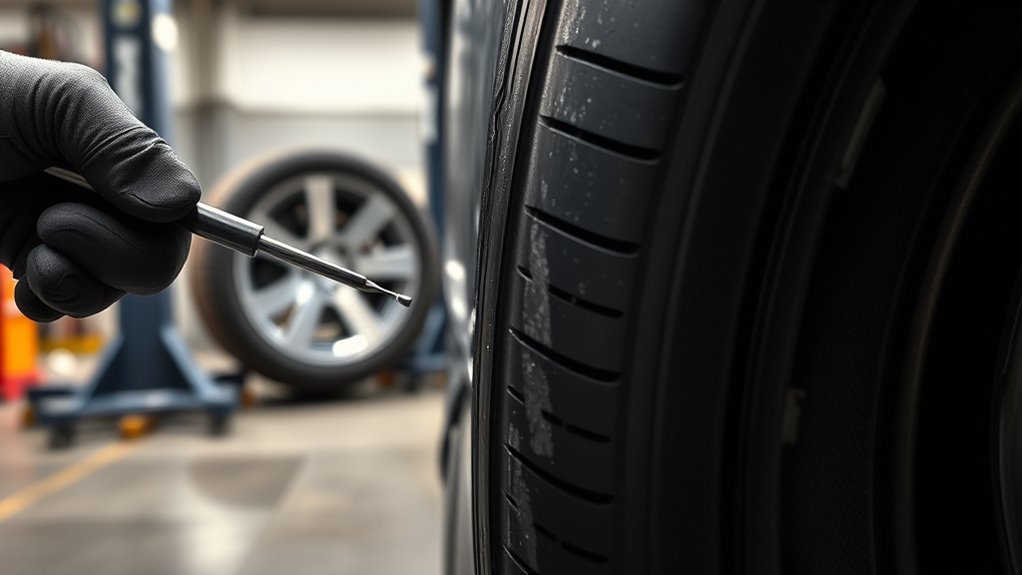
You can repair a run-flat tire only if the puncture sits in the tread area, you’ve driven zero miles flat, and your manufacturer permits it—otherwise, you must replace it. Most manufacturers recommend replacement because hidden structural damage compromises safety even when repairs seem possible. Sidewall punctures, driven-flat incidents, and “Do Not Repair” labels all require new tires. Your safest choice depends on understanding these strict repair limits and knowing what technicians must check inside your tire.
When Can a Run-Flat Tire Actually Be Repaired?
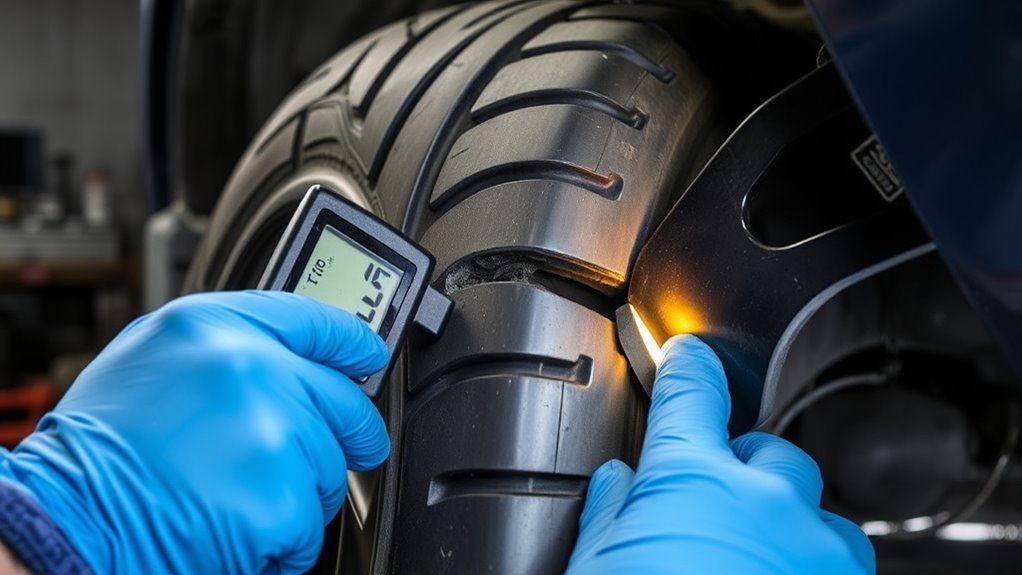
How exactly do you determine whether your run-flat tire qualifies for repair? You must inspect three critical factors: puncture location, driving history, and internal integrity.
First, examine the damage. You can only repair punctures in the tread area—sidewall damage disqualifies the tire immediately. Second, be honest about your driving behavior. If you’ve driven any distance after pressure loss, you’re risking catastrophic failure. The reinforced sidewalls mask internal damage you cannot see.
Third, seek professional evaluation. A qualified technician must verify the tire’s internal structure remains intact using proper inspection equipment. Don’t attempt self-assessment.
Understand the repair limitations clearly. Even when technically feasible, most manufacturers recommend replacement to preserve tire longevity and your safety. Some run-flat models carry explicit “Do Not Repair” labels—honor these without exception.
Your liberation demands informed choice, not dangerous shortcuts. When doubt exists, replace. Your safety isn’t negotiable.
How Are Run-Flat Tires Built Differently?
Understanding why repair options remain so limited requires examining what sets these tires apart from conventional designs. You’ll notice run-flat tire technology relies on reinforced sidewalls that maintain structural integrity even after complete air loss. These safety features use either self-supporting tough rubber compounds or internal support rings that prevent collapse.
Your tire’s internal architecture enables continued mobility—up to 50 miles at 50 mph following puncture. However, this specialized construction creates significant trade-offs. The added stiffness and weight you’ll experience translates to reduced ride comfort compared to standard tires.
Most critically, you must recognize that driving deflated generates substantial internal stress. Heat buildup and sidewall flexion often cause hidden damage invisible during external inspection. This explains why manufacturers frequently prohibit repairs after flat operation. Your safety depends on understanding these structural limitations. When tire technology prioritizes emergency mobility, it inherently sacrifices reparability—you’re exchanging convenience options for critical protection.
What Do Tire Manufacturers Recommend for Repairs?
Although you might hope to repair a run-flat tire after a puncture, manufacturer guidelines generally prohibit this if you’ve driven any distance while deflated. Driving flat compromises the internal structure, creating hidden damage that repairs cannot address. You’re only eligible for potential repair if you stopped immediately upon pressure loss and the puncture sits within the tread area—sidewall damage always mandates replacement.
Tire warranty implications demand your attention. Most manufacturers void coverage for previously repaired run-flats, and some models carry explicit “Do Not Repair” policies. You’ll find these specifications vary by brand, requiring careful review of your documentation.
Your path to informed decision-making starts with professional assessment. A qualified technician must evaluate the tire’s condition against specific manufacturer guidelines. They’ll determine whether replacement represents your only safe option. Remember: compromising on run-flat integrity risks your control and security. Prioritize manufacturer compliance over cost savings—your liberation depends on uncompromised safety.
How Can You Spot Hidden Damage Inside a Run-Flat?
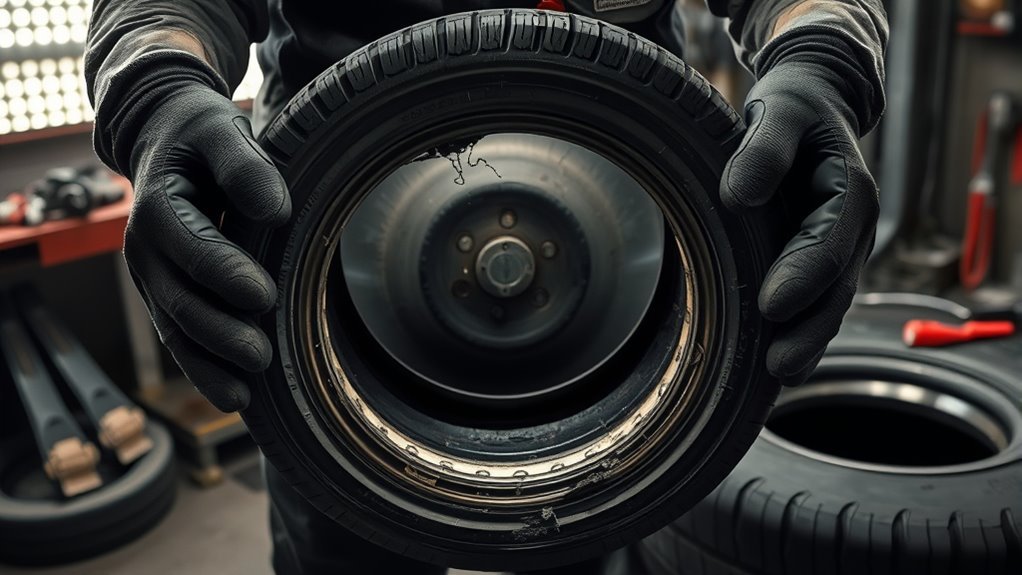
You can identify potential hidden damage through careful visual inspection methods, checking for irregular wear patterns, sidewall bulging, or unusual vibrations that signal compromised integrity. However, you’ll need professional assessment tools—such as x-ray imaging—to reveal internal structural damage that isn’t visible to the naked eye. Don’t rely solely on surface observations; internal damage often escapes detection without qualified technician evaluation.
Visual Inspection Methods
Visual scrutiny serves as your first line of defense when evaluating a run-flat tire’s internal condition. Start your damage assessment by examining the tread surface for punctures, cracks, or excessive wear—these external markers often reveal deeper structural compromise. Inspect both sidewalls meticulously for bulges or deformities, as these indicate internal reinforcement failure that threatens your safety. Rotate the tire slowly while mounted, watching for shape irregularities that suggest hidden damage from previous underinflation episodes. Run your hands across the surface to detect subtle abnormalities your eyes might miss. This hands-on tire maintenance routine empowers you to identify risks before they escalate. Remember: visual inspection has limitations. When uncertainty persists, you’re not surrendering control—you’re exercising wisdom by consulting a qualified technician for definitive integrity verification.
Professional Assessment Tools
Surface-level scrutiny can’t expose every threat lurking within a run-flat’s reinforced structure. You’ll need professional tire inspection equipment to uncover hidden damage that compromises your safety.
Take your tire to a certified technician who’ll deploy specialized tools for thorough damage assessment. They’ll use tire inspection machines and pressure testers to evaluate internal integrity. A tire scope lets them pinpoint punctures and structural failures invisible to your eye. For micro-cracks in sidewalls—critical flaws that emerge after driving flat—they’ll apply magnetic particle inspection.
These diagnostic technologies reveal what visual checks cannot. Your technician then cross-references findings against manufacturer guidelines to determine if repair is viable. Don’t gamble with compromised rubber; insist on professional damage assessment before choosing repair over replacement. Your liberation demands certainty, not guesswork.
Why Does Driving Flat Ruin a Run-Flat’s Structure?
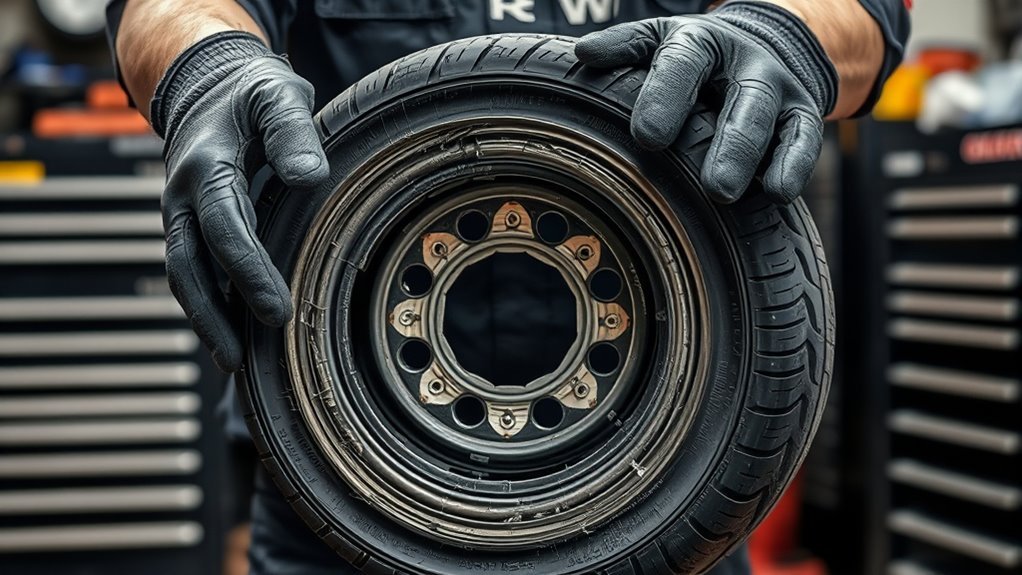
Although a run-flat tire‘s reinforced sidewalls are engineered to temporarily support your vehicle’s weight during air loss, driving on one while deflated generates destructive heat that compromises its internal structure. You subject the tire to intense heat buildup as the rubber flexes excessively without air cushion. This heat degrades the internal damage you cannot see—sidewall reinforcements, bead wires, and belt packages suffer thermal breakdown. You’re fundamentally cooking the tire’s skeleton from within.
The reinforced structure relies on specific polymer properties that heat destroys. Once you’ve driven flat, you’ve likely exceeded the tire’s thermal tolerance permanently. Manufacturers set strict distance and speed limits because they know you’ll destroy critical components otherwise. Even brief flat driving creates micro-fractures in the carcass. You cannot restore this integrity through repair. Your safety depends on recognizing that invisible damage has already compromised the tire’s ability to perform its next emergency function.
Which Repair Method Should You Choose: Patch, Plug, or Replace?
You’ve seen how driving flat cooks a run-flat’s internal structure beyond recovery, so now you’re weighing whether any repair can salvage a tire that hasn’t suffered that fate. Here’s your decision matrix:
| Method | When It Works | Your Risk |
|---|---|---|
| Patch | Tread puncture, zero flat miles | Lowest—restores integrity |
| Plug | Emergency only, manufacturer permitting | Moderate—sidewall stress persists |
| Replace | Any sidewall damage, driven deflated, or “Do Not Repair” label | Eliminated—fresh structure |
You must prioritize safety implications over convenience. A patch demands qualified assessment of the wound’s size and location; anything outside the tread’s central zone voids viability. Tire longevity hinges on this choice—compromised repairs accelerate failure. Most manufacturers explicitly prohibit plugs due to the run-flat’s reinforced sidewall complexity. When doubt exists, you replace. Freedom flows from certainty, not from gambling with blowout risk at highway speeds. Trust the technician’s inspection, honor the guidelines, and drive unburdened by second-guessing.
Is a Repaired Run-Flat as Safe as a New One?
You must recognize that a repaired run-flat tire rarely matches the structural integrity of a new one, as internal damage from driving deflated often remains hidden. Manufacturers typically reject repaired run-flats for this reason, setting strict safety standards that prioritize blowout prevention over cost savings. Even when repairs meet technical guidelines, you’ll likely notice diminished handling precision and stability, raising legitimate doubts about long-term performance reliability.
Structural Integrity Concerns
Since you’re weighing whether a repaired run-flat matches the safety of new rubber, understand that structural integrity isn’t guaranteed once the tire’s been compromised. Driving deflated damages internal components you can’t see, creating serious safety concerns that compromise tire longevity and performance.
Manufacturers warn against repairing run-flats driven flat because blowout risk escalates dramatically. Hidden sidewall damage persists even after patching. You’re only eligible for repair if the puncture sits in the tread and you stopped immediately—no driving on flat rubber.
Most qualified technicians will push replacement over repair. They’ll inspect internal structure, but their conservative recommendation protects your freedom on the road. Don’t gamble with compromised integrity. A new tire guarantees predictable handling, maintaining your autonomy without catastrophic failure threatening your journey.
Manufacturer Safety Standards
Although manufacturer safety standards vary across brands, nearly all run-flat tire makers maintain strict positions against repairs after deflation incidents. You must understand that manufacturer guidelines explicitly label many run-flat tires as “Do Not Repair” when driven deflated. The safety implications are significant: internal structural damage remains invisible yet compromises performance. You’re risking catastrophic failure if you ignore these warnings. Some manufacturers permit repairs only when the tire wasn’t driven flat and damage stays strictly within the tread area—never the sidewall. However, even approved repairs carry safety implications. A repaired run-flat won’t match new tire performance standards. You cannot verify hidden internal damage. For your liberation through true road safety, replacement remains the only reliable path. Don’t gamble with compromised integrity.
Performance Reliability Doubts
Manufacturer prohibitions against repairs stem from a fundamental question you can’t ignore: can a repaired run-flat ever match a new tire’s safety profile? You must scrutinize performance expectations against harsh reality.
- Structural integrity: Driving deflated damages internal components you cannot see, compromising the tire’s reinforced sidewalls.
- Pressure retention: Repairs may fail to restore original sealing capabilities, creating unpredictable failure points.
- Long-term durability: Heat buildup and flexing stress test compromised materials beyond their engineered limits.
The safety implications demand your attention. You’re gambling with catastrophic blowout risks when you choose repair over replacement. A patched run-flat cannot guarantee the zero-pressure mobility that defines its purpose. Your liberation from roadside emergencies depends on uncompromised equipment—don’t let cost calculations override physics. Replace, don’t gamble.
How Much Does Run-Flat Repair Cost vs. Full Replacement?
How much should you expect to pay when your run-flat tire sustains damage? Repair limitations often make replacement your only viable path forward. You’ll typically spend $25–$50 for a repair, assuming the shop accepts the job. However, full replacement runs $150–$400+, varying by brand and specifications.
Cost comparisons reveal a deceptive economy. You might save initially with a repair, but you’ve driven on a deflated run-flat, you’ve likely compromised its structural integrity. Most technicians recommend replacement precisely because hidden damage creates catastrophic failure risks.
Some manufacturers explicitly mark their tires “Do Not Repair”—you’ve got no choice then. Even when repair seems possible, you’re gambling with safety for minimal savings. The long-term math favors replacement: you avoid premature failure, repeated service visits, and potential roadside emergencies.
Your freedom demands reliable mobility. Choose replacement. You invest once, you drive confidently, you eliminate uncertainty.
How Can You Find a Shop Qualified for Run-Flat Repairs?
You’ve accepted that replacement often outweighs repair—but when damage appears minor and a shop claims they can fix it, you need to verify they won’t compromise your safety.
Start by confirming tire certifications. Demand TIA certification; it proves technicians follow standardized repair protocols, not guesswork. Ask directly about run-flat-specific experience—these tires demand specialized knowledge their reinforced sidewalls require.
Scrutinize their equipment. Proper inspection tools detect internal damage you cannot see. Without them, you’re risking catastrophic failure at speed.
- Verify they follow manufacturer guidelines—brands like Bridgestone and Pirelli publish strict repair policies that void repair warranties if ignored.
- Check reviews specifically mentioning run-flat work; general praise means nothing here.
- Confirm they document every repair decision—paper trails protect you if failures occur later.
You’re not being difficult. You’re exercising your right to informed, safe service. Qualified shops welcome scrutiny; evasive ones don’t deserve your trust or your tires.
Frequently Asked Questions
Can I Repair a Run-Flat Tire Myself at Home?
You shouldn’t repair a run-flat tire yourself at home. Tire maintenance tips emphasize professional inspection due to hidden internal damage. Run flat benefits degrade after driving deflated, making DIY repairs unsafe and unreliable.
Does Repairing Void My Tire Warranty?
Your heart pounds as you slice into the sidewall—yes, repairing voids your warranty coverage instantly. Manufacturer repair limitations exist precisely because structural integrity fails invisibly. You’re liberated from false security, not safety protocols.
How Long Does a Run-Flat Repair Last?
Your run-flat repair typically lasts the tire’s remaining tread life if properly done, though you must monitor repair longevity closely. Never compromise tire safety—inspect regularly and replace immediately if you detect bulging, vibration, or pressure loss.
Can I Mix Repaired and New Run-Flat Tires?
You crave freedom, yet you’d chain your vehicle to instability? Don’t mix repaired and new run-flats—uneven run flat performance and tire incompatibility compromise safety, handling, and your liberation on the road. Replace in matched sets.
Are Repaired Run-Flats Legal for Highway Driving?
Yes, repaired run-flats are legal for highway driving when properly fixed following tire repair regulations, but you must verify run flat safety standards and local laws to confirm your compliance and protection.
Conclusion
You’ve walked a tightrope pushing that run-flat past its limits, and now you’re gambling with structural integrity you can’t eyeball. Most manufacturers won’t bless a repair after zero-pressure driving—internal damage spreads like wildfire through reinforced sidewalls. When safety’s non-negotiable, replacement usually wins. Don’t let a penny-wise repair cost you everything.

Related Articles

How to Calculate Correct Tire Pressure After Upsizing
Noting the importance of accurate tire pressure after upsizing can enhance safety and performance; discover essential steps to ensure optimal tire function.
Read More
4Runner TPMS Sensor Replacement: When and How to Do It
A 4Runner's TPMS sensors demand replacement when warning lights appear or batteries expire—but the critical steps to avoid costly mistakes remain untold.
Read More
How to Use a Portable Air Compressor for 4Runner Tires
Breathe new life into your 4Runner tires with a portable air compressor; discover essential tips for efficient use and maintenance that you can't afford to miss.
Read More