
Toyota Camry Wheel and Tire Package Guide: Understanding Your Options
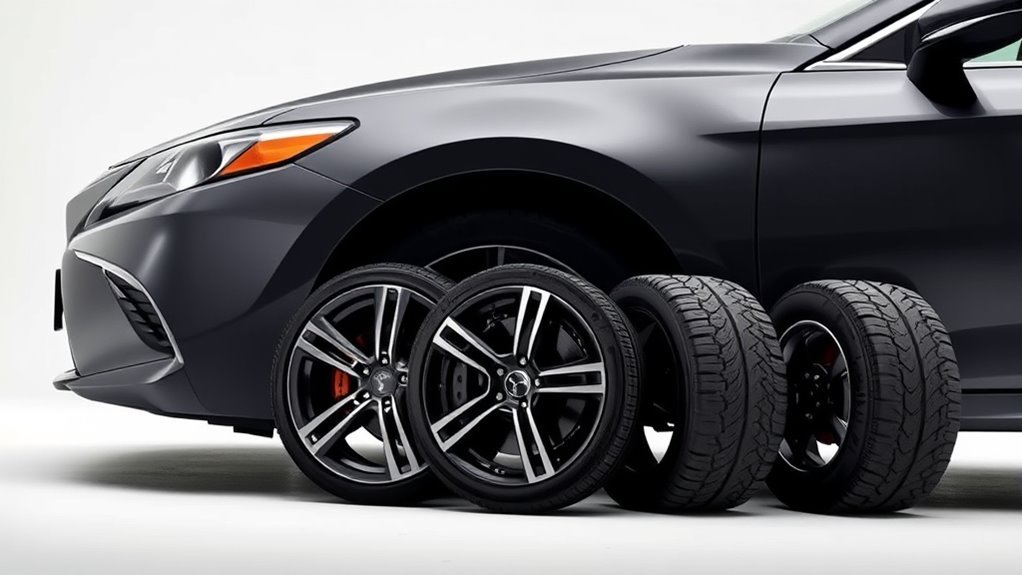
Choosing the right Toyota Camry wheel and tire package starts with one rule: match your exact model year, trim, and door-jamb tire placard before you shop. Most recent Camry setups use practical passenger-car fitment, but tire size, wheel diameter, load index, and trim equipment can change by year. Use the factory specs as your baseline, then compare bolt pattern, hub bore, offset, wheel width, rolling diameter, TPMS needs, and tire type before you buy.
Quick Answer
The best Toyota Camry wheel and tire package matches your door-jamb placard, keeps the rolling circumference close to stock, meets or exceeds the OE load and speed ratings, and clears the brakes, fenders, and suspension. For current-generation Camry models, common factory examples include 205/65R16, 235/45R18, and 235/40R19.
Key Takeaways
- Start with the tire placard on the driver’s door jamb, not a generic online fitment chart.
- Most modern Camry wheel searches should verify 5×114.3mm bolt pattern, 60.1mm hub bore, compatible offset, and correct lug hardware.
- Keep rolling diameter close to stock because large changes can affect speedometer accuracy, ABS, stability control, and clearance.
- Choose tires that meet or exceed the original load index and speed rating unless your owner’s manual or tire professional approves otherwise.
- Plan for TPMS sensors, balancing, alignment checks, and a post-install rubbing inspection.
At a Glance
| Time Required | 15–30 minutes to verify specs; longer if you compare custom fitments |
| Difficulty | Moderate if upgrading; easy if staying with OEM-equivalent sizes |
| Tools Needed | Door-jamb placard, owner’s manual, tire-size calculator, tape measure, torque wrench for installation |
| Cost | Varies by wheel material, tire brand, TPMS sensors, mounting, balancing, and alignment needs |
Camry Wheel and Tire Size Basics

Before you choose a wheel and tire setup for your Toyota Camry, separate factory fitment from upgrade fitment. Factory fitment means the tire size, wheel diameter, load index, speed rating, and inflation pressure Toyota selected for your trim. Upgrade fitment means you change wheel size, tire width, or offset while keeping the car safe and predictable.
Current-generation Camry examples show why model year matters. Toyota’s 2025 Camry brochure lists all-season tire examples of P205/65R16 for LE, P235/45R18 for SE and XLE, and P235/40R19 for XSE. Older Camry trims may use other sizes, including 215/55R17, so never copy a size from another car without checking your placard.
Most modern Camry wheel searches also involve a 5×114.3mm bolt pattern and a 60.1mm center bore, but you should still confirm the numbers for your exact model year. Offset often sits in a positive range near OEM fitment, and aftermarket wheels usually need careful checking for brake, fender, and suspension clearance.
Note: A wheel can have the right bolt pattern and still fit poorly if the offset, hub bore, wheel width, lug seat, or brake clearance is wrong.
[Products Worth Considering]

The Tymate TM3 RV TPMS delivers real-time tire pressure monitoring from 0 to 144 PSI with accurate readings and dependable wireless communication. It includes four external sensors with pre-pairing, six alarm modes for rapid leak, pressure extremes, temperature, and signal loss, plus an easy-reference setup for alert thresholds. Solar and USB-C charging help keep the display powered, while the color LCD and adaptive backlight improve visibility for safer driving and towing.

Protect your Tesla during lifting with durable rubber jack pads designed to cushion pressure and help safeguard the battery and chassis. The non-slip, plug-and-play puck set fits Tesla Model 3/Y/X/S for safe, secure jacking. Each pack includes a portable storage case for cleaner trunk organization.

This portable cordless tire inflator delivers up to 160 PSI with fast 17 L/min airflow to help you quickly top up tires and get back on the road. It features dual power mode, running on a 21V rechargeable battery or a 12V DC adapter for convenient roadside use. An automatic shut-off with digital pressure gauge helps prevent overinflation, and a built-in LED light improves visibility in low-light conditions.
Check Your Factory Fitment First
You should start by finding your stock specs in three places: the tire and loading placard on the driver’s door jamb, the owner’s manual, and the tire sidewall. The placard matters most because it shows the original tire size, recommended cold inflation pressure, and load information for your vehicle.
The Tire Industry Association recommends following the tire information placard or owner’s manual when selecting replacement tires. It also warns against installing tires with a lower load index than the original equipment tire.
Find Your Stock Specs
Write down these factory specs before you shop:
- Tire size: Example: 205/65R16, 235/45R18, or 235/40R19.
- Load index and speed rating: Example: 95H, 94V, or a similar rating listed on the sidewall or placard.
- Wheel diameter and width: Example: 16×6.5, 18×8, or 19-inch factory wheel examples by trim.
- Bolt pattern: Confirm the lug pattern for your model year before ordering.
- Center bore: Confirm whether the wheel is hub-centric or needs a proper centering ring.
- Offset: Compare the new wheel’s offset with your original wheel to avoid rubbing or poor steering feel.
- TPMS requirements: Plan to reuse, replace, or register tire pressure sensors.
Read Tire Sidewall Markings
The tire sidewall gives you the quickest way to confirm what is currently installed. A size like 235/45R18 means the tire is about 235 mm wide, the sidewall height is 45% of that width, and the tire fits an 18-inch wheel. The letters and numbers after the size show load index and speed rating.
Bridgestone’s tire-size guide explains that the sidewall can also show the DOT tire identification number. The last four digits of the DOT code show the manufacturing week and year. For example, a code ending in 2524 means the tire was made in the 25th week of 2024.
NHTSA notes that tires become more prone to failure as they age, and some vehicle or tire manufacturers recommend replacement after six to 10 years regardless of tread depth. If your Camry has older tires, cracks, bulges, vibration, or repeated air loss, replace or inspect them before you build a new package.
Match Bolt Pattern, Offset, and Hub Bore
You need more than the right diameter to make a Camry wheel fit correctly. A safe wheel package must match the lug pattern, center properly on the hub, clear the brakes, and sit in the wheel well without rubbing.
Bolt Pattern Basics
The bolt pattern tells you how many lugs the wheel uses and the diameter of the circle they form. Many modern Toyota Camry listings use 5×114.3mm, also shown as 5×4.5 inches. If the bolt pattern does not match, the wheel should not be installed.
Be careful with “universal” wheels. A multi-pattern wheel may bolt on, but that does not automatically mean the hub bore, offset, load rating, or lug nut seat works with your Camry. Check every listing against your exact model year and trim.
Offset and Hub Bore
Offset controls how far the wheel sits inward or outward from the hub. Too much positive offset can push the tire closer to suspension parts. Too little positive offset can push the tire outward and cause fender rubbing. A small change may work, but a large change can alter steering feel, bearing load, and clearance.
Hub bore controls how the wheel centers on the hub. A Camry hub-centric setup should seat cleanly without vibration. If an aftermarket wheel has a larger center bore, use the correct hub-centric ring. Do not rely on lug nuts alone to center a wheel that was designed to be hub-centric.
Warning: Do not install wheels that rub brake components, suspension parts, fender liners, or the outer fender. Even light contact can damage a tire under load, during cornering, or over bumps.
Pick the Right Wheel Size
Choosing the right wheel size for a Toyota Camry starts with your factory setup and driving goals. Smaller wheels with taller tire sidewalls usually ride softer and handle potholes better. Larger wheels with shorter sidewalls can sharpen steering and improve appearance, but they may ride firmer and cost more to replace.
Use current-generation examples only as a guide, not a substitute for your own placard:
| Camry example | Factory-style wheel/tire example | Best use case |
|---|---|---|
| LE current-generation example | 16-inch wheel with 205/65R16 tire | Comfort, value, winter practicality |
| SE current-generation example | 18-inch wheel with 235/45R18 tire | Balanced style and handling |
| XLE current-generation example | 18-inch wheel with 235/45R18 tire | Comfort with a more premium look |
| XSE current-generation example | 19-inch wheel with 235/40R19 tire | Sportier appearance and response |
| Older Camry examples | May include 17-inch sizes such as 215/55R17 | Use only if your placard or fitment data confirms it |
If you upsize from 16 to 18 or 19 inches, choose a tire size that keeps overall diameter close to stock. Continental Tire warns that a rolling-circumference deviation greater than 3% can affect the speedometer, ABS, stability control, and other safety systems.
Compare Alloy, Steel, and OEM Wheels
When you compare alloy wheels, steel wheels, and OEM wheels, think about weight, durability, winter use, ride quality, and exact fitment. The right choice depends on whether you want daily comfort, a winter tire set, a sportier stance, or factory-correct replacement wheels.
Alloy Wheel Benefits
Alloy wheels are usually lighter than steel wheels, which can help steering response and reduce unsprung weight. They also offer more finish choices, such as machined, silver, dark gray, gloss black, or two-tone designs. Many factory Camry trims use alloy wheels, including current-generation 16-, 18-, and 19-inch examples.
| Option | Benefit | Tradeoff |
|---|---|---|
| Alloy | Lighter feel, more styles, good factory-style choices | Can crack or bend from severe pothole impacts |
| Steel | Durable, practical, useful for winter tire sets | Heavier and less stylish |
| OEM | Factory fit, known clearance, correct system compatibility | Less design flexibility |
| Aftermarket | More styles, widths, and finishes | Requires careful offset, hub bore, load rating, and lug-seat checks |
Steel Wheel Strength
Steel wheels make sense if you want a simple winter package or a lower-cost replacement set. They are heavier than alloy wheels, but the extra strength and lower replacement cost can help when roads are rough, salted, or full of potholes.
Steel wheels are not automatically correct just because the diameter matches. You still need the proper bolt pattern, center bore, offset, brake clearance, and load rating. You may also need compatible wheel covers and lug nuts.
OEM Wheel Fitment
OEM fitment is the safest baseline because Toyota designed those wheels around the Camry’s suspension, brakes, load capacity, and body clearance. If you want a no-drama replacement package, an OEM wheel with the tire size shown on your placard is usually the simplest route.
Aftermarket wheels can work well, but they require more checks. Confirm wheel load rating, approved tire rim width, lug nut seat type, hub-centric fit, and clearance at full steering lock. If you plan a wider tire, ask the installer to test-fit before mounting all four tires.
Choose the Best Tire Type
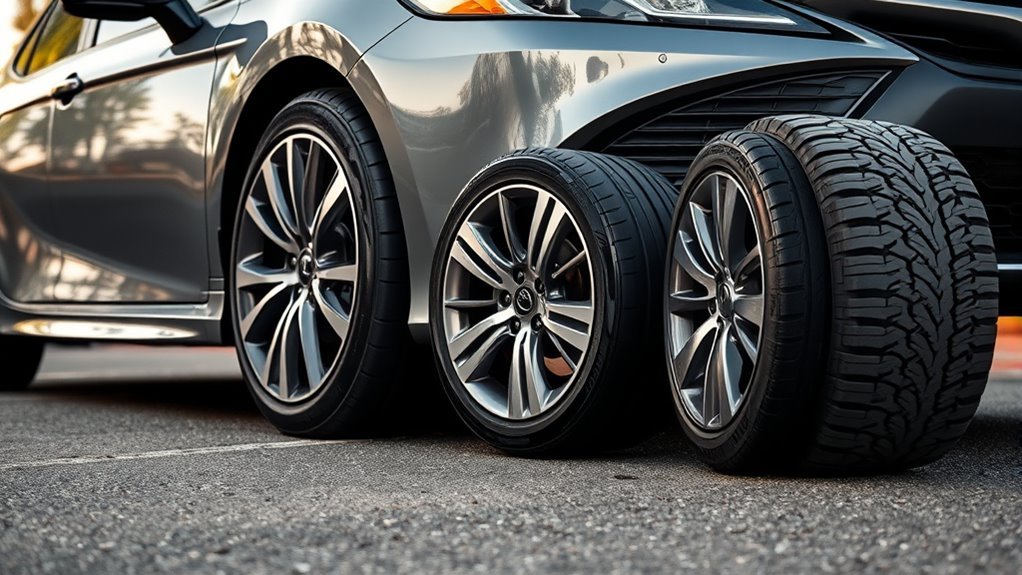
Choosing the best tire type for your Toyota Camry starts with your climate and driving style. The tire category affects braking, cornering, wet traction, snow control, ride comfort, road noise, and tread life.
- All-season tires: Best for most daily Camry drivers in mild climates. They balance comfort, tread life, and wet-weather traction.
- All-weather tires: A good option if you want year-round use with better winter capability than a basic all-season tire. Look for the Three-Peak Mountain Snowflake symbol if winter traction matters.
- Winter tires: Best for snow, ice, and long periods of cold weather. A smaller wheel with a taller sidewall can improve winter ride comfort and pothole protection if the size is approved for your Camry.
- Summer tires: Best for warm-weather grip and steering response. They are not the right choice for freezing temperatures, snow, or ice.
- Performance tires: Best for sharper handling on sportier trims, but they may ride firmer and wear faster.
Pro Tip: If you drive in winter, consider a dedicated winter wheel-and-tire package. It protects your nicer wheels from salt and lets you use a tire compound built for cold roads.
Build a Camry Wheel and Tire Package
A well-matched Camry wheel and tire package starts with the basics, then narrows by driving goal. Do not start with appearance alone. Start with fitment, then choose the design and tire category.
| Package goal | Smart setup direction |
|---|---|
| Daily comfort | Stay close to factory wheel size and choose a quiet touring all-season tire. |
| Sportier handling | Use an approved 18- or 19-inch package with correct rolling diameter and load rating. |
| Winter driving | Use a compatible winter tire and consider a smaller approved wheel for more sidewall. |
| OEM replacement | Match the wheel diameter, tire size, load index, speed rating, and pressure on your placard. |
| Style upgrade | Choose a wheel finish you like only after offset, hub bore, width, and brake clearance check out. |
When buying wheels and tires together, ask whether the package includes mounting, balancing, valve stems, TPMS sensors, and hub-centric rings. A package that looks cheaper can cost more after sensors, hardware, balancing, and installation.
[Products Worth Considering]

EVOULTES heavy duty tire inflator with an integrated gauge delivers accurate pressure readings from 10–120 PSI, helping you inflate, deflate, and check tires in one tool. The 16.5-inch extended dual-head air chuck with swivel base reaches hard-to-access dual wheel valves on trucks and RVs. A brass trigger core and side-mounted air release valve make operation smooth, with standard 1/4" NPT threading and quick-connect compatibility for easy setup.

The AstroAI 2 pack air chucks provide a heavy-duty, closed-flow locking design that helps keep air flowing during inflation while securely attaching to the valve stem. Built with 250 PSI rated brass components and compatible with Schrader valves, they feature 1/4" female NPT threads for a wide fit with common inflators. The straight tip and locking clip make filling tires and monitoring pressure more convenient.
Avoid Common Fitment Mistakes
Once you’ve picked a Camry wheel and tire setup, avoid the mistakes that cause vibration, rubbing, warning lights, and unsafe handling.
- Do not ignore the tire placard. The placard is your baseline for size, pressure, and load information.
- Do not choose a lower load index. Use a tire that meets or exceeds the original equipment load index.
- Do not assume all 5-lug wheels fit. Bolt pattern, center bore, offset, and lug seat still matter.
- Do not exceed safe rolling-diameter changes. Keep the new diameter close to OE to protect speedometer, ABS, and stability-control behavior.
- Do not skip hub-centric rings when needed. A larger aftermarket bore can cause vibration if the wheel is not centered properly.
- Do not forget TPMS sensors. A new wheel set may need new sensors or sensor transfer and registration.
- Do not mount tires on the wrong rim width. Use an approved tire-and-rim combination from the tire maker.
- Do not ignore rubbing. Check clearance at full steering lock, over bumps, and with passengers or cargo.
A tire package is only an upgrade if it keeps the Camry’s safety systems, load capacity, and clearance within a safe working range.
Plan Installation and Torque Specs
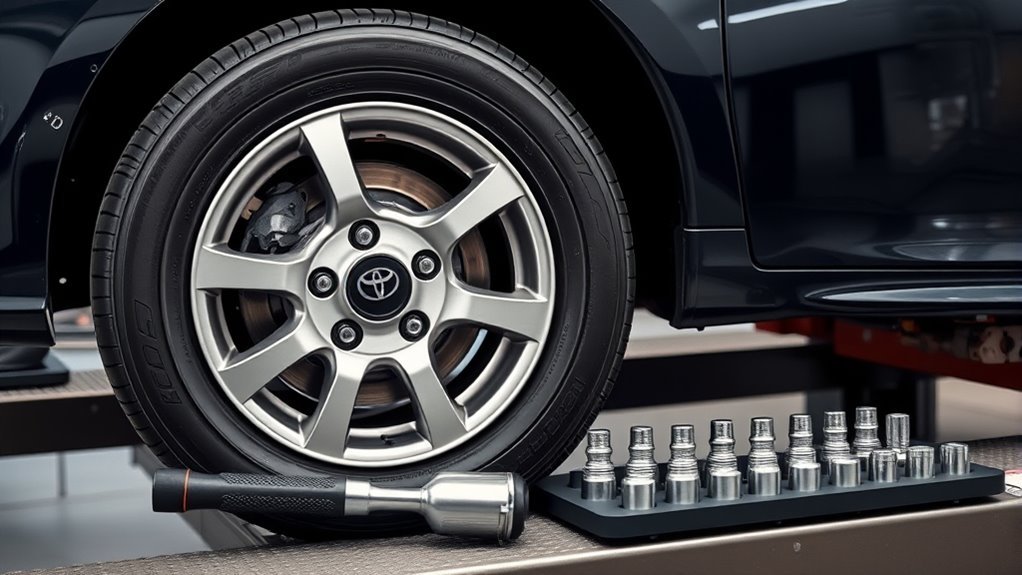
Install your Camry wheel and tire package with care. Use clean hub surfaces, correct lug nuts, correct lug-seat style, properly registered TPMS sensors, and a calibrated torque wrench. Many Camry owner manuals list 76 ft-lb for wheel-nut torque, but you should confirm the exact specification for your model year in your owner’s manual or with a Toyota dealer.
Use this installation checklist before normal driving:
- Confirm every tire size, load index, and speed rating before mounting.
- Confirm wheel load rating, offset, center bore, and lug-seat compatibility.
- Clean rust or debris from the hub face so the wheel seats flat.
- Install TPMS sensors or transfer your original sensors if compatible.
- Tighten lug nuts by hand first to avoid cross-threading.
- Torque the lug nuts in a crisscross pattern with a calibrated torque wrench.
- Set cold tire pressure to the placard value unless a tire professional gives approved replacement guidance.
- Check for brake, fender, liner, and suspension clearance at full steering lock.
- Drive slowly at first and listen for rubbing, vibration, or pulling.
- Recheck torque after the first short break-in period if your installer or wheel maker recommends it.
Warning: Never use oil or grease on wheel studs or lug nuts unless your owner’s manual specifically instructs it. Lubrication can change clamping force and lead to unsafe torque results.
Know When to Upsize Wheels and Tires
Upsizing makes sense when you want a sharper look, firmer steering response, or a sportier stance. It does not make sense if it creates rubbing, reduces ride comfort more than you expect, lowers load capacity, or pushes rolling diameter too far from stock.
If you move from a smaller wheel to an 18- or 19-inch setup, use a shorter tire sidewall to keep overall diameter close to the original. That is why factory packages often pair larger wheels with lower-profile tires. The wheel grows, the sidewall shrinks, and the total tire height stays close.
For AWD Camry models, be especially careful with tire matching. Continental recommends using the same tire size on AWD and 4WD vehicles unless the vehicle was designed for staggered fitment. Mixing sizes or rolling circumferences can affect drivetrain behavior and safety-system inputs.
Handle TPMS, Pressure, and Post-Install Checks
Your Camry’s tire pressure monitoring system helps alert you when pressure drops too low. NHTSA states that passenger cars, light trucks, and vans from model year 2008 and newer have TPMS, and a TPMS light means at least one tire is significantly underinflated.
If you buy a second wheel set, ask whether the shop will install new TPMS sensors, clone the original sensor IDs, or register the new sensors to the car. After installation, set pressure when the tires are cold and follow the door-jamb placard unless your installer provides approved guidance for a specific replacement tire.
After the first drive, inspect the tires again. Look for fresh rub marks, uneven sidewall contact, vibration, steering pull, TPMS warnings, or pressure loss. Fix small problems early before they damage a tire or wheel.
Frequently Asked Questions
Is XLE or XSE a higher trim?
XLE and XSE serve different buyers. XLE focuses more on comfort and premium features, while XSE focuses more on sport styling and sharper appearance. For wheels and tires, current-generation examples list XLE with 18-inch wheels and XSE with 19-inch wheels, but you should still verify your own trim and model year.
Which is better, Camry XLE or LE?
Choose XLE if you want more comfort features and a larger factory-style wheel package. Choose LE if you want a simpler, more comfort-focused setup with more tire sidewall on current-generation models. For wheel and tire cost, LE-style sizes can be more practical, especially for winter tires.
Can I put 18-inch wheels on a Toyota Camry LE?
Often yes, but only if the wheel and tire package matches the correct bolt pattern, hub bore, offset, wheel width, load rating, and rolling diameter. Use a tire size that stays close to the factory overall diameter, and test-fit for brake and fender clearance before committing.
Do all Toyota Camry wheels use 5×114.3mm?
Many modern Camry fitment listings use 5×114.3mm, but you should confirm your exact model year before buying wheels. A matching bolt pattern alone is not enough; the hub bore, offset, wheel width, load rating, and lug hardware also need to fit.
Do I need hub-centric rings for aftermarket Camry wheels?
You may need hub-centric rings if the aftermarket wheel’s center bore is larger than the Camry hub. The ring helps center the wheel on the hub and can reduce vibration. Use the exact ring size recommended for the wheel and vehicle.
Should I replace TPMS sensors when buying new wheels?
If your sensors are old, damaged, or staying with another wheel set, new TPMS sensors may make sense. Ask your installer whether they will transfer, clone, or register sensors so the Camry does not show a tire-pressure warning after installation.
Conclusion
Choosing the right Toyota Camry wheel and tire package comes down to fitment, safety, and driving needs. Start with your door-jamb placard, then confirm tire size, load index, speed rating, wheel diameter, wheel width, bolt pattern, hub bore, offset, and TPMS requirements.
If you stay close to factory specs, you protect ride quality and reduce the chance of rubbing, vibration, speedometer error, and warning lights. If you upsize, do it carefully: keep rolling diameter close to stock, use approved tire-and-rim combinations, and have a qualified installer verify clearance. A good package should make your Camry look better and drive properly without compromising safety.
Sources
- Toyota 2025 Camry eBrochure — backs current-generation Camry wheel and tire examples by trim.
- NHTSA TireWise — backs tire age, DOT date code, TPMS, pressure, and tire-condition safety guidance.
- Tire Industry Association: Tire Replacement — backs placard-first replacement guidance, load index, speed rating, and tire inspection advice.
- Bridgestone: How to Read Tire Size — backs sidewall reading, tire size format, load index, speed rating, and DOT code explanation.
- Continental Tire: Plus-sizing Guidance — backs rolling circumference, 3% deviation, AWD matching, rim-width, and clearance guidance.
- Toyota Owner’s Manual Example — backs Camry wheel-nut torque guidance for models that specify 76 ft-lb; always confirm your exact model year.

Related Articles

Toyota Camry All-Season Tires Explained: What They Can and Can’t Do
In exploring Toyota Camry all-season tires, discover their benefits and limitations—are they really the right choice for your driving needs?
Read More
Toyota Camry Tire Traction in Ice and Snow: A Practical Winter Driving Guide
Learn essential tips for maximizing tire traction on ice and snow in your Toyota Camry, ensuring your winter driving is safe and confident. Discover more now!
Read More
Do Toyota Camry Tires Need Snow Chains? When They Help and When They Don’t
How do snow chains enhance your Toyota Camry's winter driving safety, and when should you avoid using them? Discover the essential details inside!
Read More