What Does 105H Mean on a Tire? Load, Speed & Rating Guide
105H on a tire tells you two things: 105 is the load index, so each tire can carry up to 2,039 pounds, and H is the speed rating, meaning it’s built for sustained speeds up to 130 mph. You’ll find this marking on the sidewall with the tire size. You should match your vehicle’s placard and manual, because load and speed ratings affect safety, handling, and replacement choices. There’s more to compare if you keep going.
Key Takeaways
- 105 is the tire’s load index, meaning it can support up to 2,039 pounds (925 kg) per tire.
- H is the speed rating, meaning the tire is rated for sustained speeds up to 130 mph (210 km/h).
- Always match tire load index and speed rating to your vehicle’s manual and placard for safe performance.
- Tire numbers are printed on the sidewall, where size, load index, and speed rating appear together.
- Replace tires when tread reaches 2/32 inch, or sooner if there are cracks, bulges, cuts, or other damage.
What Does 105H Mean on a Tire?
A tire marked 105H tells you two key things: 105 is the load index, meaning the tire can carry up to 2,039 pounds (925 kg) when properly inflated, and H is the speed rating, meaning it’s designed for speeds up to 130 mph (210 km/h). You use this code to verify that the tire matches your vehicle’s needs. The load index signals how much weight the tire can support, while the speed rating shows the maximum safe speed under rated conditions. Together, they help you choose tires that fit your car’s design and your driving demands. Passenger-car load index values usually fall between 70 and 110, so 105 sits on the higher end of that range. When you select the correct load index and speed rating, you protect handling, stability, and tire life. That’s how you keep control and keep your mobility free. Additionally, selecting tires with a suitable UTQG rating can further enhance your driving experience by ensuring optimal performance and durability.
Tire Load Index 105 Explained
For passenger vehicles, load indexes usually run from 70 to 110, and higher values mean greater carrying strength. You don’t need guesswork: match or exceed the original equipment load index to preserve handling, braking balance, and ride stability. That choice helps you keep control and avoid overloading. Additionally, understanding tire performance factors can enhance your decision-making for optimal safety and comfort.
H Rating and Top Speed Limits
The H speed rating means the tire is engineered for sustained speeds up to 130 mph (210 km/h), so it’s suitable for most sedans and some sportier vehicles that need a balance of comfort and performance. When you choose an H rating, you’re selecting one of the common speed ratings that supports stable heat control and predictable handling at highway pace. If you exceed that limit, you can overload the casing, build excess heat, and lose control sooner than you expect. That risk rises fast with lower-rated tires, especially during long, high-speed runs. In 105H, the H comes after the load index 105, which means 2,039 pounds per tire, but the speed rating defines your top-speed ceiling. You should follow the manufacturer’s recommended speed ratings to keep performance sharp and safety intact. Additionally, selecting dedicated winter tires can enhance grip and stability in challenging conditions, making them essential for winter driving. Stay within spec, and your vehicle stays free to work as designed.
Where to Find Tire Numbers
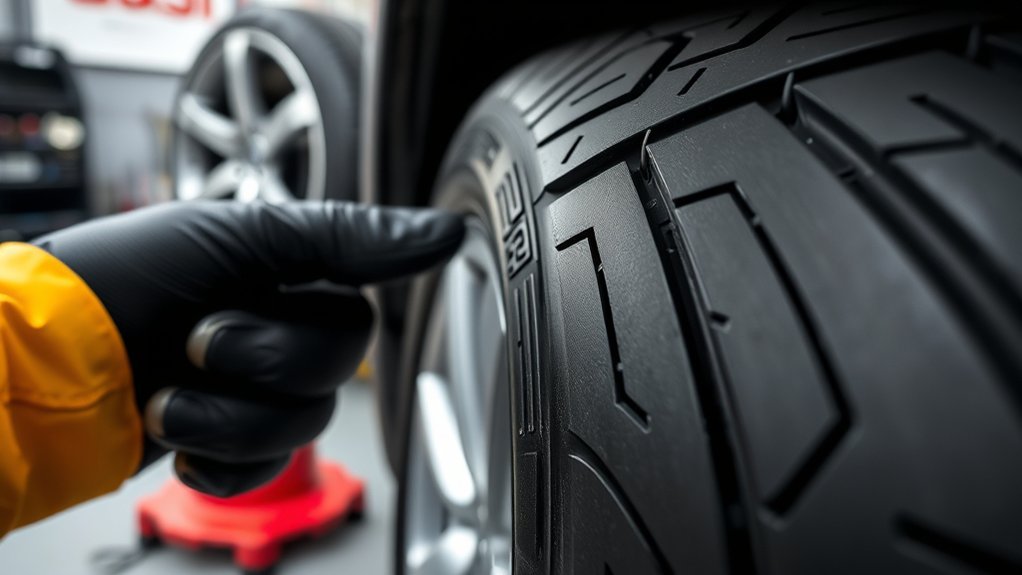
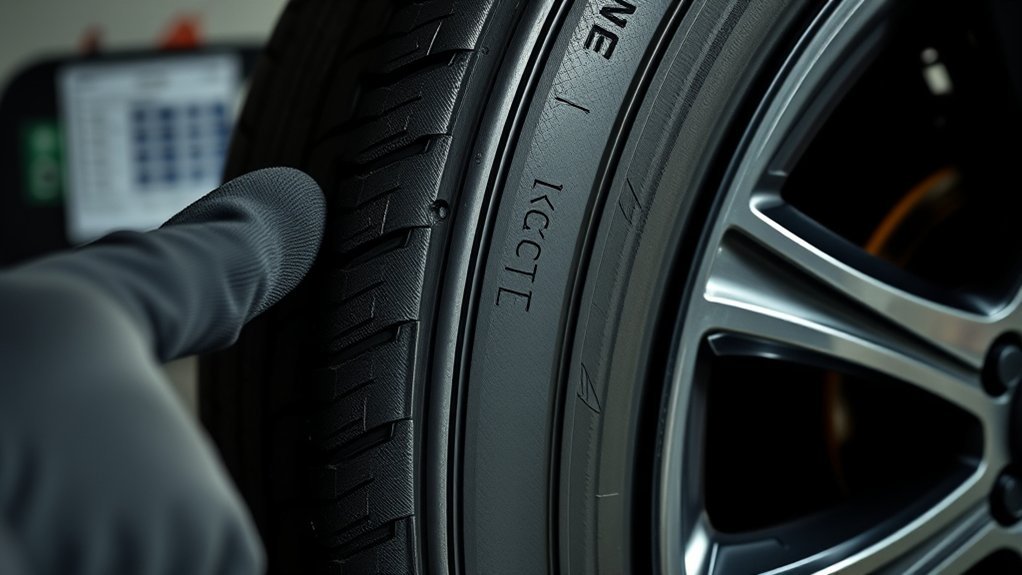
You’ll usually find the tire numbers on the sidewall, where the full code lists the size, load index, and speed rating in one place. Check one outer face first; manufacturers often print the complete markings there for quick inspection. Read the code left to right, and you can spot the load rating and other tire numbers without removing the wheel.
- Find the size code beside the brand mark
- Locate the load index, such as 105
- Identify the speed rating letter, such as H
- Look for the DOT code near the same area
- Confirm the manufacture date and compliance details
The sidewall gives you direct access to the facts you need, so you can verify specs fast and move on with confidence. If the markings are dirty, wipe the rubber clean and inspect it under good light. By learning this layout, you keep control over maintenance and avoid guesswork when checking tire numbers for your vehicle. Additionally, understanding the UTQG ratings can help you choose the best tires for your driving needs.
Why Load Index and Speed Rating Matter
When load index and speed rating match your vehicle’s requirements, they help keep the tire within its safe operating range for weight, handling, and road speed. The load index tells you how much weight each tire can carry; a 105 load index means 2,039 pounds per tire. The speed rating shows the maximum speed the tire’s construction can support; H means 130 mph. Together, load index and speed rating define whether a tire can support your vehicle’s demands without excess stress. If you choose a tire with too low a load index, you can trigger premature wear or failure. If the speed rating doesn’t match, you may lose stability and performance at speed. You should follow the vehicle manual or tire placard, because the manufacturer sets these specs for safe, precise control. All-season tires provide versatility under varying conditions, ensuring optimal performance. That’s how you keep your machine responsive and your drive free.
How 105H Compares to Other Ratings
When you compare 105H to lower load indices like 99, you’ll see a clear increase in load capacity: 2,039 pounds per tire versus 1,709 pounds. The H speed rating also raises the maximum speed limit to 130 mph, which gives you more margin than a T rating at 118 mph. Together, these ratings indicate a tire built for heavier loads and higher-speed stability. Additionally, tires with severe snow rating are specifically designed to perform better in winter conditions, enhancing safety and traction.
Load Index Comparison
A load index of 105 means each tire can carry up to 2,039 pounds, which puts it above a 100-rated tire at 1,764 pounds and makes 105H better suited for heavier vehicles or loads. You get more load capacity, and that means more freedom to match your tire rating to your real use.
- 105: 2,039 lb per tire
- 100: 1,764 lb per tire
- 110: 2,403 lb per tire
- 70: about 738 lb per tire
- Higher load ratings improve stability under stress
When you compare load indices, 105 sits in the upper range, so you shouldn’t downrate your tires. Match the load index to your vehicle specs to keep handling safe, precise, and dependable.
Speed Rating Differences
The H in 105H indicates a maximum speed capability of 130 mph (210 km/h), so it sits above T-rated tires at 118 mph and S-rated tires at 112 mph while still offering a practical balance of grip, comfort, and everyday usability. When you read this speed rating, the tire indicates how fast you can safely run it under proper conditions. Compared with V-rated tires at 149 mph, H gives you less top-end margin but better ride comfort and broader daily use. ZR tires push past 149 mph and suit sports cars that demand stronger high-speed stability and grip. Don’t mix mismatched ratings across an axle; the lowest-rated tire limits performance and can weaken handling and safety.
Is 105H Right for Your Car?
Is 105H right for your car? You need to verify both the load index and speed rating before you decide. A 105 load index supports about 2,039 pounds per tire when properly inflated, and the H speed rating permits up to 130 mph. That combination fits many passenger vehicles and light trucks, but only if your placard says so.
- Check the tire placard first.
- Match the recommended load index exactly.
- Confirm the speed rating meets spec.
- Review your owner’s manual.
- Ask a tire professional if you’re unsure.
If you choose a lower load index than required, you can overload the tire and compromise safety. Don’t guess; confirm compatibility with your specific make and model. When the placard, manual, and tire spec align, 105H can be a solid, precise choice that supports safe, responsive driving, especially if you’re considering options like all-terrain tires for diverse driving conditions.
Can You Mix Different Tire Ratings?
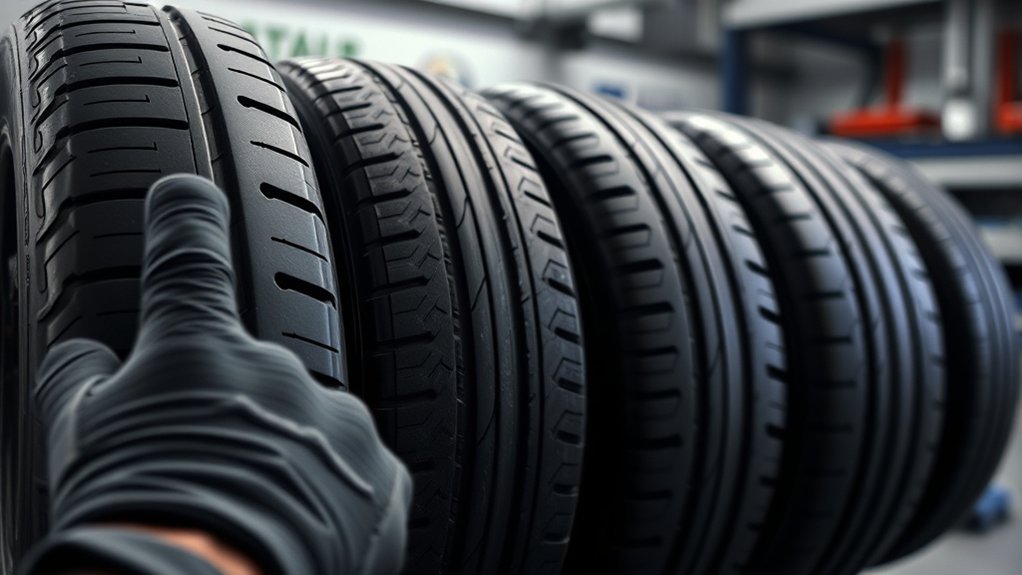
Mixing tire ratings matters because you change how your vehicle handles, brakes, and corners. Your maximum safe speed drops to the lowest-rated tire on the vehicle, so you can’t treat the set as the highest-rated tire installed. For best safety and performance, you should match all four tires by size, type, and speed rating. Additionally, unequal tire specifications can lead to irregular wear patterns, impacting the longevity and performance of your tires.
Why Mixing Ratings Matters
Even if a vehicle can physically run different tire ratings, doing so can compromise handling and safety. You should keep your tire rating matched across all positions so the chassis responds predictably and you stay in control.
- Mixed load or speed values disrupt balance.
- A lower speed tire rating caps the whole setup.
- Front-axle lower speed tires can promote oversteer.
- Uniform size and type support stable cornering.
- Follow the maker’s ratings to preserve dynamics.
When you install a lower speed tire on one wheel, the vehicle’s effective speed limit drops to that tire. That mismatch can change steering feel, braking response, and emergency behavior. To drive freely and safely, keep specs consistent, and verify every tire rating before you fit it.
Lowest Rating Limits Speed
When you mix tire ratings, your vehicle’s usable speed is capped by the lowest-rated tire, not the highest. That rule applies even if one tire carries a 105 load index and another has an H speed rating. The 105 load index means 2,039 pounds at full inflation, while H allows up to 130 mph (210 km/h). If one tire has a lower speed rating, you can’t safely exceed that limit. Mixing speed rating values can reduce traction, blur handling, and compromise control when you push the vehicle. You keep real performance only when all four tires share the same size, load index, and speed rating. For precise, liberated driving, treat the weakest tire as the system limit and drive within it.
Match Tires For Safety
Your tire set should stay matched for safe, predictable handling, because different tire ratings can change how the vehicle responds in corners, braking, and emergency maneuvers. You shouldn’t mix tire ratings unless the manual permits it, and even then, you need to understand the tradeoffs. To match tires for safety, keep:
- identical size
- same construction
- same tread type
- compatible speed rating
- equal load capacity
If you mix them, the lowest speed-rated tire sets your vehicle’s limit, which can hurt control when you need full performance. If you must mix, place the lower speed-rated tires on the front axle to reduce oversteer risk. Uniform tires on all four corners deliver the most consistent handling, grip, and freedom to drive with confidence. Always verify your tire rating against the owner’s manual before mounting.
Common Speed Ratings Beyond H
Beyond H, common speed ratings include T, V, W, and Y, which indicate maximum sustained speeds of 118 mph, 149 mph, 168 mph, and 186 mph, respectively. You use the speed rating of the tires to match your vehicle’s load and performance demands. T suits everyday driving, while V, W, and Y support progressively higher heat tolerance, grip, and cornering stability. These ratings help you see how a tire manages stress at speed without losing control. A ZR mark signals tires built for speeds above 149 mph, often on performance and sports cars. You shouldn’t mix different speed-rated tires, because that can upset handling and weaken safety. When you choose tires, follow the manufacturer’s specification exactly; it keeps the car balanced and lets you drive with confidence. The right rating frees you from guesswork and supports precise road behavior. Additionally, understanding all-season tire performance can help you select tires that optimize grip and comfort in various conditions.
When to Replace 105H Tires
You should replace 105H tires when tread depth drops below 2/32 inch, since traction and wet performance decline sharply. Check the sidewalls for cracks, bulges, or other damage, because those signs mean the tire’s structure may be compromised. You should also track age and mileage, and inspect the tires every 5,000 to 7,500 miles to catch wear or damage before failure. Additionally, consider the impact of tire quality on vehicle performance to ensure optimal safety during winter conditions.
Tread Wear Indicators
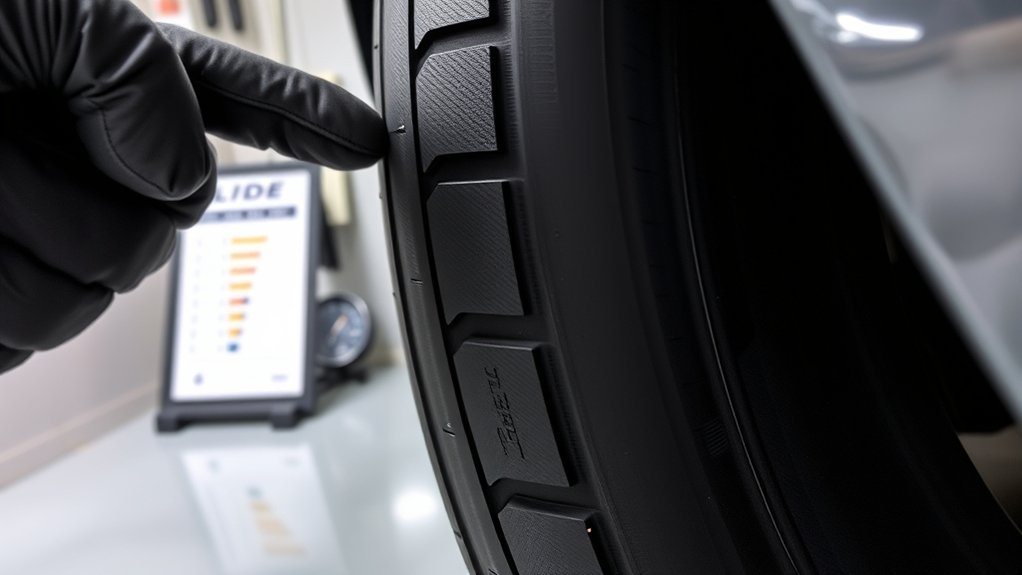
Tread wear indicators (TWIs) are the clearest sign that it’s time to replace 105H tires: once the tread wears down to 2/32 of an inch, the raised bars become flush with the surface. On your tire size, these tread wear indicators show you when grip, braking, and steering precision are no longer reliable.
- Check with a tread gauge regularly.
- Use the penny test for a quick read.
- Replace tires at TWI level.
- Watch for uneven wear patterns.
- Keep tires properly inflated.
The 105 load index supports 2,039 pounds, and the H rating allows 130 mph, but worn tread undermines both. You need fresh rubber to keep control and move freely, without compromise.
Sidewall Damage Signs
Sidewall damage is a hard stop for 105H tires: cuts, cracks, tears, punctures, or bulges can weaken the tire’s structure and call for immediate inspection and likely replacement. You shouldn’t ignore any sidewall damage, because even a small flaw indicates the tire may fail under load or speed.
| Sign | Action |
|---|---|
| Cut | Replace |
| Crack | Inspect |
| Tear | Replace |
| Bulge | Replace |
| Puncture | Replace |
Check the sidewall regularly for irregularities. If you see swelling, exposed cords, or deep scuffs, stop driving and consult a professional. Technical freedom starts with reliable rubber, and a compromised sidewall can’t deliver safe handling or blowout resistance.
Age And Mileage Limits
Even if a 105H tire still looks serviceable, age and mileage set hard limits on safe use. You should plan replacement around 6 years from manufacture, even with good tread. At 10 years, don’t gamble; inspect closely or install new tires. Watch these triggers:
- Cracks in sidewalls or tread
- Bulges, cuts, or exposed cords
- Tread below 2/32 in
- Uneven wear after poor alignment
- Storage in heat, sun, or ozone
Proper rotation and alignment can stretch service life, but they don’t erase age-related rubber loss. A 105H tire still carries 2,039 pounds and 130 mph capability only when its structure stays sound. Check the DOT date code, track mileage, and replace early if you drive hard or store the car outdoors. New tires restore margin, control, and freedom.
Frequently Asked Questions
Which Is Better, S or H Speed Rating?
H is better if you want stronger tire performance and a higher speed rating. You’ll get better handling, grip, and stability at speed, thanks to stiffer sidewalls. S works fine for calmer commuting and can feel softer and more comfortable. Choose H when your vehicle and driving style demand more responsiveness and safety margin. If you mainly drive slowly, S can still meet your needs efficiently, but H gives you more capability.
What Does the 105H Mean on 245 60R18 105H?
105H means your tire has a load index of 105 and an H speed rating. You’re looking at a load capacity of 2,039 pounds per tire when properly inflated, with speed capabilities up to 130 mph. On 245/60R18 tires, the 245 is width, 60 is aspect ratio, and 18 fits the rim. These tire specifications help you preserve tire performance, handling, and safety under manufacturer limits.
Which Is Better, T or H Speed Rating?
H is better if you want stronger tire performance and higher speed ratings; T works fine if you drive normally and want lower cost. You’ll get up to 130 mph with H versus 118 mph with T, plus better handling under load. Choose H when your vehicle calls for it, but don’t upsize speed ratings beyond what’s approved. Always follow your manufacturer’s spec for safe, precise tire selection.
Which Is Better, 95H or 95V?
95V is better if you want more speed capabilities; 95H is fine if you value slightly longer tread life. Like a freer road opening ahead, 95V lets you push harder, with a higher speed rating and often sharper tire performance. Both carry the same load index, so you’re choosing between speed and durability. If you drive mostly at moderate speeds, 95H can still meet your needs well.
Conclusion
In the end, 105H gives you a clear picture of your tire’s carrying comfort and speed ceiling. You should match it to your vehicle’s placard and driving needs, then keep an eye on wear, age, and damage so you can plan a timely tire refresh. If you stay within the right load and speed range, you’ll help your tires work gracefully and keep your ride composed, safe, and predictable.

Related Articles

Is Tire Insurance Worth It? Honest Cost-Benefit Analysis
Might tire insurance save you money, or just add another expense? Find out when it pays off and when it doesn’t.
Read More
How to Check If a Tire Is Good: Tread, Age & Damage Inspection
Before you trust your tires, discover the hidden signs of wear, age, and damage that could change everything.
Read More
Does Town Fair Tire Do Brakes? Services, Pricing & Reviews
Brakes at Town Fair Tire? Discover what they inspect, what it may cost, and whether their service lives up to the reviews.
Read More