
Disclosure: As an Amazon Associate, we earn from qualifying purchases. If you click a link on this page and make a purchase, we may receive a small commission at no extra cost to you.
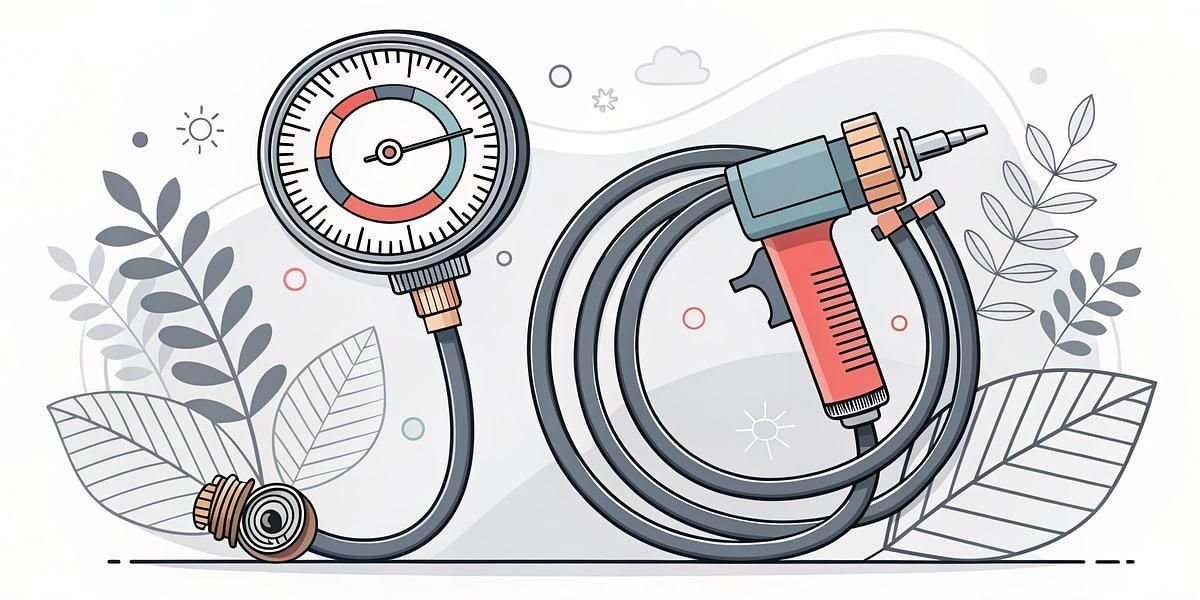
Reaching an inner dually valve stem can turn a simple pressure check into an awkward job. The WYNNsky Tire Inflator with Tire Pressure Gauge uses a 12-inch rubber hose and straight-on chuck to give you more reach while you inflate. Its battery-free mechanical gauge covers 10 to 160 PSI, but the straight chuck will not suit every wheel or valve-stem angle. This review helps you decide whether its simple design fits your compressor, vehicle, and accuracy needs.
Quick Verdict
Rating: 8/10, recommended with caveats
Best For: Truck, RV, trailer, and home-garage users who need extra reach and prefer an analog gauge.
Bottom Line: The 12-inch hose, straight-on chuck, and 160 PSI range make this a practical inflator for routine tire work. Its main tradeoff is fit, because a straight chuck may not seal well on every recessed or sharply angled valve stem.
WYNNsky Tire Inflator Gauge

Model W54-004C with a 10 to 160 PSI analog gauge, straight-on air chuck, and 12-inch flexible rubber hose.
View Product on Amazon →Key Specifications
| Specification | Detail |
|---|---|
| Brand | WYNNsky |
| Model | W54-004C |
| Product type | Air-compressor tire inflator with analog pressure gauge |
| Gauge range | 10 to 160 PSI |
| Scale increments | 2 PSI |
| Maximum working pressure | 160 PSI |
| Air inlet | 1/4-inch NPT female |
| Chuck design | Extended straight-on air chuck |
| Hose | 12-inch flexible rubber hose |
| Materials | Rubber hose with stainless-steel components |
| Power | Mechanical, no batteries required |
| Item weight | About 1.33 pounds |
| Package dimensions | About 16.5 x 3.62 x 2.64 inches |
Before You Buy: This is a compressor attachment, not a portable electric air pump. Your air line also needs a compatible 1/4-inch NPT fitting or quick-connect adapter, and the straight chuck may not fit every dually valve orientation.
What Is the WYNNsky Tire Inflator Gauge?
The WYNNsky W54-004C combines an inflation trigger, a mechanical dial, a rubber hose, and a straight-on chuck in one tool. You connect it to an air compressor, press the chuck against the tire valve, and use the gauge to watch pressure while air flows.
Its main selling point is reach. The 12-inch hose gives you room to work around wheel openings, while the extended straight chuck can access valve stems that sit deeper inside a wheel. The analog gauge also works without batteries, which makes the tool easy to leave in a garage, service vehicle, or RV storage bay.
Who Should Buy It?
Best For
- Truck or RV owners who need extra reach around dual-wheel valve stems
- Home-garage users who already own an air compressor
- Buyers who prefer a simple analog gauge with no batteries
Skip If
- You need a self-powered inflator for roadside use
- Your valve stems require an angled, dual-head, or locking chuck
- You need fine digital resolution for small pressure adjustments
[Products Worth Considering]

This brass tire air chuck with clip adapter locks securely to the valve stem for a tight seal with minimal leakage. Simply press the locking clip, push or twist the nozzle onto the tire valve, and release the clip to keep it in place during inflation. Designed for efficient, convenient connection between a vehicle inflator hose and common tire valves, with a compatible 8mm bore hose end.

Inflate Presta and Schrader bike and car tires with one compressor attachment, including tubeless setups. The digital gauge lets you monitor 2–200 PSI readings in 0.1 PSI increments with ±2 PSI accuracy, while the adjustable lever and built-in bleed button help you dial in precise pressure. Quick-connect coupler, hose, and a complete Presta service kit with spare cores and caps make it ready for fast maintenance.

This tire inflator with pressure gauge delivers long-lasting performance with a durable rubber-protected gauge and sturdy build. The longer hose and 360 swivel air chuck help you seal the valve securely and keep your hands free while measuring, inflating, or deflating. It’s battery-free for reliable use and provides ±2 PSI accuracy in the mid-range for most typical tires, with universal compatibility for 1/4 NPT compressor outputs.
Feature-by-Feature Review
Fit and Compressor Compatibility
The tool uses a 1/4-inch NPT female air inlet. Many compressor setups can support that thread size, but you may need to install the correct male plug for your coupler system. Check your existing fittings before ordering so you do not discover a mismatch when the tool arrives.
The straight-on chuck is most useful when a valve stem points outward and gives you a direct approach. It can be less convenient on short, recessed, angled, or poorly aligned stems. Dually owners should inspect both inner and outer valve positions rather than assuming one chuck style will reach every wheel.
Gauge Range and Readability
The mechanical gauge reads from 10 to 160 PSI in 2 PSI increments. That range covers common passenger-vehicle pressures and the higher pressures used by many truck, trailer, and RV tires. The analog face gives you an immediate reading without a startup button, display mode, or battery check.
A 2 PSI scale is suitable for routine inflation, but it is not designed for tiny decimal-level adjustments. If exact pressure matters for diagnostics or calibration work, compare the reading with a known accurate reference gauge.
Hose Reach and Chuck Design
The 12-inch rubber hose separates your hand from the valve stem and reduces the need to bend the entire gauge body into a wheel opening. That extra distance is the strongest reason to choose this model over a short, rigid inflator.
The hose may feel firm when new, and cold storage can make rubber less flexible. Let it return to a moderate temperature before forcing a sharp bend, and avoid pulling the tool by the hose.
Materials and Build
WYNNsky uses rubber and stainless-steel components in this inflator. The metal parts are intended to resist abrasion and corrosion, while the rubber hose provides the flexibility needed around wheels. The tool weighs about 1.33 pounds, so it feels more substantial than a pocket pressure gauge.
Build consistency is the main concern reported in the original article. Inspect the dial, hose crimps, trigger, inlet threads, and chuck when you receive it. A quick leak check can reveal a loose joint before you use it on a high-pressure tire.
How It Performs in Real Use
Routine Car and SUV Checks
For normal garage maintenance, the all-in-one design lets you add air and watch the dial without switching between a compressor chuck and a separate gauge. The 160 PSI capacity is more than most passenger-vehicle applications need, although the broad scale offers less fine detail than a lower-range precision gauge.
Truck and Dually Tires
The extended straight chuck and hose can reduce bending when an inner stem is aligned with a wheel opening. Results depend heavily on stem placement. A straight approach works well on some dual-wheel setups, while other wheels need an angled or dual-head chuck.
RV and Trailer Preparation
The battery-free gauge is useful before a trip because it can stay stored for long periods without a dead display battery. You still need an air compressor with enough pressure and airflow for your tires. The inflator controls and measures air, but it does not create air pressure by itself.
Garage and Work Use
The simple dial and metal construction suit occasional home use and repeated maintenance checks. For a busy commercial shop, a certified professional gauge, replaceable chuck, or protected digital display may offer better long-term serviceability and documented accuracy.
What Buyers Mention
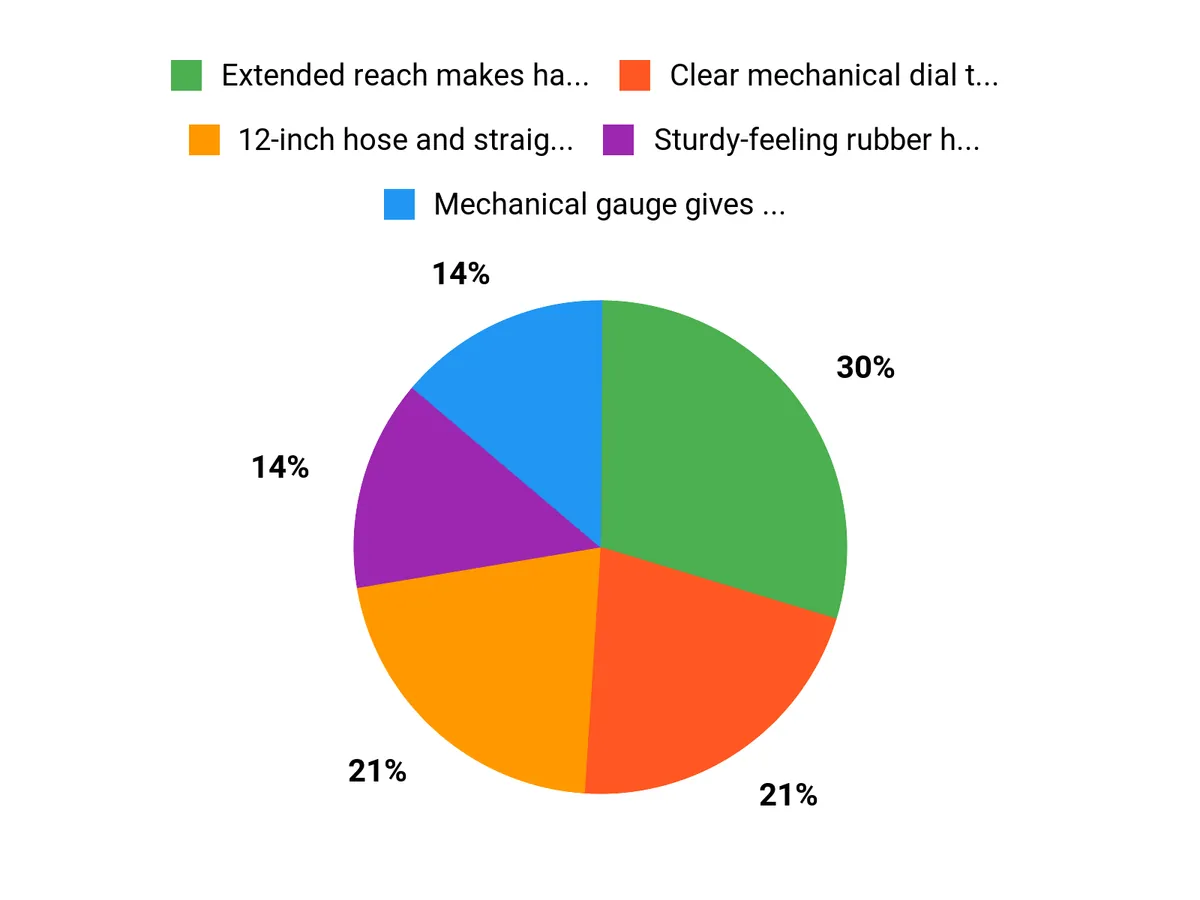
The customer feedback summarized in the original article is mostly positive about reach, readability, and use on trucks or RVs. The most useful criticism concerns fit and workmanship, because an extended chuck still needs the correct valve angle and a sound seal to work well.
Overall Sentiment: Positive, with fit and quality-control caveats.

Pros and Cons
Pros
- 12-inch hose adds reach around deep or awkward wheel openings
- 10 to 160 PSI gauge covers a wide range of vehicle tires
- 2 PSI markings are easy to follow during routine inflation
- Mechanical design works without batteries
- 1/4-inch NPT female inlet supports common compressor fitting systems
Cons
- Straight chuck does not match every dually or recessed valve angle
- 2 PSI increments are less precise than a fine-resolution digital gauge
- You may need to add a compressor plug or quick-connect fitting
How to Use It Correctly
- Confirm that your compressor and hose can safely supply the pressure required by your tire.
- Install a compatible fitting in the 1/4-inch NPT female inlet. Use thread sealant only as directed for the fitting, and keep sealant out of the air passage.
- Check the recommended cold tire pressure on the vehicle placard or owner’s manual.
- Press the straight chuck squarely onto the valve stem to create a firm seal.
- Add air in short, controlled bursts while watching the gauge.
- Stop at the vehicle manufacturer’s recommended pressure, then verify with a second trusted gauge when accuracy is critical.
Pro Tip: Before the first full inflation, connect the tool at low pressure and listen around the inlet, hose crimps, and chuck. Finding a small leak early is easier than troubleshooting it beside a loaded truck or RV.
Compatibility and Safety
The 160 PSI figure is the tool’s maximum working pressure, not a recommended setting for every tire. Use the pressure specified by your vehicle manufacturer and never exceed the limits of the tire, wheel, compressor, hose, coupler, or inflator.
Wear eye protection when working with compressed air. Do not use a damaged hose, cracked gauge, bent chuck, or leaking fitting. If the needle does not return properly or the reading differs sharply from a trusted gauge, stop using the inflator until you can check or replace it.
Why Customers Choose It
You are most likely to choose this model for its combination of extended reach, a wide analog pressure range, and battery-free operation. It keeps the workflow simple when a basic short chuck cannot reach comfortably, yet it costs less and has fewer controls than many professional digital inflators.
Is It Worth the Price?
The WYNNsky gauge sits in the budget-friendly part of the compressor-inflator market. It offers strong value for the price when your main needs are extra hose reach, a 160 PSI analog scale, and a straight chuck for truck, RV, trailer, or garage work.
You get less value if you must immediately replace the chuck, add several fittings, or buy a second precision gauge. Buyers who need documented calibration, a locking chuck, a backlit screen, or finer resolution should compare higher-tier options before deciding.
[Products Worth Considering]

This digital tire pressure gauge with built-in inflator helps you accurately check and adjust tire pressure for safer driving and better fuel efficiency. It supports multiple units (PSI, KPA, BAR, KG/CM²) and reads within 1% for reliable results. The 3-in-1 design inflates, deflates, and measures, with a quick-connect air chuck and compatible hose setup for cars, trucks, SUVs, RVs, and motorcycles.

AstroAI’s digital tire pressure gauge inflates and measures with high accuracy, reading within 1% and supporting four pressure units from 3 to 250 PSI. The heavy-duty brass air chuck locks securely on valve stems, while the 19.7-inch stainless braided hose and 360° rotatable dial improve comfort and control for faster single-hand operation. Battery-saver behavior and an integrated flashlight add convenience and safety for everyday roadside and garage use.

This EVOULTES 2-way air chuck set includes a dual head closed flow air chuck and a ball head chuck for versatile tire inflation. It connects easily to air lines, inflator gauges, and compressors using 1/4" NPT threads and includes two 1/4" male quick plugs for fast coupling. Built with durable metal construction and sealed threads using Teflon tape to help prevent air leaks, it’s ideal for inflating Schrader valve tires across cars, bikes, and motorcycles.
How It Compares to Alternatives
The Milton 517 is a heavier professional-style option with a longer hose, a dual-head chuck, and the same 10 to 160 PSI range. It makes more sense when you need a shop-grade extended-reach tool and broader dually access. The AstroAI ATG250 offers a digital display and finer readings for buyers who prefer electronic measurement, while the JACO FlowPro focuses on a locking chuck and documented gauge accuracy.
The WYNNsky makes the most sense when you want a simpler, lower-cost analog inflator and its straight chuck matches your valve stems. None of these designs is best for every wheel, so chuck angle and compressor connection should guide your choice.
[Products Worth Considering]

The AstroAI 2 pack air chucks provide a heavy-duty, closed-flow locking design that helps keep air flowing during inflation while securely attaching to the valve stem. Built with 250 PSI rated brass components and compatible with Schrader valves, they feature 1/4" female NPT threads for a wide fit with common inflators. The straight tip and locking clip make filling tires and monitoring pressure more convenient.

AstroAI’s tire pressure gauge with inflator helps you check and adjust car tire pressure accurately for safer, smoother driving. It offers 3-in-1 operation to inflate, deflate, or measure pressure, with an easy-to-read 2.5-inch glow dial and a heavy-duty air chuck for convenient use. Universal compatibility supports Schrader-valve tires and quick-connect 1/4" NPT air compressors for quick maintenance.

The LockNFlate locking air chuck uses six hardened steel jaws to grip any Schrader valve for a secure, hands-free connection that helps prevent leaks or accidental pop-off. It’s rated to 150 PSI and inflates tires with or without the valve core installed. Choose Open Flow for hand/foot valves and automatic inflators, or Closed Flow for compressor/air-hose use requiring valve engagement.
Frequently Asked Questions
Does the WYNNsky inflator include an air compressor?
No. This tool attaches to a separate air compressor and helps you control and measure airflow at the tire. You need a compressor, air hose, and compatible coupling before you can inflate a tire.
What fitting does it use?
The inflator has a 1/4-inch NPT female air inlet. You may need to add the correct male plug for your compressor’s quick-connect system.
Will the straight chuck reach every inner dually valve?
No chuck design fits every dual-wheel setup. The extended straight chuck works best when the inner stem is visible and aligned with the wheel opening. Angled or inward-facing stems may need a dual-head or angled chuck.
How accurate is the mechanical gauge?
The dial is marked from 10 to 160 PSI in 2 PSI increments and is intended for routine tire inflation. The listing does not provide a verified accuracy tolerance, so compare it with a trusted reference gauge when precise measurement matters.
Can you use it on cars and SUVs?
Yes, when the chuck fits the valve stem and your compressor uses a compatible connection. The broad gauge range also covers common passenger-vehicle pressures, though a lower-range gauge may show finer detail.
Does it need batteries?
No. The pressure gauge is mechanical, so you do not need batteries or charging. Store it where the dial, hose, and fittings will not be crushed or exposed to damaging chemicals.
What should you inspect before first use?
Check the inlet threads, hose crimps, trigger, dial needle, and chuck for damage or looseness. Connect it at controlled pressure, listen for leaks, and confirm the reading against a trusted gauge before relying on it for high-pressure tires.
The Bottom Line
The WYNNsky W54-004C is a practical choice for compressor owners who want a battery-free 160 PSI gauge and extra reach from a 12-inch hose. Buy it when a straight-on chuck suits your truck, RV, trailer, or garage setup, but skip it when you need a locking or angled chuck, digital precision, or a self-powered roadside inflator.

