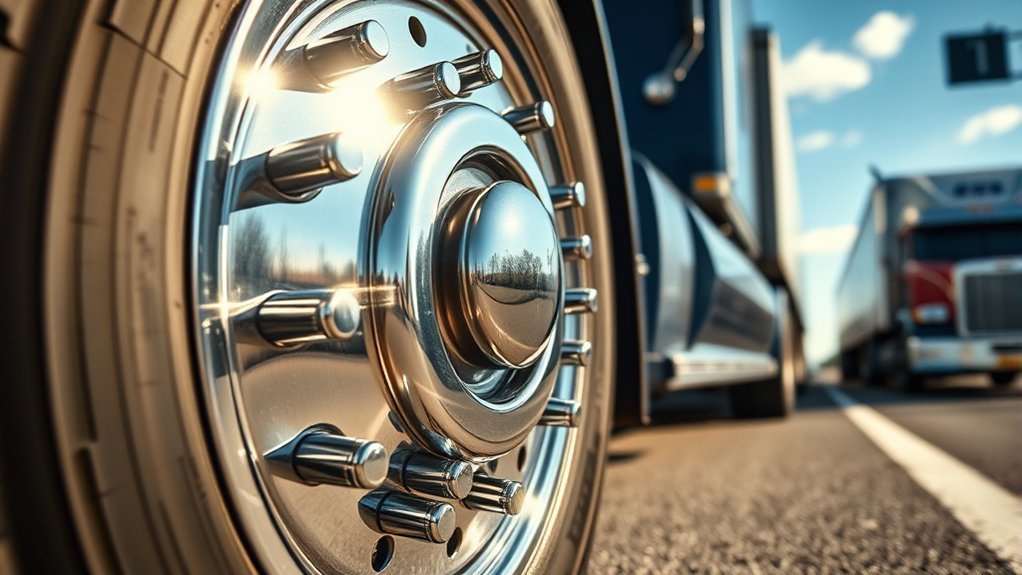
Semi trucks sometimes have pointed covers over their wheel lug nuts because drivers and owners like the customized look, and the covers can also shield exposed lug hardware from some dirt and road grime. These accessories are usually called spike-style lug nut covers or wheel spikes. They are not traction devices, weapons, or required safety equipment, and laws can vary by location.
Quick Answer
Semi trucks have wheel spikes mainly for appearance. Most are pointed lug nut covers that give a truck a bold, customized look while covering the lug nuts underneath. They may help keep some dirt and road grime off exposed hardware, but they do not improve traction, secure loose lug nuts, or replace regular wheel inspections.
Key Takeaways
- Most semi-truck wheel spikes are decorative covers fitted over lug nuts.
- Their main purpose is customization, although the covers can shield exposed lug surfaces from some dirt and road grime.
- They do not tighten lug nuts, improve traction, improve braking, or replace wheel inspections.
- Materials vary. Commercial truck-accessory manufacturers sell both plastic and metal lug nut covers in pointed, bullet, and other shapes.
- Federal wheel-condition and vehicle-width rules can matter, while additional restrictions may come from state or local law.
What Are Wheel Spikes on Semi Trucks?
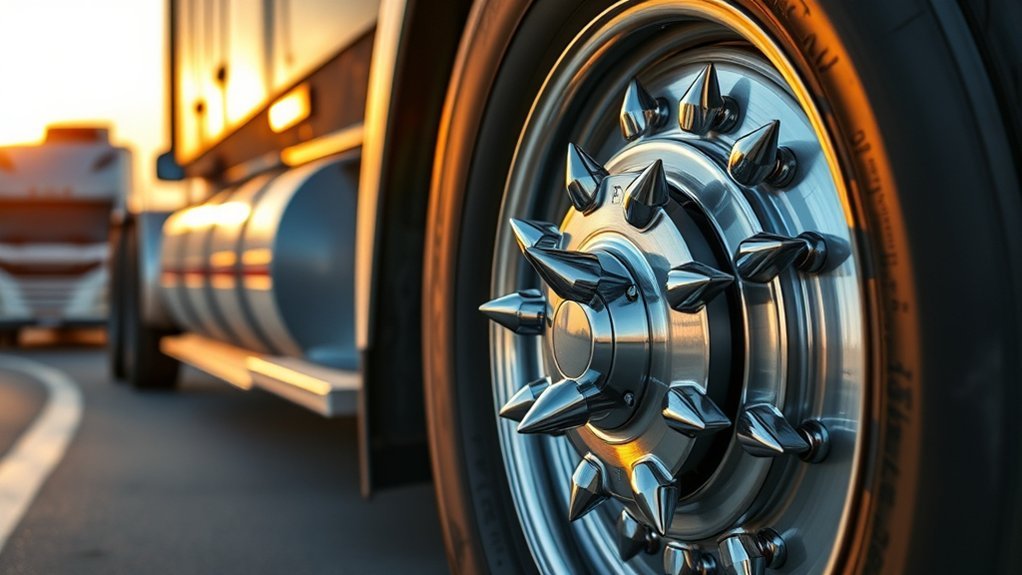
What people call wheel spikes on a semi truck are usually pointed covers fitted over the wheel’s lug nuts. You may also hear them called spike lug nut covers, pointed lug covers, bullet covers, or decorative wheel accessories.
They should not be confused with studded tires. Tire studs are small traction devices installed in a tire tread for winter driving. The spikes discussed here sit around the wheel hub and normally serve as covers and visual accessories.
Commercial truck-accessory manufacturers sell lug nut covers in many shapes, including pointed, bullet, rocket, flat-top, and other designs. Materials also vary. For example, truck-accessory catalogs include both plastic and steel lug nut covers.
Those dramatic-looking points are usually aftermarket lug nut covers, not a mechanical part required to operate the truck.
Depending on the design, a cover may push over the lug nut or use a threaded or screw-on attachment. The correct size and attachment method matter because a loose accessory can fall off on the road.
Why Do Semi Trucks Have Wheel Spikes?
The main reason is style and customization. Truck owners often personalize tractors with polished metal, lighting, trim, wheel covers, and other exterior accessories. Pointed lug nut covers create a distinctive appearance without changing the basic wheel itself.
There is also a modest practical benefit: because the accessory sits over an exposed lug nut, it can help keep some dirt, salt, splash, and road grime off the visible surface. That does not make the underlying hardware maintenance-free.
Style and Presence
Wheel spikes create a bold visual effect, especially when they match polished wheels, chrome trim, or other exterior details. Different lengths, finishes, shapes, and materials let drivers give their rigs a more personalized appearance.
This is the strongest reason you see them on custom semis. They are aftermarket appearance accessories rather than equipment a truck needs for steering, braking, traction, or carrying a load.
Lug Nut Covering
A lug nut cover forms a physical barrier over part of the exposed fastener. That can help keep the visible lug surface cleaner and reduce direct contact with some road grime.
| Exposure | What a Cover Can Do | What It Cannot Guarantee |
|---|---|---|
| Dirt and road grime | Reduce direct buildup on the covered surface | A completely clean wheel assembly |
| Water and road salt | Provide some physical shielding | Prevention of all corrosion |
| Loose or damaged hardware | Nothing mechanically | Correct torque or secure wheel attachment |
What Wheel Spikes Do Not Do
It is easy to assign extra functions to such a noticeable accessory, but spike-style lug nut covers have clear limits.
- They do not improve tire traction.
- They do not increase braking performance.
- They do not tighten or retain a loose lug nut.
- They do not replace torque checks or wheel inspections.
- They are not recognized blind-spot warning equipment.
- They do not make it safe for another vehicle to drive beside a truck.
Warning: Never assume a decorative lug nut cover means the hardware underneath is secure. Commercial-vehicle wheel fasteners still need to be properly installed, maintained, and inspected.
Safety and Regulations
Federal commercial-vehicle rules focus on the condition of the wheel and its fasteners. Under 49 CFR §393.205, commercial-vehicle wheels and rims cannot be cracked or broken, stud or bolt holes cannot be elongated, and nuts or bolts cannot be missing or loose.
That rule does not create a special nationwide decorative-spike length limit. However, a truck still has to comply with other applicable federal, state, and local equipment requirements.
Overall vehicle width can also matter. 23 CFR §658.15 establishes a 102-inch width framework for vehicles operating on the National Network, with the exception specified for Hawaii. That width rule should not be confused with permission to use a particular aftermarket accessory.
Do Wheel Spikes Protect Lug Nuts?
Yes, but only in a limited physical sense. A spike-style cover sits over the lug nut, so it can shield part of the exposed surface from dirt, splash, road salt, and minor contact. That can help keep the visible fastener cleaner.
It would be misleading, however, to say that the covers guarantee longer lug-nut life or prevent wheel problems. Moisture can still reach wheel hardware, corrosion can still develop, and a covered lug nut can still become loose.
How Much Protection Do They Provide?
Think of a lug nut cover as a protective cap, not as structural wheel equipment. Its benefit is similar to covering another exposed piece of hardware: the cover takes some of the direct dirt and cosmetic abuse while the actual fastener remains underneath.
The exact protection depends on the design, fit, material, road environment, and maintenance. A loose-fitting cover may provide little protection and could become a road hazard itself.
Debris and Corrosion
Road grime, salt, water, and dirt can collect around truck wheels. Covers can reduce direct exposure on the surfaces they physically shield, but they should not trap moisture or hide deteriorating hardware.
- Clean around the lug area during normal wheel maintenance.
- Remove covers when necessary to inspect the actual fasteners.
- Replace cracked, loose, or damaged covers.
- Never use a cover to hide a damaged or badly corroded lug nut.
Decorative Wheel Covers
The decorative role remains the main reason for the pointed shape. Manufacturers offer many shapes that would not be necessary if the only goal were covering a lug nut.
For example, commercial truck-accessory catalogs offer pointed, bullet, rocket, flat-top, and other styles of plastic lug nut covers. Metal versions are also available.
Pro Tip: If you are choosing covers for a truck, prioritize correct fit and secure attachment over maximum length. A shorter, securely fitted cover is easier to justify than an unusually long or sharp accessory that projects farther from the wheel.
Are Wheel Spikes Dangerous to Other Drivers?
They can create a contact hazard, but the level of risk depends heavily on the design and material. A short plastic lug nut cover is very different from a long, rigid metal projection.
If another vehicle rubs against a truck wheel equipped with pointed covers, the accessories could contribute to scratches, dents, broken covers, or other damage. It is not accurate to promise that a spike will only scratch a vehicle or that it cannot cause injury.
The safest approach is simple: do not drive alongside a large truck unnecessarily, especially near its wheels and blind spots. That advice applies whether the truck has decorative wheel spikes or not.
- Allow large trucks extra lateral space.
- Avoid lingering beside a tractor or trailer.
- Do not assume another driver can see you simply because you can see the truck.
- Treat unusually long or sharp aftermarket projections cautiously.
The intimidating appearance of wheel spikes may cause some motorists to give a truck more room, but that is an observation about appearance, not a substitute for proper mirrors, lighting, safe driving, or blind-spot awareness.
[Products Worth Considering]

The Trivd Frol 1/2" air impact wrench delivers high performance torque up to 1500 ft-lbs with a twin hammer impact mechanism for strong, balanced blows. It features an ergonomic grip, compact lightweight design, and quick-stop control with 3 forward speeds up to 8000 RPM plus a reverse speed. Built for demanding automotive repair and tire shop work, the rear exhaust helps keep debris away from the surface.

These M14x1.5 closed-end chrome lug nuts are a one-piece replacement designed for secure fitment on compatible GM, Ford, and select Chrysler/Dodge models. Featuring a 60-degree conical seat and anti-rust chrome plating, they help resist corrosion and maintain a bright look for everyday driving. Built for long-term durability, they include OEM-style part references and are backed by 12 months of support.

Upgrade your wheels with MIKKUPPA M12x1.5 mag seat lug nuts built for secure, corrosion-resistant performance. These closed-end chrome lug nuts are a direct replacement for select Toyota models, including Camry, Corolla, RAV4, Sienna, Avalon, Highlander, Matrix, Venza, and Prius. Triple-chromium plating and cold-forged, heat-treated steel help deliver strength for daily driving and replacement needs.
Which States Restrict Truck Wheel Spikes?
There is no single simple nationwide answer because several different types of law can affect a wheel accessory. Depending on the state and vehicle, rules may address wheel projections, unsafe equipment, overall vehicle width, or accessories that could damage a roadway.
Hawaii provides one useful example. Hawaii Revised Statutes §291-33 addresses projections on the face of wheels and lists items including spikes when they are destructive to road surfaces, subject to statutory exceptions. That is more specific than saying Hawaii simply enacted a blanket decorative-spike ban in 2016.
At the federal level, vehicle-width rules also matter for trucks operating on the National Network. The general federal framework is 102 inches, with the Hawaii provision described in 23 CFR §658.15.
Note: A legal vehicle width does not automatically make a pointed wheel accessory legal. State statutes, local rules, inspection requirements, and the exact design can change the answer. Check the current law for every jurisdiction where the truck will operate.
Be especially cautious about relying on proposed legislation. A bill that has been introduced but not enacted is not the same as current law.
Can Wheel Spikes Create Liability?
Potentially. Any aftermarket accessory can become relevant after a collision if someone argues that its design, installation, condition, or projection made the resulting damage or injury worse.
That does not mean wheel spikes automatically make a truck driver or carrier liable. Liability depends on the facts, applicable law, the cause of the incident, the conduct of the people involved, and whether the equipment violated a relevant requirement.
- A loose cover that falls from the truck could create an equipment issue.
- An unusually long rigid projection may receive more scrutiny after side contact.
- A noncompliant accessory could become relevant evidence in a claim.
- Properly maintaining the underlying wheel hardware remains essential regardless of the covers fitted over it.
Legal information: This article provides general information, not legal advice. Equipment laws and liability rules vary by jurisdiction and by the facts of an incident.
[Products Worth Considering]

Slip the Powerbuilt tire step over your vehicle’s tire to reach roof racks, engine bays, truck boxes, and more without overreaching. Its adjustable, universal design fits tires with a cross tread width up to 13 inches, including car, truck, RV, and semi tires. The non-slip cheesegrater surface and anti-slip tape provide secure grip while the open design lets mud and debris pass through. Fold-flat storage with rubber bumpers helps keep your tire and the step protected between uses.

Upgrade your wheels with MIKKUPPA closed-end lug nuts designed for reliable fit and corrosion resistance. The one-piece, cold-forged and heat-treated steel construction helps resist rust and stripping, while the integrated finish delivers a durable black appearance. Built to OEM standards with a conical 60-degree seat, these nuts provide a secure solution for compatible Ford, Honda, Jeep, and Chevrolet models.

These aluminum alloy tire valve stem caps with an O-ring seal help protect valve stems from corrosion while adding a clean, stylish look to your vehicle. The universal fit works across cars, trucks, motorcycles, bicycles, and more, making them an easy upgrade for everyday driving and off-road use. Installation is quick, and the included four-pack keeps all your tires dressed and protected.
What to Do After a Spiked Wheel Truck Accident?
If a truck with pointed wheel accessories is involved in a collision, treat it like any other vehicle accident first. Focus on safety and medical needs before worrying about the accessory itself.
| Step | Why It Matters |
|---|---|
| Move to a safe location if possible | Reduces the risk of a second collision |
| Call emergency services when needed | Gets medical and police assistance to the scene |
| Photograph the vehicles and wheel area | Documents the condition and position of the equipment |
| Record visible damage and injuries | Preserves useful factual information |
| Exchange required information | Supports insurance and accident reporting |
| Keep relevant records | Preserves medical, repair, towing, and other documentation |
If a wheel cover breaks off during the collision, do not put yourself in traffic to retrieve it. Photograph it if that can be done safely and let police or other appropriate personnel handle dangerous debris.
For serious injuries, disputed responsibility, or substantial property damage, a qualified attorney in the relevant jurisdiction can explain how local law applies. No particular settlement or recovery is guaranteed.
[Products Worth Considering]

The 22800 wheel stud installer makes replacing wheel studs quick and secure, saving time and effort during tire service. It uses a ratchet or impact wrench to pull new studs firmly into place, helping when existing studs are too long. Compatible with most automotive wheels and light-duty truck wheel studs, it’s designed for easy, tool-assisted installation.

RVMATE dual-axle RV tire covers help shield your tires from sunlight, snow, rust, and dirt to keep them in better condition in harsh weather. Made with heavy-duty waterproof, UV-resistant 420D Oxford fabric, they provide strong shading and help reduce wear. They install easily by placing the cover on the wheel and fastening the rope for a stable fit.
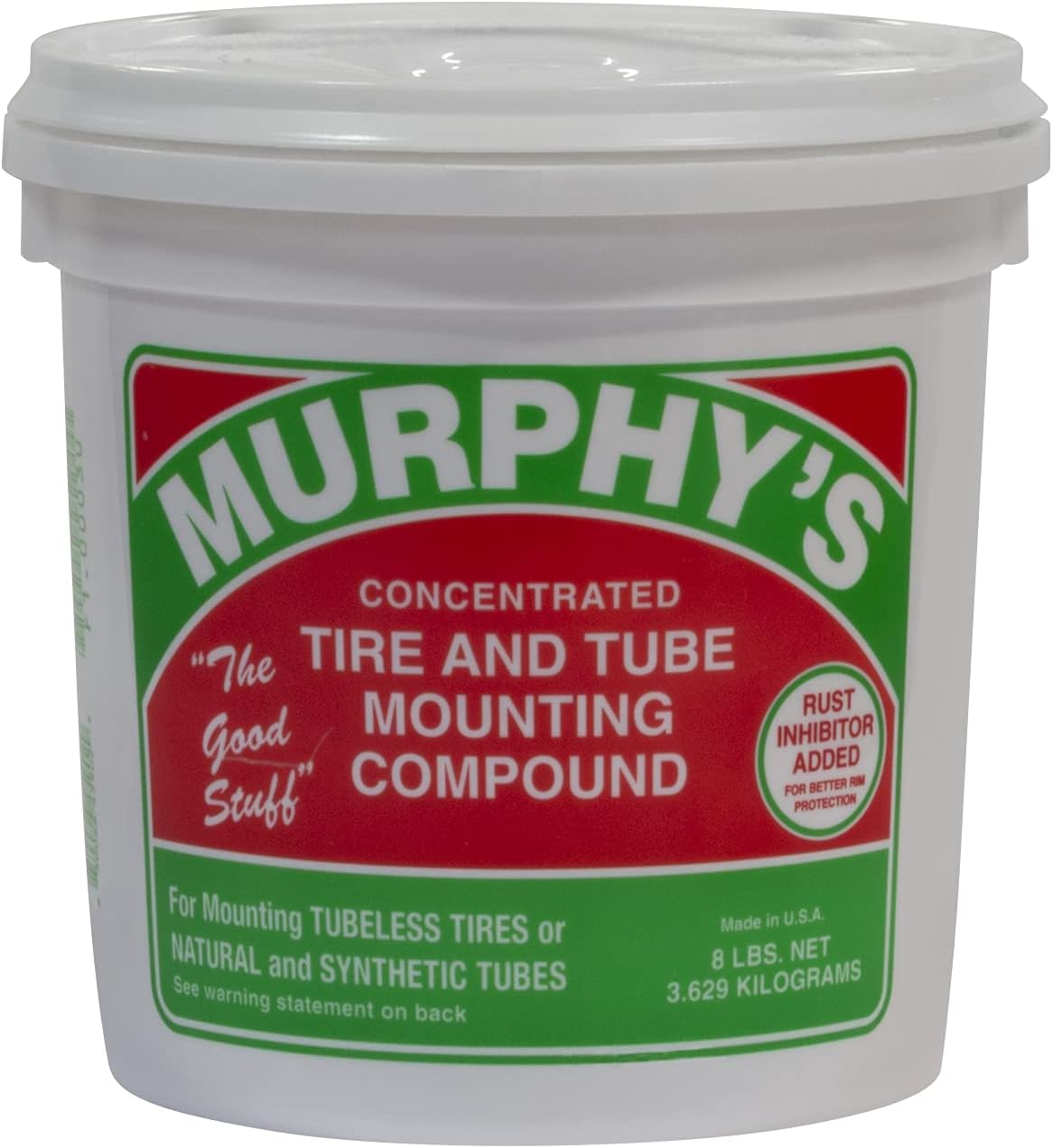
A concentrated tire and tube mounting compound designed to help simplify mounting rubber tires and tubes on passenger, semi truck, construction, and OTR applications. Its ultra-thick formula packs beads effectively and includes rust inhibitors to help protect against corrosion during use.
Frequently Asked Questions
Is It Legal for Trucks to Have Spikes on Their Wheels?
Sometimes. Decorative lug nut covers are not subject to one simple nationwide yes-or-no rule. Federal wheel-condition and vehicle-width rules may apply, while states and local jurisdictions can impose additional equipment or projection restrictions. Check current rules for the states where the truck operates.
Why Can’t Semi-Trucks Go to Buc-ee’s?
Buc-ee’s official FAQ does not provide a simple nationwide explanation stating why every semi would be prohibited. Its current FAQ does say vehicles cannot remain in its parking lots for extended periods. Commercial drivers should follow posted signs and the rules at the specific location rather than assume every travel center has identical truck access or parking policies.
Are Tire Spikes Illegal?
The term “tire spikes” is ambiguous. The pointed accessories discussed in this article are lug nut covers mounted on the wheel. Studded winter tires use small studs in the tread and are regulated separately. Always identify which device you mean before checking the applicable law.
Why Do 18 Wheelers Have Spiked Hubcaps?
What looks like a spiked hubcap is often a set of pointed lug nut covers. Truck owners use them mainly for a customized appearance. Because the covers sit over the lug nuts, they can also keep some grime off the covered surfaces, but they do not perform a structural wheel function.
Do Wheel Spikes Keep Lug Nuts From Coming Loose?
No. A decorative cover does not provide the required clamping force that holds a wheel in place. If a lug nut is loose, the underlying wheel hardware needs proper inspection and service.
Are Semi-Truck Wheel Spikes Made of Metal?
Some are, but not all. Truck-accessory manufacturers sell both plastic and metal lug nut covers. The material, length, mounting method, and shape depend on the product.
Conclusion
So, why do semi trucks have spikes on their wheels? In most cases, those points are decorative lug nut covers. They help customize the truck’s appearance and can shield some of the exposed lug surface from dirt and road grime. Their purpose should not be overstated: they do not improve traction, tighten wheel hardware, or replace inspection.
Safety and legality depend on the exact accessory and where the truck operates. Federal rules require sound wheel hardware and establish vehicle-width requirements, while state and local laws may add restrictions on wheel projections or aftermarket equipment. If you install them, use properly fitting covers, keep them secure, inspect the wheel hardware underneath, and verify current rules for your route.
Sources
- Electronic Code of Federal Regulations — 49 CFR §393.205, Wheels — federal commercial-vehicle wheel and fastener requirements.
- Electronic Code of Federal Regulations — 23 CFR §658.15, Width — federal vehicle-width framework for the National Network.
- Grand General Accessories — Plastic Lug Nut Covers — examples of commercial truck lug nut cover materials and pointed/decorative designs.
- Buc-ee’s — Frequently Asked Questions — official parking and travel-center information relevant to the Buc-ee’s FAQ.