
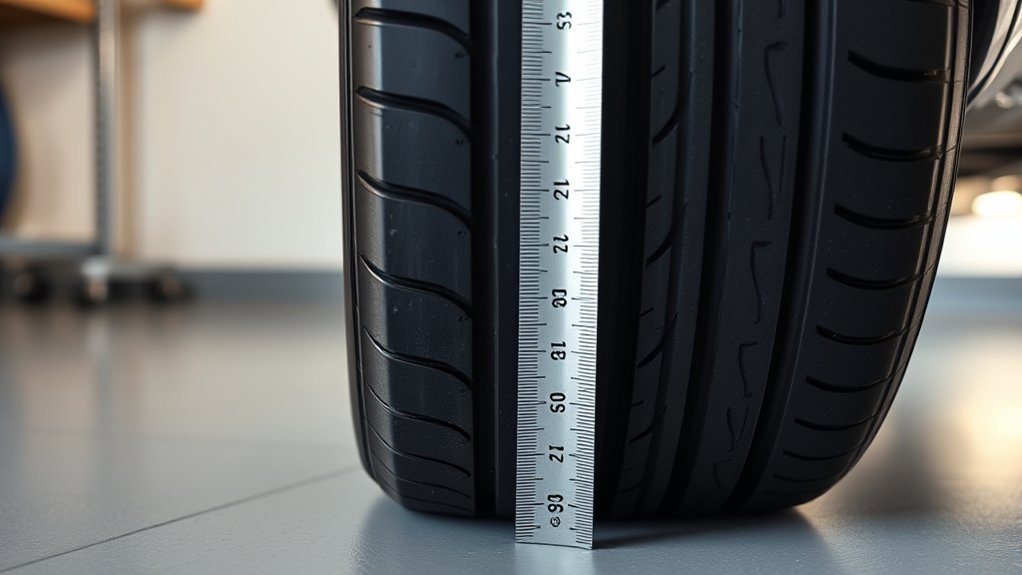
The overall diameter of a tire is the tire’s outside height from tread to tread when the tire is mounted and inflated. You calculate it from the tire size code by adding the wheel diameter to twice the sidewall height. For example, a 205/60R16 tire is about 25.69 inches tall, usually rounded to 25.7 inches. This number matters because tire diameter affects fitment, clearance, ride height, gearing, speedometer accuracy, and odometer readings.
Quick Answer
Tire overall diameter is the tire’s full outside height. For metric tire sizes, calculate sidewall height first: width × aspect ratio ÷ 100. Convert that sidewall height to inches, double it, then add the wheel diameter. A 205/60R16 is about 25.7 inches tall.
Key Takeaways
- Tire overall diameter is the tire’s full outside height, including the wheel and both sidewalls.
- The basic formula is: wheel diameter + 2 × sidewall height.
- Sidewall height comes from tire width multiplied by aspect ratio.
- Diameter changes can affect speedometer readings, odometer readings, gearing, traction control, and clearance.
- Before changing tire size, check your owner’s manual, driver-door tire placard, load index, speed rating, rim width, and physical clearance.
What Is Tire Overall Diameter?
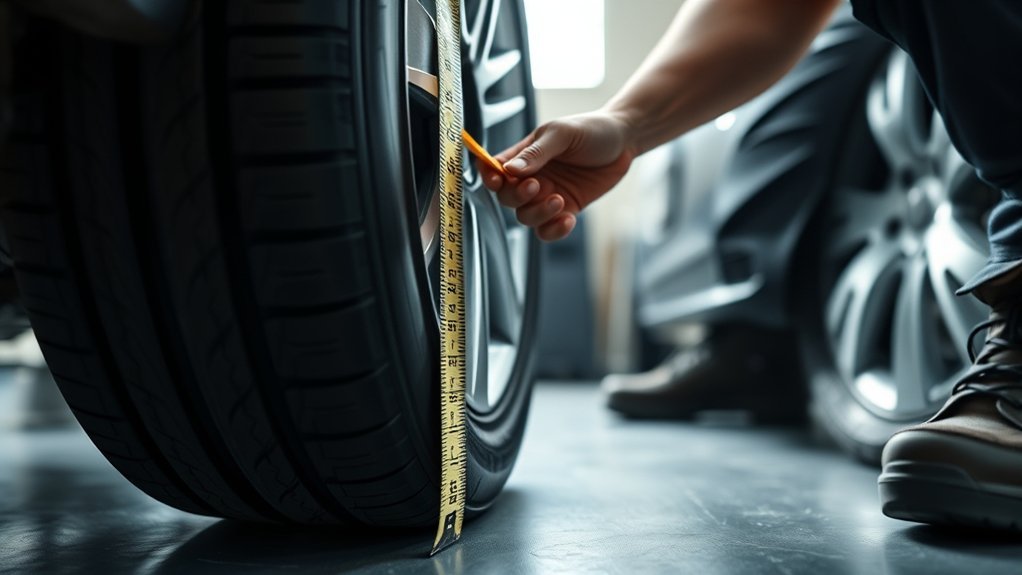
Tire diameter is the tire’s total outside height. You may see it called overall diameter, outside diameter, or tire height. It tells you how much vertical space the tire takes up inside the wheel well.
For a normal passenger-vehicle tire size, such as 205/60R16, the first number gives the section width in millimeters, the second number gives the aspect ratio, and the last number gives the wheel diameter in inches. Those three values let you estimate the tire’s overall diameter.
Note: A calculated tire diameter is a useful estimate, not a perfect measurement for every tire. Real mounted height can vary by tire model, rim width, air pressure, tread depth, load, and manufacturer specifications.
That difference matters because a taller tire travels farther with each wheel rotation. A shorter tire travels less distance with each rotation. That is why tire diameter affects speedometer accuracy, odometer readings, gearing feel, clearance, and sometimes driver-assistance systems.
How Tire Size Is Calculated
You can read a tire code like 205/60R16 as three main inputs: width, aspect ratio, and wheel diameter. The width and aspect ratio tell you the sidewall height. The wheel diameter tells you the rim size the tire fits.
Tire Code Breakdown
A tire size such as 205/60R16 breaks down like this:
| Element | Meaning | Example |
|---|---|---|
| 205 | Section width in millimeters | 205 mm wide |
| 60 | Aspect ratio, or sidewall height as a percent of width | 60% of 205 mm |
| R | Radial tire construction | Radial tire |
| 16 | Wheel diameter in inches | 16-inch wheel |
Some tire sizes include a service prefix such as P for passenger vehicle or LT for light truck. Some also include a load index and speed rating after the size. Those ratings matter when replacing tires because the new tire must be able to carry the vehicle’s load and meet the required speed rating.
Section Height Formula
Sidewall height, also called section height, is the key number you need before calculating overall diameter.
Sidewall height = tire width × aspect ratio ÷ 100
For a 205/60R16 tire, the sidewall is 60% of 205 mm:
- 205 × 60 ÷ 100 = 123 mm
- 123 mm ÷ 25.4 = 4.84 inches
That means each sidewall is about 4.84 inches tall. Because a tire has one sidewall above the wheel and one below it, you use that number twice in the overall diameter formula.
Overall Diameter Formula
The overall diameter formula is simple once the sidewall height is in inches:
Overall diameter = wheel diameter + 2 × sidewall height
Here is the full calculation for 205/60R16:
| Step | Calculation | Result |
|---|---|---|
| Find sidewall height | 205 × 60 ÷ 100 | 123 mm |
| Convert to inches | 123 ÷ 25.4 | 4.84 in |
| Double the sidewall | 4.84 × 2 | 9.69 in |
| Add wheel diameter | 16 + 9.69 | 25.69 in |
So a 205/60R16 tire is about 25.7 inches in overall diameter. You can also estimate circumference by multiplying diameter by 3.1416. For this tire, 25.69 × 3.1416 = about 80.7 inches of circumference.
How to Read a Tire Code
When you read a tire code, do not treat the numbers as random markings. Each part tells you something that affects fitment. A 225/50R17, for example, is 225 mm wide, has a sidewall height equal to 50% of that width, uses radial construction, and fits a 17-inch wheel.
Extra markings matter too. A tire may show a load index, speed rating, XL marking, LT marking, or service description after the size. Those markings should match the vehicle’s needs, not just the wheel diameter.
Warning: Do not choose a tire by diameter alone. The tire also needs the correct load index, speed rating, rim-width range, inflation pressure, and clearance for your vehicle.
For the correct original size, check your vehicle owner’s manual and the Tire and Loading Information Label on the driver-side door edge or doorjamb. The National Highway Traffic Safety Administration also advises drivers to use the owner’s manual or tire placard when choosing tire size.
Overall Diameter vs. Sidewall Height
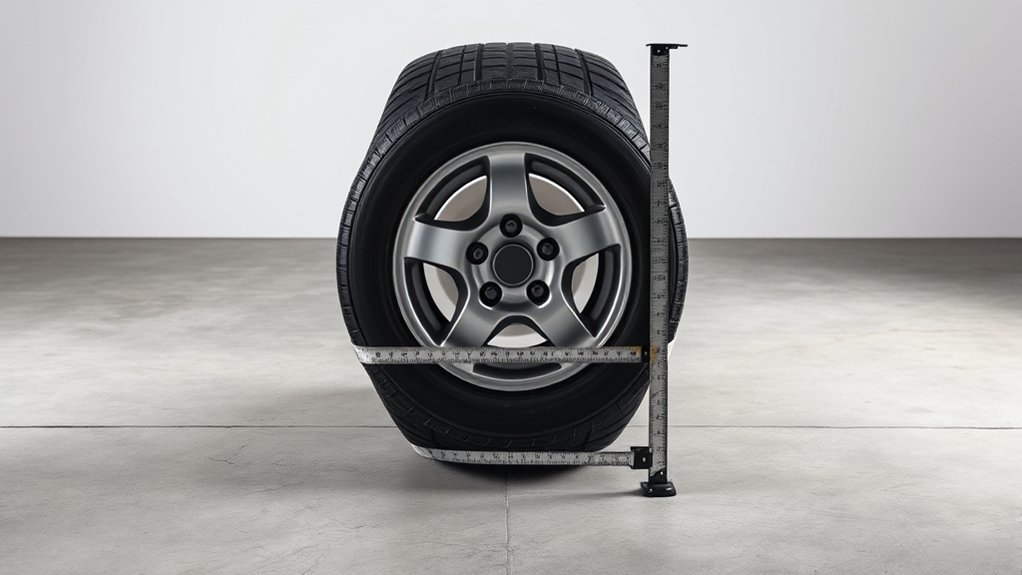
Overall diameter and sidewall height are related, but they are not the same thing. Sidewall height is only one side of the tire, measured from the wheel rim to the outer tread. Overall diameter is the full tire height, including the wheel and both sidewalls.
Using 205/60R16 again, the sidewall height is about 4.84 inches. The overall diameter is about 25.69 inches because the 16-inch wheel sits between two 4.84-inch sidewalls.
- Sidewall height affects ride comfort, steering feel, and how much cushion the tire has.
- Overall diameter affects wheel-well clearance, ride height, gearing, speedometer readings, and odometer readings.
- Circumference affects how far the vehicle travels per wheel rotation.
- Revolutions per mile affects speed and distance calculations.
A lower-profile tire on a larger wheel can have almost the same overall diameter as the factory tire. This is common in plus sizing. The wheel gets larger, but the sidewall gets shorter, so the total tire height stays close to stock.
How Tire Diameter Affects Speedometer Readings
Your speedometer is calibrated around the factory tire diameter. If you install larger tires, the vehicle travels farther with each wheel rotation. The speedometer can then read lower than your real speed. If you install smaller tires, the vehicle travels less distance with each rotation, so the speedometer can read higher than your real speed.
Speedometer Calibration Effects
A small diameter change may create only a small error. A large change can affect speedometer accuracy, odometer mileage, transmission shift behavior, traction control, stability control, and driver-assistance systems.
Here is the basic speedometer relationship:
Actual speed ≈ indicated speed × new tire diameter ÷ original tire diameter
For example, changing from 205/60R16 at about 25.69 inches to 225/50R17 at about 25.86 inches is a small increase of about 0.7%. If the speedometer shows 60 mph, actual speed would be about 60.4 mph, assuming the original tire was the calibration baseline.
Tire Size and Speed Changes
| Tire change | Speedometer effect | Revolutions per mile |
|---|---|---|
| Larger overall diameter | Usually reads low | Fewer |
| Smaller overall diameter | Usually reads high | More |
| Very close to stock | Small error | Near factory |
A common rule of thumb is to keep the new tire diameter close to the factory size, often within about 3%. Still, the factory-approved tire sizes in your owner’s manual or tire placard should come first.
What to Check Before Changing Tire Size
Before changing tire size, start with the vehicle manufacturer’s specifications. In the United States, vehicle tire placards must list original tire size and recommended cold tire inflation pressure under 49 CFR 571.110. That placard is usually on the driver-side doorjamb or door edge.
- Original tire size: Use the owner’s manual or Tire and Loading Information Label as the baseline.
- Overall diameter: Keep the new diameter close enough to avoid major speedometer and clearance issues.
- Load index: Do not use a tire with a lower required load capacity.
- Speed rating: Match or exceed the rating required by the vehicle manufacturer.
- Rim width: Make sure the tire is approved for your wheel width.
- Brake and suspension clearance: Check clearance at full steering lock and through suspension travel.
- AWD or 4WD matching: Keep tire sizes and tread depths closely matched to avoid drivetrain stress.
- TPMS and calibration: Recheck tire pressure and confirm whether recalibration is needed after a major size change.
Pro Tip: If you are comparing two sizes, calculate the percent difference: new diameter minus old diameter, divided by old diameter, then multiplied by 100. This shows how far the new size moves from the factory setup.
[Products Worth Considering]

This 3-piece wheel brush set makes it easy to clean wheels and tires with soft, scratch-free brushes designed for lifting brake dust and grime. The flexible rim brush bends up to 360 degrees to reach hard-to-access areas for a thorough clean, while the comfortable grip helps control during detailing. A dedicated detailing brush supports gentle cleaning for sensitive surfaces, including interior use.

Measure tire tread depth quickly and accurately with this LUMITECO dial gauge that reads in 1/32" increments up to 14/32". The color-coded green/yellow/red zones make it easy to judge tire wear and know when replacement is needed. A rugged, compact design with a protective pouch helps keep the gauge ready for use on cars, trucks, motorcycles, and more.

This manual duck head tire changer kit makes tire installation and removal simpler by letting you embed the duck head into the tire with applied pressure. The integrated design and durable steel construction help reduce friction and improve efficiency and safety during use. Suitable for 16–21 inch wheels, it’s convenient for cars, trucks, SUVs, and ATV tires, with 24-hour after-sales support.
Compare Common Tire Sizes
When you compare tire sizes, focus on overall diameter first, then check width, rim fit, load rating, and clearance. Two sizes can use different wheel diameters but still end up close in total tire height.
| Tire size | Sidewall height | Overall diameter | Notes |
|---|---|---|---|
| 205/60R16 | 4.84 in | 25.69 in | Common baseline example |
| 215/55R16 | 4.66 in | 25.31 in | Slightly shorter than 205/60R16 |
| 215/50R17 | 4.23 in | 25.46 in | Plus-size style match |
| 225/50R17 | 4.43 in | 25.86 in | Very close to 205/60R16 |
| 235/45R18 | 4.16 in | 26.33 in | Taller, wider setup |
| 30X10.50R15 | Listed by inch sizing | About 30 in nominal | Light-truck flotation sizing |
These are calculated values. Always compare them with tire-maker specs when exact clearance matters.
[Products Worth Considering]

This professional wheel and rim cleaning brush set lifts brake dust, grime, and dirt with soft, scratch-free microfiber and synthetic wool fibers. The rim brush bends up to 360 degrees for easy access to hard-to-reach areas around spokes, lips, and faces. Ideal for thorough cleaning of car, truck, motorcycle, bicycle, RV, and more wheel and tire surfaces.

The SAFELIFE dial tire tread depth gauge measures tread depth in 1/32 inch increments with clear, easy-to-read 2-inch dial face. Color zones using a traffic light system help you quickly judge whether tread is low, marginal, or ample for safer driving. Built with a durable zinc cast body and a metal detect probe for precise, comfortable use across cars, motorcycles, trucks, and buses.

This 15-inch tire spoons kit makes tire removal and installation easier with added leverage, reducing time and effort for everyday repairs. It includes tire spoons, rim protectors, a valve tool, and valve cores/caps, helping protect rims and streamline deflation and re-sealing. Built with durable hardened steel and a non-slip ergonomic grip for confident use on motorcycles, dirt bikes, ATVs, and lawn equipment.
Use a Tire Size Calculator
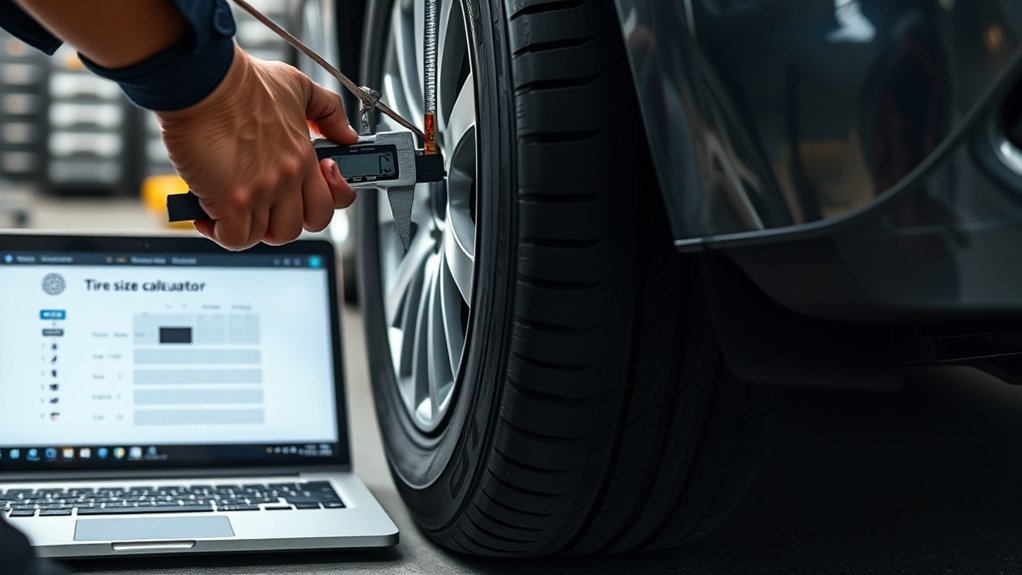
A tire size calculator saves time because it calculates diameter, sidewall height, circumference, and revolutions per mile for you. It also helps you compare two sizes side by side before you buy.
You can use a calculator such as the TireSize.com tire size calculator to compare tire diameter, width, sidewall, circumference, revolutions per mile, and speedometer effect. Still, treat calculator results as estimates until you confirm the specific tire model’s published specs.
A tire size calculator is best used as a comparison tool. Your final tire choice should still match your vehicle placard, owner’s manual, wheel size, load rating, and clearance.
When using a calculator, enter the factory size first. Then enter the new size. Look for:
- Overall diameter difference
- Percent change from stock
- Width change
- Sidewall change
- Speedometer difference
- Revolutions-per-mile difference
If the new tire is much taller, wider, or lower-rated than the factory tire, pause before buying. A size that looks close on paper can still rub during sharp turns, hit suspension parts, or change how the vehicle handles.
[Products Worth Considering]

The TOOLITIN floor bike pump delivers high pressure performance with an easy-to-read gauge so you can dial in the right tire pressure for safer rides. It is compatible with both Presta and Schrader valves and features a stable, durable design for efficient pumping. Suitable for road, MTB, and hybrid tires as well as inflating sports balls and other inflatables, it also includes ball and bladder needles and convenient accessory storage.

The Continental Grand Prix 5000 is an allround road bike tire engineered for faster rolling, improved ride comfort, and enhanced puncture protection. It features a Vectran Breaker cut-protection layer, Lazer Grip micro-profile tread for confident cornering control, and Active Comfort Technology to damp vibration for smoother rides. BlackChili compound optimizes grip and speed for everyday performance and long-lasting confidence.

ETENWOLF T300 is a calibrated digital tire pressure gauge for accurate readings from 3 to 200 PSI across light and heavy-duty vehicles. It includes thermal compensation for reliable performance in extreme cold or heat, with an auto shut-off to extend battery life and an LED for easier reading. The sturdy design supports rugged everyday use, making it ideal for pickups, RVs, and industrial applications.
Frequently Asked Questions
How do you find the overall diameter of a tire?
Find sidewall height first: tire width × aspect ratio ÷ 100. Convert that number from millimeters to inches by dividing by 25.4. Then use this formula: wheel diameter + 2 × sidewall height. For example, 205/60R16 has a 123 mm sidewall, or 4.84 inches, so its overall diameter is about 25.69 inches.
What size tire does Tadej Pogačar use?
That question applies to bicycle tires, not car tires. Pogačar’s exact setup changes by race, bike, wheels, and conditions. Recent 2026 race-bike coverage has shown Continental GP5000 tires in sizes such as 25 mm for time-trial use and 28 mm for road-race setups. For your own bike, use the tire width that matches your rim, frame clearance, riding surface, and pressure range.
Is 285 the width of a tire?
Yes, in a metric tire size such as 285/75R16, the 285 means the tire’s section width is 285 millimeters. It does not tell you the full tire height by itself. You still need the aspect ratio and wheel diameter to calculate overall diameter.
What does overall diameter mean on a tire?
Overall diameter means the tire’s full outside height, measured from the outer tread at the top to the outer tread at the bottom. It is important because it affects fitment, ground clearance, speedometer readings, odometer readings, gearing, and how the tire fits inside the wheel well.
Can I use a tire with a different overall diameter?
Sometimes, but you should stay close to the factory size unless the vehicle manufacturer or a qualified tire professional confirms the change. Check diameter, width, load index, speed rating, rim width, brake clearance, suspension clearance, and AWD or 4WD tire-matching needs before changing size.
Conclusion
Tire overall diameter is one of the most important numbers in tire sizing because it connects the tire code to real-world fitment. Once you know the formula, you can compare sizes with more confidence: calculate sidewall height, double it, then add wheel diameter. A 205/60R16 is about 25.7 inches tall, while a 225/50R17 is about 25.9 inches tall. That small difference may be fine on some vehicles, but every tire change should still match the owner’s manual, tire placard, load rating, rim width, and available clearance.
Sources
- NHTSA TireWise — backs up checking the owner’s manual or Tire and Loading Information Label for correct tire size and tire safety guidance.
- 49 CFR 571.110, Tire Selection and Rims — backs up vehicle placard requirements for original tire size and recommended cold inflation pressure.
- TireSize.com Tire Size Calculator — backs up the tire-size calculation format, diameter comparison fields, and speedometer effect explanations.
- Cyclingnews, Pogačar 2026 race-bike setup — backs up the bicycle-tire FAQ context for 28 mm Continental road tires.
- Cycling Weekly, Pogačar 2026 TT bike setup — backs up the bicycle-tire FAQ context for 25 mm Continental TT tires.
