
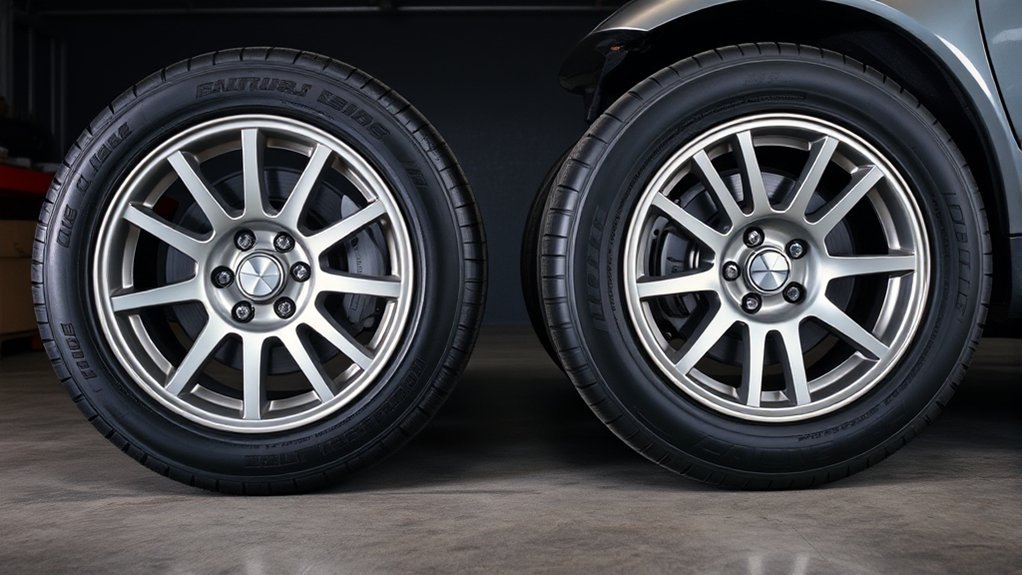
215 and 235 tires differ first in their nominal section width: a 235 tire is 20 mm wider than a 215 tire. That difference can influence handling, clearance, noise, wet performance, and efficiency, but width alone does not tell you which tire is better or whether it will fit. You need the complete tire size, wheel specifications, load index, speed rating, and your vehicle manufacturer’s approved sizes before making a change.
Quick Answer
A 235 tire is nominally 20 mm wider than a 215 tire, but that does not automatically make it better. Wider tires can improve dry-road grip in some setups, while narrower tires may offer advantages in clearance or snow and slush. Always compare the complete size and use a vehicle-approved fitment.
Key Takeaways
- 235 is 20 mm wider than 215 in nominal section-width terms, or about 9.3% wider.
- The width number alone does not determine overall tire diameter, load capacity, steering response, ride comfort, or fuel economy.
- A wider tire can provide stronger dry-road grip in a suitable setup, but tread compound, construction, pressure, rim width, and suspension also matter.
- Wider tires can have a greater hydroplaning tendency, while vehicle-approved narrower winter sizes can work well in snow and slush.
- Check the owner’s manual or tire placard, approved rim range, clearance, load index, speed rating, and rolling diameter before changing sizes.
What Do 215 and 235 Tire Sizes Mean?
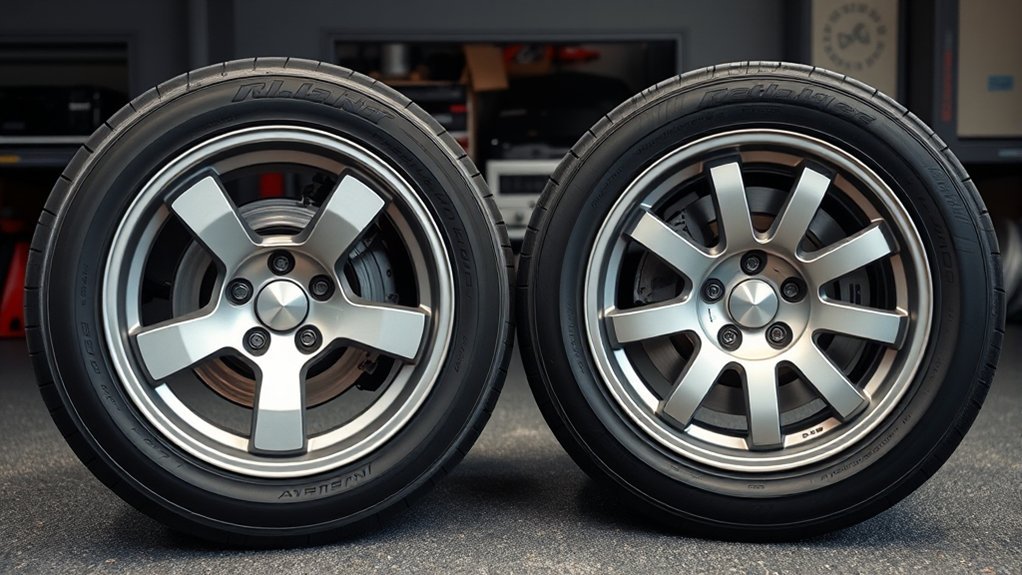
A tire size such as 215/60R16 or 235/55R16 contains several specifications. According to Michelin’s tire-size guidance, the first number is the tire’s nominal section width in millimeters.
- 215: nominal section width of 215 mm
- 60: sidewall height is 60% of the section width
- R: radial construction
- 16: wheel diameter in inches
The same system applies to a 235 tire. Therefore, 235 is nominally 20 mm wider than 215. However, the first number does not describe the tire’s complete dimensions or performance.
Actual mounted section width can also vary somewhat with tire model and rim width. That is why you should use the tire manufacturer’s specification sheet when checking precise clearance rather than assuming every 215 or every 235 measures exactly the same when installed.
Note: A 215/60R16 and a 235/60R16 are not simply the same tire with different widths. Because sidewall height is a percentage of width, keeping the same aspect ratio also changes overall diameter.
215 Vs 235 Tires: Key Width Differences
The certain dimensional difference is simple: 235 is 20 mm wider than 215 nominally. That equals about 0.79 inch, or roughly 9.3% more nominal section width.
A 235 tire is nominally 20 mm wider than a 215 tire, but the full size code determines sidewall height, diameter, rolling circumference, and wheel compatibility.
- 215 width: 215 mm nominal section width
- 235 width: 235 mm nominal section width
- Nominal difference: 20 mm, or about 0.79 inch
- Wheel-well space: a 235 generally requires more lateral clearance
- Rim compatibility: the approved rim-width range must be checked for the exact tire model and size
- Load capacity: determined by the load index and tire specification, not width alone
A wider casing also changes how the tire sits on a wheel. If the rim is too narrow or too wide for that exact tire, steering response, sidewall shape, wear, and handling can suffer.
How 215 Vs 235 Tires Change Grip and Steering
A properly matched 235 tire can offer stronger dry-road grip and cornering capability than a comparable narrower tire, especially when the wider setup is part of a vehicle or wheel package designed for it. Continental notes that wider tires can improve dry grip and cornering performance.
That does not mean width alone creates a guaranteed improvement. Tire compound, tread design, temperature, wheel width, pressure, alignment, suspension geometry, and vehicle weight all influence available grip.
Steering response is equally nuanced. A 235 may feel more planted but can also produce heavier steering in some vehicles. A 215 may feel lighter, but it is not automatically quicker or more precise. Sidewall height and rim width can have a major effect: a lower-profile tire on a suitable rim may respond more sharply than a taller tire even if both share the same nominal width.
For that reason, compare complete tire specifications rather than assuming that 215 always means agile and 235 always means stable.
Do 215 Vs 235 Tires Improve Ride Comfort?
Neither width has a guaranteed ride-comfort advantage. Comfort depends heavily on sidewall height, casing stiffness, tire pressure, tread construction, wheel diameter, vehicle suspension, and tire model.
A 215 tire paired with a taller sidewall can absorb bumps well. A 235 with an equally suitable sidewall and construction can also ride comfortably. Conversely, a wide low-profile performance tire may transmit more sharp impacts than a narrower touring tire.
- More sidewall height generally gives the tire more room to absorb impacts.
- Stiffer performance-oriented constructions can transmit more road texture.
- Incorrect inflation can harm both comfort and handling.
- Larger wheels commonly reduce available sidewall height when overall tire diameter is kept similar.
- Tread design and tire construction affect noise and vibration independently of width.
If ride comfort matters most, compare tires of the same category and look at their complete sizes instead of choosing solely between 215 and 235.
How Tire Width Affects Fuel Economy
You should not assume that every 215 tire has lower rolling resistance than every 235 tire. Continental’s rolling-resistance guidance explains that width by itself has no direct, universal relationship with rolling resistance; tire pressure, compound, construction, and other design factors are important.
In real vehicle applications, moving to a wider wheel-and-tire package can still reduce efficiency if the new setup is heavier, has greater aerodynamic drag, uses a higher-grip compound, or has higher rolling resistance as a complete tire design. Continental’s broader tire-size guidance also notes that larger and wider configurations can trend toward higher energy use.
That means a 215 may provide an efficiency advantage when comparing suitable alternatives, but it is not guaranteed merely because the number is smaller.
Maintain the vehicle manufacturer’s recommended pressure because underinflation increases deformation and rolling resistance. NHTSA TireWise recommends using the pressure specified on the vehicle’s Tire and Loading Information label or in the owner’s manual.
Will 215 Vs 235 Tires Fit Your Wheels?
A 215 and a 235 tire may sometimes fit the same wheel, but compatibility is not automatic. Every specific tire size has an approved rim-width range, and the vehicle must also have enough clearance around the suspension, bodywork, brakes, and steering components.
- Check the exact wheel width.
- Check the tire manufacturer’s approved rim-width range.
- Confirm wheel offset and available inner and outer clearance.
- Check clearance at full steering lock.
- Consider suspension compression with passengers or cargo aboard.
- Match or exceed the required load index.
- Meet the vehicle manufacturer’s speed-rating requirements.
- Confirm the resulting overall diameter and rolling circumference are acceptable.
Warning: A tire physically fitting on the wheel does not mean it is an approved or safe replacement for the vehicle. Check the owner’s manual, tire placard, and manufacturer-approved alternatives before changing size. Michelin recommends using the specified original size or an approved alternative.
Michelin’s current replacement-size guidance recommends using the same size designated by the vehicle manufacturer or another approved option with suitable capacity and specifications.
[Products Worth Considering]

Measure tire tread depth quickly and accurately with this LUMITECO dial gauge that reads in 1/32" increments up to 14/32". The color-coded green/yellow/red zones make it easy to judge tire wear and know when replacement is needed. A rugged, compact design with a protective pouch helps keep the gauge ready for use on cars, trucks, motorcycles, and more.

The Continental Grand Prix 5000 is an allround road bike tire engineered for faster rolling, improved ride comfort, and enhanced puncture protection. It features a Vectran Breaker cut-protection layer, Lazer Grip micro-profile tread for confident cornering control, and Active Comfort Technology to damp vibration for smoother rides. BlackChili compound optimizes grip and speed for everyday performance and long-lasting confidence.

Keep your tires properly inflated with this analog VONDIOR tire pressure gauge, designed for fast, easy readings without batteries. The swiveling, two-axis hose and large glow dial help you measure at any tire angle with instant visibility. Built with a protective rubber shield, it supports durable, low-maintenance use for cars and trucks.
Which Tire Size Is Better for Your Vehicle?
The better size is the one approved for your vehicle that best matches your driving needs. Do not select a 215 or 235 solely because one sounds more efficient or performance-oriented.
If both sizes are manufacturer-approved alternatives, a 215 setup may provide more wheel-well clearance and can be useful in some winter applications. A suitable 235 setup can provide a broader tread footprint and stronger dry cornering performance.
But those tendencies can be outweighed by differences between individual tire models. A high-performance 215 can outperform an economy-focused 235 in grip, while a low-rolling-resistance 235 can be more efficient than some 215 tires.
Start with your vehicle documentation. NHTSA advises checking the Tire and Loading Information label or owner’s manual for the proper tire size and inflation pressure.
[Products Worth Considering]

This manual duck head tire changer kit makes tire installation and removal simpler by letting you embed the duck head into the tire with applied pressure. The integrated design and durable steel construction help reduce friction and improve efficiency and safety during use. Suitable for 16–21 inch wheels, it’s convenient for cars, trucks, SUVs, and ATV tires, with 24-hour after-sales support.
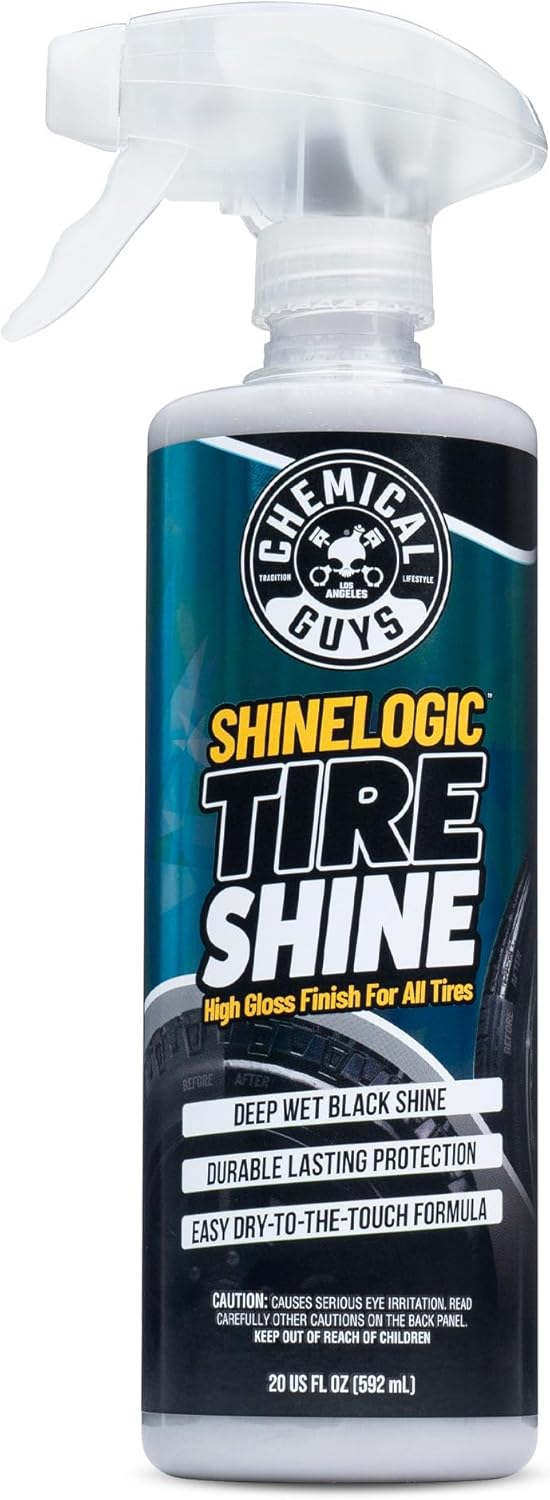
Chemical Guys ShineLogic Tire Shine delivers a deep wet black, high-shine finish for rubber tires with a sleek look. It’s designed for durable, one-step application with minimal drips, streaks, or runs, and it helps produce effortless, long-lasting shine. Choose aerosol or trigger spray for easy use on cars, trucks, motorcycles, RVs, and more.

This car D-wheel lock nut key provides an anti-theft solution for D-shaped wheel lock bolts, helping keep your wheels secure. It features a flower-shaped internal pattern that resists micro-adjustment theft while allowing removal and mounting of compatible locking nuts. Made for reliable performance under high torque, it’s easy to use with standard socket wrench turning for quick tire maintenance and emergency repairs.
Do 215 Vs 235 Tires Affect Speedometer Accuracy?
Switching from a 215 to a 235 tire affects speedometer accuracy only if the overall rolling diameter or circumference changes enough to alter wheel revolutions per mile. Width itself does not directly change the speedometer reading.
The full tire size matters because sidewall height is calculated as a percentage of section width.
Speedometer Reading Changes
If the replacement tire has a larger rolling circumference, the vehicle travels farther with each wheel revolution. The speedometer can then read lower than the actual road speed. A smaller rolling circumference can cause the opposite effect.
You should also consider odometer readings and vehicle systems that use wheel-speed information. Continental recommends comparing diameter and rolling circumference when evaluating alternative sizes.
Tire Diameter Impact
You can estimate an unloaded tire’s theoretical overall diameter from its size:
Overall diameter in millimeters = wheel diameter in inches × 25.4 + 2 × section width × aspect ratio.
For example:
- 215/60R16: 16 × 25.4 + 2 × 215 × 0.60 = approximately 664.4 mm
- 235/55R16: 16 × 25.4 + 2 × 235 × 0.55 = approximately 664.9 mm
Despite the 20 mm width difference, those theoretical diameters differ by only about 0.5 mm because the aspect ratio changed from 60 to 55.
Pro Tip: Compare the complete size and the tire manufacturer’s published revolutions-per-mile or overall-diameter specification. Two tires with very different widths can still have nearly the same rolling diameter when their aspect ratios are matched appropriately.
How Do 215 and 235 Tires Perform in Rain and Snow?
Wet and winter performance cannot be predicted from width alone. Tread depth, groove design, rubber compound, temperature, tire pressure, water depth, and vehicle speed are critical.
A wider tire can provide strong wet grip when its tread and compound are designed to clear water effectively. However, Continental notes that wider tires may also have a greater tendency toward hydroplaning under some conditions.
In snow and slush, a vehicle-approved narrower setup can be useful because the narrower footprint can help the tire work through loose material. Continental notes that manufacturers often approve narrower, higher-profile winter sizes for this reason.
The most important factor is still using the correct tire type for the conditions. A quality winter tire generally provides far more meaningful cold-weather improvement than changing from 235 to 215 while keeping an unsuitable tire compound.
What About AWD, 4WD, and Staggered Tire Sizes?
AWD and 4WD vehicles can be especially sensitive to differences in tire circumference because the drivetrain expects the wheels to rotate at closely matched rates. Follow the vehicle manufacturer’s requirements for size, model, and allowable tread-depth variation.
Michelin advises against mixing tire sizes on four-wheel-drive vehicles unless the vehicle manufacturer specifically calls for that configuration.
Some performance vehicles are factory-designed with a staggered setup, meaning the front and rear tires intentionally use different sizes. That is different from arbitrarily installing 215 tires on one axle and 235 tires on the other. If your vehicle was designed for staggered sizes, follow its specified front and rear combination.
Pros and Cons of 215 Vs 235 Tires
There are useful general tendencies, but they should be treated as tendencies rather than guarantees.
Handling And Grip
A compatible 235 tire can provide a broader tread footprint and strong dry cornering grip. Wider performance-oriented tires are commonly used when dry-road traction is a priority.
A 215 can require less lateral clearance and may produce lighter steering in some applications, but steering response depends strongly on sidewall height, rim width, casing design, alignment, and suspension tuning.
- 235s can offer stronger dry grip when the tire and vehicle are designed for the width.
- 215s require less lateral wheel-well space.
- Wider does not automatically mean shorter braking distances in every tire comparison.
- Lower-profile construction often affects steering precision more noticeably than width alone.
- Compound and tread design can outweigh the nominal-width difference.
Fuel Economy Impact
A 215 tire is not automatically more fuel-efficient. Efficiency depends on the complete tire design, inflation pressure, mass, aerodynamics, tread compound, and rolling resistance.
When a 235 upgrade also uses a heavier wheel, stickier compound, or less efficient tire design, fuel consumption may rise. On the other hand, comparing two unrelated tires based only on their width is not enough to predict the result.
Use the vehicle-recommended pressure and, when available, compare manufacturer efficiency or rolling-resistance information for the exact tires you are considering.
Ride Comfort Tradeoffs
Ride quality is influenced more reliably by sidewall height and construction than by a simple 215-versus-235 rule.
- A taller sidewall can absorb road impacts more effectively.
- A low-profile tire can feel firmer even if its nominal width is narrow.
- Performance casings are often stiffer than touring-tire casings.
- Road noise depends on tread pattern, pavement, construction, and size.
- Correct pressure is essential for both comfort and safety.
How To Choose Between 215 And 235 Tires
Choosing between 215 and 235 tires begins with compatibility, not performance preference. First confirm that the complete tire size is approved for the vehicle and fits the wheel. Then compare the actual tire models for grip, efficiency, comfort, wet performance, tread life, noise, and price.
| Factor | 215 | 235 |
|---|---|---|
| Nominal width | 215 mm | 235 mm |
| Clearance | Generally needs less lateral space | Generally needs more lateral space |
| Dry grip | Depends on tire design and vehicle setup | Can offer an advantage in a properly matched performance setup |
| Fuel economy | May have an advantage in some comparable setups | May use more energy in some wider/heavier setups |
| Snow/slush | Often used for approved narrower winter setups | Performance depends heavily on winter tread and compound |
| Load capacity | Check load index | Check load index |
| Best choice | Only when approved and suitable for your priorities | Only when approved and suitable for your priorities |
Before buying, verify the exact size on the vehicle’s tire placard or owner’s manual. Then confirm wheel width, clearance, load index, speed rating, and rolling diameter for the proposed tire.
[Products Worth Considering]

Monitor tire tread wear with a smart, color-coded depth gauge that shows clear condition ranges at a glance. The bar is range marked for fast, easy readings, helping you maintain safer traction and performance. Each gauge is portable with a pocket clip, and the set includes 20 units for daily use and sharing.

This universal wheel alignment tool helps you accurately restore tire tilt angles after tire or suspension repairs using an adjustable camber gauge. It features a powerful magnetic base that firmly attaches to brake rotors for stationary, slip-free readings, improving consistency during measurement. Built from durable PC plastic, it resists wear and corrosion and is compact enough for car, truck, RV, and motorcycle alignment tasks.

This 13-inch flat-free wheelbarrow tire uses solid polyurethane foam construction with steel rims, so it will not puncture, rot, or go flat. The anti-skid tread improves stability and maneuverability across garden, lawn, and mixed terrain. It includes pre-installed 5/8-inch bearings plus extra 3/4-inch bearings and a versatile adapter kit to fit compatible wheel sizes and cart hubs.
Frequently Asked Questions
Are 215 Tires Cheaper Than 235 Tires?
Not always. A 215 may cost less when you compare equivalent models, but price depends on brand, tire line, load and speed rating, availability, and retailer. A premium 215 can easily cost more than a budget 235.
Can I Mix 215 and 235 Tires on the Same Car?
Do not mix the two sizes unless the vehicle manufacturer specifies or approves that combination, such as a factory staggered setup. Different rolling circumferences can alter handling and may be especially problematic on AWD or 4WD vehicles.
Do Wider Tires Increase Road Noise?
They can, but width is only one factor. Tread pattern, rubber compound, pavement type, casing construction, inflation pressure, and vehicle insulation can have a greater effect on cabin noise.
Which Tire Size Lasts Longer, 215 or 235?
Neither width has an inherent tread-life advantage. Tire compound, treadwear design, alignment, inflation, rotation practices, vehicle weight, driving style, and road conditions usually matter more than the difference between 215 and 235.
Will 235 Tires Improve Cornering in Rain?
Not automatically. A good 235 tire can provide excellent wet grip, but tread design, compound, tread depth, pressure, and water depth are critical. A wider tire can also have a greater tendency to hydroplane in standing water under some conditions.
Can I Replace 215 Tires With 235 Tires?
Only if the complete 235 size is approved or technically suitable for the vehicle. Check wheel width, inner and outer clearance, overall diameter, load index, speed rating, and the manufacturer’s approved tire-size information before changing.
Does a 235 Tire Always Have a Larger Diameter Than a 215 Tire?
No. Overall diameter depends on section width, aspect ratio, and wheel diameter together. For example, a 215/60R16 and a 235/55R16 have nearly identical theoretical overall diameters even though one is 20 mm wider.
Conclusion
The main difference between 215 and 235 tires is straightforward: the 235 is nominally 20 mm wider. Everything beyond that requires more context. Wider tires can offer useful dry-grip advantages in the right setup, while narrower approved sizes can provide extra clearance and may suit winter driving well. Fuel economy, comfort, steering response, tread life, load capacity, and wet performance cannot be predicted from width alone.
Before changing sizes, compare the complete tire code, approved rim width, load index, speed rating, clearance, and overall rolling diameter. Most importantly, use the vehicle manufacturer’s approved tire sizes rather than choosing solely from generalized 215-versus-235 advantages.
Sources
- NHTSA TireWise — vehicle tire-size, tire-pressure, and safety guidance.
- Michelin: Choosing the Right Tire Size — explains section width, aspect ratio, and where to find the vehicle’s specified size.
- Michelin: Changing Tire Size or Specifications — replacement-size, tire-mixing, and AWD/4WD guidance.
- Continental: Tire Size Guide — tire dimensions, handling, wet performance, diameter, load index, speed rating, and alternative-size considerations.
- Continental: Rolling Resistance of Car Tires — factors affecting rolling resistance and fuel use.
